Marketing Master Calendar Development Best Practices

How to Supercharge your Marketing Operational Effectiveness

Integrated Marketing Planning Calendar

Integrated Marketing Planning Calendar

Having developed numerous marketing master calendars for Fortune clients world-wide, here are top 10 lessons learned & best practices for developing a marketing planning master calendar:

1) All involved marketing & supporting departments must have input into the development of, and be fully represented on the master marketing calendar.

2) All the departments represented on the calendar in must understand their responsibilities, deliverables, due dates, inter-dependencies with other departments as well as the metrics that they are being held accountable for in each step in the process.

3) Process Service Level Agreements (SLA’s) shall be in place for each process handoff such that the overall calendar timeline retains tactical delivery integrity.

4) The calendar must be chronologically intuitive (flow left to right for each sequential major marketing event).

5) Process details must be developed for each major milestone represented on the marketing calendar.

6) A process step owner must be identified for each process step with clear articulation of their responsibilities.

7) Calendar post-event reviews must capture marketing event & campaign lessons learned, planned vs. actual metrics, customer feedback, etc.

8) An actively managed marketing best practices knowledge base must be maintained to capture & propagate captured calendar relevant & other best practices & lessons learned to all stakeholders.

9) Marketing executive sponsors & steering committee members must play a role in the development & execution of the master marketing calendar.

10) Periodic calendar process reviews must be conducted to ensure the calendar & critical processes on the calendar are as efficient & effective as possible.

The following are Master marketing calendar and planning best practices examples that I developed for several Fortune 500 clients as represented by this one (of several examples):

 Integrated Marketing Planning Calendar

Integrated Marketing Planning Calendar

A Best Practice Master Marketing Calendar Represents All Major Events, The Critical Timeline and Major Calendar Development Participants and Stakeholders


Assessment of Current Marketing Capabilities

             Assessment of Current Marketing Capabilities

A Very Honest Assessment of the Current State Marketing Capability along with Gaps and Development Needs is Critical for Future Process Improvements

Integrated Marketing Planning Solution

               Integrated Marketing Planning Solution

A Future-State Solution Vision Must Be Established in Order to Achieve Future State Capabilities

Marketing Business Outcomes Meeting Summary

        Marketing Business Outcomes Meeting Summary

For Each Meeting on The Marketing Master Calendar, Critical Outcomes must be determined for each Calendar Development Meeting Along with Identification of the Meeting Key Owner

Marketing Master Calendar Development Stakeholder Responsibilities

Every Stakeholder and Responsible Leader Must Be Represented on Marketing Master Calendar Development Meeting Master List

Marketing Planning Event Cadence Map

                  Marketing Planning Event Cadence Map

Clearly Defined Responsibilities and Outputs Must Be Defined for Each Marketing Calendar Channel

Marketing Roles & Accountability

                       Marketing Roles & Accountability

Clearly Defined Accountability Must Be Defined for Marketing Calendar Development

Marketing Roles & Accountability for Each Functional Area

Marketing Roles & Accountability for Each Functional Area

Clearly Defined Accountability Must Be Defined for Marketing Calendar Development

Clearly Defined Accountability Must Be Defined for Each Functional Area

Clearly Defined Accountability Must Be Defined for Each Functional Area

Clearly Defined Accountability Must Be Defined for Each Functional Area (left Blue Boxes) in the Marketing Calendar Development Process

Marketing Critical Success Factors

                Marketing Critical Success Factors

Critical Success Factors Must Be Identified in the Master Marketing Calendar Development Process

Marketing Meeting Summary & Next Steps

         Marketing Meeting Summary & Next Steps

Summary Actions & Next Steps Must Be Identified in the Master Marketing Calendar Development Process

Achieving Market Leadership by Effectively Managing Customer Loyalty and Advocacy


  • Do you know which of your customers is destroying your company and brand value via negative word-of-mouth comments?
  • Do you know which of your customers is on the verge on defecting from your company and brands to one of your competitors?
  • Do you know which of your customers is promoting your company and brands and generating positive company and brand value on your behalf?
  • Do you know which of your customers is as passionate about your company and brand as your CxOs and should be rewarded as such?


To find out the answer to these questions, read the rest of this informative blog article below.

Customer Loyalty & Advocacy

     Customer Loyalty & Advocacy

{Click on image above for a larger/clearer view}

Your customer base is almost always represented by the above spectrum of customers. What varies from business to business is the percentage in each segment group. The more well managed your business, the more skewed to the right your customers tend to be. Therefore a business must develop strategies to migrate customers continually from the left to the right from segment group to segment group in increasing numbers. The rest of this blog is dedicated to sharing best practices on how to migrate more of your customers to the right of the spectrum.

Customer Loyalty and Advocacy Framework

    Customer Loyalty and Advocacy Framework

{Click on image above for a larger/clearer view}

For any company to achieve world-class status, one must carefully map out a customer loyalty and advocacy framework including the following component steps from the chart above:

  1. Clearly articulated customer segment definitions based on customer satisfaction levels, in addition to customer buy/sell segment definitions (top independent seller, high volume digital seller, etc.)                                                     
  2. A clear customer segment strategy and detailed tactics on the customer treatment that should be employed for each customer satisfaction segment               
  3. Customer cross-segment best practices and processes to drive segment migrations from the far most left segment to the far most right segment (i.e. from dissenters to super advocates)
Customer Loyalty & Advocacy Framework Segments

   Customer Loyalty & Advocacy Framework Segments

{Click on image above for a larger/clearer view}

The above customer loyalty & advocacy framework includes the following segments:

  • Customer Brand Dissenters or Malcontents – Very negative and detrimental to the company’s brand(s)
  • Customer Company Defectors – Very likely to defect to a competitor
  • Customer Neutral or Indifferent – Neither brand supporters or detractors of the company’s brand(s)
  • Customer Brand Supporters – Slightly positive about the company’s brand(s)
  • Customer Brand Advocates – Very positive and generating positive value to the company brand image
  • Customer Brand Super Advocates or Delighted Customers – Active promoters of the company’s brands, adding continuous & tremendous value to the company brand image

A formal social and company/brand listening and tracking program is a best practice on how to identify which of your customers exist in each of the above segments (see my previous blog entry on the topic of Social listening programs).

Customer Dissenters & Defectors

Customer Dissenters & Defectors

{Click on image above for a larger/clearer view}

From this graphic above, we can see clearly that the strategy should be as follows:

  • Dissenters: Diffuse and redirect customer angst and anger and come to some sort of closure agreement on for the source of their angst/anger.
  • Defectors: Get the defectors to see the entire spectrum of value the company has to offer and get them back to the level of positive company engagement vs. disenfranchisement. Provide insights to how a more positive company relationship would reward them – loyalty programs and other rewards.

Unless the individuals in these segments are high value or high profitability customers, then you would want to minimize the financial rewards to these customer satisfaction segments.

In addition and based on my research and experience, you are wasting your marketing and sales $$ spend to these two segments as they are much more unlikely to respond to any marketing offers due to being so currently dissatisfied with the company and brands (think about it – why would they trust you and buy more of the same when their initial experiences were so terrible?). 

Customer Neutrals & Supporters

  Customer Neutrals & Supporters

{Click on image above for a larger/clearer view}

From this graphic above, we can see clearly that the strategy should be as follows:

  • Neutrals: Develop strategies to more of these customers to a net positive relationship by communicating more frequently and effectively with this segment group. The path toward becoming a company/brand supporter should be clearly and frequently communicated to these customers so that they are encouraged to become ever more value to the company and its brands. This group is likely to be lukewarm to your sales and marketing efforts so expenditures here should be highly selective. 
  • Supporters: Develop these supporters into more loyal and more committed customers by developing brand ‘stickiness’ through company loyalty rewards, referral programs, by making it easy (discounts) to buy additional company brands or products, etc. The path toward becoming a company/brand advocate should be clearly and frequently communicated so that these customers become ever more value to the company and its brands. You should have formal programs in place that amplifies their support of your company and brands via social media, forums, etc. 


Customers in these segments should be offered tiered financial rewards to incentivize them to want to contribute at even higher levels to brand value and to remain even more loyal to the company and its brands.

Customer Advocates & Super Advocates

 Customer Advocates & Super Advocates

{Click on image above for a larger/clearer view}

From this graphic above, we can see clearly that the strategy should be as follows:


  • Advocates: This group should be provided with an array of rewards and accolades for helping effectively spread the word about the company or value of the company’s brands, especially if the individual customer is of high value, profitability or influence. The path toward becoming a company/brand super-advocate should be clearly and frequently communicated to these customers so that they are encouraged to become ever more value to the company and its brands. You should have formal programs in place that amplifies their advocacy of your company and brands via social media, forums, etc. 
  • Super Advocates: This group should be provided with top tier rewards and accolades for helping effectively spread the word about the company or value of the company’s brands, especially if the individual customer is of high value, profitability or influence. You should have formal programs in place that, not only amplifies their super-advocacy of your company and brands via social media, forums, etc., but also provides significant rewards for helping increase your brand value (i.e. via a “brand ambassador” rewards program). 
Customer Loyalty & Advocacy Cross-Segment Best Practices

Customer Loyalty & Advocacy Cross-Segment Best Practices

{Click on image above for a larger/clearer view}

The graphic above highlights just a few of the cross-segment customer loyalty & advocacy best practices I recommend that companies continually practice to migrate customers from the negative segments that hurt the company’s brand value (dissenters, defectors) to positive segments (advocates and super advocates) that adds incredible value to a company’s brand.


Here are the brands for which I am a Dissenter, Defector, Neutralist, Advocate and Super-Advocate for based on my own personal experience and opinions:


  • Companies and Brands for which I am an official dissenter:
Companies For Which I am Dissenter

Companies For Which I am a Dissenter

{Click on image above for a larger/clearer view}

Sears

Sears

Sears – I received abject customer service back in the late 1980’s and don’t want anything to do with the retailer ever again. I have tried to give them a second chance and continue to have an unsatisfactory experience.  I pledge to never set foot in a Sears store again.

Target

Target

Target – I interviewed for a senior management position at Target a several years ago was treated so poorly that even the HR manager at the time said the treatment of me was ‘questionable’. She then shared with me that she asked upper management “are we really trying to hire the best candidate here?” before she left the company.  I vowed to never shop in Target again and have held true to my word. 

Empire Carpet Today

Empire Carpet Today

Empire Carpet – We had several issues with our carpet installation and follow up customer service.  They are very disorganized, non-customer friendly and do not seem to keep with the volume of sales that they generate.  I will never use this company ever again. We steer people away from this company if asked.

2) Companies and Brands I am likely to Defect from or have defected from and tell everybody about why I am about to leave (or have left) these company & brands:

Companies for which I am a (potential) Defector

Companies for which I am a (potential) Defector

Bank of America

Bank of America

Bank of America – Closed many of the local branches where I live and the abundance of local branches was the reason I opened an account with BOA in the first place. The remaining branches are now crowded and not staffed adequately. This tells me they care more about the bottom line than customer satisfaction.

Marriott

Marriott

Marriott – In my opinion Marriott has lost its way. I used to be a Platinum member at Marriott for many years. Their properties since that time have become worn as compared to their competitors and they seem to not listen well to their customers. An example of this myopia is when they converted the Courtyards to the Bistro concept. Every customer I speak to was disappointed by this change but they went ahead and did it anyway (presumably to save $$ on operations costs).

Frigidaire/Electrolux

Frigidaire/Electrolux

Frigidaire/Electrolux – Our dehumidifier stopped working after only 1 year.  We have been trying to get a credit from them for six months with no end in sight.  The return process is the most customer unfriendly I have ever encountered with no possibility of human interaction. We have been without a dehumidifier for an entire year due to their poor customer service process.

3) Companies and Brands I am Neutral about and don’t really have much to say about them:

Companies For Which I Have Neutral Sentiment
Companies For Which I Have Have Neutral Sentiment

Samsung, Sony, Direct TV, Time Warner Cable, Panasonic, Cuisinart, Hunter Fans, Home Depot, Lowes, Macy’s, Sunoco, US Air, Delta, Tractor Supply, Wal-Mart, McDonalds, Burger King, Chili’s, Pizzeria Uno, American Airlines, Holiday Inn and many more. This category contains the most number of brands due to the distribution across segment group being shaped like a bell curve

4) Companies and Brands I am an Advocate of and share positive stories with anybody who is willing to listen:


Companies For Which I am An Advocate
 Companies For Which I am An Advocate
American Express

American Express

American Express – I have worked with American Express as a consultant on several different strategic projects.  They are an extremely well run organization with some very smart people running the company. I have also been a Platinum card member for many years.  They provide excellent customer service and their fee structure is the only thing keeping me from being a super-advocate. I tell everyone I meet I consider American Express a world-class company.

Southwest Airlines

Southwest Airlines


Southwest Airlines – Southwest is just a great airline and makes the flying experience pleasurable. They are almost always on-time, the employees are friendly (some even humorous) and they try to be reasonable to their customers at every turn. I used to hate Southwest and am now a Southwest lover/advocate.

Hilton Hotels

Hilton Hotels

Hilton Hotels – Did you guess what hotel I become more loyal to after minimizing my Marriott loyalty? Guess no further. Hilton has been on a roll creating new and invigorating hotels and I am now an advocate/loyalist and stay at Hilton Hotels whenever possible.

Dooney & Bourke

Dooney & Bourke

Dooney & Burke – Dooney & Bourke creates high quality, classic and trendy handbags and accessories that last over long periods of time even with heavy usage.  Styles and collections are priced to reflect the consistent durability and attractiveness of this brand. If something goes wrong with their products, they stand behind them through high quality customer service.

5) Companies and Brands I am a Super – Advocate of and go out of my way to tell everyone how wonderful my experience has been with dealing with these companies:


Companies For Which I am a Super Advocate

Companies For Which I am a Super-Advocate


Cox Automotive

  Cox Automotive

Cox Automotive – Cox Automotive has a great company culture consisting of many top automotive brands that includes Kelly Blue Book, Autotrader, Manheim, NextGear, DealSheild to name a few. The company is one of the best places I have ever worked and includes an employee first culture that they actually adhere to and practice. The company is run by a world-class CEO named Sandy Schwartz that has a great vision for the company’s future and is very visible in his support for the employee oriented culture.

Toyota

Toyota

Toyota  – My family has owned Toyota vehicles for many years.  Toyotas are extremely reliable automobiles. I have a Tundra with 132,000 miles on it and have had zero major issues with it. I have such an affinity with my Tundra I have a hard time thinking about trading it in for another vehicle even though it would most definitely be another Toyota.

Ritz Carlton

Ritz Carlton

Ritz-Carlton – I love staying at Ritz-Carlton since the experience each and every time is truly memorable. I also worked as a consultant for Ritz-Carlton to help design the perfect customer experience for guests.  Ritz Carlton’s goal is to create an experience to remember and smile about and they live up to this promise every time.


The amazing (or sad) part about my sentiment rankings of the above companies is that, despite spending millions ($$$) on analytic systems and databases, I am willing to bet that very few, if any, actually were knowledgeable about my sentiment toward their brands prior to my writing this article.

This relates directly to a previous blog entry I developed on why CRM (Customer Relationship Management based on historical analytic insights) is dead and a new CRRM model is now a best practice. In this article I point out how world-class companies now query their customers how they feel about the company and brands on a periodic basis. Like me, many customers would be more than willing to share their sentiment and how they are feeling towards the company and their associated brands. Bottom Line: Analytic models provide minimal understand of true customer sentiment when it is primarily focused on historical purchases, spend, etc.

The Loyalty Program Toolkit: Lessons Learned & Best Practices Enabling Break-Away Competitive Advantage

The content of this blog is a customer loyalty toolkit containing a host of loyalty program development ‘how to knowledge’ including best practices, project plan, business case, pros/cons, customer loyalty definition, customer loyalty benefits, loyalty program communications plan, loyalty program change drivers and loyalty program development lessons learned.

Sample Blog Content

                                                               Sample Blog Content

{Click on image above for a larger/clearer view}

The market is currently saturated with customer loyalty programs that are either marginally effective or that actually represent an inconvenience to the very customers they are trying to retain. If you are even thinking of launching a loyalty program, consider the Ten Commandments of Loyalty Programs listed below.

Ten Commandments of Loyalty Programs:

  1. The rewards of the loyalty program must be so compelling that customers are actually driven to defect from your competitors and organically refer other customers to your program
  2. The rewards from the loyalty program must be so super-simple to redeem, the customer can do it without any unnatural and inconvenient steps: finding their card, remembering their rewards number, etc.
  3. The rewards from the loyalty program maximize customer choice for redemption: Cash back, points with cash payments, merchandise, travel, buy points, donate points, transfer points, etc.
  4. Company employees are empowered to distribute points to customers based on need such as distributing points to make up for a customer service issue or for a customer’s good will toward the company
  5. Top Tier Customer loyalty achievers for each year are recognized in special ways: Meet with company CxOs to get their feedback; special in-person awards ceremonies, extra unannounced super-perks the following year, etc.
  6. The pre-launch company rewards program is designed such that rewards programs rating agencies (Freddie Awards, Flyertalk), pre-determine the program to be top in class prior to launch based on the design concepts, rewards program content, etc. Ongoing reviews ensure top program billing following the program launch
  7. Rewards program acquisition strategy must include conversion of a customer’s competitor points to join your company’s rewards program at the same level as your competitor(s). (a.k.a. a lateral join)
  8. Any loyalty program should not even be considered without first leveraging Advanced Predictive Modeling Techniques (APMTs) to determine an overall program cost estimate. These APMTs tend to be much more responsive and accurate, quickly reflecting the impacts of all available information on the program liability. Without this APMT component, the program must be cost prohibitive and drive your product/services costs up to unsustainable levels.
  9. The loyalty program must enable communications with its members via the member’s communication channel of choice without burdening members will annoying and redundant member information requests. 
  10. The loyalty program should encourage family company loyalty to the extent of top market leaders (USAA insurance for military service members) such that rewards can be transferred to family members, left to family members after death, allow entry at preferred reward program loyalty levels for select family members of top earners, etc.
Loyalty Program Strategic Drivers & Levers

Loyalty Program Strategic Drivers & Levers

Any world-class loyalty programs that I have helped establish and/or evolve at Macy’s, Bank of America, Wells Fargo, Starwood, Marriott, and American Airlines ALL contain (at least, as a common denominator) the above seven (7) strategic levers as part of their loyalty program. 

{Click on image above for a larger/clearer view}

Loyalty Program Levers

Reasons People Leave Companies

Reasons People Leave Companies

 The Relationship Between Customers Treatment & Retention

{Click on image above for a larger/clearer view}

 Benefits of Customer Loyalty

Benefits Of Customer Loyalty

Benefits Of Customer Loyalty

Company Benefits of Customer Loyalty

{Click on image above for a larger/clearer view}

Loyalty Definition

What Is Customer Loyalty

What Is Customer Loyalty

A Good Definition for Customer Loyalty

{Click on image above for a larger/clearer view}

 Change Drivers for Loyalty Programs

Change Drivers For Customer Loyalty Programs

Change Drivers For Customer Loyalty Programs

Drivers (Reasons) for Creating a Customer Loyalty Program

{Click on image above for a larger/clearer view}

Objectives & Desired Behavior Of A Loyalty Program

Objectives & Desired Behavior Of A Loyalty Program

Loyalty Program Corporate Objectives

{Click on image above for a larger/clearer view}

Loyalty Program Approach

                                Loyalty Program Approach

Customer Loyalty Program Approach

{Click on image above for a larger/clearer view}

Positioning The Loyalty Program

Positioning The Loyalty Program

Customer Loyalty Program Requirements Development

{Click on image above for a larger/clearer view}

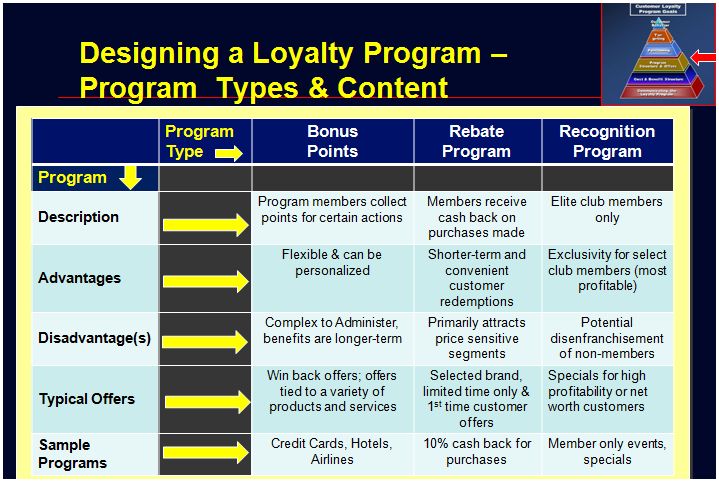
Loyalty Program Type & Content Examples

Loyalty Program Type & Content Examples

{Click on image above for a larger/clearer view}

Loyalty Program - Balancing Benefits With Company Costs

Loyalty Program – Balancing Benefits With Company Costs

Loyalty Program Customer Benefits & Company Costs

{Click on image above for a larger/clearer view}

Loyalty Program Business Case

                            Loyalty Program Business Case

Loyalty Program Business Case and Reward Financial Model

{Click on image above for a larger/clearer view}

Loyalty Program Communications Plan

Loyalty Program Communications Plan

Customer Loyalty Program Communication Plan Structure

{Click on image above for a larger/clearer view}

Loyalty Program Point Collection Simulator

Loyalty Program Point Collection Simulator

Customer Loyalty Program Reward Point Redemption Simulator

{Click on image above for a larger/clearer view}

Loyalty Program Point Redemption Calculator

Loyalty Program Point Redemption Calculator

Loyalty Program Reward Category Point Redemption Volume Estimates

{Click on image above for a larger/clearer view}

Loyalty Program Business Case & Project Plan

Loyalty Program Business Case & Project Plan

Loyalty Program Business Case & Project Plan

{Click on image above for a larger/clearer view}

Loyalty Program Pros and Cons

Loyalty Program Pros and Cons

Customer Loyalty Program Pros & Cons

{Click on image above for a larger/clearer view}

Loyalty Program Lessons Learned - 1 of 3

Loyalty Program Lessons Learned – 1 of 3

Customer Loyalty Program Lessons Learned & Best Practices (1 of 3)

{Click on image above for a larger/clearer view}

Loyalty Program Lessons Learned - 2 of 3

Loyalty Program Lessons Learned – 2 of 3

Customer Loyalty Program Lessons Learned & Best Practices (2 of 3)

{Click on image above for a larger/clearer view}

Loyalty Program Lessons Learned - 3 of 3

Loyalty Program Lessons Learned – 3 of 3

Customer Loyalty Program Lessons Learned & Best Practices (3 of 3)

{Click on image above for a larger/clearer view}


Bottom Line: If you are ever considering implementing a customer loyalty program, please take the above lessons learned and best practices into account as these were all developed after having successfully implemented several of these loyalty programs at Fortune 500 companies across the globe.

Measuring Marketing ROI vs. Measuring Customer Value & Equity

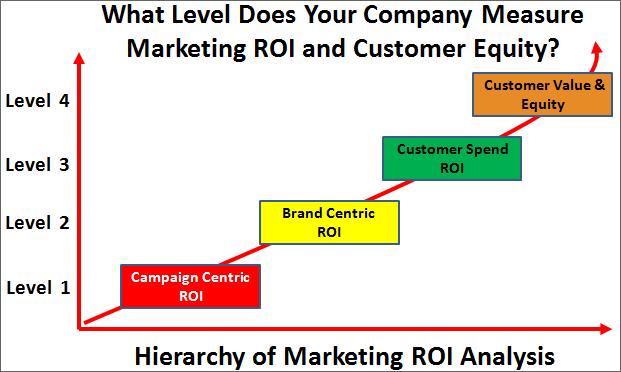
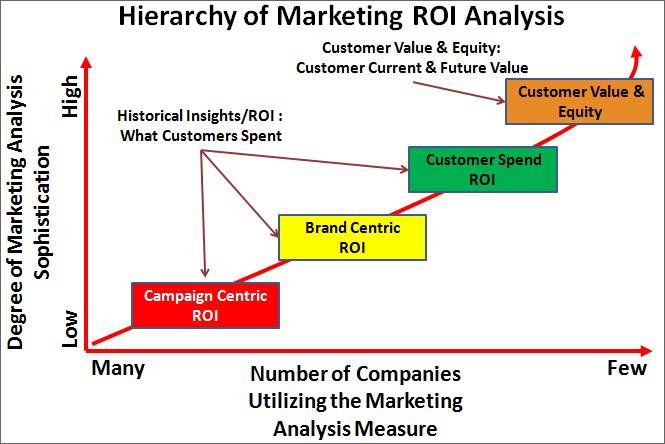
Hierarchy of Marketing ROI Analysis (Levels 1-4)

Hierarchy of Marketing ROI Analysis (Levels 1-4)

In this blog we cover the following topics:

  1. The four (4) levels of sophistication in measuring marketing and customer ROI
  2. The three traditional levels of marketing ROI that focus on spend vs. return
  3. The calculations for measuring campaign ROI, Brand ROI and Customer Spend ROI
  4. Why measuring customer value and equity is a far better measure than traditional marketing ROI
  5. How Customer Value and Equity Covers the Measurement of ALL customer facing activity – marketing, PR, sales, customer service, community relations, etc.
  6. What your company needs to do to increase its sophistication of measuring market and customer insights

The following chart depicts the capability levels for measuring market ROI and customer value.

Level 1: Campaign centric ROI is the measurement, at a campaign level, of campaign costs vs. campaign return (customer spend vs. campaign return)

Level 2: Brand Centric ROI is the measurement, at a brand level, of brand return for all conducted campaigns (roll up of campaign ROI to a brand level)

Level 3: Customer Spend ROI is the sum of all brand and all brand campaign ROI at a customer level.

Levels of Marketing ROI Measurement (Levels 1-4)

Levels of Marketing ROI Measurement (Levels 1-4)

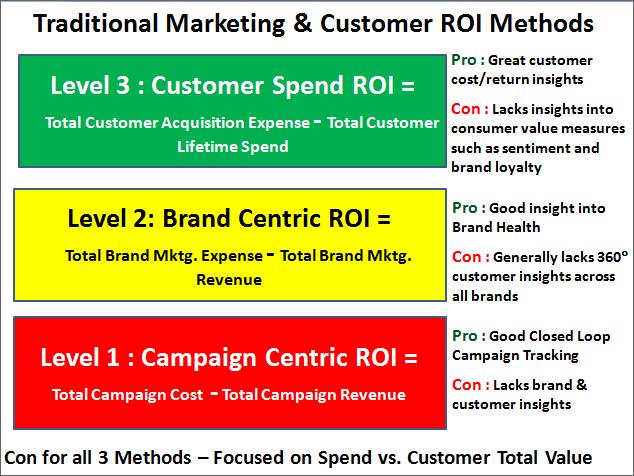
The following chart defines the first three levels of marketing ROI and points out the pros and cons for utilizing each method. The downfall for all three methods, as indicated at the bottom of the chart, is that they rely on historical spend vs. forward looking measures as are found in Level 4 – Customer Value and Equity Measures.

Traditional Marketing & Customer ROI Methods (Levels 1-3)

Traditional Marketing & Customer ROI Methods (Levels 1-3)

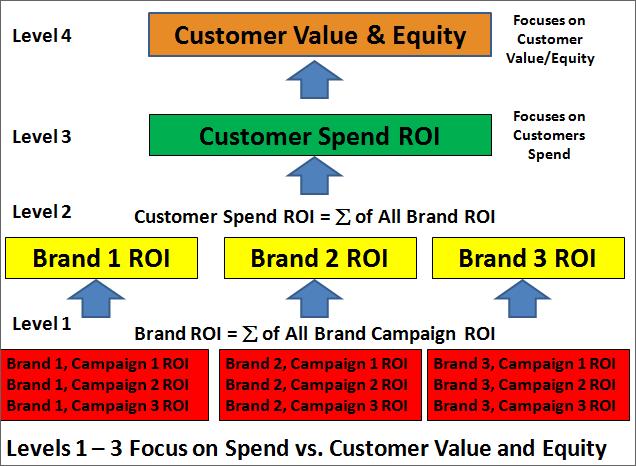
The following chart depicts the calculations for determining campaign level and brand level ROI that, if done correctly, should roll up to a customer level (Level 3 – Customer Spend ROI). The detailed definition of the highest level (Level 4 – Customer Value & Equity) is covered just below in this blog.

Levels 1 – 3 Focus on Spend vs. Customer Value and Equity

Levels 1 – 3 Focus on Spend vs. Customer Value and Equity

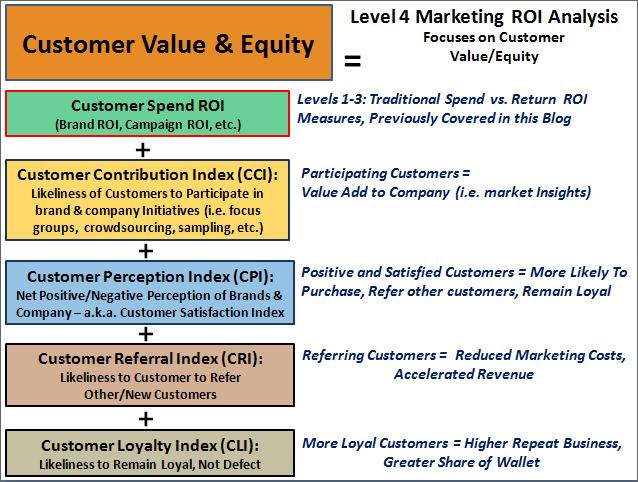
The following chart defines the components of Level 4 ROI analysis – “Customer Value and Equity”.  This level includes the roll-up for Customer Spend ROI, but also includes insights that predict customer future behavior as well as defining how valuable the customer is to the company beyond what they spend.

For example, a customer who is referring 2-3 customers to the company per week, participating in customer focus groups is a far more valuable customer than another customer with equal spend with your company.  

Similar to company stock value, the measurement of customer value and equity is a far more robust way to measure the value of the customer base, how likely they are to remain a loyal customer, etc. 

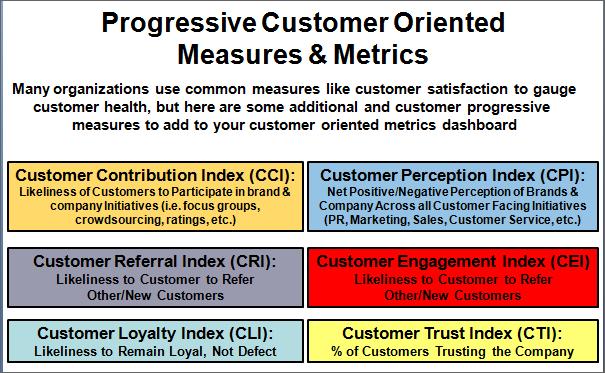
Customer Value & Equity Calculations, as shown below includes several different indices such as Customer Contribution Index (CCI), Customer Perception Index (CPI), Customer Referral Index (CRI) and Customer Loyalty Index (CLI). These indices help determine the overall health of the customer base vs. merely customer spend as is associated with levels 1-3 (spend focused).

Customer Value and equity calculations take into account the level 1-3 spend ROI measures, but utilizes a balanced scorecard approach in that the indices above are weighted against the spend vs. ROI measures. For example, if Brand A has a high ROI but also has a bunch of irate customers unwilling to partner and participate in brand activities, then this is indicative of a brand that, while doing well now, will experience a great deal of future customer churn, negative social comments, brand tarnishing, etc.

Level 4 Marketing ROI Analysis - Customer Value & Equity

Level 4 Marketing ROI Analysis – Customer Value & Equity

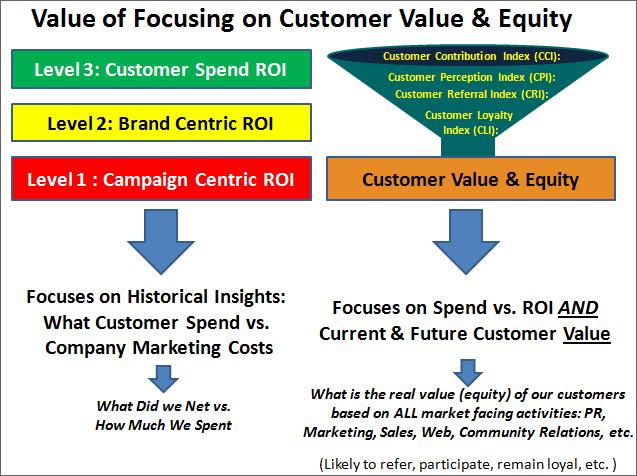
The following chart further defines the difference between focusing on spend ROI analysis vs. focusing on customer value and equity.

Value of Focusing on Customer Value & Equity

Value of Focusing on Customer Value & Equity

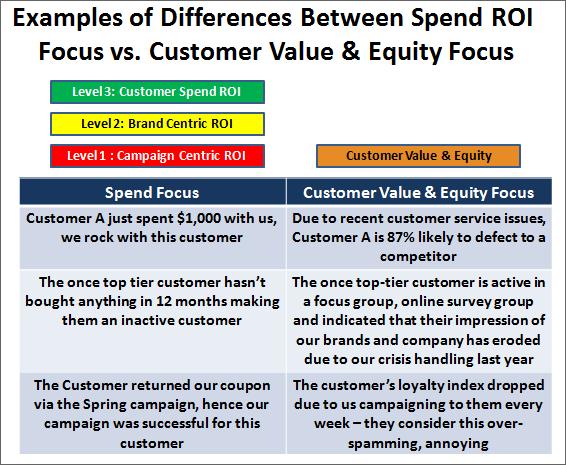
The last chart provides some real examples of the difference between focusing on spend ROI analysis vs. focusing on customer value and equity.

Examples of Differences Between Spend ROI  Focus vs. Customer Value & Equity Focus

Examples of Differences Between Spend ROI
Focus vs. Customer Value & Equity Focus

The bottom line here is that if you are focusing on Level 1-3 ROI calculations, you have a short-term and myopic view of the health and value of your customer base and are missing the strategic and longer-term insights that enable you to determine customer, company and brand future value and earnings.

Any company thinking about acquiring another should perform this robust customer diagnostic to determine if they are inheriting a group of angry/upset customers that will defect after a merger or a set of extremely valuable customers with positive customer equity who will take the stock value of the merged company to the stratosphere.

Contact me to find out how to move past traditional marketing ROI measurement and how to evolve into developing more robust customer value and equity insights for your company.  

Change Management 101 Primer for Senior Executives (CEOs, COOs, CSOs, CMOs, CFOs, CCOs, etc.)

The following blog was written to provide a simple primer on Change Management for Top Executives. It is written so you ‘get it’ in 15 minutes or less of reading this article.

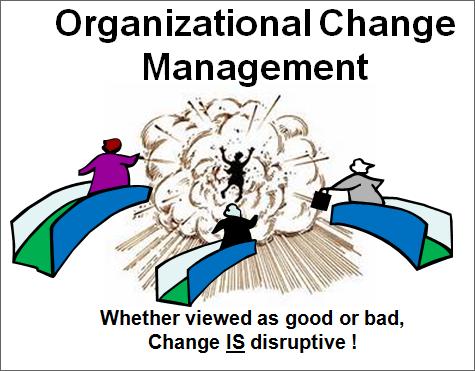
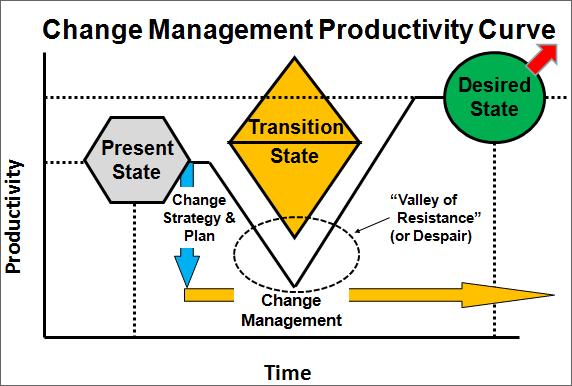
Change IS Disruptive, but Change Management Can Mitigate Impacts to Productivity

Change IS Disruptive, but Change Management Can Mitigate The Impact on Productivity

As a business leader, have you ever encountered the following challenges within your company:?

1. Implemented new technology or IT system and people failed to adopt & fully utilize it?

2. Implemented new processes and ways of doing business and your employees continued to follow the older methods?

3. Your competition continually seems to be evolving and innovating, developing new and more effective ways of doing business, while your company culture resists change and new ways of doing business?

The remainder of this blog is dedicated to sharing some of the techniques to get your organization to embrace and be supportive of change.  These change management techniques are based on my years of implementing change at organizations like Macy’s, American Express, Intuit, AT&T, Pfizer, Bristol-Myers Squibb, Oracle, CBS Interactive, Wells Fargo, and numerous other Fortune 500 companies.


Topics in this blog:

1)      What is Change Management – A Simple Definition

2)      Why is it Important?

3)      Why is change resisted by so many employees?

4)      Do all employees approach change the same way and how do you harness the power of the innovators and change ‘early adopters’?

5)      How Change Management Helps Accelerate Change

6)      Change Management Mitigates the Impact on Productivity while Implementing Change

7)      The Organizational Change Model Facilitates Change Success & Greater Business Results

8)      Steps in the Organizational Change Model Ensure Change Project Success

9)      The Importance of the eight (8) Change Management Steps

10)   Summary – Change Management & Innovation Requires a 360°, holistic approach driven by skilled and experienced change management professionals

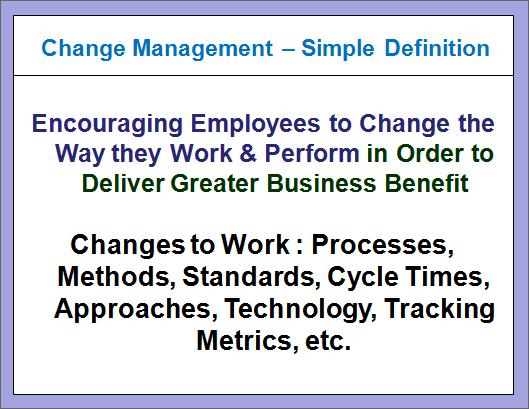
1)    A simple definition of what change management is:

A Simple Definiton for Change Management

A Simple Definiton for Change Management

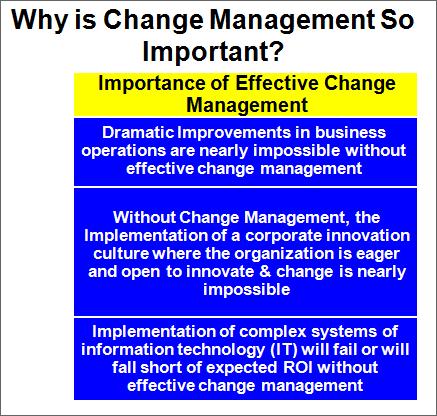
2)    Why is change management so important?

Why Is Change Management So Important?

Why Is Change Management So Important?

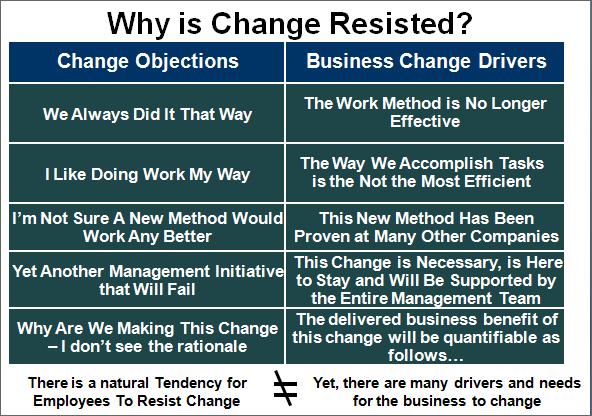
3)    Why is change resisted by many employees?

Why is change resisted by many employees?

Why is change resisted by many employees?

Bottom Line: Without proper education and motivation, change is naturally resisted within the workplace by all but a few.

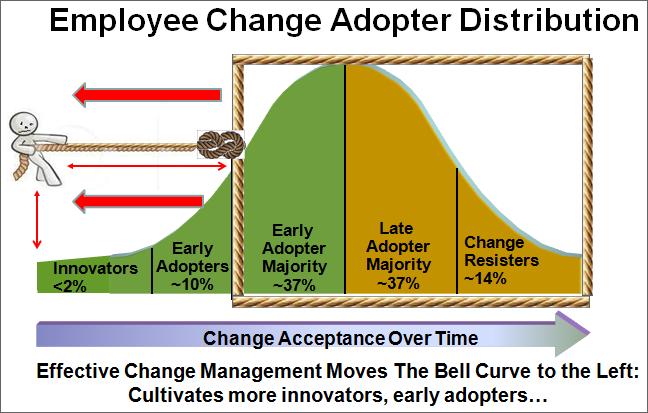
4)    Do all employees approach change the same way?

Employee Change Adopter Curve

Employee Change Adopter Curve

As depicted by the above chart, employees range from ardent resisters to innovators. Change management solicits the support from innovators and early adopters to help diffuse organizational change to the remainder of the organization.   

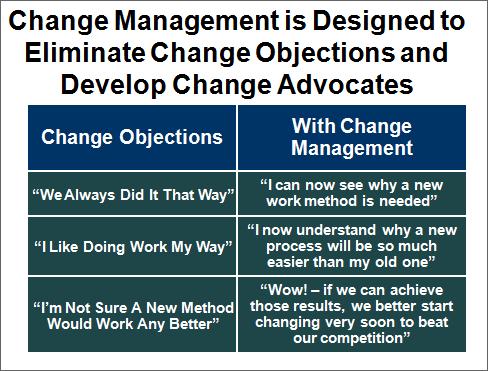
5)    How Change Management Helps Accelerate Change

How Change Management Helps Accelerate Change

How Change Management Helps Accelerate Change

Change management not only removes obstacles to change, it helps develop enthusiasm and excitement for accelerated change in the future. 

6)    Change Management Mitigates the Impact on Productivity While Implementing Change

Change Management Productivity Curve

Change Management Productivity Curve

By having a robust change management methodology and plan, disruptions to business productivity can be minimized until the desired change state is achieved.  

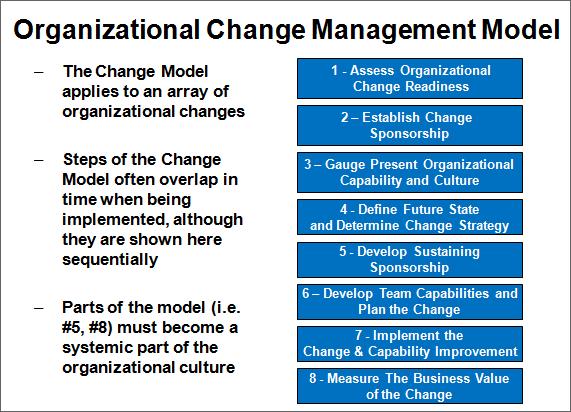
7)    The Organizational Change Model Facilitates Change Success & Greater Business Results

Organizational Change Management Model

Organizational Change Management Model

By having a robust change management methodology and model, change success and enhanced business performance can be nearly guaranteed.

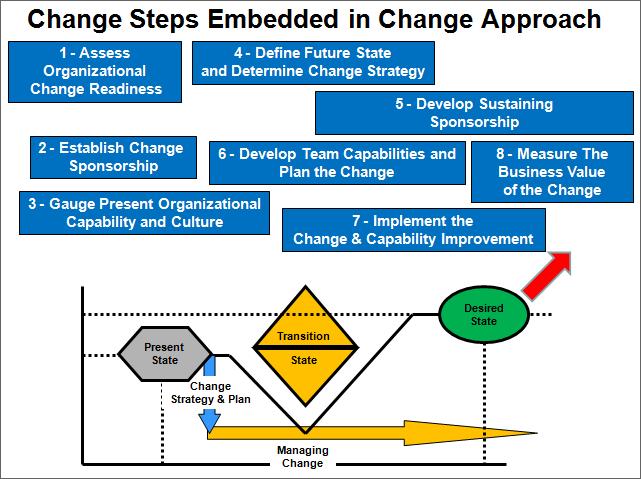
8)    Steps in the Organizational Change Model Ensure Change Project Success

Change Steps in The Change Management Approach

Change Steps in The Change Management Approach

Change projects must have clearly defined and measurable steps that align with the overall change methodology.  This approach greatly enhances the chance that the change project will be successful as well as facilitates the achievement of desired-positive business outcomes.

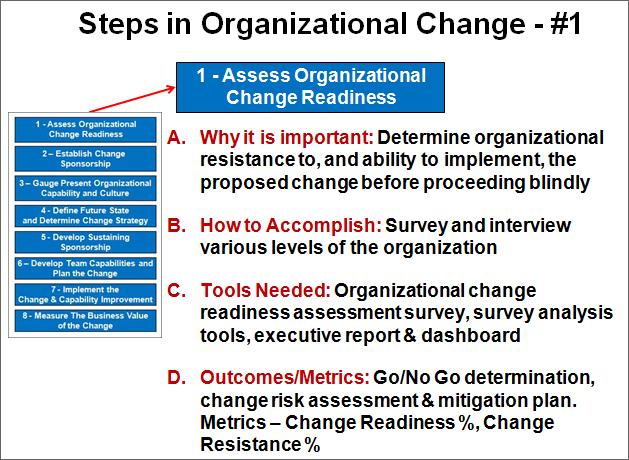
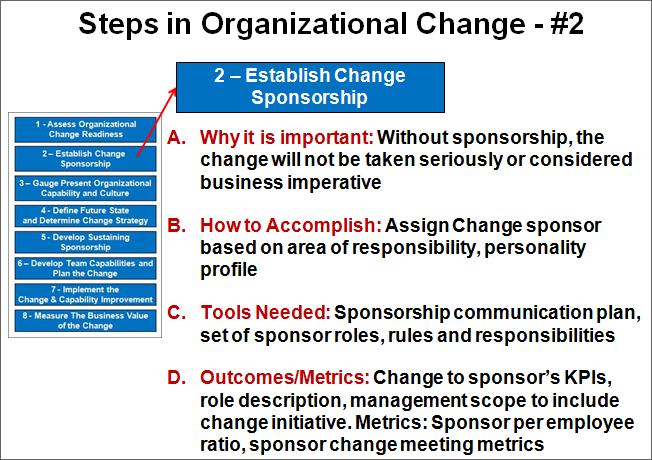
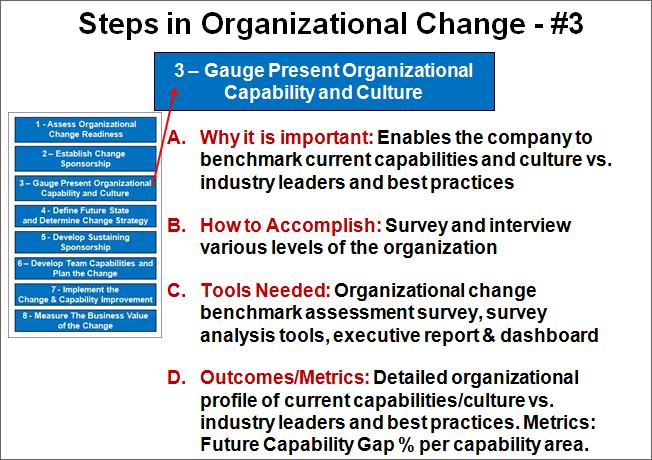
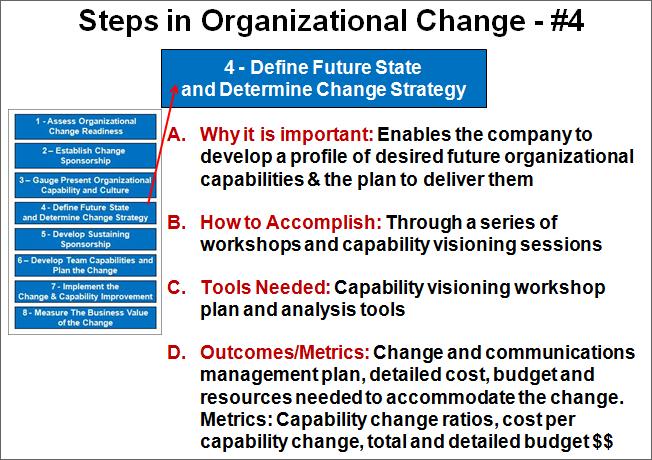
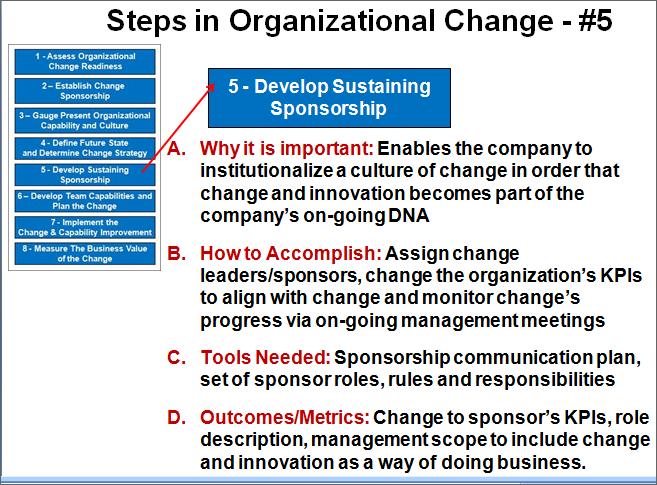
9)    The Importance of the eight (8) Change Management Steps

The next set of graphs highlight the importance of each step in the change management (project) process:

Step #1

Change Management - Step #1

Change Management – Step #1

Step #2:

Change Management - Step #2

Change Management – Step #2

Step #3:

Change Management - Step #3

Change Management – Step #3

Step #4:

Change Management - Step #4

Change Management – Step #4

Step #5:

Change Management - Step #5

Change Management – Step #5

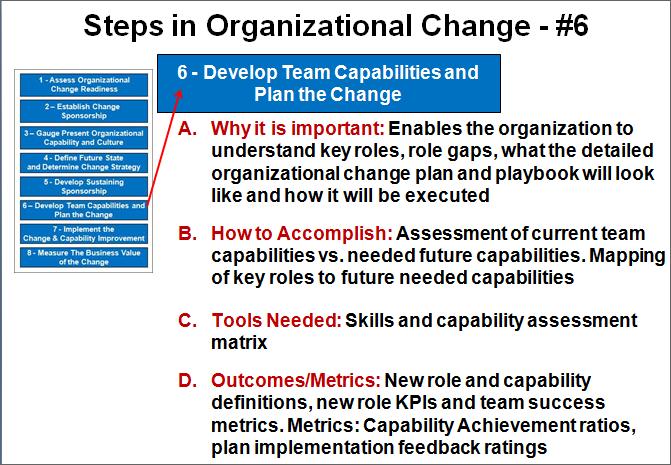
Step #6:

Change Management - Step #6

Change Management – Step #6

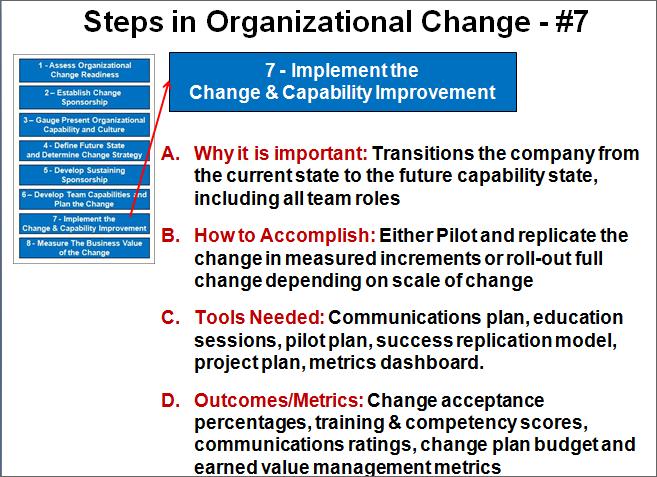
Step #7:

Change Management - Step #7

Change Management – Step #7

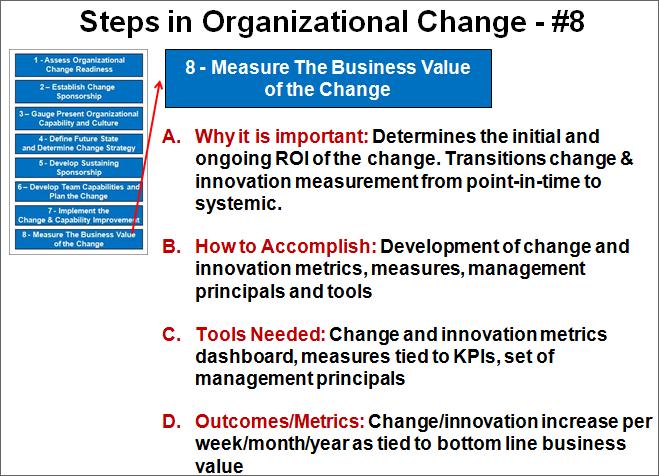
Step #8:

Change Management - Step #8

Change Management – Step #8

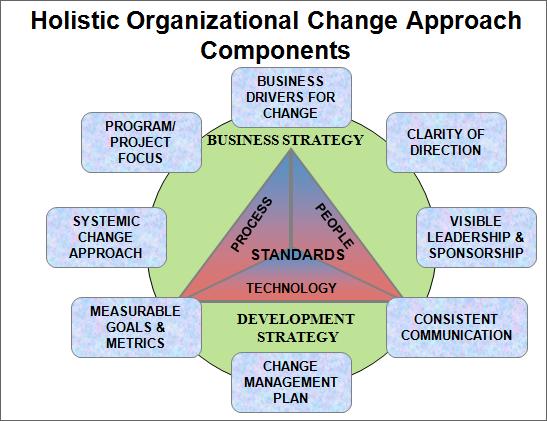
10)         Summary – Change Management & Innovation Requires a 360°, holistic approach

Holistic Organizational Change Components

Holistic Organizational Change Components

In summary, change management requires leveraging a proven change methodology, skilled change management practitioners and a holistic approach to implementing corporate innovation and change. The above is a simple depiction of a best practice approach I have used on many change management projects at many of the Fortune 500 companies in the US.

Sales Influencer (Power) Mapping

How to Win Key Strategic Sales Deals through Client Relationship Analysis, Management and Improvement – in 5 Easy Steps !

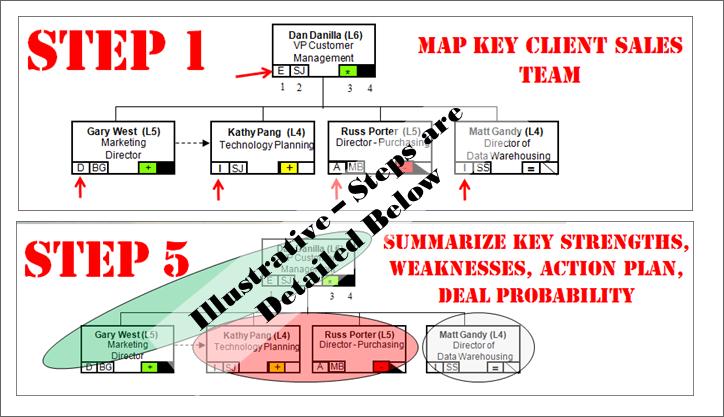
Illustrative of the 5 Step to Power Mapping (Ilustrative - Covered Below}
Illustrative of the 5 Step to Power Mapping (Ilustrative – Covered Below}

Analysis and Management of the key decision makers and influencers in any strategic and long-term sale is crucial for success and for obtaining that BIG SALES CONTRACT WIN. This type of analysis of multi-million dollar & strategic sales deals is a common practice of the top revenue generating firms throughout the world including Accenture, IBM, PricewatehouseCoopers, McKinsey, General Electric, Deliotte, KPMG, etc.  Through this proven sales analysis technique called Sales Influencer Mapping or Power mapping, you can quickly ascertain the following:

  1. How likely you are to win the deal based on the status of your relationships with the various client company team members?
  2. Who at your client company are for or against you and your firm winning this sale?
  3. Who from your client company has a pre-existing positive or negative perception of your company?
  4. What is the nature of your relationship with all of the key decision makers and influencers that must approve and/or condone this sale to your firm?

{Click on Chart for a larger/clearer image}:

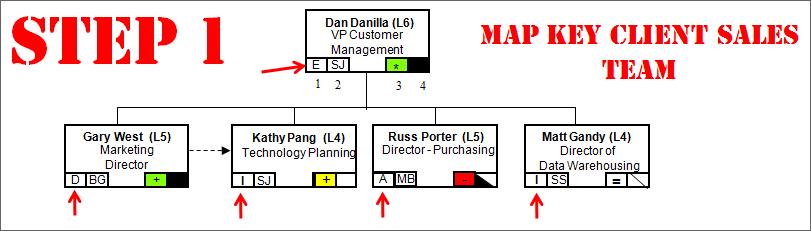
Map Key Client Sales Team
Step #1 – Map Key Client Sales Team
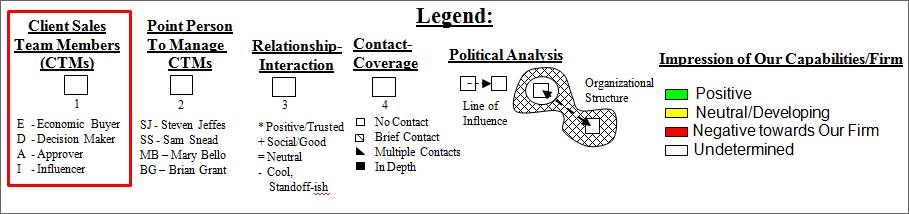
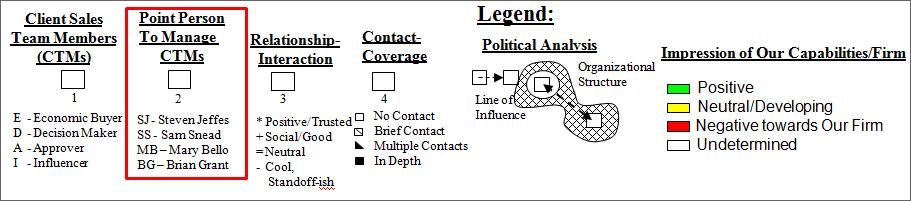
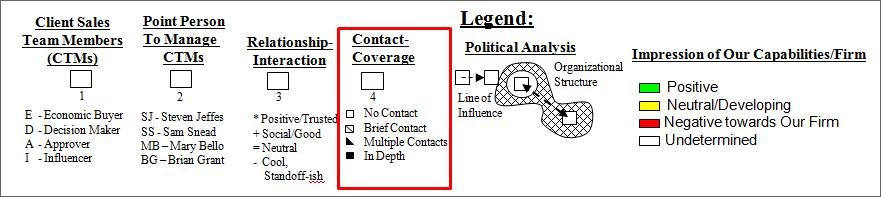
Step #1 Legend
Step #1 Legend

Directly related to the last bullet (#4) above, the first and key step to influencer mapping for longer-term strategic sales is determining the sales influencer landscape as follows:

  1. Who is the economic buyer(s) that has an allocated budget for the item you are selling and who will ultimately make the final decision for the sale? It is the economic buyer’s budget that will fund your sale of your product/service.
  2. Who are the decision maker(s) who the economic buyer must get to concur (sign-off) that they are selecting the right firm, solution, products for this sale? Decision makers are the people who are putting their reputations and careers on the line for selecting you and your firm for this sale.
  3. Who are the key influencer(s) that will influence the opinions and impressions of your company with both the economic buyer and the decision makers? It is the key influencer(s) who can help or hurt the chances of your sale with the economic buyer(s) and the decision makers.

Take Chart #1 below that represents a strategic sale of over $1.2MM to a potential pharmaceutical client. Our strategic sales team consisted of four of us attempting to sell a strategic roadmap for our client to enable an enhanced direct to consumer (DTC) pharmaceutical marketing model.

{Click on Chart for a larger/clearer image}:

Map Key Client Sales Team
Step #1 – Map Key Client Sales Team
Step #1 Legend
Step #1 Legend

In step one, we carefully analyzed the client company organization and quickly determined that Dan Danilla, as VP of Customer Management, was the Economic Buyer for this sale and had adequate allocated budget to actually buy our services. You will notice the “E” noted below his name in box #1 for Economic buyer per the above power mapping legend.

Gary West was determined to be responsible for the project’s delivery and success, so he was labeled at the Decision Maker “D” in box #1 below his name/organizational box.

Russ Porter was determined as being one of the signatories of the contract, so he is marked with an “A” for being a contract Approver in box #1 below his name/organizational box.

Lastly, since Matt Gandy has a great social relationship with both Dan Danilla (Economic Buyer) and Gary West and is often called for professional advice by both, we marked him as a key influencer for this sales deal with an “I” in box #1 below his name/organizational box.

Chart #2 represents Step #2 in Sales Power Mapping {Click on Chart for a larger/clearer image}::

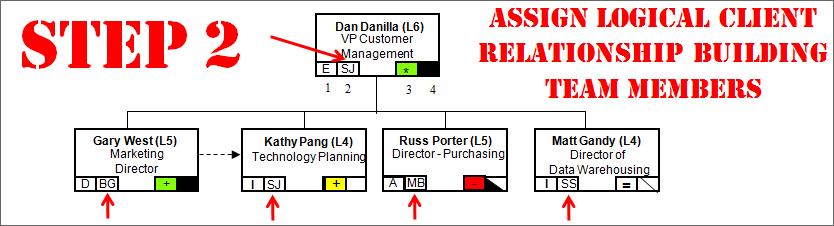
Assign Logical Client Relationship Building Team Members
Step #2 – Assign Logical Client Relationship Building Team Members
Power Mapping Step #2 Legend

In this step we assign our company team members to effectively manage the key influencer client relationships based on personality matching and previous interaction history.

In the above example, I (Steven Jeffes-SJ) was assigned to cover Dan Danilla (Economic Buyer) as I have had very good previous interactions with him and he seemed to like my ideas/insights.

Likewise Brian Grant (BG) was assigned to Gary West (Decision Maker), Me assigned also to Kathy Pang (Influencer), Mary Bello (MB) to Russ Porter (Approver) and Sam Snead (SS) to Matt Gandy as they head out for drinks together occasionally and have a budding social relationship.

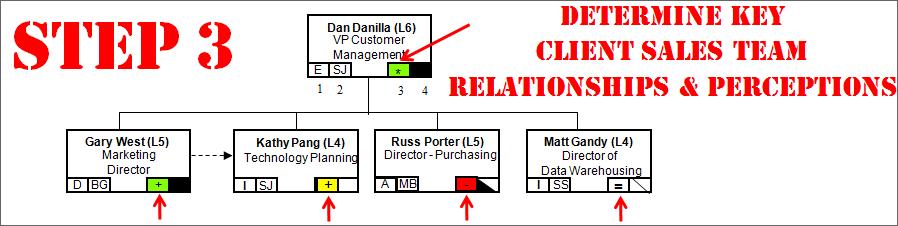
Chart #3 represents Step #3 in Sales Power Mapping {Click on Chart for a larger/clearer image}::

Determine Key Client Sales Team Relationship & Perceptions
Step #3 – Determine Key Client Sales Team Relationship & Perceptions
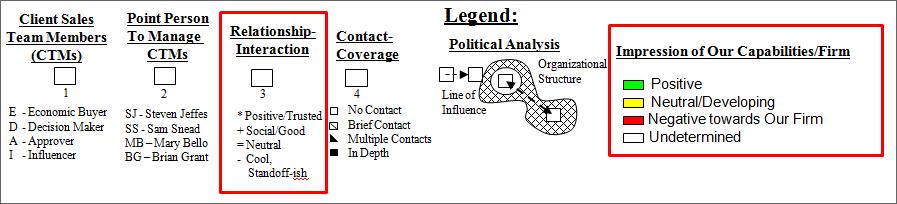
Power Mapping Step 3 - Legend
Power Mapping Step 3 – Legend

In this step we accomplish two bits of sales analysis as follows:

1)      We determine what our previous interaction with each person has been like and how have they reacted to our team members in the past (on average).  This is represented by box #3 above “Relationship Interaction”.  In box 3 for each client team member, we noted “*” for having a positive/trusted relationship with Dan Danilla, a “+” for having a good relationship with Gary West, a “+” also for Kathy Pang as she has a good relationship with Steve Jeffes, and “-“ with Russ Porter as he has been cool and stand-offish with team members and a “=” with Matt Gandy as he has been neutral in our previous interactions with him.

2)      Our second step in this phase is to determine what each person’s impressions are of our Firm’s capabilities based on any previous statements. We color the same box #3 with colors Green for Positive, Yellow for Neutral, Red for the person having negative impressions of our firm.  These colors are noted above in box #3 for each client team member – Dan Danilla (Green), Gary West (Green), Kathy Pang (Yellow), Russ Porter (Red), and Matt Gandy (White for undetermined).

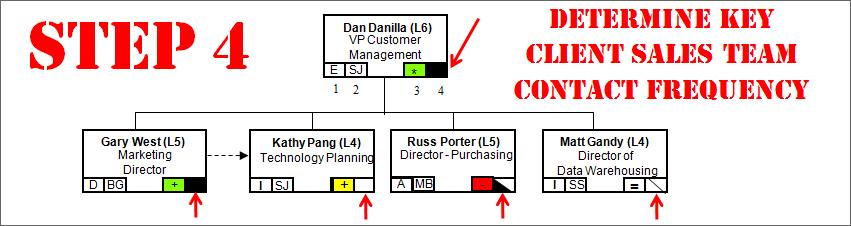
Chart #4 represents Step #4 in Sales Power Mapping {Click on Chart for a larger/clearer image}::

Determine Key Client Sales Team Contact Frequency
Step #4 – Determine Key Client Sales Team Contact Frequency
Power Mapping Step #4 - Legend
Power Mapping Step #4 – Legend

In this fourth step we accomplish the following:

Determine the extent to which we have had contact with each client sales team member. This step is critically important in order to be able to develop an effective action plan to help develop better relationships with each client team member.  In addition to noting the frequency of contact, detailed notes must be cultivated from each strategic sales team member to determine the following for each client team member:

1)      What previous concerns has the client team member mentioned when dealing with our team or when our potential solution was presented?

2)      What previous likes or preferences has the client team member mentioned when dealing with our team or when our potential solution was presented?

3)      What type of personality type is this client team member – analytical, introverted, social, extroverted, etc. (Should also be used in matching team members in step #2 above)
4)      What checkpoints or process steps is this client team member looking to ‘check off’ as part of this product/solution evaluation?

5)      Are there any other team stakeholders missing in developing the above organization chart that should now be added?

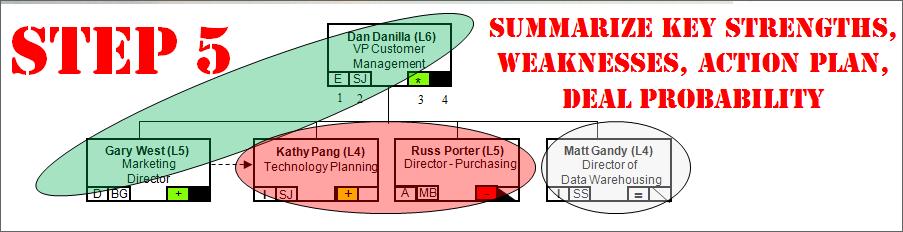
In the fifth and final step of this process, we perform the following:

A)     Aggregate and summarize the above sales analysis including deal strengths & weaknesses

B)     Develop a Sales Action Plan

C)     Estimate Deal Probability Closure %

The picture that summarizes the sales analysis can be shown as follows {Click on Chart for a larger/clearer image}::

Summarize Sales Deal Key Strenghts, Weaknesses, Action Plan, Closure Probability (%)
Step #5 – Summarize Sales Deal Key Strenghts, Weaknesses, Action Plan, Closure Probability (%)

A)     Summarize Sales Analysis:

The summary of our sales analysis (as depicted in Chart #5 above) for this sale deal is as follows:

  1. We have good and strong relationships with Dan Danilla (Economic Buyer) and Gary West (Decision Maker) putting us in a good position to win the deal.
  2. We have weaker relationships with Kathy Pang (Deal Influencer) and Russ Porter (Deal Approver) and these relationships need to be strengthened via our sales action plan. They also have either neutral or negative impressions of our firm as compared to our competitors.
  3. Matt Gandy (Deal Influencer) has a neutral position in terms of relationships with our team members and impression of our firm’s solutions and capabilities. 

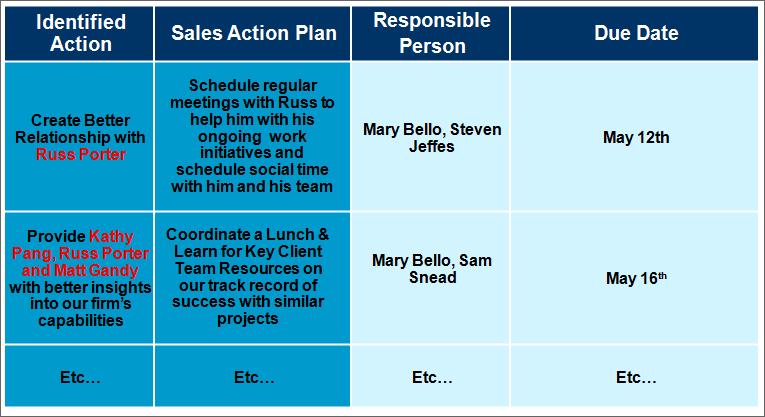
B)     Develop a Sales Action Plan (Sample):

The action plan that aligns to our above sales analysis for this sales deal is as follows {Click on Chart for a larger/clearer image}::

Sales Power Mapping - Action Plan
Sales Power Mapping – Action Plan

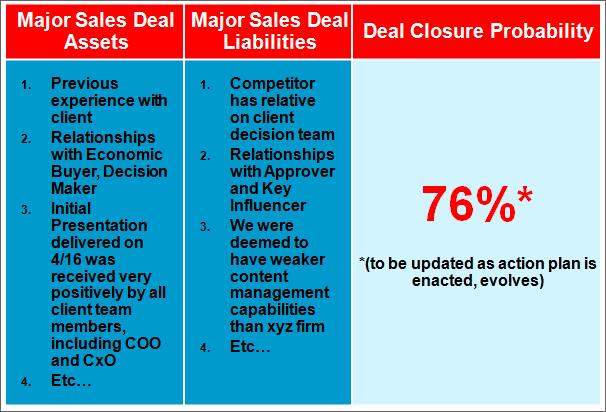
C)     Estimate Deal Probability Closure %:

The final step is to estimate, utilizing all of the above insights, as well as major sales deal assets and liabilities, the probability that this sales deal will close favorably (as a win) for our firm as follows {Click on Chart for a larger/clearer image}::

Sales Power Mapping - Sales Deal Summary Assets, Liabilities, Closure Probability %
Sales Power Mapping – Sales Deal Summary Assets, Liabilities, Closure Probability %

The bottom line to sales power (influencer) mapping is that the best sales companies and your most formidable competitors are using this level of sales analysis and action planning in order to win that strategic multi-million $$$ deal.

Your organization will be at a competitive disadvantage if you do not employ this level of rigor in your sales pursuits. Trust me, it works and I have closed many large multi-million $$$$ deals (including this one – YES, the above example was A WIN!) using this technique at many of the world’s leading firms. 

Blow Away Your Competition by Replacing Your Old CRM Program with the New Customer Relevant Relationship Management (CRRM) Model – Part 2: The Necessary Components.

1) Introduction:

In my previous blog, I covered what the new Customer Relevant Relationship Model (CRRM) is and the benefits of adopting this new model. In this blog, I will cover the components of the new CRRM model and what you need to put in place to make this new model a reality.

Ever wonder why companies like ESPN, Apple, Google, Zynga, Amazon, and Marriott dominate their respective markets? The reason is that they are ‘Customer First’ organizations and are passionate about listening to, understanding and then delighting their customers based on leveraging true customer insights. They treat their customers as business partners vs. commodities and include them in many critical decision making processes. They get this new CRRM model. Why/how ? – Read the rest of this blog to find out…

The differences between the old CRM model and how these companies are embracing the newer CRRM model are depicted in the following chart:

The Old CRM Model vs. New CRRM Model – Customers as Business Partners

2) Customers are fed up with old Dictatorial Management Style & Want to be Empowered as Business Partners

Customers and stakeholders today are longing for a company to partner with them and include them in the corporate decision making process.  These same constituencies are sick and tired of political, corporate, and other organizations making unilateral decisions for them that are really not in-line with their needs,  wants, etc. The backlash from this unwanted dictatorial management style of some companies can be seen in the Bank of America fee customer rebellion, the customer backlash from Netflix deciding to  split their company without first consulting with their customers and HPs initial decision to exit the computer market.

3) Components of the New CRRM Model:

In order to progress your organization from the old CRM model to the new CRRM  model, a few key essentials must be put in place and are as follows:

A. New CRRM Model that includes the 360° Cultivation of Customer & Market Insights.  This model enables a 360° view of all customer and market insights including customer feedback, preferences, likes, dislikes, social sentiment, competitor activity, etc. This new model takes your insights to an entirely new level whereby you are now enabled to delight customers, stakeholders and stockholders by having insights that are light-years ahead of insights provided by a traditional CRM model.
B. Customer First Culture driven by management that is passionate about their customers including a set of customer first principles and guidelines developed by company leaders

C. Customer Ratings & Feedback Structure that will identify areas where you will collect customer 360° feedback from customer and stakeholder interactions

D. Customer Feedback & Preferences Cultivation Process and corresponding infrastructure in order to allow your customers to continually rate how well you are serving them

E. Customer Health Scorecard that provides real-time insights on how well the customers, stakeholders and stockholders perceives you as serving them as well as insights into a Continuous Customer Improvement Process (CCIP) that enables you to continually improve your customer perceptions, satisfaction, brand loyalty, etc.
These components can apply to large enterprises as well as Small to Medium Businesses (SMBs).

The following graphics are all sample components from the list above (A-D) that need to be put in place to enable this new CRRM Model.

New CRRM Model – 360° Cultivation of Customer & Market Insights

 3A) The above chart “New CRRM Model – 360 Cultivation of Customer & Market Insights” demonstrates the new insights model that must be put in place to deliver world-class stakeholder and customer programs.

These enhanced insights will enable you to deliver products and services that delight your customers, stakeholders and stockholders as well as enable you to leapfrog the competition in terms of market share if they continue to rely on their antiquated CRM data and analytics insights only model. 

For Small to Medium sized Businesses (SMBs), some of the insights do not apply, but the following charts (3B-3E) most certainly apply and can be tracked via simple Microsoft Excel spreadsheets.

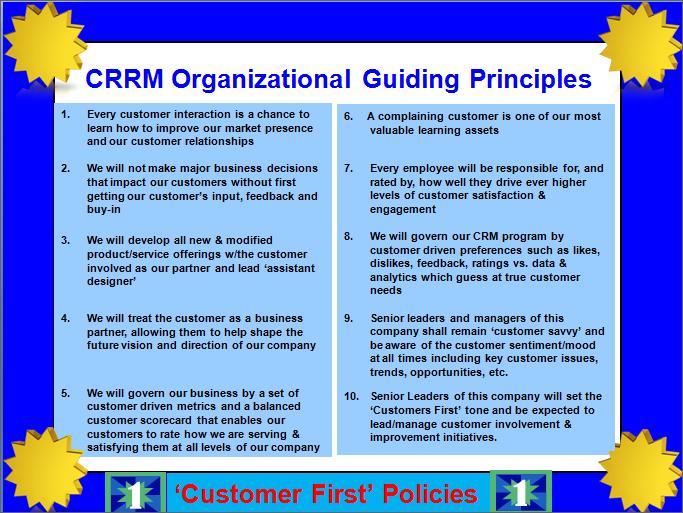
CRRM Customer First Policies & Organizational Principles

3B) The above chart “CRRM Organizational Guiding Principles” demonstrates the principles that must be in-place to be customer first culture. This culture is driven by management that is passionate about their customers and governs the company around a set of customer first policies.

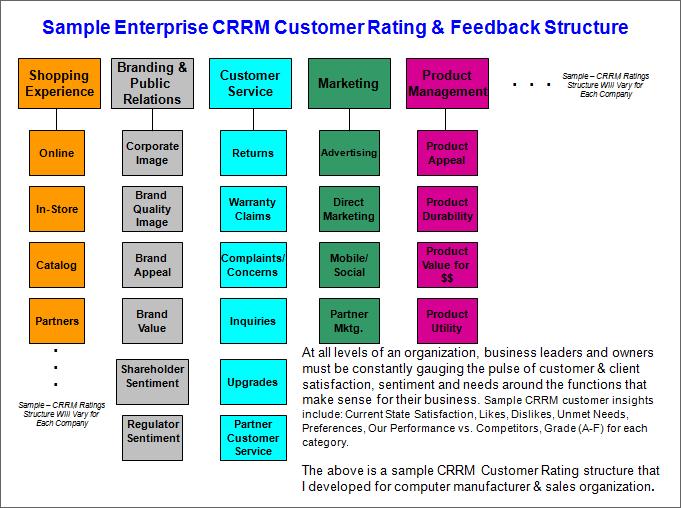
Sample Enterprise CRRM Customer Rating & Feedback Structure

3C) The above chart “Enterprise CRRM Customer Rating & Feedback Structure” illustrates a sample structure (will vary for each type of business) whereby customer feedback and preferences will be cultivated in order to develop 360° insights into customer needs, wants, likes, etc.
Enterprise CRRM Customer Feedback & Preferences Cultivation Process

3D) The above chart “CRRM Customer Ratings & Feedback Cultivation Process” illustrates a how customer feedback and preferences will be cultivated in order to develop 360° insights into customer needs, wants, likes, etc.
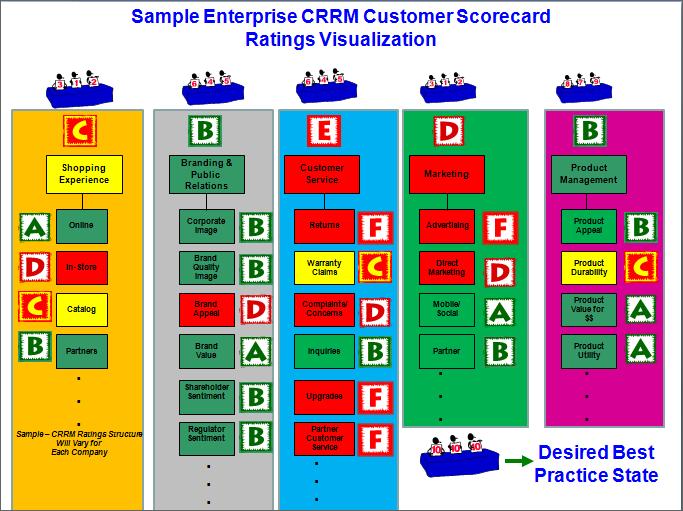
Sample Enterprise CRRM Customer Scorecard Ratings Visualization

3E) The above chart “Enterprise CRRM Customer Scorecard Ratings Visualization” illustrates a how customer feedback and preferences ratings will be visually represented in a scorecard. 
Sample Enterprise CRRM Customer Scorecard Metrics

3E-2) The above chart “Enterprise CRRM Customer Scorecard” illustrates a how customer feedback and preferences ratings will be rolled up into an analytical scorecard that provides insights into customer trends,  customer feedback, customer issues, core customer strengths and weaknesses, etc. 

This scorecard can also be used to manage a Continuous Customer Improvement Process (CCIP) that continually drives improvements to customer perceptions, ratings, satisfaction, etc. 

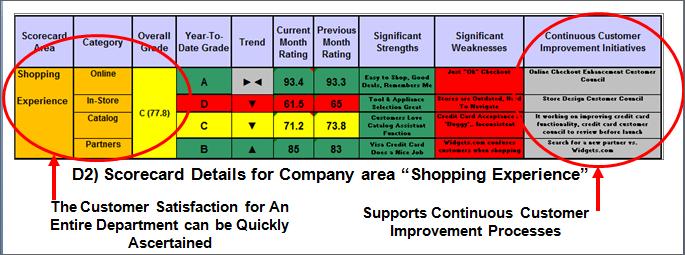
Sample Scorecard for “Shopping Experience”

The above depicts how analytics and metrics would be maintained for a business who had a retail or wholesale shopping function.

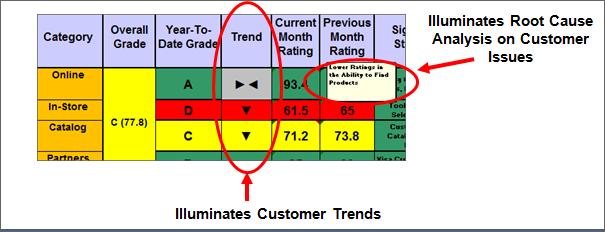
Sample Shopping Experience Scorecard – #2

Robust Scorecard Analytics and Metrics should support Customer Trend Identification and Root Cause Analysis for Customer Issues.

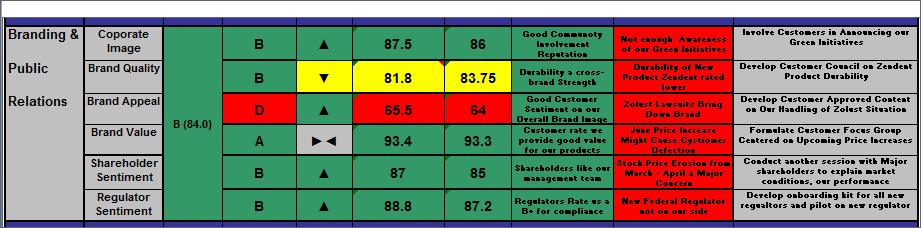
Sample Branding & Public Relations Scorecard

Sample Public Relations Scorecard Above gives you insights into how well your company and brands are perceived by customers, stakeholders, stockholders, etc.

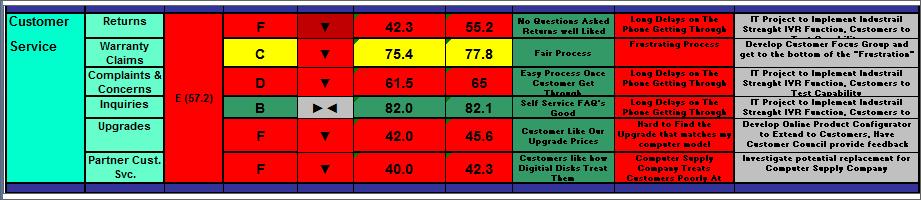
Sample Customer Service Scorecard

Sample Customer Scorecard Above from Customer Service tells how well you are serving your customers.

Sample Marketing Scorecard

Sample Marketing Scorecard Above Gives you insights into how well your Marketing Efforts are resonating with your customers.

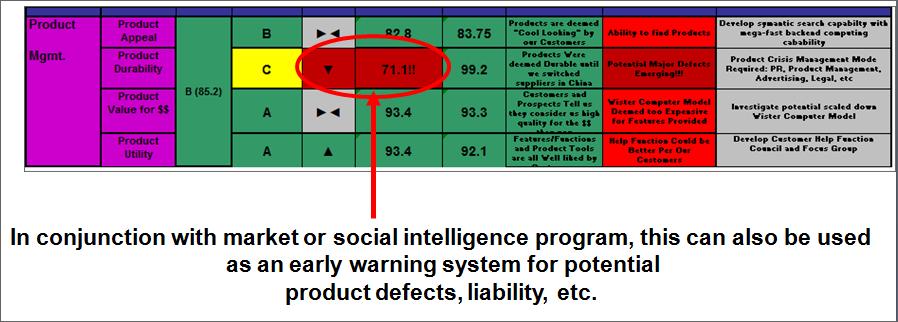
Sample Product Management Scorecard

The Sample Product Management Scorecard above gives you insights into how well perceived your products and services are with customers and prospects.

4) Company & Customer Benefits of Adopting the CRRM Model:

By treating customers as business partners (vs. commodities) and including them in the corporate decision making process, as well as allowing them to rate how well you are serving them from an array of customer facing areas, companies can reap huge rewards including the following:

1. Better insights into the types of products and services customers want & need

2. Fiercely loyal customers who feel part of the corporate team

3. Customers who are most likely to spend more, be retained longer and purchase at premium prices with higher profit margins

4. Customers who are very likely to be brand advocates and refer others to your company, brands, and services.

5. Customers who feel connected to the company and empowered to improve company operations

The following are actual customer comments from those who have participated in a customer feedback program to help shape products & services:

“I feel like xyz company cares about me since they ask my opinion”

“Finally a company that listens to us”

“It is so refreshing to have a company ask you your opinions on products and services vs. ramming something down our throats that we don’t like”

“Wow – this is fun. I enjoy providing my opinion”

“As silly as this might sound, xyz company is the only company that ever asked me what I wanted”

“In my opinion, xyz company is much more progressive than their competitors by seeking consumer opinions, what matters to them, etc.

 5) Conclusion:

More dynamic companies like Goodle, Zynga, Amazon, etc. are inviting customers to become part of the corporate decision making process and empowering them to provide feedback, insights and rate company operations in order to drive continous customer improvements. Companies who adopt this new CRRM model whereby company management is democratized by including stakeholders and customers into the decision making process will reap the rewards of ever higher customer acquisition, retention and spend – leading to ever higher profits and share price.

Blow Away Your Competition by Replacing Your Old CRM Program with the New Customer Relevant Relationship Management (CRRM) Model

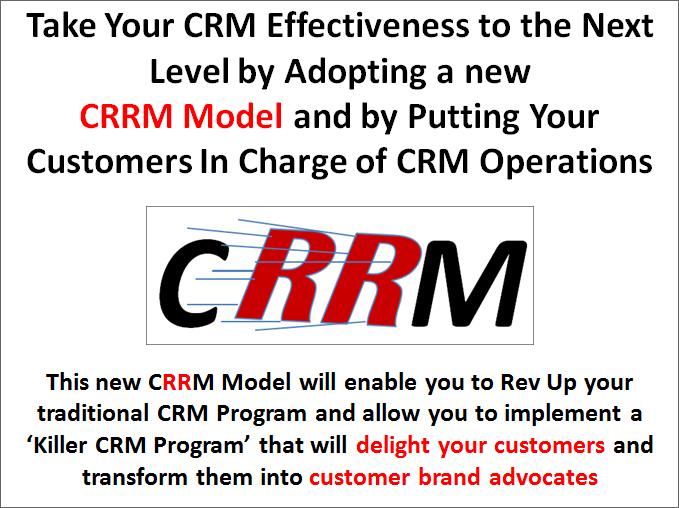
Blow Away Your Competition by Replacing Your Old CRM Program with a more effective Customer Relevant Relationship Management (CRRM) Model

1)               Introduction

  1. Do you have a robust CRM program in-place, but you feel you are still missing the mark in terms of delivering what your customers really want & need?
  2. Is your organization at risk of making market decisions that can cause a backlash and mass defection by your customers like the Bank of America $5 fee decision or the Netflix business split decision?
  3. Do you have volumes of consumer data and analytics, but sales are declining or flat and customers are churning at an increasing rate?
  4. Do you feel you could improve the quantity and quality of your customer insights including ascertaining critical consumer needs, preferences, likes/dislikes, interests, preferred communication channel for you to contact them, preferred timing and frequency for you to communicate with them, etc?

If you can say “Yes” to any of these questions, the rest of this post is a MUST READ for you and it is time to consider this more effective CRRM Model to replace your outdated CRM Model.

2)               CRM vs. CRRM Model Overview

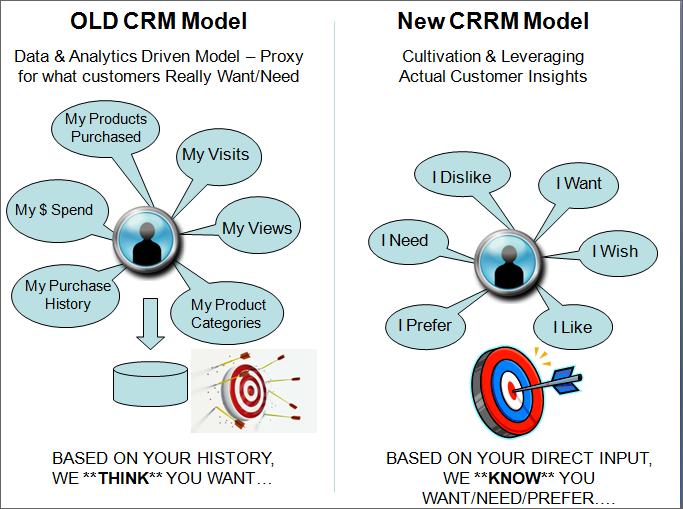
The following diagram depicts the major differences between the old CRM Model and the new CRRM Model including the problems associated with the old CRM model and benefits of the newer CRRM model.

Old CRM Model vs. Customer Relevant Relationship Management (CRRM)

Old CRM Model (left above):

  1. Relies on historical data and analytics to determine what customers need, want, etc. by the analysis of sales history, types of products purchased, categories of products purchased, views on websites, stores visited, etc.
  2. Customer activity information is a proxy to what customers really want and need. Example, you will seldom learn that a customer hates an in-store or web experience through this proxy for what they are wanting, feeling, needing, disliking, etc.
  3. Companies are unlikely to gain insights into the impact that any future company decisions will have on customer loyalty, retention, acquisition.

New CRRM Model (right above):

  1. Takes a more direct approach with customers and utilizes a systemic querying method to ascertain exactly what customer want/need/prefer/etc.
  2. Embraces customer councils, customer forums, customer voting to drive future content, interactions, product/service offerings, etc.
  3. Activity solicits ratings from customers on many aspects (marketing materials, web experience, in-store experience, product usability, quality of customer service, etc.) regarding the health of the overall customer relationship and continually asks “How well are we managing our relationship”

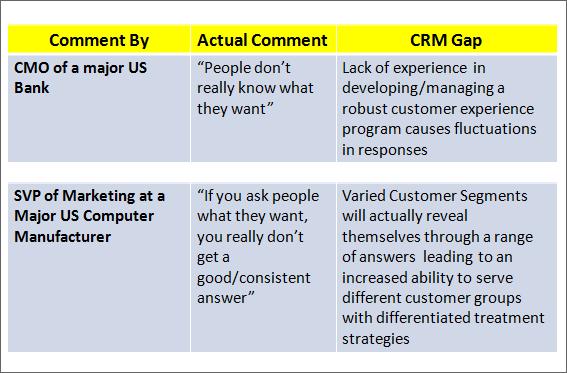
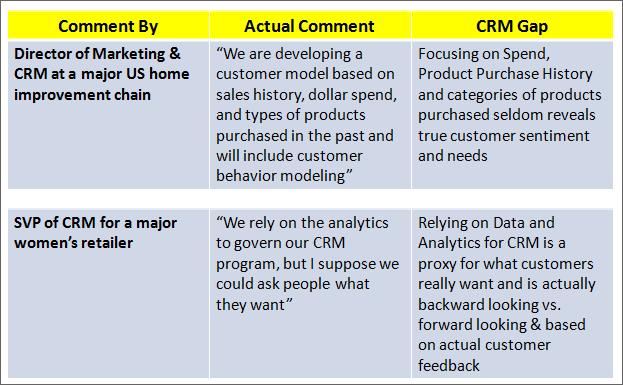
3)               Example of CRM Model Gaps

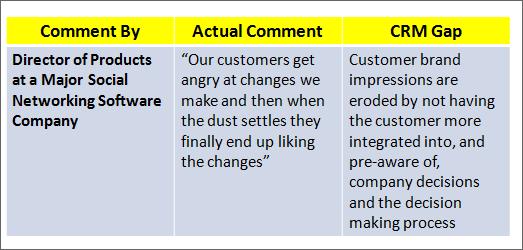
To illustrate how companies are struggling to really determine the real needs of their customers, I took selected comments from interactions with senior CRM executives from major US Corporations based on consulting engagements, job interviews, speaking to them in passing, etc. The following charts are their actual verbatim comments as well as my read on their CRM gap that prevents them from developing world-class relationships with their customers.
Traditional CRM Programs:

  1. Organizational culture, operations, and go-to-market strategy does not put the customer and real customer insights into the center of CRM operations
  2. Relies on data, analytics, and customer history to drive on-going customer interactions.
  3. Puts the organization at extreme risk of missing the boat from a customer’s perspective – real needs, wants, concerns, preferences, experiences, etc.
  4. Companies that rely on this model are at-risk of customer defections, decreased customer spend/loyalty, etc.

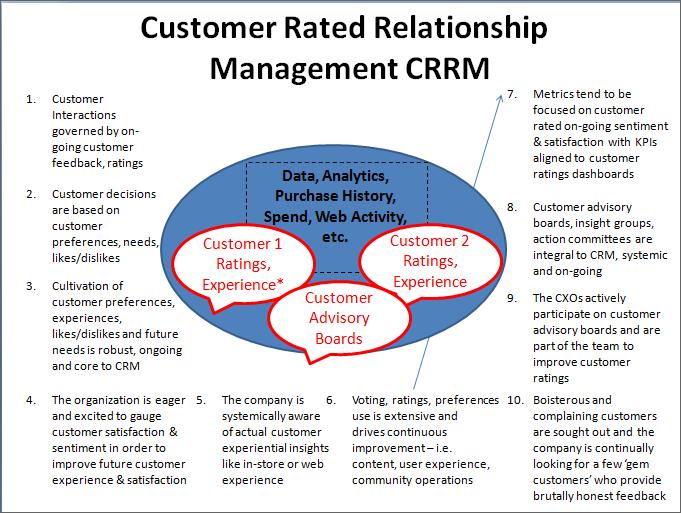
New CRRM Model – with Customers In The Center of Customer Operations

New CRRM Program:

  1. The organizational culture, operations, and go-to-market strategy puts the customer and real customer insights into the center of CRM operations rather than rely on the proxies of what customers want, i.e. data, analytics, and customer history.
  2. The customer becomes the actual judge, ‘rater’ of whether you are delivering quality, value and a good relationship to them.
  3. The customer is put in charge of CRM operations and enables a bi-directional and on-going dialog with the customer whereby they tell you their real needs, wants, concerns, preferences, experiences, etc.
  4. Companies that rely on this model are more likely to develop products, services, offers, communications that delight the customer and whereby they are more loyal, greater brand advocates, and likely to refer your company to their friends as a company who listens, cares and empowers their customers.

6)             Companies That ‘Get ‘CRRM

The following are samples of companies that, in my opinion, get the CRRM model and details how/why each of them get this new go-to-market customer model.

Companies That ‘Get’ CRRM – 1 of 2

Companies That Get CRRM – 2 of 2

Phrases That Describe Companies who ‘Get’ the New CRRM Model

  1. We don’t hide behind data and analytics to drive our customer & CRM operations, but rather we ask our customers what they want.
  2. We are eager to ask our most disgruntled customers how we can improve our relationship with them and to determine who to improve our go-to-market strategy
  3. Before we make any major market-facing decisions, we ask a cross-segment of our customers what they think about each of our proposed decisions and then ask them how to improve upon how these changes are implemented so we ensure a continued delighted customer base.

The bottom line of this post is that, if your company relies less on historical data and analytics to determine what customer want and actually builds methods, processes, and systems to put the customer in charge of rating CRM operations in order to provide you with ongoing and valuable real insights (needs, wants, likes dislikes, preferences, concerns, etc.), the customers will feel more valued and connected with your brands. The benefit of adopting this new CRRM model will be more loyal, empowered and delighted customers who will be brand advocates and brand referrers that will increase shareholder and company value.

As I have now built this new CRRM model for several major US brands, my next blog post will be on ‘how to’ develop this capability at the enterprise level.