Turn Customer Feedback & Complaints into Market Leadership, Dominance, Max Profitability
March 24, 2017 Leave a comment
Customer Experience, Marketing, CRM, Corporate Innovation Best Practices
March 24, 2017 Leave a comment
Filed under CRM, Customer Profitability, customer service Tagged with brand perception, continuous customer improvement, continuous improvement, CRM Blog, Customer Advisory Groups, customer advocate, customer ambassador, customer analytics, customer approach, customer benchmarking, customer benefit, customer brainstorming, customer brand partner, customer brand partners, customer brand perception, customer commitment, Customer Complaints, customer continuous feedback, customer crowd sourcing, customer detriment, customer disdain, customer feedback, Customer focus groups, customer generated ideas, customer goals, customer golden insights, customer golden opportunities, customer golden questions, customer ideas, customer improvement opportunities, customer improvement programs, customer information, customer innovative, customer innovators, customer insights, customer insights sharing groups, customer loyalty groups, customer loyalty increase, customer market share, customer needs, customer negative feedback, customer partner program, customer partner system, customer partners, customer perception, customer pet peeves, customer pilots, customer point of view, customer points of light, customer preferences, customer product previews, Customer Profitability, customer questionnaire, customer remediation, customer service pilots, customer SLAs, Customer Strategy Blog, customer surveys, customer transformation, Customers first, frequent customers, ignoring customer feedback, ignoring customer trends, long-term loyalty, loyal customers, Market Dominance, market erosion, Market Leadership, market trends, Maximized Profitability, Most Valuable Customers, mystery shoppers, new customer products, new customer services, trend spotter, voice of customer
March 18, 2012 4 Comments

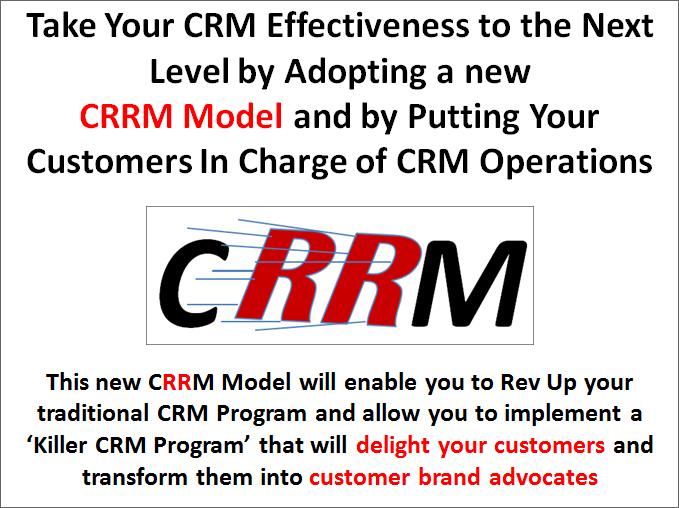
In my previous blog, I covered what the new Customer Relevant Relationship Model (CRRM) is and the benefits of adopting this new model. In this blog, I will cover the components of the new CRRM model and what you need to put in place to make this new model a reality.
Ever wonder why companies like ESPN, Apple, Google, Zynga, Amazon, and Marriott dominate their respective markets? The reason is that they are ‘Customer First’ organizations and are passionate about listening to, understanding and then delighting their customers based on leveraging true customer insights. They treat their customers as business partners vs. commodities and include them in many critical decision making processes. They get this new CRRM model. Why/how ? – Read the rest of this blog to find out…
The differences between the old CRM model and how these companies are embracing the newer CRRM model are depicted in the following chart:
Customers and stakeholders today are longing for a company to partner with them and include them in the corporate decision making process. These same constituencies are sick and tired of political, corporate, and other organizations making unilateral decisions for them that are really not in-line with their needs, wants, etc. The backlash from this unwanted dictatorial management style of some companies can be seen in the Bank of America fee customer rebellion, the customer backlash from Netflix deciding to split their company without first consulting with their customers and HPs initial decision to exit the computer market.
In order to progress your organization from the old CRM model to the new CRRM model, a few key essentials must be put in place and are as follows:
These components can apply to large enterprises as well as Small to Medium Businesses (SMBs).
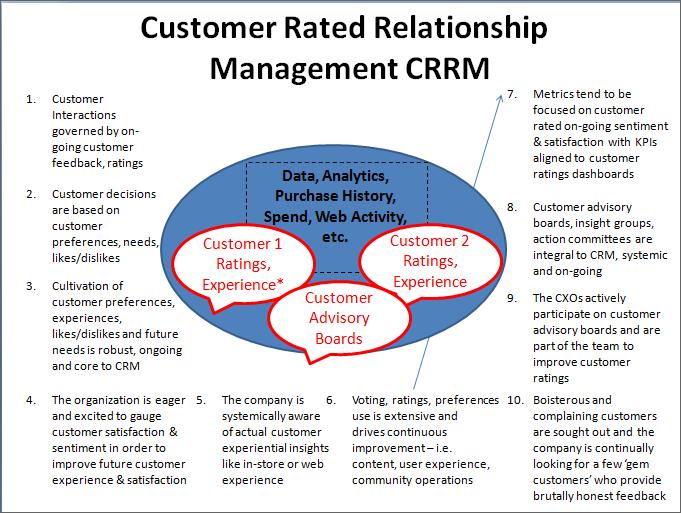
3A) The above chart “New CRRM Model – 360 Cultivation of Customer & Market Insights” demonstrates the new insights model that must be put in place to deliver world-class stakeholder and customer programs.
These enhanced insights will enable you to deliver products and services that delight your customers, stakeholders and stockholders as well as enable you to leapfrog the competition in terms of market share if they continue to rely on their antiquated CRM data and analytics insights only model.
For Small to Medium sized Businesses (SMBs), some of the insights do not apply, but the following charts (3B-3E) most certainly apply and can be tracked via simple Microsoft Excel spreadsheets.
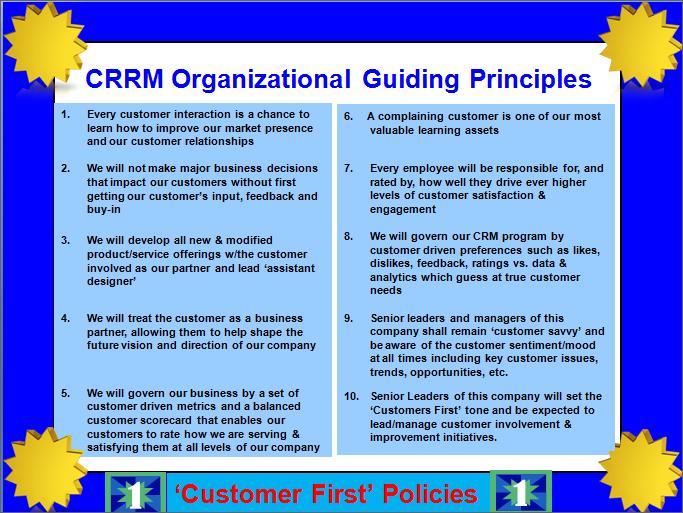
3B) The above chart “CRRM Organizational Guiding Principles” demonstrates the principles that must be in-place to be customer first culture. This culture is driven by management that is passionate about their customers and governs the company around a set of customer first policies.
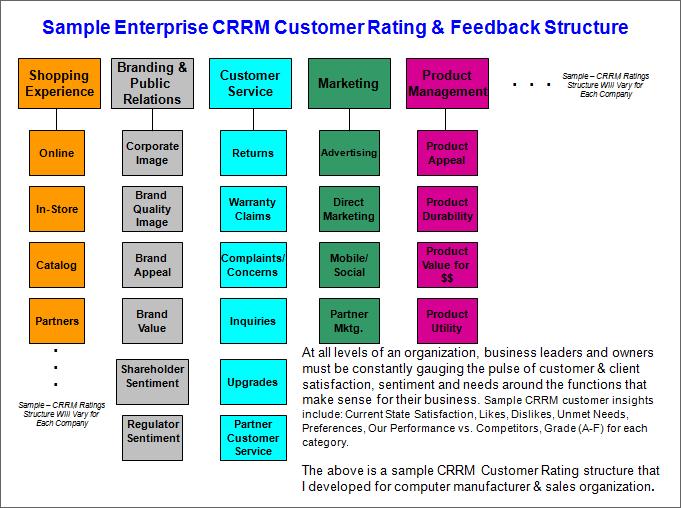
3C) The above chart “Enterprise CRRM Customer Rating & Feedback Structure” illustrates a sample structure (will vary for each type of business) whereby customer feedback and preferences will be cultivated in order to develop 360° insights into customer needs, wants, likes, etc.
3D) The above chart “CRRM Customer Ratings & Feedback Cultivation Process” illustrates a how customer feedback and preferences will be cultivated in order to develop 360° insights into customer needs, wants, likes, etc.
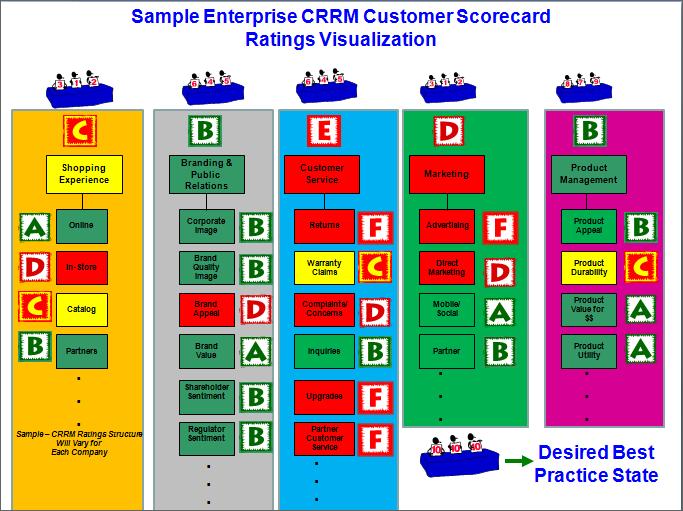
3E) The above chart “Enterprise CRRM Customer Scorecard Ratings Visualization” illustrates a how customer feedback and preferences ratings will be visually represented in a scorecard.
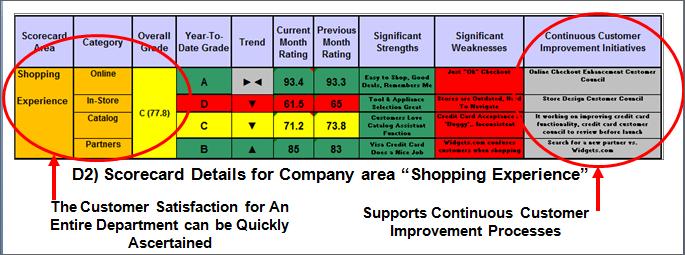
3E-2) The above chart “Enterprise CRRM Customer Scorecard” illustrates a how customer feedback and preferences ratings will be rolled up into an analytical scorecard that provides insights into customer trends, customer feedback, customer issues, core customer strengths and weaknesses, etc.
This scorecard can also be used to manage a Continuous Customer Improvement Process (CCIP) that continually drives improvements to customer perceptions, ratings, satisfaction, etc.
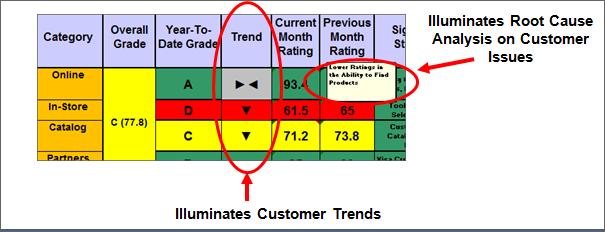
The above depicts how analytics and metrics would be maintained for a business who had a retail or wholesale shopping function.
Robust Scorecard Analytics and Metrics should support Customer Trend Identification and Root Cause Analysis for Customer Issues.
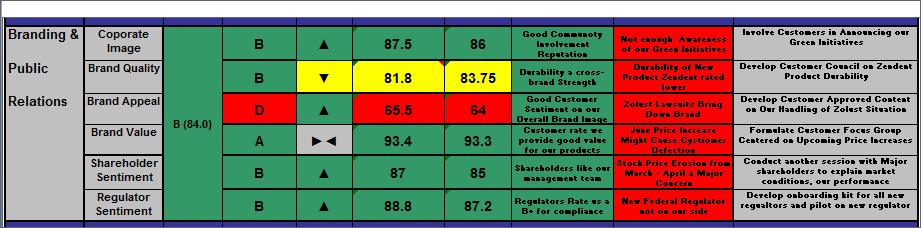
Sample Public Relations Scorecard Above gives you insights into how well your company and brands are perceived by customers, stakeholders, stockholders, etc.
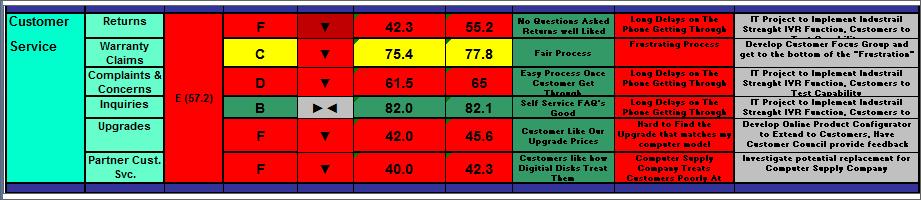
Sample Customer Scorecard Above from Customer Service tells how well you are serving your customers.
Sample Marketing Scorecard Above Gives you insights into how well your Marketing Efforts are resonating with your customers.
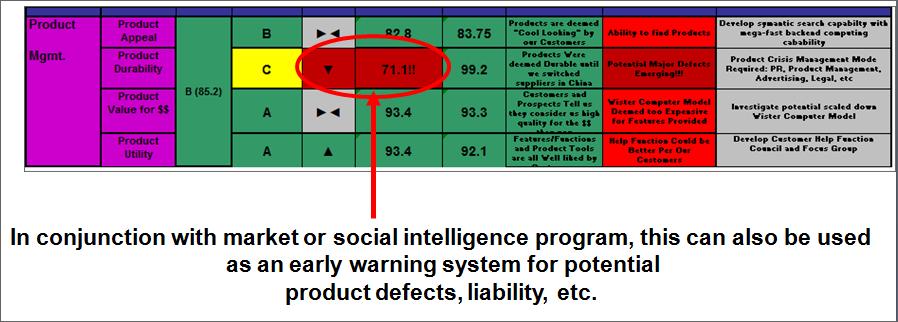
The Sample Product Management Scorecard above gives you insights into how well perceived your products and services are with customers and prospects.
By treating customers as business partners (vs. commodities) and including them in the corporate decision making process, as well as allowing them to rate how well you are serving them from an array of customer facing areas, companies can reap huge rewards including the following:
1. Better insights into the types of products and services customers want & need
2. Fiercely loyal customers who feel part of the corporate team
3. Customers who are most likely to spend more, be retained longer and purchase at premium prices with higher profit margins
4. Customers who are very likely to be brand advocates and refer others to your company, brands, and services.
5. Customers who feel connected to the company and empowered to improve company operations
The following are actual customer comments from those who have participated in a customer feedback program to help shape products & services:
“I feel like xyz company cares about me since they ask my opinion”
“Finally a company that listens to us”
“It is so refreshing to have a company ask you your opinions on products and services vs. ramming something down our throats that we don’t like”
“Wow – this is fun. I enjoy providing my opinion”
“As silly as this might sound, xyz company is the only company that ever asked me what I wanted”
“In my opinion, xyz company is much more progressive than their competitors by seeking consumer opinions, what matters to them, etc.
More dynamic companies like Goodle, Zynga, Amazon, etc. are inviting customers to become part of the corporate decision making process and empowering them to provide feedback, insights and rate company operations in order to drive continous customer improvements. Companies who adopt this new CRRM model whereby company management is democratized by including stakeholders and customers into the decision making process will reap the rewards of ever higher customer acquisition, retention and spend – leading to ever higher profits and share price.
Filed under CRM, Social Media Tagged with Alain Monié, Amazon, Amy C. McPherson, Andrew R. Jassy, Ann Mather, Apple, Arne M. Sorenson, Arthur D. Levinson, balanced customer scorecard, Bank of America, Barry Cottle, benefits of listening to customers, best practice customer listening programs, best practice customer management, best practice customer measurement, best practice customer policies, best practice customer scorecards, Blake G. Krikorian, Bob Mansfield, branding ratings, branding scorecard, Bruce Sewell, Cadir Lee, Colleen McCreary, consumer data warehouse, CRM programs, crowd sourcing, customer advocacy, customer advocacy councils, customer advocates, customer analytics, customer annoyances, customer attrition, customer balanced customer scorecard, customer beliefs, customer betterment, customer councils, customer culture, customer dashboard, customer data, customer data mining, customer data warehouse, customer defection, customer driven design, customer ethics, customer feedback, Customer focus groups, customer friendly organizations, customer friendly policies, customer guiding principles, customer idea sourcing, customer improvement process, customer intelligence program, customer listening program, customer management, customer management dashboard, customer measurement, customer measures, customer metrics, customer mindset, customer mindshare, customer monitoring, customer mood, customer motto, customer orientation, customer oriented culture, customer oriented policies, customer partners, customer passion, customer passionate, customer perception, customer policies, customer principles, customer procedures, customer pushback, customer ratings, customer relationship building, customer relationship enhancement, customer relationship improvement, customer satisfaction, customer satisfaction enhancement, customer satisfaction improvement, customer satisfaction ratings, customer scorecard, customer scorecard benefits, customer scorecard example, customer scorecard template, customer sentiment, customer service, customer service dashboard, customer service evaluation, customer service feedback, customer service governance, customer service improvement, customer service scorecard, customer tone, Customers first, Dave Ko, Dave Wehner, David C. Drummond, David J. Grissen, Diane B. Greene, Diego Piacentini, Eddy Cue, Edwin D. "Ed" Fuller, Eric E. Schmidt, ESPN, George Bodenheimer, Google, H. Brian Valentine, Hewlett Packard, intelligent customer service, J.W. Marriott, Jamie S. Gorelick, Jeff Karp, Jeff Williams, Jeffrey A. Wilke, Jeffrey M. Blackburn, Jeffrey P. Bezos, John L. Hennessy, John Schappert, John Seely Brown, John Skipper, Jonathan Ive, Jonathan Rubinstein, Jr, K. Ram Shriram, L. John Doerr, L. Michelle Wilson, Larry Page, Larry Page CEO, Marc A. Onetto, Mark Pincus, Market Intelligence, marketing balanced scorecard, marketing feedback, marketing ratings, marketing scorecard, Marriott, Marriott Courtyard, Marriott International, Marriott Vacation Club, Mike Verdu, Netflix, Nikesh Arora, Patricia Q. Stonesifer, Patrick Pichette, Paul S. Otellini, Peter Oppenheimer, Philip W. Schiller, pro customer policies, product defect warnings, product defects, product issues, product management feedback, product management ratings, product management scorecard, public relations feedback, public relations ratings, public relations scorecard, Reggie Davis, Robert A. Iger, Scott Forstall, Sebastian J. Gunningham, Sergey Brin, shareholder satisfaction, Shelley L. Reynolds, shopping experience feedback, shopping experience ratings, shopping experience scorecard, smart customer service, Social Intelligence, Social Listening, Social Listening Programs, SRM Programs, stakeholder management, Steve Chiang, Steven Jeffes, Steven Kessel, stockholder satisfaction, Thomas J. Szkutak, Thomas O. Ryder, Tim Cook, Tom A. Alberg, William B. (Bing) Gordon, Zynga
January 29, 2012 8 Comments
If you can say “Yes” to any of these questions, the rest of this post is a MUST READ for you and it is time to consider this more effective CRRM Model to replace your outdated CRM Model.
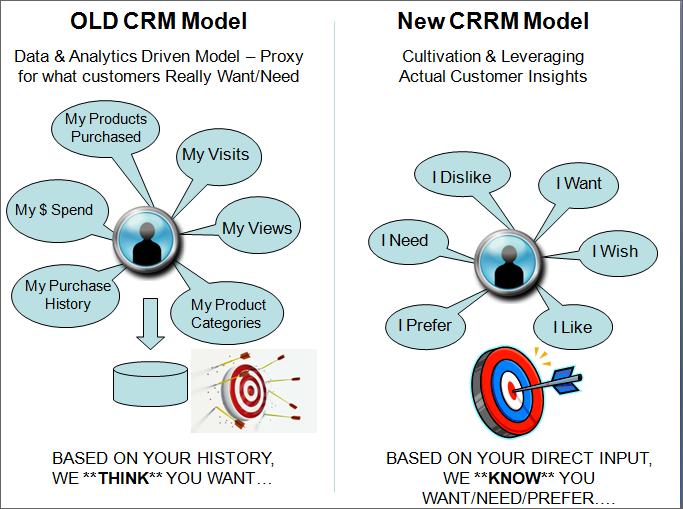
The following diagram depicts the major differences between the old CRM Model and the new CRRM Model including the problems associated with the old CRM model and benefits of the newer CRRM model.
Old CRM Model (left above):
New CRRM Model (right above):
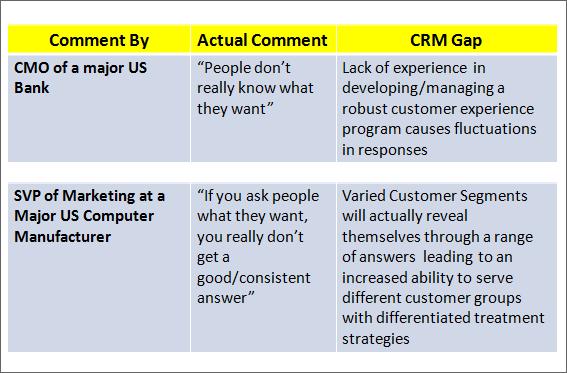
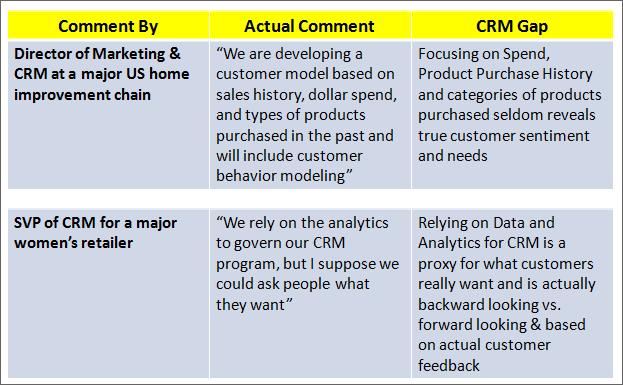
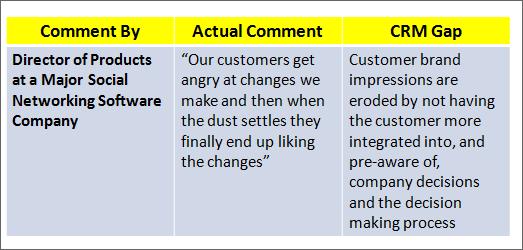
To illustrate how companies are struggling to really determine the real needs of their customers, I took selected comments from interactions with senior CRM executives from major US Corporations based on consulting engagements, job interviews, speaking to them in passing, etc. The following charts are their actual verbatim comments as well as my read on their CRM gap that prevents them from developing world-class relationships with their customers.
Traditional CRM Programs:
New CRRM Program:
The following are samples of companies that, in my opinion, get the CRRM model and details how/why each of them get this new go-to-market customer model.
Phrases That Describe Companies who ‘Get’ the New CRRM Model
The bottom line of this post is that, if your company relies less on historical data and analytics to determine what customer want and actually builds methods, processes, and systems to put the customer in charge of rating CRM operations in order to provide you with ongoing and valuable real insights (needs, wants, likes dislikes, preferences, concerns, etc.), the customers will feel more valued and connected with your brands. The benefit of adopting this new CRRM model will be more loyal, empowered and delighted customers who will be brand advocates and brand referrers that will increase shareholder and company value.
As I have now built this new CRRM model for several major US brands, my next blog post will be on ‘how to’ develop this capability at the enterprise level.
Filed under CRM Tagged with Alex Lintner, Amtrak, Amtrak CEO, Amtrak Customer service, Amy C. McPherson, Anne B. Ireland, Arne M. Sorenson, AVID MODJTABAI, Bank of America, Bill Campbell, Brad Smith, Brian Boardman, Caroline Donahue, Carrie L. Tolstedt, CDW, CeCe Morken, Chairman of the Board, Christina M. Corley, Communispace, Computer Discount Warehouse, consumer analytics, consumer backlash, consumer councils, consumer data, consumer data mining, consumer data warehouse, consumer feedback, Consumer focus groups, consumer information, consumer insight mining, consumer insights, Consumer Intelligence, consumer loyalty, consumer needs, consumer preferences, consumer sentiment, Consumer trends, CRM, CRM Excellence, CRM model, CRM Operating model, CRM Operations, CRM process, customer acquisition, customer analytics, customer backlash, customer brand advocate, customer brand referrer, customer churn, customer concerns, customer councils, customer data, customer data mining, customer data warehouse, customer defection, customer dissatisfaction, customer driven design, customer driven operations, customer driven requirements, Customer Experience, customer feedback, Customer focus groups, customer hate, customer hates, customer information, customer insight mining, customer insights, customer insights group, customer intelligence, customer ire, Customer Loyalty, customer management, customer needs, customer oriented, customer oriented culture, customer preferences, customer products group, Customer Relationship Management, customer satisfaction, customer service excellence, customer service feedback, customer strategy, customer strategy development, Customer Trends, customers are always right, Customers first, customers suck, Dan Maurer, DAVID A. HOYT, David J. Grissen, DAVID M. CARROLL, Dennis G. Berger, Douglas E. Eckrote, Eric Dunn, Executive Vice President, Facebook, Federal Emergency Management Administration, FEMA, frustrated customer, Ginny T. Lee, Godiva, Godiva Chocolate, Intuit, Intuit CEO, Intuit Software, J.W. Marriott, JAMES M. STROTHER, Jill Ward, John A. Edwardson, John G. Stumpf, Jonathan J. Stevens, Jr, KEVIN A. RHEIN, Kiran Patel, Laura Fennell, Macys, Macys Corporate Marketing, Macys Marketing, Maria M. Sullivan, market insights, Market Intelligence, Marriott, Matthew A. Troka, Michael J. Loughlin, Mr. Don Gould, Mr. Gene Dunkin, Mr. James A. Goldman, Mr. Michael Simon, Mr. Richard M. Paschal, Neal J. Campbell, Netflix, Nora Denzel, PATRICIA R. CALLAHAN, Per-Kristian (Kris) Halvorsen, poor customer service, product councils, R. Neil Williams, RICHARD D. LEVY, Sasan Goodarzi, Scott Cook, Sears Holdings, Senior VIce President, Sherry Whiteley, Social Listening, Social Listening Programs, Social Sentiment, Steve Malik, Steven Jeffes, Tayloe Stansbury, Terry Lundgren, Thomas E. Richards, Timothy J. Sloan, Volvo, Volvo North America, Wells Fargo, Wells Fargo CEO