Leverage Customers as the Chief Customer Officer (CCO) While Increasing Customer Diversity and Inclusion
May 25, 2021 Leave a comment
How & why top companies are inverting their organization charts and putting their own customers in charge of customer operations while increasing Customer Diversity & Inclusion (D&I).
How and why this practice also leads to the following ratings:
1) Higher NPS,
2) Increased customer loyalty,
3) Increased customer satisfaction levels & CSAT,
4) Growth in customer zealots that virally promote your brands and company,
5) Increased customer diversity and inclusion (D&I).
The top 10 things you will learn by reading this blog:
1) The spectrum of customer first cultures – find out where you stand on this spectrum.
2) The trends in developing customer insights and customer feedback via customer inclusionary programs and customer onramps.
3) How customer onramps support customer diversity and inclusion (i.e., customer D&I programs).
4) Customer Experience metrics from real companies who have developed and deployed these customer onramps.
5) Creative win-wins to make your customer experience more fun, engaging, educational, rewarding, and inclusive.
6) Innovations in creating customer communities that increase brand loyalty, customer referrals.
7) Market leading companies and their case studies in leveraging customers as the Chief Customer Officer (CCO).
8) The customer organization Inversion and customer empowerment of the future.
9) Quick & easy wins in getting started in the customer inversion that will create customer zealots and a customer experience 2nd to none.
10) The top 10 things you should immediately consider implementing to increase Customer Satisfaction (CSAT) levels, NPS and customer loyalty rates by double digits.
A) The Customer Organizational Inversion-Revolution:
There is an organizational customer inversion-revolution going on and it will only accelerate in the future. What this revolution entails is a complete inversion of the customer decision making structure for companies, one where the customers (vs. the company) are in charge, leading the design of customer strategy and future customer programs. I call it the customer inversion revolution. This inversion looks something like the chart below. We will detail this customer organization inversion-revolution in following sections of this blog.
FROM:

Traditional Customer Service Organization
TO:
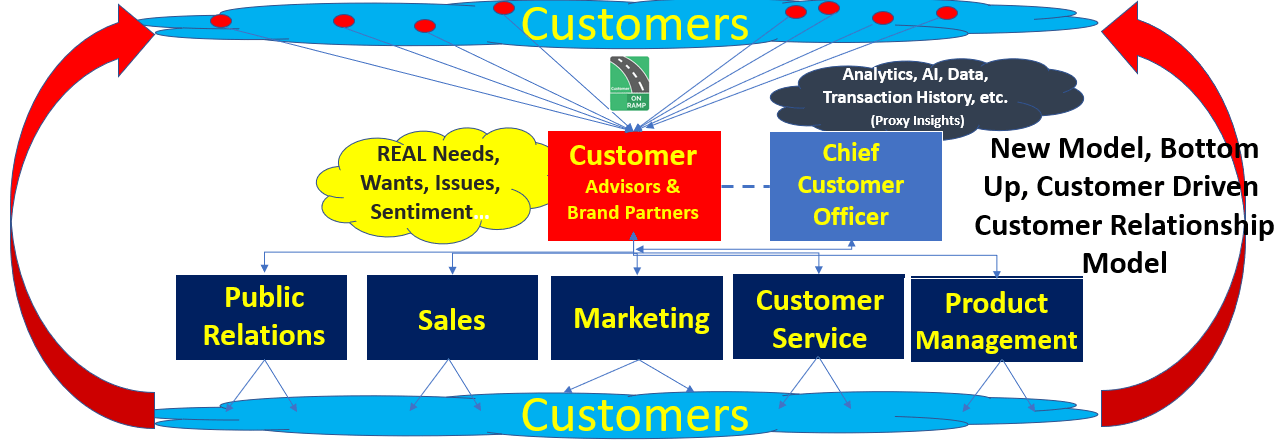
Customer Service Organization Inversion-Revolution
Key to implementing this customer organizational inversion-revolution is the development of customer inclusionary “on ramps” (shown in the green symbol above) that allows customers to participate and join the company team as brand partners, advocates, insights experts, advisors, etc. We will cover this more in depth in following sections but hence forward, customer on ramps will be designated by this symbol below:

Customer Inclusionary Onramp
These onramps detailed in the following blog increase customer inclusion by their very nature of creating an array of customer chosen methods for these customers to contribute to and participate in the company’s success. The enhanced diversity is derived from tapping into and leveraging the diverse set of perspectives and needs from existing customers that represent a cross-section of different cultures, races, genders, ages, political views, national origins and religions, etc. so that the best product and/or services are engaged in the marketplace.
Many companies have omitted these onramps in the vetting of new products, services, marketing campaigns, etc. and have ended up offending and alienating their own customers and potential prospects. A great web article points to how companies have fielded expensive and disastrous marketing campaigns and ads in the past only to have to quickly pull them from the market. These campaigns/ads are often a result of corporate myopathy and not taking into account a multitude of diverse perspectives enabled by an array of customer D&I onramps: “7 of the most controversial ads of our time” https://www.thedrum.com/news/2019/04/08/7-the-most-controversial-ads-our-time. A major West Coast bank vets all of it marketing concepts through a customer insights group (covered below) before ever releasing the ad and/or campaign into the market. Only after the CIG group (onramp) has weighed in and provided their approval and feedback will this bank to go market with their marketing concepts.
Bottom line, these onramps enable your customers to become brand and company partners/advocates who, through time and continued onramp participation, develop an ever increasing vested interest in the brand(s) and company success.
To be receptive to this change and to get onboard with customer leaders who are in the process of putting customers in charge and implementing the customer organizational inversion-revolution, you must first have a foundational customer centric culture. Companies that are implementing this customer centric change and building customer brand partners include Apple, Southwest Airlines, Ritz Carlton, Amazon, Marriott, Bank of America, Wells Fargo, etc. Let us first explore what a customer centric culture is and the spectrum of companies on the customer centric continuum.
B) The Customer First, Customer Centric Culture
To begin with, almost every company claims to be customer centric, that their customers are their most important asset, customer satisfaction is a priority, etc. In practice I have found that there is a spectrum of truth to these public statements ranging from treating customers as a necessary commodity to the other end of the spectrum and treating customers as equal and respected partners and treating customers as a true extension of the company-employee team.
Referring to the chart below, we can see that spectrum of company cultures and their treatment of customers based on these different company customer cultures. To simplify this illustration, I have only included 3 types of companies as follows (along top of chart):

Customer Centric Company Spectrum
- “Customers are our most valuable asset”: Companies that truly value their customers and view them as an integral part of their team and company’s success. This type of company also maintains a true customer first culture, policies, standards, etc. (right side of chart, spectrum).
- “We Value our Best Customers”: Companies that only strive to cater to their most valuable customers since these customers benefit the company the most (middle of chart, spectrum).
- “Customers are a Necessary Commodity”: Companies that interact and ‘deal with’ customers when it benefits them (they pay lip service to slogan ‘customers are their most important asset’), left side of chart, spectrum.
On the left side of the above chart, we have a number of customer facing dimensions including the following:
1) “Customer Input”: How the company views and approaches soliciting customers for insights, input on new programs, detailed feedback (i.e., focus groups, crowdsourcing, etc.), etc.
2) “Customer Complaints”: How the company views and approaches the handling of customers complaints.
3) “Customer Inclusion, Partnership”: How the company approaches being customer inclusive by offering customers ways to partner with the company including online communities, customer co-blogging, customer spotlights, etc.
4) “Customer Engagement”: How the company approaches customer communication and creates a rewarding and engaging customer experience.
Companies located on the far-right side of the chart have the following belief that is not only a slogan, but embodied in the company culture, operations, practices, standards, rewards systems, etc.:
“Customers are our Most Valuable Asset”.
For the first customer dimension on the left side of the chart, “Customer Input”, a comment that I heard from a CEO with this type of culture is as follows:
“We make no (major) decisions (that will impact the customer) without the customer’s direct input”.
For the first customer dimension of “Customer Complaints”, a company CEO said the following,
“Customer complaints are a valuable insight and gift to help us improve, beat our competition”.
You can read the comments for each type of company aligned to each customer dimension. Bottom line, without a foundational customer first mindset, rewards and incentive system and culture, you will be impeded on implementing the effective customer inclusion program with many possible customer onramps detailed in the remainder of this blog.
C) Mainstream Customer Inclusionary Programs & Onramps:
As I mentioned before, once you have established a totally customer centric culture, the 2nd step is to build customer incremental onramps for the customer to become a brand partner and an integral part of the customer team. These onramps invite the customer to participate in a number of activities that will increase customer satisfaction (CSAT), loyalty, NPS, viral referrals, etc. Based on my experience, building these customer inclusionary onramps can net your company huge increases in key customer measures as follows:
1) NPS: +14 to 49
2) Customer Loyalty: + 4% to 36%
3) Customer Positive Sentiment: +12% to 71%
4) Customer Viral Referrals: +11% to 26%
Customer On-Ramp: Customer Advisory Board Program
1) Customer Advisory Board Program:
A Customer Advisory Board (CAB) is the composition of a group of trusted, and generally top customers, who meet on a regular basis (i.e., Quarterly) to advise the company on strategic direction such as the product and/or service roadmap and on upcoming major new programs. Customer advisory boards (a.k.a. trusted customer advisors) can also be a conduit to award top customers for their input, loyalty, spend, referrals, etc.
At a top US automotive company, we invited our top and most open/honest customers to these focus group and advisory events, paid their travel expenses, hosted a nice dinner reception and, at the end of the session, gave them an appreciation gift for their continued participation and loyalty. We also had Platinum private customer events for our top 1% spend customers which were meetings with the EVP and above for open-ended candid feedback & insights gathering discussions.
Customer On-Ramp: Customer Insights Group Program
2) Customer Insights Group Program:
A Customer Insights Group (CIG) is the composition of a wider cross-section of customers or specific customer segment(s) who meet on a regular basis (i.e., weekly, quarterly) to advise the company on new tactical programs, proposed sales campaigns, and marketing concepts, provide feedback on existing program effectiveness, provide customer experience insights based on their own actual experience, etc. Customer insights groups are usually on a voluntary enrollment basis and typically come with some sort of incentive to participate (i.e., participate and be entered in a drawing for a gift certificate).
A top 5 US bank uses these extensively and there is a directive from the CMO that no new marketing programs/materials/etc. will be fielded without first getting the input of this insights group. After implementing this program, marketing effectiveness increased by an overall 27% and the loyalty of the group increased by a whopping 38% as compared to non-CIG participants. When surveyed, 92% of CIG members indicated that they told 26+ about their positive perception of this bank CIG program (survey choices were 0-5, 6-10, 11-15, 16-25 or 26+).
Amazingly enough, 5,000 participants volunteer up to 8 hours of their time per week to participate with another 5,000 eagerly waiting in the wings for their term to participate (participation is limited to a 2-year term).
In addition, by tapping into a diverse customer set, the bank was able to avoid potential marketing disasters by stopping the fielding of proposed marketing materials that were deemed offensive and culturally insensitive by members of the customer insights group.
Customer On-Ramp: Customer Co-blogging & Co-Authoring Program
3) Customer Co-Blogging & Co-Author Program:
Customers telling their story (the voice of the customer) about their success in using your product/service and their customer experiences are 5-7x more credible than coming from the company. In addition, customer authors bring with them an entirely new audience sphere (their friends, connection, relatives, etc.) which will result in a dramatically increasing your website traffic, SEO, referrals, etc. Customers love the opportunity to be spotlighted and write their own story (with helpful company editing of course) when it comes to their experience interacting with the company. Co-blogging can also be about customer stories with a human-interest side to it vs. always being business oriented. Customer co-authored articles can be about topics such as how to gain the most value from the product/service, tips/tricks they have learned, the value they have gained from using same, etc.
We recently used this for a struggling newsletter program that had only penetrated 27% of our customer base. Six months after I implemented the co-blogging program, the newsletter distribution grew to 56% of our customer base and we experienced a simultaneous increase of 17% in new visitor web traffic.

Customer On-Ramp: Top Customer Appreciation & Recognition Program
4) Top Customer Appreciation & Recognition Program:
Remember the movie “Up in the Air” with George Clooney? He was a top traveler who strived to be in the 1% club in terms of air miles flown per year on a particular airline whereby, if he achieved this distinction, he would then be invited to an awards dinner with the CEO of the airline and be showered with a whole host of flying perks after achieving that level of spend/loyalty. Banks, hotels, brokerage firms, etc. all have an array of top customer loyalty rewards programs.
For the very top customers, there are more hands-on personal perks like a dedicated/private concierge assigned to customers like for the American Express Black credit card which can only be obtained by direct invite by American Express (i.e. not via request). A top US air conditioning company I used to work for had top distributorship recognition events for the distributors who sold the highest revenue generating air conditioning units. While focused internally for a company, many salespersons have benefitted from such top achievement loyalty programs by achieving the distinction as top salespersons for their companies and being rewarded with trips, cash, luxury items, cars, etc. as a thank you for their contributions.

Customer On-Ramp: Customer Product/Service Beta Group Program
5) Customer Product/Service Beta Group Program:
Before top companies like Microsoft and Apple ever release a new product into the market, they first try these new products with limited volunteer beta groups. They gather feedback from these beta test groups and then continuously improve the beta product before releasing the product to mitigate potentially disastrous consequences of releasing products with potential flaws that internal testing failed to consider via their test cases.
Customer On-Ramp: Customer Success Program
6) Customer Success (Spotlight) Program:
Does your company have successful customers using your product and/or service? Why not showcase or spotlight this success by detailing what they did, how they did it and the value they were able to derive from doing so? Challenge customers to submit their success stories for selection to spotlight in the newsletter, website, articles, FAQs, consideration for prizes for the top stories, etc. The more customers witness real customer successes, the more other customers will want to figure out how to acquire your product/service to emulate the success of other customers.
Customer On-Ramp: Ambassador Program
7) Customer Ambassador Program:
The Syracuse University (SU) admissions and student success programs received a big boost with the adoption of its Alumni ambassador program whereby successful alumni would volunteer to host regional recruiting events, student college send-off events, and answer questions from interested students in their area. Alumni ambassador groups increased the level of excitement and enthusiasm for new students and families while simultaneously decreasing the levels of anxiety and confusion among students and families.
The entire ecosystem of a customer first, customer inclusive company that has inverted the customer organizational structure and has built a comprehensive set of customer onramps to be able to put customers in charge of customer operations would look something like the following chart:

Customer Inclusionary & Participatory Programs, Onramps
D) Other Customer Inclusionary Programs & Onramps:
In addition to the more popular and mainstream customer inclusionary programs above, there are several other programs that I have encountered that were effective by increasing the levels or customer loyalty and creating many customer-brand zealots (those who actively and aggressively advocate for the brand/company).
Customer On-Ramp: Creative Council Program
1) Customer Creative Council Program:
Many customers have a wide range of creative talents outside of simply being a customer. A company with a large customer base tends to have customers who are very creative such as artists, craftspeople, etc. A large SaaS software firm I consulted for would solicit creative ideas for new campaign concepts from the creative group among their customer base (and sometimes from their employees) to get the best creative concepts as possible. Many times, customers would develop far more appealing creative concepts than their own dedicated creative talent working within the company. Why not source from the best of the best, including creative customers?! This would allow the company to harness this creativity while allowing creative customers to be spotlighted for their hidden talents and feel valued by the company.

Customer On-Ramp: Talent Showcase
Program
2) Customer Talent Showcase Program:
Beyond just being creative, a company with a large customer base typically includes customers who are also poets, book authors, those with interesting and varied professions such as paramedics, volunteer firefighters, food bank volunteers, world travelers, iron men or women, triathletes, extreme cyclists, paragliders, scuba divers, treasure hunters, etc. Many companies I have worked with have conducted customer showcases that highlight the interesting lives of their customer base beyond merely being a customer. These personal story showcases add a human-interest side to the customer base and tend to make customers feel more connected to and understood-appreciated by the company.

Customer Journey Customer Co-Mapping
3) Customer Involved Customer Journey Mapping & Continuous Improvement Program:
Are you planning on creating a customer journey map and want to know what the important steps and metrics are in that journey? Why not invite the customer to join in on these development sessions to provide the team with some insights, feedback, important items to consider? I have used this approach quite effectively and have developed far more qualitative customer journeys as a result. I used this approach to develop a brand new and innovative customer journey map I have labeled “The Quantifiable Customer Journey Map”. Refer to my previous blog article for insights here: https://bit.ly/3bvPRal

The Quantifiable Customer Journey Map
Bottom line, without the customer’s input, the high quality achieved in the final customer journey map would have been much more difficult and time consuming to achieve.

Customer Diversity & Inclusion Council
4) Customer Diversity & Inclusion Council:
A few companies I have worked with in the past have managed and conducted employee diversity councils whereby employees would provide their perspective on how the company can be more diverse, culturally sensitive, and overall inclusive.
A few companies have taken this further and included their own customers into the diversity council along with their employees. In this manner, the company ensures that it is considering the widest possible perspective on D&I and not falling victim to company group think.
Regardless of whether you include a formal customer diversity council, what all the above illustrated customer onramps do in essence is help build a company culture that supports customer diversity and inclusion (D&I) as follows:
1) Enables the assembling of a diverse set of perspectives, based on unique and diverse set of customer experiences, needs, etc.
2) Provides diverse feedback on potential new customer programs, marketing, etc. that might be perceived as offensive and discriminatory to certain customer groups.
3) Enables customers to showcase their diverse backgrounds, talents, interests, viewpoints.
4) Enables a voice of the customer cultivation that represents the full cross section of diverse customers.
5) Enables the delivery of the best of the best solutions by allowing feedback on proposed programs from a wide and diverse set of customers.
If your organization is seeking experienced assistance in creating these customer onramps and a more diverse and inclusive and customer first organization where customers are leveraged to assist the insights Chief Customer Officer (CCO) and are transitioned to full brand-partners/advocates/participants/etc., then give me a call or e-mail me at 518-339-5857 or stevenjeffes@gmail.com. I am also a Certified CultureTalk (https://culturetalk.com/) consultant that can help you develop and/or improve a customer-oriented, customer first culture.

Steven Jeffes, Certified CultureTalk Consultant
Lastly, this is just one article of over 50 articles I have written on customer strategy, customer experience, CRM, sales excellence, marketing, product management, competitive intelligence, corporate innovation, change management – all of which I have significant experience in delivering for numerous Fortune 500 companies. In fact, my blog is now followed by nearly 107,000 world-wide and was just named one of the top 100 CRM blogs on the planet by Feedspot, alongside Salesforce.com, Infor, Microsoft, SAS, etc. – Reference this informative site here: https://blog.feedspot.com/crm_blogs/ .