Leverage Customers as the Chief Customer Officer (CCO) While Increasing Customer Diversity and Inclusion

How & why top companies are inverting their organization charts and putting their own customers in charge of customer operations while increasing Customer Diversity & Inclusion (D&I).

How and why this practice also leads to the following ratings:

1) Higher NPS,
2) Increased customer loyalty,
3) Increased customer satisfaction levels & CSAT,
4) Growth in customer zealots that virally promote your brands and company,
5) Increased customer diversity and inclusion (D&I).

The top 10 things you will learn by reading this blog:
1) The spectrum of customer first cultures – find out where you stand on this spectrum.
2) The trends in developing customer insights and customer feedback via customer inclusionary programs and customer onramps.
3) How customer onramps support customer diversity and inclusion (i.e., customer D&I programs).
4) Customer Experience metrics from real companies who have developed and deployed these customer onramps.
5) Creative win-wins to make your customer experience more fun, engaging, educational, rewarding, and inclusive.
6) Innovations in creating customer communities that increase brand loyalty, customer referrals.
7) Market leading companies and their case studies in leveraging customers as the Chief Customer Officer (CCO).
8) The customer organization Inversion and customer empowerment of the future.
9) Quick & easy wins in getting started in the customer inversion that will create customer zealots and a customer experience 2nd to none.
10) The top 10 things you should immediately consider implementing to increase Customer Satisfaction (CSAT) levels, NPS and customer loyalty rates by double digits.

A) The Customer Organizational Inversion-Revolution:

There is an organizational customer inversion-revolution going on and it will only accelerate in the future. What this revolution entails is a complete inversion of the customer decision making structure for companies, one where the customers (vs. the company) are in charge, leading the design of customer strategy and future customer programs. I call it the customer inversion revolution. This inversion looks something like the chart below. We will detail this customer organization inversion-revolution in following sections of this blog.

FROM:

Traditional Customer Service Organization

TO:
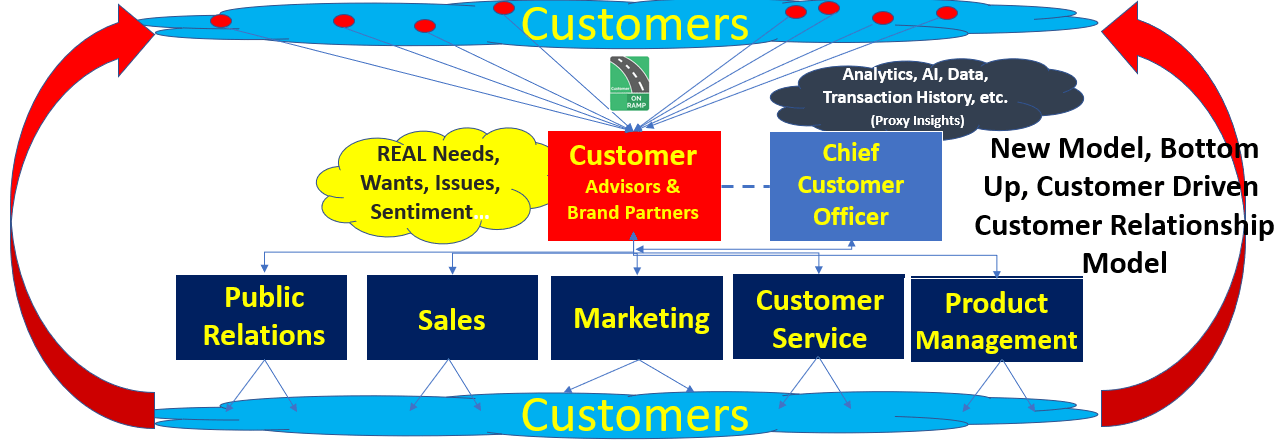
Customer Service Organization Inversion-Revolution

Key to implementing this customer organizational inversion-revolution is the development of customer inclusionary “on ramps” (shown in the green symbol above) that allows customers to participate and join the company team as brand partners, advocates, insights experts, advisors, etc. We will cover this more in depth in following sections but hence forward, customer on ramps will be designated by this symbol below:

Customer Inclusionary Onramp

These onramps detailed in the following blog increase customer inclusion by their very nature of creating an array of customer chosen methods for these customers to contribute to and participate in the company’s success. The enhanced diversity is derived from tapping into and leveraging the diverse set of perspectives and needs from existing customers that represent a cross-section of different cultures, races, genders, ages, political views, national origins and religions, etc. so that the best product and/or services are engaged in the marketplace.

Many companies have omitted these onramps in the vetting of new products, services, marketing campaigns, etc. and have ended up offending and alienating their own customers and potential prospects. A great web article points to how companies have fielded expensive and disastrous marketing campaigns and ads in the past only to have to quickly pull them from the market. These campaigns/ads are often a result of corporate myopathy and not taking into account a multitude of diverse perspectives enabled by an array of customer D&I onramps: “7 of the most controversial ads of our time” https://www.thedrum.com/news/2019/04/08/7-the-most-controversial-ads-our-time. A major West Coast bank vets all of it marketing concepts through a customer insights group (covered below) before ever releasing the ad and/or campaign into the market. Only after the CIG group (onramp) has weighed in and provided their approval and feedback will this bank to go market with their marketing concepts.

Bottom line, these onramps enable your customers to become brand and company partners/advocates who, through time and continued onramp participation, develop an ever increasing vested interest in the brand(s) and company success.

To be receptive to this change and to get onboard with customer leaders who are in the process of putting customers in charge and implementing the customer organizational inversion-revolution, you must first have a foundational customer centric culture. Companies that are implementing this customer centric change and building customer brand partners include Apple, Southwest Airlines, Ritz Carlton, Amazon, Marriott, Bank of America, Wells Fargo, etc. Let us first explore what a customer centric culture is and the spectrum of companies on the customer centric continuum.

B) The Customer First, Customer Centric Culture

To begin with, almost every company claims to be customer centric, that their customers are their most important asset, customer satisfaction is a priority, etc. In practice I have found that there is a spectrum of truth to these public statements ranging from treating customers as a necessary commodity to the other end of the spectrum and treating customers as equal and respected partners and treating customers as a true extension of the company-employee team.

Referring to the chart below, we can see that spectrum of company cultures and their treatment of customers based on these different company customer cultures. To simplify this illustration, I have only included 3 types of companies as follows (along top of chart):

Customer Centric Company Spectrum

  1. “Customers are our most valuable asset”: Companies that truly value their customers and view them as an integral part of their team and company’s success. This type of company also maintains a true customer first culture, policies, standards, etc. (right side of chart, spectrum).
  2. “We Value our Best Customers”: Companies that only strive to cater to their most valuable customers since these customers benefit the company the most (middle of chart, spectrum).
  3. “Customers are a Necessary Commodity”: Companies that interact and ‘deal with’ customers when it benefits them (they pay lip service to slogan ‘customers are their most important asset’), left side of chart, spectrum.

On the left side of the above chart, we have a number of customer facing dimensions including the following:

1) “Customer Input”: How the company views and approaches soliciting customers for insights, input on new programs, detailed feedback (i.e., focus groups, crowdsourcing, etc.), etc.
2) “Customer Complaints”: How the company views and approaches the handling of customers complaints.
3) “Customer Inclusion, Partnership”: How the company approaches being customer inclusive by offering customers ways to partner with the company including online communities, customer co-blogging, customer spotlights, etc.
4) “Customer Engagement”: How the company approaches customer communication and creates a rewarding and engaging customer experience.

Companies located on the far-right side of the chart have the following belief that is not only a slogan, but embodied in the company culture, operations, practices, standards, rewards systems, etc.:

“Customers are our Most Valuable Asset”.

For the first customer dimension on the left side of the chart, “Customer Input”, a comment that I heard from a CEO with this type of culture is as follows:

“We make no (major) decisions (that will impact the customer) without the customer’s direct input”.

For the first customer dimension of “Customer Complaints”, a company CEO said the following,

“Customer complaints are a valuable insight and gift to help us improve, beat our competition”.

You can read the comments for each type of company aligned to each customer dimension. Bottom line, without a foundational customer first mindset, rewards and incentive system and culture, you will be impeded on implementing the effective customer inclusion program with many possible customer onramps detailed in the remainder of this blog.

C) Mainstream Customer Inclusionary Programs & Onramps:

As I mentioned before, once you have established a totally customer centric culture, the 2nd step is to build customer incremental onramps for the customer to become a brand partner and an integral part of the customer team. These onramps invite the customer to participate in a number of activities that will increase customer satisfaction (CSAT), loyalty, NPS, viral referrals, etc. Based on my experience, building these customer inclusionary onramps can net your company huge increases in key customer measures as follows:

1) NPS: +14 to 49
2) Customer Loyalty: + 4% to 36%
3) Customer Positive Sentiment: +12% to 71%
4) Customer Viral Referrals: +11% to 26%
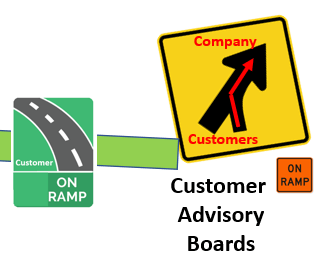
Customer On-Ramp: Customer Advisory Board Program

1) Customer Advisory Board Program:

A Customer Advisory Board (CAB) is the composition of a group of trusted, and generally top customers, who meet on a regular basis (i.e., Quarterly) to advise the company on strategic direction such as the product and/or service roadmap and on upcoming major new programs. Customer advisory boards (a.k.a. trusted customer advisors) can also be a conduit to award top customers for their input, loyalty, spend, referrals, etc.

At a top US automotive company, we invited our top and most open/honest customers to these focus group and advisory events, paid their travel expenses, hosted a nice dinner reception and, at the end of the session, gave them an appreciation gift for their continued participation and loyalty. We also had Platinum private customer events for our top 1% spend customers which were meetings with the EVP and above for open-ended candid feedback & insights gathering discussions.
Customer On-Ramp: Customer Insights Group Program

2) Customer Insights Group Program:

A Customer Insights Group (CIG) is the composition of a wider cross-section of customers or specific customer segment(s) who meet on a regular basis (i.e., weekly, quarterly) to advise the company on new tactical programs, proposed sales campaigns, and marketing concepts, provide feedback on existing program effectiveness, provide customer experience insights based on their own actual experience, etc. Customer insights groups are usually on a voluntary enrollment basis and typically come with some sort of incentive to participate (i.e., participate and be entered in a drawing for a gift certificate).

A top 5 US bank uses these extensively and there is a directive from the CMO that no new marketing programs/materials/etc. will be fielded without first getting the input of this insights group. After implementing this program, marketing effectiveness increased by an overall 27% and the loyalty of the group increased by a whopping 38% as compared to non-CIG participants. When surveyed, 92% of CIG members indicated that they told 26+ about their positive perception of this bank CIG program (survey choices were 0-5, 6-10, 11-15, 16-25 or 26+).

Amazingly enough, 5,000 participants volunteer up to 8 hours of their time per week to participate with another 5,000 eagerly waiting in the wings for their term to participate (participation is limited to a 2-year term).

In addition, by tapping into a diverse customer set, the bank was able to avoid potential marketing disasters by stopping the fielding of proposed marketing materials that were deemed offensive and culturally insensitive by members of the customer insights group.
Customer On-Ramp: Customer Co-blogging & Co-Authoring Program

3) Customer Co-Blogging & Co-Author Program:

Customers telling their story (the voice of the customer) about their success in using your product/service and their customer experiences are 5-7x more credible than coming from the company. In addition, customer authors bring with them an entirely new audience sphere (their friends, connection, relatives, etc.) which will result in a dramatically increasing your website traffic, SEO, referrals, etc. Customers love the opportunity to be spotlighted and write their own story (with helpful company editing of course) when it comes to their experience interacting with the company. Co-blogging can also be about customer stories with a human-interest side to it vs. always being business oriented. Customer co-authored articles can be about topics such as how to gain the most value from the product/service, tips/tricks they have learned, the value they have gained from using same, etc.

We recently used this for a struggling newsletter program that had only penetrated 27% of our customer base. Six months after I implemented the co-blogging program, the newsletter distribution grew to 56% of our customer base and we experienced a simultaneous increase of 17% in new visitor web traffic.

Customer On-Ramp: Top Customer Appreciation & Recognition Program

4) Top Customer Appreciation & Recognition Program:

Remember the movie “Up in the Air” with George Clooney? He was a top traveler who strived to be in the 1% club in terms of air miles flown per year on a particular airline whereby, if he achieved this distinction, he would then be invited to an awards dinner with the CEO of the airline and be showered with a whole host of flying perks after achieving that level of spend/loyalty. Banks, hotels, brokerage firms, etc. all have an array of top customer loyalty rewards programs.

For the very top customers, there are more hands-on personal perks like a dedicated/private concierge assigned to customers like for the American Express Black credit card which can only be obtained by direct invite by American Express (i.e. not via request). A top US air conditioning company I used to work for had top distributorship recognition events for the distributors who sold the highest revenue generating air conditioning units. While focused internally for a company, many salespersons have benefitted from such top achievement loyalty programs by achieving the distinction as top salespersons for their companies and being rewarded with trips, cash, luxury items, cars, etc. as a thank you for their contributions.

Customer On-Ramp: Customer Product/Service Beta Group Program

5) Customer Product/Service Beta Group Program:

Before top companies like Microsoft and Apple ever release a new product into the market, they first try these new products with limited volunteer beta groups. They gather feedback from these beta test groups and then continuously improve the beta product before releasing the product to mitigate potentially disastrous consequences of releasing products with potential flaws that internal testing failed to consider via their test cases.
Customer On-Ramp: Customer Success Program

6) Customer Success (Spotlight) Program:

Does your company have successful customers using your product and/or service? Why not showcase or spotlight this success by detailing what they did, how they did it and the value they were able to derive from doing so? Challenge customers to submit their success stories for selection to spotlight in the newsletter, website, articles, FAQs, consideration for prizes for the top stories, etc. The more customers witness real customer successes, the more other customers will want to figure out how to acquire your product/service to emulate the success of other customers.
Customer On-Ramp: Ambassador Program

7) Customer Ambassador Program:

The Syracuse University (SU) admissions and student success programs received a big boost with the adoption of its Alumni ambassador program whereby successful alumni would volunteer to host regional recruiting events, student college send-off events, and answer questions from interested students in their area. Alumni ambassador groups increased the level of excitement and enthusiasm for new students and families while simultaneously decreasing the levels of anxiety and confusion among students and families.

The entire ecosystem of a customer first, customer inclusive company that has inverted the customer organizational structure and has built a comprehensive set of customer onramps to be able to put customers in charge of customer operations would look something like the following chart:

Customer Inclusionary & Participatory Programs, Onramps

D) Other Customer Inclusionary Programs & Onramps:

In addition to the more popular and mainstream customer inclusionary programs above, there are several other programs that I have encountered that were effective by increasing the levels or customer loyalty and creating many customer-brand zealots (those who actively and aggressively advocate for the brand/company).
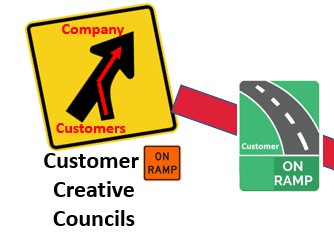
Customer On-Ramp: Creative Council Program

1) Customer Creative Council Program:

Many customers have a wide range of creative talents outside of simply being a customer. A company with a large customer base tends to have customers who are very creative such as artists, craftspeople, etc. A large SaaS software firm I consulted for would solicit creative ideas for new campaign concepts from the creative group among their customer base (and sometimes from their employees) to get the best creative concepts as possible. Many times, customers would develop far more appealing creative concepts than their own dedicated creative talent working within the company. Why not source from the best of the best, including creative customers?! This would allow the company to harness this creativity while allowing creative customers to be spotlighted for their hidden talents and feel valued by the company.

Customer On-Ramp: Talent Showcase
Program

2) Customer Talent Showcase Program:

Beyond just being creative, a company with a large customer base typically includes customers who are also poets, book authors, those with interesting and varied professions such as paramedics, volunteer firefighters, food bank volunteers, world travelers, iron men or women, triathletes, extreme cyclists, paragliders, scuba divers, treasure hunters, etc. Many companies I have worked with have conducted customer showcases that highlight the interesting lives of their customer base beyond merely being a customer. These personal story showcases add a human-interest side to the customer base and tend to make customers feel more connected to and understood-appreciated by the company.

Customer Journey Customer Co-Mapping

3) Customer Involved Customer Journey Mapping & Continuous Improvement Program:

Are you planning on creating a customer journey map and want to know what the important steps and metrics are in that journey? Why not invite the customer to join in on these development sessions to provide the team with some insights, feedback, important items to consider? I have used this approach quite effectively and have developed far more qualitative customer journeys as a result. I used this approach to develop a brand new and innovative customer journey map I have labeled “The Quantifiable Customer Journey Map”. Refer to my previous blog article for insights here: https://bit.ly/3bvPRal

The Quantifiable Customer Journey Map

Bottom line, without the customer’s input, the high quality achieved in the final customer journey map would have been much more difficult and time consuming to achieve.

Customer Diversity & Inclusion Council

4) Customer Diversity & Inclusion Council:

A few companies I have worked with in the past have managed and conducted employee diversity councils whereby employees would provide their perspective on how the company can be more diverse, culturally sensitive, and overall inclusive.

A few companies have taken this further and included their own customers into the diversity council along with their employees. In this manner, the company ensures that it is considering the widest possible perspective on D&I and not falling victim to company group think.

Regardless of whether you include a formal customer diversity council, what all the above illustrated customer onramps do in essence is help build a company culture that supports customer diversity and inclusion (D&I) as follows:

1) Enables the assembling of a diverse set of perspectives, based on unique and diverse set of customer experiences, needs, etc.
2) Provides diverse feedback on potential new customer programs, marketing, etc. that might be perceived as offensive and discriminatory to certain customer groups.
3) Enables customers to showcase their diverse backgrounds, talents, interests, viewpoints.
4) Enables a voice of the customer cultivation that represents the full cross section of diverse customers.
5) Enables the delivery of the best of the best solutions by allowing feedback on proposed programs from a wide and diverse set of customers.

If your organization is seeking experienced assistance in creating these customer onramps and a more diverse and inclusive and customer first organization where customers are leveraged to assist the insights Chief Customer Officer (CCO) and are transitioned to full brand-partners/advocates/participants/etc., then give me a call or e-mail me at 518-339-5857 or stevenjeffes@gmail.com. I am also a Certified CultureTalk (https://culturetalk.com/) consultant that can help you develop and/or improve a customer-oriented, customer first culture.

Steven Jeffes, Certified CultureTalk Consultant

Lastly, this is just one article of over 50 articles I have written on customer strategy, customer experience, CRM, sales excellence, marketing, product management, competitive intelligence, corporate innovation, change management – all of which I have significant experience in delivering for numerous Fortune 500 companies. In fact, my blog is now followed by nearly 107,000 world-wide and was just named one of the top 100 CRM blogs on the planet by Feedspot, alongside Salesforce.com, Infor, Microsoft, SAS, etc. – Reference this informative site here: https://blog.feedspot.com/crm_blogs/ .

Introducing: The Quantifiable Customer Journey Map

The top 10 things you will learn by reading this blog article:
1) What a customer journey map is and what it is used for.
2) What a customer service map is and what it used for.
3) The business benefits of developing a best practice customer journey.
4) How a customer journey map and a customer service map relate and map to each other.
5) Best practices in the development of customer journey maps and customer service maps.
6) How to build a hierarchy of customer journey map levels such that a customer service map is a natural outcome of the customer journey mapping process.
7) What completed examples of customer journey maps and service maps look like.
8) What critical components are missing from many customer journey maps.
9) How the invention, development and rollout of the quantifiable customer journey map is the wave of the future adding tremendous new business and customer value to its usage.
10) How this new quantifiable customer journey map is the most comprehensive and quantifiable method to come along.

One of the relatively newer tools for larger companies and enterprises in the customer experience professional’s toolbox is the practice of customer journey mapping as well as customer service mapping. First, a complete and simple definition of both of these tools is as follows:

1) Customer journey map definition:

A customer journey map is the pictorial representation, from the customer’s viewpoint, of their experience of interacting with a company for various customer service needs.

2) Customer service map definition:

A customer service map is the pictorial representation, from the company’s (internal) viewpoint, of the capabilities and processes used to fulfill various customer service needs.

Difference Between the Two Definitions Above: The major difference between the two techniques above is the perspective as follows:

Journey mapping is from the customer’s external viewpoint (interacting with the company for various customer service needs), while the service map is an internal viewpoint (company provision of services for various customer needs).

One key point is that service mapping is much less valuable if constructed prior to building the customer journey map. A best practice customer journey map documents the major paths the customer uses to obtain service from the company, the various reasons customers interact with the company, gaps in the current delivery of customer service, best practices that should be kept and strengthened and most importantly, it should map and track customer health metrics that customers indicate are most important to them. Once this journey is documented and mapped, then the current state and future state service maps can be constructed to determine how and how well the company is serving the customer including any service gaps that need to be filled.

It is worthy to note that there are now a number of emerging tools that automate the development of a customer journey map. While these accelerate the timeline of the development of the customer journey map, the automation of this process can shortchange the most valuable parts of the team map development exercise which include the following (sample):

  1. Team discussion & agreement on the overall current state of customer service and experience.
  2. Team customer journey point of view discussion, socialization and consensus building.
  3. Team prioritization of the top future state customer service programs and processes.
  4. Developing team concurrence on the matrix of cost to serve vs. service quality delivery levels.

I have used these customer experience tools extensively in the past during numerous client consulting engagements and found them very useful. Some of the business benefits for utilizing these tools are as follows:

1) Provides a comprehensive pictorial of the various paths the customer transits through to obtain service from the company.
2) Provides a great assessment of the current state of customer practices and customer health.
3) Provides a great assessment of the future (needed) state of the optimal way to provide customer service that would enhance the service quality level vs. current state.
4) Provides a gateway to be able to map out internal service pathways as well as to document existing gaps and opportunities in those pathways.
5) (New) The “Quantifiable Customer Journey Map” now provides the best assessment of the current state of customer health across all major customer journey phases.
6) (New) The “Quantifiable Customer Journey Map” now provides the best snapshot of both the current state of customer health as well as needed future state program capabilities based directly on customer input and feedback.

One of the major historical gaps in producing customer journey maps was that many times the journey map merely documented the customer journey and experience without regard to the measurement of customer relevant metrics that can be leveraged to increase customer loyalty, spend, share of wallet, CSAT, NPS, etc. The exercise to measure customer health was often performed separately or in parallel to the customer journey mapping process. In order to bridge this gap in many existing customer journey maps, I have developed a new and innovative way to map a customer journey while simultaneous accomplishing the following:
1) Cultivating and documenting the customer metrics that matter most to the customer.
2) Delivering current state quantification of those top customer metrics.
3) Delivering feedback from the customer on what capabilities future state customer programs should contain.

Introducing: The NEW Quantifiable Customer Journey Map

The following graphic is the final version of a new quantifiable customer journey map I have developed which now includes the discrete measurement of customer health as part of the customer journey map development process. I will break down and detail each best practice component of this new customer journey map in later sections of this article.

The Quantifiable Customer Journey Map

Best Practice Customer Journey Detailed Components
Next we will detail each component of this new “quantifiable customer journey map”.

First let’s detail how the components of a customer journey map are determined. The structural framework components of a customer journey map exist along the x and y axis of the map. The components you will find in both the x-axis and y-axis of a customer journey map are actually highly variable based on the type of customer journey map being constructed. Below is a sample list of the most common types of customer journey maps.

Existing Types of Customer Journey Maps:

1) Current state map
2) Future state map
3) Macro map (strategic),
4) Micro-level map (tactical)
5) User experience maps
6) Customer emotion map
7) Day in the life map

This new and more effective quantifiable customer journey map I will cover takes into account many of the following from above (1-4) plus something new & innovative:

1) Current state map
2) Future state map
3) Macro-map (strategic)
4) Micro-level map (tactical)
5) New & Innovative: Quantifiable current state of customer health across all journey phases.

This last customer journey map component (5) is missing from many other customer journey maps but has been incorporated into this new quantifiable customer journey map. This new method in my opinion is by far the most comprehensive snapshot you can take of current customer health as well as simultaneously taking into account both macro and micro customer journey map components. This new method also integrates customer service mapping in a single synergistic exercise.

Quantifiable Customer Journey Map Detail Components (x-axis)

The first component of the quantifiable customer journey map exists along the top (horizontal) portion of the map, representing the major stages the customer transits through in a common customer journey. Customer journey phases exist along the x-axis commonly for many, but not all, customer journey maps. Typically several major top-level (level 1.0) customer journeys exist to document critical and common customer paths such as new customer, renewing customer, customer obtaining customer service, etc. Depicted below are the major phases (level 1.0) for a new customer journey for a client who sells SaaS market analytics/AI software. Remember, a customer journey map is a structural framework that, no matter the type variation, should always be constructed from the customer’s (vs. the company’s) viewpoint.

Quantifiable Customer Map Journey Customer Stages (x-axis)

Quantifiable Customer Journey Map Detail Components (y-axis)
The y-axis of the quantifiable customer journey map contains the following components (developed from the customer’s perspective and via customer direct input):
1) Sub Level Customer Journeys – The level 1.1, 1.2, 1.3, etc. sub-journeys that the customer experiences as they typically transit each phase of the top 1.0 level customer journey.
2) New! Top 2-3 Customer Needs and Drivers – Driven by direct customer input and feedback, the top 2-3 needs and drivers (i.e. what is most important) for each phase of the customer journey
3) New! Customer Ratings and Metrics (rating scale of 1.0 to 5.0) – Driven by direct customer input and feedback, the current (snapshot) quantification of the top 2-3 customer needs and drivers for each phase of the customer journey.
4) Current State Best Practices – Driven by direct customer input and feedback, the top best practices that are operating well within each phase of the customer journey. These best practices should be retained and continuously improved to maintain a competitive edge.
5) Suggested Future State Programs – A comprehensive review of the current state gaps for each customer journey phase such that future state customer experience programs can be implemented to improve customer satisfaction levels.

Quantifiable Customer Journey Map Framework Components (y-axis)

Sub-Micro Customer Journeys
The first detail in the y-axis customer journey is the documentation of which customer sub-journeys can be broken down to the 1.1, 1.2, etc. level for each major (level 1.0) customer journey phase. For example, under the first customer journey stage of “Customer Purchases”, there exists the sub-phases (level 1.1) of the following:
1.1 Customer Discovery (we will show an example of this sublevel drill-down later in this article)
1.2 Customer Deep Dive Q&A
1.3 Customer Trial/Evaluation
1.4 Customer Explores Purchase Options
1.5 Customer Contract Evaluation, negotiation, closure
1.6 Customer On-Boarding Preparation
We detail how to drill down and further detail these customer journey sub-phases later in this article.

Quantifiable Customer Journey Map, Level 1.0,
Customer Stage Sub-Journeys (y-axis, row 1)

The next two intricately tied y-axis components (rows 2 & 3) are the key components in this quantifiable customer journey:

1) The Top 2-3 Customer Needs and Drivers (Row 2) (for each 1.0 level customer journey phase):
These are determined by querying a cross segment of customers (via customer feedback-focus groups) about what is most important to them during that particular customer journey phase. These key customer needs and drivers then formulate the current state metrics that need to be, not only collected in an as-is current state assessment, but also collected systemically moving forward via automated customer health dashboards to determine ongoing and longitudinal customer health.
Continuing the drill down on the 1st phase, “Customer Purchases”, we find that customers are most concerned with, in order of importance:
a) How well the software covers their business requirements and business use cases (vs. price when against business requirements coverage %)
b) The Quality Perception of the Product/Brand/Company they are buying into for enterprise level software
c) Ease of Doing Business with the Company/Brand they are doing business with. Described another way in focus groups “we want to buy software from a company that values and respects our time and is easy (and a pleasure) to do business with”

Quantifiable Customer Journey Map, Level 1.0,
Top 2-3 Customer Needs and Drivers (y-axis, row 2)

2) The Current State Customer Ratings and Metrics (Row 3) (for each of the top customer phases needs and drivers):
This component is the current state quantification of the top 2-3 customer relevant measures from above as determined via direct customer measurement. In continuing with the previous example we find that the quantification of the top 3 measures for this particular client were as follows:
a) Price vs. functional fit index rating of 3.8 which indicates the company is meeting most of the needs of their customer’s use cases and needs. This client thought it important to gauge price along with functional fit rather than succumb to the ‘build it at any price’ product management quagmire.
b) Quality Perception index rating by customers of 1.9 is a low and concerning score that needs to be rectified
c) The ease of doing business CSAT score of 3.3 which, while slightly above average, still warrants some focus for improvement.

Quantifiable Customer Journey Map, Level 1.0,
Customer Ratings and Metrics (y-axis, row 3)

As previously mentioned, once the current state snapshot is taken via the customer journey mapping process, the top 2-3 customer needs and drivers need to be incorporated into an overall automated “customer health metrics dashboard” that systemically and automatically tracks and monitors these metrics across all level 1.0 customer journey phases.

The quantification of customer health across all customer journey stages can quickly point to areas needing major improvements like the 2nd stage (“Customer On-boards”) highlighted in red below. Of particular concern is the very low metric of “Brand Support Education” at a rating of 1.7.

Next up are the yellow highlighted areas of 1 – “Customer Purchases” and 3 – “Customer Uses” and are the 2nd area where customer average phase ratings are less than superior (3.0 and 3.4 respectively). Of particular concern under the 1 -“Customer Purchases” stage is the low customer rating for the intra-phase detailed metric of “Quality Perception” with a score of 1.9.

Best Practice: Many companies often use the customer journey phase total metric as a measure of customer health (i.e. 1 -“Customer Purchases” and 3- “Customer Uses” ratings of 3.0 and 3.4 respectively), but a best practice is to also measure customer journey intra-phase sub-metrics like “Quality Perception” (rating of 1.9) under “Customer Purchases”. In this manner major specific and critically important customer service sub-processes can be measured and adjusted to ensure their continued effective operation.

Lastly, stages highlighted in green are 4 – “Customer Engages Brand”, 5 – “Customer Engages Support” and 6 – “Customer Renews “might be subject to ongoing continuous improvement since they are approaching superior ratings (3.8 averages for all 3 phases).

The sum totals of all level 1.0 ratings are as follows:
1 – Customer Purchases – 3.0
2 – Customer On-Boards – 1.7
3 – Customer Uses – 3.4
4 – Customer Engages Brand – 3.8
5 – Customer Engages Support – 3.8
6 – Customer Renews – 3.8
For an executive summary dashboard metric of 3.25 ((3.0+1.7+3.4+3.8+3.8+3.8)/6) for all level 1.0 customer journeys.

Quantifiable Customer Journey Map, Level 1.0,
Highlighted Customer Ratings and Metrics (y-axis, row 3)

Full view of Customer Needs & Drivers with Ratings and Metrics (y-axis, row 3 & 4)

While the next two sections might appear to be constructed from the company’s point of view, these were carefully constructed via direct customer feedback and inquiry. By asking a cross section of customers a series of multi-dimensional questions (sample questions* below) these highly valuable insights were cultivated.

*Sample questions: “what is working well?”, “what were the top factors in your purchase (or renewal) decision?”, “what were the detractors in your decision to purchase (or renew)?”, “what else could we do to improve our functionality, processes, capabilities”, “what is missing vs. what you consider our competitor’s best practice?”, “what did you like most about the renewal process?”, etc..

While this inquiry results in additional cost and extends the timeline in the development of a customer journey map, the value of the insights generated are worth 2x-20x the investment.

Existing Best Practices (Row 4)
The next row (4) in the quantifiable customer journey map is the top best practices that are operating effectively and efficiently within each phase of the customer journey. These best practices should be maintained and continuously improved in order to maintain a competitive edge. Continuing with the drill-down on the 1st, “Customer Purchases” customer journey phase, we find the following best practices being employed that should be maintained and continuously improved:
1) Maintaining functionality considered within the top 5% of all competitors as rated by (name of rating company purposely omitted, client confidential).
2) Maintaining and continuously improving the flexible and highly optioned payment purchase plans.
3) Maintaining and strengthening the Gartner relationship such that we remain on their radar in a favorable way, get top recommendations for adoptions, market ratings.

Quantifiable Customer Journey Map, Level 1.0,
Existing Best Practices to Maintain, Strengthen (y-axis, row 4)

Suggested Future Changes (Row 5)
The next row (5) in the quantifiable customer journey map is the top “Suggested Future Programs” that need to be implemented within each phase of the Level 1.0 customer journey map. Continuing with the drill-down on the 1st, “Customer Purchases” phase, we find the following improvement programs should be implemented:
1) In addition to the strong relationship we have with Gartner, maintaining and strengthening the relationship with several other top respected & independent software reviewer companies (names client confidential) such that we remain on their radars in a favorable way, get top recommendations for adoptions, market ratings.
2) Perform a multi-dimensional performance and “solution comprehensiveness” benchmark study vs. other top competitors and publish in a white paper and publish to 3rd party reviewers.
3) Continue to build out our product road map with the top rated desired customer functionality, taking into account the PY business case for the build-out of these functions.

Quantifiable Customer Journey Map, Level 1.0,
Suggested Future Improvement Programs (y-axis, row 5)

Customer Journey Micro Stage Drill-Down (1.0 –> 1.1)
In order to fully document the customer journey process, it is important to drill down and document all major customer journey sub-levels where the customer receives a major different customer experience based on path chosen to fulfill their needs. The sections following demonstrate this technique and components but does not fully show all of the quantification components (y-axis) as shown in the above examples.

Below is the depiction of the mapping of the 1st customer journey phase of “Customer Purchases” under level 1.0 into the journey map that covers these sub-phases in customer journey map level 1.1

The sub-phases under this 1.1 level consist of the following:
1.1.1 Customer Discovery
1.1.2 Customer Deep Dive Q&A
1.1.3 Customer Trial/Evaluation
1.1.4 Customer Discusses Purchase Options
1.1.5 Customer Contract Evaluation, Negotiation, Closure
1.1.6 Customer On-boarding Preparation

Quantifiable Customer Journey Map, Level 1.0,”Customer Purchases”
Drill-Down to Level 1.1 Customer Journeys

Customer Journey Micro Sub-Stage Drill-Down (1.0 –> 1.1–> 1.2.1)
Here is the depiction of the drill down to the level 1.1 “Customer Discover” sub-phase under level 1.0 “Customer Purchases” that further details these sub-phases as follows:
Customer:
1.2.1 Visits Website
1.2.2 Calls Sales Team
1.2.3 Calls Account Team
1.2.4 Completes Web Query Form to Learn More
1.2.5 Requests 3rd party attestation information
1.2.6 Requests software demonstration (variants: scripted or unscripted)
These sublevels then can be further detailed and documented down to the 1.2.1.1 levels if necessary.

Quantifiable Customer Journey Map, Level 1.1,”Customer Discovery”
Drill-Down to Level 1.2.x Customer Sub-Journeys

Hierarchy of Strategic Customer Journey Map to Tactical Map to Customer Service Map
Here is the full depiction of the hierarchy of the top level customer journey map major phases down to the sub-levels as well as to the service map we developed to document and diagnose how well the company was delivering upon their service level commitments and requirements (SLAs). Again, note that the customer journey map is typically and mostly from the customer’s viewpoint while the service map is constructed from an internal standpoint of HOW that service is provided to the customer.

One key take-away from this is that the service map documentation should align to the lowest logical level of customer journey map as to document all service map path permutations in order to ensure adequate customer service coverage as well as to document any gaps in the variants of service that are provided to the customer.

Quantifiable Customer Journey Map, Relationship & Hierarchy from Level 1.0 to Level 1.1 to Level 1.2 to the Customer Service Map Detail

Best Practice Customer Service Map
Here is a depiction of a portion of the customer service map that aligns to the 1.2.x level of the customer journey map. While this graphic is not the full service map for “Customer Discovery”, it illustrates the major components of a service map. The service map is constructed from an internal standpoint of HOW that service is provided to the customer via the various methods and channels.

A future blog topic will cover more in-depth the best practices associated with the development of a customer service map, following on from this specific client example.

Best Practice Customer Service Map Example

Summary:

In summary, measuring your customer experience quality/effectiveness must be guided by a set of effective best practice tools, diagnostic techniques as well as a solid methodology. The use of customer service maps and customer journeys with embedded customer experience journey analytics is an emerging best practice to accomplish this goal. The new tool of a “Quantifiable Customer Journey Map” is being introduced as the latest tool in the toolkit for customer experience architects and professionals to address gaps in previous customer journey map’s framework designs (measurement of customer health). In the practice of developing a customer journey map, the customer’s viewpoint, input and feedback is critical to developing any credibility and value.

By utilizing this new quantifiable customer journey tool and methodology there are vast improvements to be uncovered and implemented that will enable your company to leapfrog the competition and to become the market leader in customer service delivery. Market leading companies like Apple, American Express, Costco, Zappos, Intuit, Southwest Airlines, Wegmans have all adopted this customer first viewpoint and company culture and have benefitted tremendously by doing so. With all of the benefit to be achieved by your company, there is no excuse to not actively work on creating a better customer experience and adopting this new & innovative tool and associated methodology by assessing your customer health via the quantifiable customer journey map.

If your organization is seeking experienced assistance in assessing the state of your customer health including best practices, gaps, top & relevant customer measures and future state program design then give me a call or e-mail me at 518-339-5857 or stevenjeffes@gmail.com.

Lastly, this is just one article of over 50 articles I have written on customer strategy, customer experience, CRM, marketing, product management, competitive intelligence, corporate innovation, change management – all of which I have significant experience in delivering for numerous Fortune 500 companies. In fact, my blog is now followed by nearly 107,000 world-wide and was just named one of the top 100 CRM blogs on the planet by Feedspot, alongside Salesforce.com, Infor, Microsoft, SAS, etc. – Reference this informative site here: https://blog.feedspot.com/crm_blogs/.

Create Elated Customers for Life by Delivering Surprise & Delight Customer Service

Surprise & Delight Customer Service

Surprise & Delight Customer Service

The following is what you will learn by reading this blog:

  1. The main business capabilities for a company to possess to deliver superb and legendary customer service

  2. The most critical capabilities to develop in order to enable your front-line employees to be able to deliver excellent customer service

  3. The introduction of the concept and definition of Surprise & Delight Customer Service and how the world’s top customer service companies deliver this consistently

  4. Examples of the best Surprise & Delight Customer Service that I have personally encountered and how they are linked to the critical components listed in #2 above

  5. Top customer service companies considered to be world-class in delivering Surprise & Delight Customer Service

  6. The programs you need to implement so that your company can deliver consistent Surprise & Delight Customer Service to your customers

___

SECTION 1: Benefits of having elated, “surprised and delighted”, customers:

The research I have conducted indicates that truly elated customers, who are consistently surprised by the level of service they receive from your company, go on to tell multiple friends, relatives, acquaintances, co-workers about your company, products/services and stories of their great experiences interacting with your company. This grass roots customer advocacy transforms your customers from just your customers into infectious and 24×7 adjunct company sales and marketing agents, convincing people they interact with to buy from your company.

Additional research also shows that this customer transformation does not come when they rate your company and service as merely “Satisfied” but rather only when a customer is elated and rates your customer service with a 7 , or “Extremely satisfied”, rating as shown here:

Sample Customer Service Ratings

Sample Customer Service Ratings

____

The following graph illustrates the correlation between the rating provided by a customer on their customer service and the strength of their company advocacy and likeliness to recommend a company.

Correlation between Customer Satisfaction Ratings and the Likeliness to Recommend/Advocate for a Company

Correlation between Customer Satisfaction Ratings and the Likeliness to Recommend/Advocate for a Company

____

SECTION 2: Capabilities required to deliver exceptional “surprise and delight” customer service:

There are more than 10 dimensions in developing and delivering customer service excellence including the following:

  1. Development of a customer-oriented vision and strategy.

  2. Development of service excellence standards that are institutionalized across the enterprise.

  3. Development and maintenance of a company culture that drives team unity and focus as well as customer service excellence and a mindset of customers first.

  4. Implementation of a customer errors, omissions and anomaly recovery processes.

  5. Implementation of a customer experience and customer service excellence measurement system.

  6. Inclusion of customers in helping define and develop the final customer management capabilities, content, methods, etc.

  7. Implementation of a customer bill of rights and non-negotiable customer standards.

  8. Development of customer emotional connection points based on customer journeys.

  9. Development of a set of hiring criteria and standards to be able to identify and source employees who have a predisposition for delivering exceptional customer service (friendly, outgoing, personable, believes in helping others, rates high on empathy, etc.)

  10. Deployment of training that ensures front-line employees are customer service excellence certified so that they can deliver world-class customer first service.

  11. Delivery of surprise and delight (S&D) customer service & experience through the development of S&D customer processes.

While all of the above are important I feel that the last three are of critical importance in making customers consistently extremely satisfied.  In the next section we will cover the definition of surprise and delight customer service and share real examples of its delivery across many service-related industries.

____

SECTION 3 – Surprise & Delight definition, examples:

Surprise and delight customer service is consistently going well above and beyond customer expectations such that customers feel both surprised and delighted by their treatment & level of service by your company.

Surprise & Delight Customer Service

Surprise & Delight Customer Service

Here are some examples of where I have personally encountered surprise & delight customer service:

___

1) Hotels:

A) High Peaks Resort, Lake Placid, NY: I recently checked into the High Peaks Resort in the Adirondack Mountains during the time of my birthday.  The front desk has a champagne reception for all incoming guests. When we were offered champagne, my wife told them that we were celebrating my birthday.  The attendant responded by saying, “we will take care of it” and took the glasses away. I said to my wife, “that was confusing as they said we will take care of it” and then promptly took our glasses from us.   We got to our room shortly thereafter and heard a knock on the door. It was a service attendant with a bottle of champagne and a personalized birthday card signed by the front desk staff. Talk about surprise and delight customer service!! We were so impressed! Obviously, this resort embraces and understands the importance of S&DCS as described in #11 below.

  1. Delivery of surprise and delight (S&D) customer service & experience through the development of S&D customer processes

Here are the thoughts and emotions I recorded just after this superb treatment by the High Peaks Resort:

  1. They really care about their customers.

  2. This hotel really goes out of their way to make their customer’s stay memorable.

  3. They know how to make a customer smile.

  4. That just made my day.

Bottom line, I felt emotionally connected to the hotel and its employees following this treatment and felt like it was in business to make their customers happy vs. merely making $$$.

High Peaks Resort, Lake Placid NY

High Peaks Resort, Lake Placid NY

____

As a global consultant I have had my share of extended stays at Marriott hotels. Here are a couple of surprise and delight stories that I have always remembered:

B) Marriott Shelton, CT.   I stayed at the Shelton, CT Marriott for nearly 8 months, typically staying from Sunday to Friday. When the hotel wasn’t busy for the weekend, they blocked out my room for reservations and let me keep many of my belongings in my room so I didn’t have to pack & unpack each week and could feel at home upon returning.  While away, they would gather all my dirty clothes for dry cleaning and have them hanging in my room closet upon my return.  On my last evening at the hotel the hotel staff threw me a surprise farewell party! They paid for everything – dinner, drinks, etc.  Talk about taking care of the customer with true surprise and delight service! I am willing to bet this instance of the delivery of S&DCS came as a result of both 9 & 10 on our list of needed customer service excellence capabilities:

  1. Development of a set of hiring criteria and standards to be able to identify and source employees who have a predisposition for delivering exceptional customer service (friendly, outgoing, personable, believes in helping others, rates high on empathy, etc.)

  2. Deployment of training that ensures front-line employees are customer service excellence certified so that they can deliver world-class customer first service.

Here are the thoughts and emotions I recorded just after this superb treatment by the Shelton Marriott:

  1. I’d recommend this hotel to anybody.

  2. They really appreciate a customer’s business.

  3. I have never been treated so well by a hotel.

  4. What a welcoming place to stay – they made me feel at home!

C) Marriott Princeton, Princeton NJ: Another extended stay required me to stay at the Princeton, NJ Marriott for 7 months.  One evening I was entertaining clients at the bar after a day of numerous long meetings. One client was fond of Remy Martin King Louis XIII cognac which sold for about $145 per shot at the time. A tradition of Marriott was, that if you had the last shot from the bottle, they give you the bottle, made from Baccarat crystal.   My client ordered three shots over the course of several hours which emptied the bottle. The bartender, being new, said he never heard of giving such an expensive bottle away and refused to provide the bottle to my client. I complained to no avail as the bartender refused to budge. The next morning while dressing, I heard a knock at the door, and it was the hotel GM with the empty bottle of King Louis XIII as well an additional half full bottle. He asked me to accept his sincere apology for a relatively new and untrained bartender who was filling in the previous evening and promptly gave me the two bottles. Needless to say, my client was thrilled by this surprise and delight turn of customer service events!! I am willing to bet this instance of the delivery of S&DCS also came as a result of both 9 & 10 on our list of needed customer service excellence capabilities:

  1. Development of a set of hiring criteria and standards to be able to identify and source employees who have a predisposition for delivering exceptional customer service (friendly, outgoing, personable, believes in helping others, rates high on empathy, etc.)

  2. Deployment of training that ensures front-line employees are customer service excellence certified so that they can deliver world-class customer first service

Here are the thoughts and emotions I recorded just after this superb treatment by the Princeton Marriott at Forrestal Village:

  1. That general manager is a class act and knows how to run a hotel.

  2. I was shocked that my disappointment wasn’t the end of the story and it turned into a positive event I will talk about for years.

  3. It was refreshing that they admitted a mistake and then went above and beyond to make it right.

  4. Wow! Talk about doing a 360 and turning a disgruntled customer into a surprised and delighted one!

Marriott Hotel, Princeton, NJ

Marriott Hotel, Princeton, NJ

___

C) Marriott Philadelphia West, Conshohocken, PA (Philadelphia suburb): I was a senior executive at a consulting company in Conshohocken and traveled into the area frequently. The first several times in the area I stayed in several different hotels trying to find one that I liked. Since I was previously a Marriott top tier rewards member, I decided to give the Marriott Philadelphia West in Conshohocken, PA a try. The first time I stayed, I didn’t use the concierge lounge.  On my second visit, I did use the lounge in the evening and I fell in love with the place because of one incredible (a 1 in 1,000,000 person) great human being and Marriott employee.

The person’s name is Luigi and he not only manages the concierge lounge, he IS the concierge lounge and is the epitome of what a customer should experience at every concierge lounge across the globe. Luigi has been the manager of the lounge for many years and when possible, I go out of my way to stay at this hotel due because of his level of exceptional service.  Luigi always remembers my name, my wife’s name (even though he never met her), my favorite drink, food likes, dislikes, etc. I could be away from the hotel for many months and yet he always provides a warm friendly welcome” “Hello Mr. Jeffes – so nice to see you again!!” as he gives me a hug. He will tell you about all the appetizers and desserts being served that evening and then suggests some favorites. He entertains his guests by playing movies during movie night in the lounge. When he first introduced movie nights, he used his own money to provide the DVDs. Luigi clearly goes above and beyond and I can recall many surprise and delight moments where Luigi delivered superb customer service to me and many other guests. When you’re a road warrior like I was at the time, it’s the little things that make all the difference.  Seeing Luigi who makes a Marriott feel like your home and provides a relaxing haven when traveling, always puts a smile on my face. Luigi has surprise and delight customer service ingrained in his DNA and I have lost count of the number of times I have encountered this from him. One occasion stands out more than others in that I had an unusually dreadful day with many things not going as planned. I started early this day and worked unusually longer into the evening. I hadn’t slept much the night before and I was tired, hungry and feeling the pressure of the awful day I just had. When I went into Luigi’s concierge lounge, Luigi immediately picked up on my unusually sour mood as I must not have greeted him in the usual upbeat manner. He immediately sprung into gear, taking the following actions:

  1. Unsolicited, inquired of the front desk if there were any upgrades to a suite for me that evening.

  2. Asked if he could order my dinner to have it sent right to the lounge or my room.

  3. Handed me my favorite drink without asking.

  4. Since the lounge was very empty that night, asked me what I wanted on the television so I could unwind.

  5. Got me a hot towel to wipe my face and relax.

As a result, I started to immediately forget about the crappy day I had just had and started to feel myself relax. After about 30-45 minutes I was back to my old happy self with the experience of a bad day a distant memory.

What would happen to your service-oriented business if you had a Luigi? Your business volume and customer following would explode! Your customer loyalty would increase and customer service would become a distinct and immeasurable competitive advantage.

____

Luigi is a natural at delivering exceptional customer service and this 1 in 1,000,000 person and service comes as a result of Marriott getting lucky enough to hire someone so exceptional. How do I know? I have stayed at Marriott properties and other hotels across the US and have not met anyone that even comes close to delivering the level of service that Luigi does.

By implementing #9 on our customer service excellence capability list, you will have much better odds of hiring someone comparable to Luigi:

  1. Development of a set of hiring criteria and standards to be able to identify and source employees who have a predisposition for delivering exceptional customer service (friendly, outgoing, personable, believes in helping others, rates high on empathy, etc.)

Here are the thoughts and emotions I recorded when it comes to Luigi and his level of service:

  1. I’d drive a long distance out of my way to spend a relaxing evening with Luigi.

  2. Luigi is a 1 in a 1,000,000 in terms of delivering exceptional customer service.

  3. Marriott is so lucky to have Luigi working for them.

  4. If Luigi were to become the head of training for all Marriott service employees, Marriott would blow away their competition in terms of delivering exceptional S&D customer service.

I won’t list the thoughts and emotions for the remainder of my S&D examples, but the point is that delivering exceptional customer service delivers a lasting and positive emotional connection between the brand, product/service and with the customer.

Luigi, Concierge Manager at the Marriott Philadelphia West Hotel

Luigi, Concierge Manager at the Marriott Philadelphia West Hotel

____

  1. Ritz-Carlton, Battery Park, NYC. Ritz-Carlton is one of the top models for superior customer service world-wide and was a client in the past. Ritz-Carlton trains all of its employees to spot a customer opportunity in that they are trained to listen to and record each customer’s individual needs, issues, preferences, wants, wishes, etc. Employees are then empowered to deliver the type of service the customer wants without having to ask.


A great example is upon arriving at the Ritz-Carlton Battery Park, NYC a number of years ago, I remember casually saying to the bellman, among other topics, that I loved the view of lower Manhattan and that I didn’t eat on the plane.  I had just flown in from San Francisco. Upon checking in, the woman at the front desk smiled and called me by name before I mentioned it, told me that she arranged a high room with a beautiful view of lower Manhattan and the Statue of Liberty and said she arranged for a snack to be waiting for me free of charge when I arrived at my room.  She said, “I heard that you didn’t have a chance to eat on your way here”. All of this was noted by the bellman and passed onto the front desk without my knowledge to deliver Surprise and Delight Customer Service upon check-in, something Ritz-Carlton is legendary at providing. I would consider Ritz-Carlton the platinum standard for delivering S&DCS as they possess and effectively deploy all 11 of the customer service excellence capabilities listed above. Their excellent service is not by luck or chance; it is ingrained in their culture and at the center of Ritz-Carton’s core values, policies and processes.


2) Restaurants:

A) Water’ s Edge Lighthouse, Schenectady, NY:

Water’s Edge Light House on the Mohawk River, Schenectady NY

Water’s Edge Light House on the Mohawk River, Schenectady NY

There are two local restaurants that my wife and I have frequented that have world-class professionals working at them. The first is the Water’s Edge Lighthouse in Schenectady, NY who employs a gentleman named Greg.  We had originally met Greg at another restaurant that sadly closed. Greg is the type of individual that remembers your name when you arrive, makes you feel at home when he is serving you, makes conversation about you and your family and takes every chance to ensure you are having a great experience. He gets to know his all of his many 100’s of customers by name and goes out of his way to anticipate and suggest my next need as I am in the process of thinking about it. My wife and I now call this level of customer service “the Greg standard”.  One time, we arrived on a Saturday night, having made a reservation earlier in the week.  Somehow the reservation had been misplaced and the restaurant was full.  When Greg learned of the situation, he said to me, “don’t worry we have you covered” and then made room for us in very short order when the place was absolutely packed. Talk about surprise and delight customer service. There was zero questioning of me about whether I had forgotten to make a reservation, which I hadn’t since I recorded the name of the person who confirmed and the time of day when I called).  Greg and the team just made it right.

Like Luigi, you would be lucky to hire someone like Greg, but you’ll need a lot of luck as he too, is one in a million.  By implementing #9 on our customer service excellence capability list, you will have much better odds of hiring someone comparable to Greg:

  1. Development of a set of hiring criteria and standards to be able to identify and source employees who have a predisposition for delivering exceptional customer service (friendly, outgoing, personable, believes in helping others, rates high on empathy, etc.)

Greg with the Manager of Waters Edge Lighthouse, Joey

Greg (left) with the Manager of Waters Edge Lighthouse, Joey

___

B) Mario’s New Lebanon, NY:

Mario’s Restaurant, New Lebanon, NY

Mario’s Restaurant, New Lebanon, NY

Sarah from Mario’s in New Lebanon, NY is another person who stands out as meeting “the Greg Standard” with her warmth, professionalism and exceptional service.  Sarah gets to know each of her customer’s names, likes, food and drink preferences.  She remembers the new wine that you tasted the last time you were in and makes everyone feel special.  We sometimes don’t even have to look at the menu as she will recommend a special that she thinks we will like or asks if we are ordering one of our known favorites.  At peak hours, Sarah handles customer requests with a sense of calm and professionalism. When she is serving numerous drinks, dinners and taking orders in person and via phone, she always finds time to smile and accommodate requests, chat, ask questions, etc.

My surprise and delight example from Sarah came when I atypically came in without a reservation due to a change in schedule.  Sarah looked at me and said they were full and then said, if you can wait a minute, I’ll see what I can do. Sarah did her magic and creatively asked the customers if they could move down to accommodate another guest which they all surprisingly and enthusiastically did.  Sarah has a “following” that enjoy dining at the bar when she is working.  Due to her pleasant demeanor and professionalism, I was able to get a spot for dinner, and even though the bar had squeezed in one more person, Sarah handled everything without a hitch and made me feel welcome.  Over the years, customers have shared with me that one of the main reasons they go to Mario’s is because of Sarah and the great food. Just like Luigi does for the Marriott Philadelphia West and Greg does for the Water’s Edge Lighthouse, Sarah’s presence adds to the overall experience of enjoying a delicious meal in a great atmosphere at Mario’s. Luigi, Greg and Sarah are all 1 in a 1,000,000 service professionals who are naturals at surprise and delight customer service and you’d be extremely lucky to hire someone like them.

Sarah from Mario’s Restaurant

Sarah from Mario’s Restaurant

3)

3) Retail:

 A) Amazon:

Amazon
Amazon

There is a now famous story brought to light by the New York Times titled “Put Buyers First? What a Concept”. It details how a customer, by no fault of their own, didn’t receive a shipment of a PlayStation for his son just before the holidays. Here is an excerpt from this article and a potentially disastrous situation was turned into a surprise and delight customer service moment: “It was early in the morning, and I had awoken with the sudden, sinking realization that a present I had bought for one of my sons hadn’t yet arrived. It wasn’t just any present either; it was a PlayStation 3, a $500 item, and a gift, I happened to know from my sources, that he was hoping for. Like most things I buy online, the PlayStation had come from Amazon.com. So I went to the site and tracked the package– something, thankfully, that is a snap to do on Amazon. What I saw made my heart sink: the package had not only been shipped, it had been delivered to my apartment building days earlier and signed for by one of my neighbors. I knocked on my neighbor’s door, and asked if she still had the PlayStation. No, she said; after signing for it, she had put it downstairs in the hallway.

Nonetheless, I got on the phone with an Amazon customer service representative, and explained what had happened: the PlayStation had been shipped, delivered and signed for. It just didn’t wind up in my hands. Would Amazon send me a replacement? In my heart of hearts, I knew I didn’t have a leg to stand on. I was pleading for mercy.

I shudder to think how this entreaty would have gone over at, say, Apple, where customer service is an oxymoron. But the Amazon customer service guy didn’t blink. After assuring himself that I had never actually touched or seen the PlayStation, he had a replacement on the way before the day was out. It arrived on Christmas Eve. Amazon didn’t even charge me for the shipping. My son was very happy. So, of course, was I.”  Source: https://www.nytimes.com/2008/01/05/technology/05nocera.html

____

B) Zappos:

Zappos

Zappos


Right in-line with this blog article, Zappos is an e-commerce company whose #1 core value is to “Deliver WOW Through Service”.  In addition, in keeping with a customer first mantra, CEO Tomy Hsich states that Zappos is “a service company that just happens to sell shoes.” Here is a story I read while researching this article that definitely applies to Surprise and Delight Customer Service.  “Recently, a newly-married couple were packing up their belongings in preparation for moving. The husband packed his wife’s jewelry inside one of her purses, and packed the purse inside what he thought was a spare Zappos box. The wife, it turns out, was intending to return that purse to Zappos using that very box. Which she then does, having no idea that inside the purse now were several thousand dollars of her jewelry!

When the couple arrives at their new home and starts to unpack, bedlam breaks out as the wife figures out what has happened and why her jewelry is missing. The rep she reaches at Zappos decides to reroute the box directly to his desk, but once it arrives, the rep fears for the safety of the valuables if he were to ship them, and purchases a plane ticket to hand-deliver the package himself.  When he arrives, the incredibly grateful couple invite him in for dinner. Now they’re customers for life, as you can imagine.” Source: https://www.forbes.com/sites/micahsolomon/2017/08/01/three-wow-customer-service-stories-from-zappos-southwest-airlines-and-nordstrom/#77ad6ace2aba

____

Section 4: Top Surprise & Delight Delivery Companies:


Here is a list of several larger companies I consider to be at the top of their game and world-class in delivering surprise and delight customer service:

  1. Ritz-Carlton (consulting client)

  2. Marriott (consulting client)

  3. Zappos

  4. Amazon

  5. Southwest Airlines (consulting client)

  6. American Express (consulting client, 4 different projects)

  7. Costco

  8. Chic-Fil-A

  9. Wegmans Food Markets

  10. Publix

  11. Apple (consulting client)

  12. USAA Insurance


Section 5: How to implement Surprise & Delight Customer Service for your company or organization


How do companies like Amazon Ritz-Carlton and Zappos consistently deliver exceptional or legendary levels of customer service?  Do they rely on being lucky enough to hire the 1 in 1,000,000’s like Luigi from Marriott Philadelphia West or Greg from the Waters Edge Lighthouse or Sarah from Mario’s above, or do they possess something else, like a secret sauce to deliver this type of amazing customer service? Having consulted for Ritz-Carlton in the past, I know that many follow a similar 5 step process detailed below.

Step 1:  Map your customer journeys:


Leveraging an integrated team of process experts, customer service and front line employees, map the various ways customers journey through an experience with your company. Examples include:

  1. Customer prospect, exploring your potential services and/or products

  2. First time website visitor, buyer.

  3. Repeat or renewal website visits.

  4. Existing customer, new product and/or service purchase.

  5. Customer returns, complaints or warranty claims.

  6. Service termination or account closure.

Here is a chart that illustrates examples of these various types of journeys:


Customer Experience Journey Sample, Example

Customer Experience Journey Sample, with Measurements

___

Step 2:  LISTEN TO AND CULTIVATE meaningful and valuable customer needs, preferences, etc.:


In parallel with mapping you customer experience journeys, develop a program that continually gathers customer insights into what is most important and meaningful for each individual customer. A gift card could be given to any customer, but to know that customer A likes Starbucks, and customer B would love a Amazon Kindle gift card and customer C would value an ITunes gift card goes a long way to demonstrate that you are paying attention.  It also demonstrates that you are in tune with customer interests and care about them as individuals.  These 1-to-1, personalized surprise & delight moments build loyalty and  make a customer feel valued.


Step 3:  Map customer S&D opportunities along your customer journeys:

Once you have determined and documented the majority of your important customer journeys and determined what is meaningful and valuable to each of your customer’s preferences, start overlaying customer surprise & delight opportunities along these journeys. Here is a real example of how a client mapped a surprise a delight moment for high value customer issues. The key is to develop business rules that need to be satisfied in order for that surprise and delight moment to be fulfilled. In this case, a high value customer whose order was misplaced and later corrected once error was discovered, receives a gift as an apology for the error.

Customer Experience Journey with S&D Opportunity Process Example

Customer Experience Journey with S&D Opportunity Process Example

____

Example: Value of item lost $500. High value customer A would receive a $100 Starbucks gift card, customer B would receive a $100 Amazon gift card and customer C would receive a $100 ITunes gift card.


Step 4:  Develop & deploy customer S&D policies & procedures:


The next step is to distill all of the surprise & delight opportunities mapped along customer journeys into a set of front-line employee policies and procedures. Here are a couple of examples of each:

Policies:

  • We will compensate high value (high value is client specific) customers for errors and anomalies that are of no fault of their own.

  • Front-line employees shall be responsible and rewarded for turning satisfied customers into delighted, loyal customers by empowering them to easily and quickly deliver surprise & delight moments.

  • Each front-line employee shall undergo front-line customer service certification training to ensure they are prepared and equipped to delivery legendary customer service via surprise and delight moments, customer needs cultivation, etc.

  • Cultivate and reward the best employee surprise & delight customer stories from each quarter and showcase and provide rewards for ‘the best of the best’ at the end of the year.

Procedures:

  • If a high value customer is calling to complain about a missing shipment of high value that was lost of no fault of their own, we will compensate with an item of meaningful value to that customer worth 20-25% of the missing item.

  • Prior to checking into the hotel, we will check the customer preference and need profile on record to ensure all needs are met during the upcoming stay.

  • Employees are to document all cultivated customer preference insights during their current visit in the global customer preference database in order better serve the customer’s individual likes, preferences, needs, etc. Details on how to do this are documented in the global customer preference database procedures manual and trained on during front-line employee customer service certification.

Step 5:  Develop a set of S&D hiring standards & train on S&D policies, procedures, etc.

The last step is to ensure you are hiring the best employees that they have the highest Exceptional Customer Service Aptitude (ECSA). In addition, you need to continually train and certify your employees on customer service policies, procedures, processes and how to consistently deliver exceptional, surprise & delight customer service.

1) Screen for the Best:

To hire those with the highest ECSA, you need to develop a customer service screening questionnaire as I have done for many clients to be able to consistently hire those who are predisposed at delivering great customer service and screen out those who are not. By doing this, you are screening employee candidates to find and hire only those who posses the characteristics that are most like Luigi, Greg and Sarah who are naturals at delivering exceptional S&D service.

___

2) Train to be the Best, Continually Improve:

The next sub-step is to develop a set of high quality customer service training materials and processes to certify your front-line employees on exceptional customer service delivery policies and procedures. All new employees should be certified via the training and all existing employees should have to re-certify to ensure adherence to the latest exceptional customer service policies and procedures. Ongoing training for all employees will help ensure a high level of customer service is being consistently delivered.


Summary:

You can either hope for good luck in the hiring of natural and exceptional customer service employees that are 1 in 1,000,000 or you can develop a holistic Customer Service Excellence program with multiple dimensions and capabilities such that all employees perform to the level of a Sarah, Greg and Luigi. By hiring, training and enabling your front-line employees to consistently deliver surprise and delight moments for your customers, your company will develop a cult-like customer following similar to Zappos, Amazon and Ritz-Carlton.  Your customers will remain fiercely loyal and will actively advocate to increase your revenue, margins and brand reputation. With all this being true, there is no excuse to not actively work on creating the best surprise & delight customer program possible?!

If your organization is seeking experienced assistance in deploying legendary levels of “surprise and delight” customer service, then give me a call or e-mail me at 518-339-5857 or stevenjeffes@gmail.com

Lastly, this is just one article of over 50 articles I have written on Customer strategy, customer experience, CRM, marketing, product management, competitive intelligence, corporate innovation, change management – all of which I have significant experience in delivering for Fortune 500 companies.  In fact, my blog is now followed by nearly 121,000 world-wide and was just named one of the top 100 CRM blogs on the planet by Feedspot, alongside Salesforce.com, Infor, Microsoft, SAS, etc. – Reference this informative site here: https://blog.feedspot.com/crm_blogs/

Change Management Best Practices & World-Class Change Deployment Methodology


slide1

Best Practice Change Management Framework


Any change initiative should employ a proven & world-class change management implementation framework

slide2

Best Practice Change Management Project Approach & Plan – Define Goals, Obtain Buy-In

Change Management Methodology: Any change initiative should employ a proven & world-class change management implementation framework. Best Practice Steps to Define Change Goals and Obtain Buy-In for the Change

slide4

Best Practice Change Management Project Approach & Plan – Design Change Approach

Change Management Methodology: Best Practice Steps to Designing a Solid Change Approach

slide5

Best Practice Change Management Project Approach & Plan – Develop and Deploy Change

Change Management Methodology: Best Practice Steps to Developing and Deploying Change

slide6

Best Practice Change Management Project Approach & Plan – Deliver Change Results

Change Management Methodology: Best Practice Steps to Delivering Change Results

slide3

Management’s Crucial Role In Supporting Change

Management Must Have Clearly Articulated Roles in Facilitating and Supporting any Change

slide7

Organizational Change Alignment Possible Outcomes

The graphic above depicts the various change outcomes possible. Following a solid change methodology can ensure the optimal state of “total alignment”

slide8

Change Initiative Ranking Analysis Techniques

A best practice change approach includes proven methods and techniques to evaluate potential change initiatives to undertake

slide9

Typical & Critical Change Initiative Roles & Organizational Structure

A world-class change approach includes mapping out change roles and delivering sufficient training and role change orchestration. This approach ensures that aspect of the organization is pulling together in synergy on every level following the implementation of the change.

slide10

Change Management Initiative Resource Plan

A world-class change approach includes mapping out a change implementation organization including the organizational inter-relationships, special committees and groups as well as specific roles and responsibilities.

slide11

The Role of Middle Management in Change Management

A world-class change approach must include middle management inclusion strategies

slide12

Managing & Mitigating Organizational Change Resistance

Careful Considerations must be made to anticipate and mitigate change resistance, including from middle management

slide13

Executive Support for Change Management

A world-class change approach includes planning how executive support will be applied during any change initiative

slide14

Change Management Strategies for Institutionalizing Change

Best practice change methodologies and strategies can mitigate the pitfalls associated with not institutionalizing a change which risks, over time, organizational drift away from the desired change state.

Achieving Market Leadership by Effectively Managing Customer Loyalty and Advocacy


  • Do you know which of your customers is destroying your company and brand value via negative word-of-mouth comments?
  • Do you know which of your customers is on the verge on defecting from your company and brands to one of your competitors?
  • Do you know which of your customers is promoting your company and brands and generating positive company and brand value on your behalf?
  • Do you know which of your customers is as passionate about your company and brand as your CxOs and should be rewarded as such?


To find out the answer to these questions, read the rest of this informative blog article below.

Customer Loyalty & Advocacy

     Customer Loyalty & Advocacy

{Click on image above for a larger/clearer view}

Your customer base is almost always represented by the above spectrum of customers. What varies from business to business is the percentage in each segment group. The more well managed your business, the more skewed to the right your customers tend to be. Therefore a business must develop strategies to migrate customers continually from the left to the right from segment group to segment group in increasing numbers. The rest of this blog is dedicated to sharing best practices on how to migrate more of your customers to the right of the spectrum.

Customer Loyalty and Advocacy Framework

    Customer Loyalty and Advocacy Framework

{Click on image above for a larger/clearer view}

For any company to achieve world-class status, one must carefully map out a customer loyalty and advocacy framework including the following component steps from the chart above:

  1. Clearly articulated customer segment definitions based on customer satisfaction levels, in addition to customer buy/sell segment definitions (top independent seller, high volume digital seller, etc.)                                                     
  2. A clear customer segment strategy and detailed tactics on the customer treatment that should be employed for each customer satisfaction segment               
  3. Customer cross-segment best practices and processes to drive segment migrations from the far most left segment to the far most right segment (i.e. from dissenters to super advocates)
Customer Loyalty & Advocacy Framework Segments

   Customer Loyalty & Advocacy Framework Segments

{Click on image above for a larger/clearer view}

The above customer loyalty & advocacy framework includes the following segments:

  • Customer Brand Dissenters or Malcontents – Very negative and detrimental to the company’s brand(s)
  • Customer Company Defectors – Very likely to defect to a competitor
  • Customer Neutral or Indifferent – Neither brand supporters or detractors of the company’s brand(s)
  • Customer Brand Supporters – Slightly positive about the company’s brand(s)
  • Customer Brand Advocates – Very positive and generating positive value to the company brand image
  • Customer Brand Super Advocates or Delighted Customers – Active promoters of the company’s brands, adding continuous & tremendous value to the company brand image

A formal social and company/brand listening and tracking program is a best practice on how to identify which of your customers exist in each of the above segments (see my previous blog entry on the topic of Social listening programs).

Customer Dissenters & Defectors

Customer Dissenters & Defectors

{Click on image above for a larger/clearer view}

From this graphic above, we can see clearly that the strategy should be as follows:

  • Dissenters: Diffuse and redirect customer angst and anger and come to some sort of closure agreement on for the source of their angst/anger.
  • Defectors: Get the defectors to see the entire spectrum of value the company has to offer and get them back to the level of positive company engagement vs. disenfranchisement. Provide insights to how a more positive company relationship would reward them – loyalty programs and other rewards.

Unless the individuals in these segments are high value or high profitability customers, then you would want to minimize the financial rewards to these customer satisfaction segments.

In addition and based on my research and experience, you are wasting your marketing and sales $$ spend to these two segments as they are much more unlikely to respond to any marketing offers due to being so currently dissatisfied with the company and brands (think about it – why would they trust you and buy more of the same when their initial experiences were so terrible?). 

Customer Neutrals & Supporters

  Customer Neutrals & Supporters

{Click on image above for a larger/clearer view}

From this graphic above, we can see clearly that the strategy should be as follows:

  • Neutrals: Develop strategies to more of these customers to a net positive relationship by communicating more frequently and effectively with this segment group. The path toward becoming a company/brand supporter should be clearly and frequently communicated to these customers so that they are encouraged to become ever more value to the company and its brands. This group is likely to be lukewarm to your sales and marketing efforts so expenditures here should be highly selective. 
  • Supporters: Develop these supporters into more loyal and more committed customers by developing brand ‘stickiness’ through company loyalty rewards, referral programs, by making it easy (discounts) to buy additional company brands or products, etc. The path toward becoming a company/brand advocate should be clearly and frequently communicated so that these customers become ever more value to the company and its brands. You should have formal programs in place that amplifies their support of your company and brands via social media, forums, etc. 


Customers in these segments should be offered tiered financial rewards to incentivize them to want to contribute at even higher levels to brand value and to remain even more loyal to the company and its brands.

Customer Advocates & Super Advocates

 Customer Advocates & Super Advocates

{Click on image above for a larger/clearer view}

From this graphic above, we can see clearly that the strategy should be as follows:


  • Advocates: This group should be provided with an array of rewards and accolades for helping effectively spread the word about the company or value of the company’s brands, especially if the individual customer is of high value, profitability or influence. The path toward becoming a company/brand super-advocate should be clearly and frequently communicated to these customers so that they are encouraged to become ever more value to the company and its brands. You should have formal programs in place that amplifies their advocacy of your company and brands via social media, forums, etc. 
  • Super Advocates: This group should be provided with top tier rewards and accolades for helping effectively spread the word about the company or value of the company’s brands, especially if the individual customer is of high value, profitability or influence. You should have formal programs in place that, not only amplifies their super-advocacy of your company and brands via social media, forums, etc., but also provides significant rewards for helping increase your brand value (i.e. via a “brand ambassador” rewards program). 
Customer Loyalty & Advocacy Cross-Segment Best Practices

Customer Loyalty & Advocacy Cross-Segment Best Practices

{Click on image above for a larger/clearer view}

The graphic above highlights just a few of the cross-segment customer loyalty & advocacy best practices I recommend that companies continually practice to migrate customers from the negative segments that hurt the company’s brand value (dissenters, defectors) to positive segments (advocates and super advocates) that adds incredible value to a company’s brand.


Here are the brands for which I am a Dissenter, Defector, Neutralist, Advocate and Super-Advocate for based on my own personal experience and opinions:


  • Companies and Brands for which I am an official dissenter:
Companies For Which I am Dissenter

Companies For Which I am a Dissenter

{Click on image above for a larger/clearer view}

Sears

Sears

Sears – I received abject customer service back in the late 1980’s and don’t want anything to do with the retailer ever again. I have tried to give them a second chance and continue to have an unsatisfactory experience.  I pledge to never set foot in a Sears store again.

Target

Target

Target – I interviewed for a senior management position at Target a several years ago was treated so poorly that even the HR manager at the time said the treatment of me was ‘questionable’. She then shared with me that she asked upper management “are we really trying to hire the best candidate here?” before she left the company.  I vowed to never shop in Target again and have held true to my word. 

Empire Carpet Today

Empire Carpet Today

Empire Carpet – We had several issues with our carpet installation and follow up customer service.  They are very disorganized, non-customer friendly and do not seem to keep with the volume of sales that they generate.  I will never use this company ever again. We steer people away from this company if asked.

2) Companies and Brands I am likely to Defect from or have defected from and tell everybody about why I am about to leave (or have left) these company & brands:

Companies for which I am a (potential) Defector

Companies for which I am a (potential) Defector

Bank of America

Bank of America

Bank of America – Closed many of the local branches where I live and the abundance of local branches was the reason I opened an account with BOA in the first place. The remaining branches are now crowded and not staffed adequately. This tells me they care more about the bottom line than customer satisfaction.

Marriott

Marriott

Marriott – In my opinion Marriott has lost its way. I used to be a Platinum member at Marriott for many years. Their properties since that time have become worn as compared to their competitors and they seem to not listen well to their customers. An example of this myopia is when they converted the Courtyards to the Bistro concept. Every customer I speak to was disappointed by this change but they went ahead and did it anyway (presumably to save $$ on operations costs).

Frigidaire/Electrolux

Frigidaire/Electrolux

Frigidaire/Electrolux – Our dehumidifier stopped working after only 1 year.  We have been trying to get a credit from them for six months with no end in sight.  The return process is the most customer unfriendly I have ever encountered with no possibility of human interaction. We have been without a dehumidifier for an entire year due to their poor customer service process.

3) Companies and Brands I am Neutral about and don’t really have much to say about them:

Companies For Which I Have Neutral Sentiment
Companies For Which I Have Have Neutral Sentiment

Samsung, Sony, Direct TV, Time Warner Cable, Panasonic, Cuisinart, Hunter Fans, Home Depot, Lowes, Macy’s, Sunoco, US Air, Delta, Tractor Supply, Wal-Mart, McDonalds, Burger King, Chili’s, Pizzeria Uno, American Airlines, Holiday Inn and many more. This category contains the most number of brands due to the distribution across segment group being shaped like a bell curve

4) Companies and Brands I am an Advocate of and share positive stories with anybody who is willing to listen:


Companies For Which I am An Advocate
 Companies For Which I am An Advocate
American Express

American Express

American Express – I have worked with American Express as a consultant on several different strategic projects.  They are an extremely well run organization with some very smart people running the company. I have also been a Platinum card member for many years.  They provide excellent customer service and their fee structure is the only thing keeping me from being a super-advocate. I tell everyone I meet I consider American Express a world-class company.

Southwest Airlines

Southwest Airlines


Southwest Airlines – Southwest is just a great airline and makes the flying experience pleasurable. They are almost always on-time, the employees are friendly (some even humorous) and they try to be reasonable to their customers at every turn. I used to hate Southwest and am now a Southwest lover/advocate.

Hilton Hotels

Hilton Hotels

Hilton Hotels – Did you guess what hotel I become more loyal to after minimizing my Marriott loyalty? Guess no further. Hilton has been on a roll creating new and invigorating hotels and I am now an advocate/loyalist and stay at Hilton Hotels whenever possible.

Dooney & Bourke

Dooney & Bourke

Dooney & Burke – Dooney & Bourke creates high quality, classic and trendy handbags and accessories that last over long periods of time even with heavy usage.  Styles and collections are priced to reflect the consistent durability and attractiveness of this brand. If something goes wrong with their products, they stand behind them through high quality customer service.

5) Companies and Brands I am a Super – Advocate of and go out of my way to tell everyone how wonderful my experience has been with dealing with these companies:


Companies For Which I am a Super Advocate

Companies For Which I am a Super-Advocate


Cox Automotive

  Cox Automotive

Cox Automotive – Cox Automotive has a great company culture consisting of many top automotive brands that includes Kelly Blue Book, Autotrader, Manheim, NextGear, DealSheild to name a few. The company is one of the best places I have ever worked and includes an employee first culture that they actually adhere to and practice. The company is run by a world-class CEO named Sandy Schwartz that has a great vision for the company’s future and is very visible in his support for the employee oriented culture.

Toyota

Toyota

Toyota  – My family has owned Toyota vehicles for many years.  Toyotas are extremely reliable automobiles. I have a Tundra with 132,000 miles on it and have had zero major issues with it. I have such an affinity with my Tundra I have a hard time thinking about trading it in for another vehicle even though it would most definitely be another Toyota.

Ritz Carlton

Ritz Carlton

Ritz-Carlton – I love staying at Ritz-Carlton since the experience each and every time is truly memorable. I also worked as a consultant for Ritz-Carlton to help design the perfect customer experience for guests.  Ritz Carlton’s goal is to create an experience to remember and smile about and they live up to this promise every time.


The amazing (or sad) part about my sentiment rankings of the above companies is that, despite spending millions ($$$) on analytic systems and databases, I am willing to bet that very few, if any, actually were knowledgeable about my sentiment toward their brands prior to my writing this article.

This relates directly to a previous blog entry I developed on why CRM (Customer Relationship Management based on historical analytic insights) is dead and a new CRRM model is now a best practice. In this article I point out how world-class companies now query their customers how they feel about the company and brands on a periodic basis. Like me, many customers would be more than willing to share their sentiment and how they are feeling towards the company and their associated brands. Bottom Line: Analytic models provide minimal understand of true customer sentiment when it is primarily focused on historical purchases, spend, etc.

Change Management 101 Primer for Senior Executives (CEOs, COOs, CSOs, CMOs, CFOs, CCOs, etc.)

The following blog was written to provide a simple primer on Change Management for Top Executives. It is written so you ‘get it’ in 15 minutes or less of reading this article.

Change IS Disruptive, but Change Management Can Mitigate Impacts to Productivity

Change IS Disruptive, but Change Management Can Mitigate The Impact on Productivity

As a business leader, have you ever encountered the following challenges within your company:?

1. Implemented new technology or IT system and people failed to adopt & fully utilize it?

2. Implemented new processes and ways of doing business and your employees continued to follow the older methods?

3. Your competition continually seems to be evolving and innovating, developing new and more effective ways of doing business, while your company culture resists change and new ways of doing business?

The remainder of this blog is dedicated to sharing some of the techniques to get your organization to embrace and be supportive of change.  These change management techniques are based on my years of implementing change at organizations like Macy’s, American Express, Intuit, AT&T, Pfizer, Bristol-Myers Squibb, Oracle, CBS Interactive, Wells Fargo, and numerous other Fortune 500 companies.


Topics in this blog:

1)      What is Change Management – A Simple Definition

2)      Why is it Important?

3)      Why is change resisted by so many employees?

4)      Do all employees approach change the same way and how do you harness the power of the innovators and change ‘early adopters’?

5)      How Change Management Helps Accelerate Change

6)      Change Management Mitigates the Impact on Productivity while Implementing Change

7)      The Organizational Change Model Facilitates Change Success & Greater Business Results

8)      Steps in the Organizational Change Model Ensure Change Project Success

9)      The Importance of the eight (8) Change Management Steps

10)   Summary – Change Management & Innovation Requires a 360°, holistic approach driven by skilled and experienced change management professionals

1)    A simple definition of what change management is:

A Simple Definiton for Change Management

A Simple Definiton for Change Management

2)    Why is change management so important?

Why Is Change Management So Important?

Why Is Change Management So Important?

3)    Why is change resisted by many employees?

Why is change resisted by many employees?

Why is change resisted by many employees?

Bottom Line: Without proper education and motivation, change is naturally resisted within the workplace by all but a few.

4)    Do all employees approach change the same way?

Employee Change Adopter Curve

Employee Change Adopter Curve

As depicted by the above chart, employees range from ardent resisters to innovators. Change management solicits the support from innovators and early adopters to help diffuse organizational change to the remainder of the organization.   

5)    How Change Management Helps Accelerate Change

How Change Management Helps Accelerate Change

How Change Management Helps Accelerate Change

Change management not only removes obstacles to change, it helps develop enthusiasm and excitement for accelerated change in the future. 

6)    Change Management Mitigates the Impact on Productivity While Implementing Change

Change Management Productivity Curve

Change Management Productivity Curve

By having a robust change management methodology and plan, disruptions to business productivity can be minimized until the desired change state is achieved.  

7)    The Organizational Change Model Facilitates Change Success & Greater Business Results

Organizational Change Management Model

Organizational Change Management Model

By having a robust change management methodology and model, change success and enhanced business performance can be nearly guaranteed.

8)    Steps in the Organizational Change Model Ensure Change Project Success

Change Steps in The Change Management Approach

Change Steps in The Change Management Approach

Change projects must have clearly defined and measurable steps that align with the overall change methodology.  This approach greatly enhances the chance that the change project will be successful as well as facilitates the achievement of desired-positive business outcomes.

9)    The Importance of the eight (8) Change Management Steps

The next set of graphs highlight the importance of each step in the change management (project) process:

Step #1

Change Management - Step #1

Change Management – Step #1

Step #2:

Change Management - Step #2

Change Management – Step #2

Step #3:

Change Management - Step #3

Change Management – Step #3

Step #4:

Change Management - Step #4

Change Management – Step #4

Step #5:

Change Management - Step #5

Change Management – Step #5

Step #6:

Change Management - Step #6

Change Management – Step #6

Step #7:

Change Management - Step #7

Change Management – Step #7

Step #8:

Change Management - Step #8

Change Management – Step #8

10)         Summary – Change Management & Innovation Requires a 360°, holistic approach

Holistic Organizational Change Components

Holistic Organizational Change Components

In summary, change management requires leveraging a proven change methodology, skilled change management practitioners and a holistic approach to implementing corporate innovation and change. The above is a simple depiction of a best practice approach I have used on many change management projects at many of the Fortune 500 companies in the US.