Introducing: The Quantifiable Customer Journey Map

The top 10 things you will learn by reading this blog article:
1) What a customer journey map is and what it is used for.
2) What a customer service map is and what it used for.
3) The business benefits of developing a best practice customer journey.
4) How a customer journey map and a customer service map relate and map to each other.
5) Best practices in the development of customer journey maps and customer service maps.
6) How to build a hierarchy of customer journey map levels such that a customer service map is a natural outcome of the customer journey mapping process.
7) What completed examples of customer journey maps and service maps look like.
8) What critical components are missing from many customer journey maps.
9) How the invention, development and rollout of the quantifiable customer journey map is the wave of the future adding tremendous new business and customer value to its usage.
10) How this new quantifiable customer journey map is the most comprehensive and quantifiable method to come along.

One of the relatively newer tools for larger companies and enterprises in the customer experience professional’s toolbox is the practice of customer journey mapping as well as customer service mapping. First, a complete and simple definition of both of these tools is as follows:

1) Customer journey map definition:

A customer journey map is the pictorial representation, from the customer’s viewpoint, of their experience of interacting with a company for various customer service needs.

2) Customer service map definition:

A customer service map is the pictorial representation, from the company’s (internal) viewpoint, of the capabilities and processes used to fulfill various customer service needs.

Difference Between the Two Definitions Above: The major difference between the two techniques above is the perspective as follows:

Journey mapping is from the customer’s external viewpoint (interacting with the company for various customer service needs), while the service map is an internal viewpoint (company provision of services for various customer needs).

One key point is that service mapping is much less valuable if constructed prior to building the customer journey map. A best practice customer journey map documents the major paths the customer uses to obtain service from the company, the various reasons customers interact with the company, gaps in the current delivery of customer service, best practices that should be kept and strengthened and most importantly, it should map and track customer health metrics that customers indicate are most important to them. Once this journey is documented and mapped, then the current state and future state service maps can be constructed to determine how and how well the company is serving the customer including any service gaps that need to be filled.

It is worthy to note that there are now a number of emerging tools that automate the development of a customer journey map. While these accelerate the timeline of the development of the customer journey map, the automation of this process can shortchange the most valuable parts of the team map development exercise which include the following (sample):

  1. Team discussion & agreement on the overall current state of customer service and experience.
  2. Team customer journey point of view discussion, socialization and consensus building.
  3. Team prioritization of the top future state customer service programs and processes.
  4. Developing team concurrence on the matrix of cost to serve vs. service quality delivery levels.

I have used these customer experience tools extensively in the past during numerous client consulting engagements and found them very useful. Some of the business benefits for utilizing these tools are as follows:

1) Provides a comprehensive pictorial of the various paths the customer transits through to obtain service from the company.
2) Provides a great assessment of the current state of customer practices and customer health.
3) Provides a great assessment of the future (needed) state of the optimal way to provide customer service that would enhance the service quality level vs. current state.
4) Provides a gateway to be able to map out internal service pathways as well as to document existing gaps and opportunities in those pathways.
5) (New) The “Quantifiable Customer Journey Map” now provides the best assessment of the current state of customer health across all major customer journey phases.
6) (New) The “Quantifiable Customer Journey Map” now provides the best snapshot of both the current state of customer health as well as needed future state program capabilities based directly on customer input and feedback.

One of the major historical gaps in producing customer journey maps was that many times the journey map merely documented the customer journey and experience without regard to the measurement of customer relevant metrics that can be leveraged to increase customer loyalty, spend, share of wallet, CSAT, NPS, etc. The exercise to measure customer health was often performed separately or in parallel to the customer journey mapping process. In order to bridge this gap in many existing customer journey maps, I have developed a new and innovative way to map a customer journey while simultaneous accomplishing the following:
1) Cultivating and documenting the customer metrics that matter most to the customer.
2) Delivering current state quantification of those top customer metrics.
3) Delivering feedback from the customer on what capabilities future state customer programs should contain.

Introducing: The NEW Quantifiable Customer Journey Map

The following graphic is the final version of a new quantifiable customer journey map I have developed which now includes the discrete measurement of customer health as part of the customer journey map development process. I will break down and detail each best practice component of this new customer journey map in later sections of this article.

The Quantifiable Customer Journey Map

Best Practice Customer Journey Detailed Components
Next we will detail each component of this new “quantifiable customer journey map”.

First let’s detail how the components of a customer journey map are determined. The structural framework components of a customer journey map exist along the x and y axis of the map. The components you will find in both the x-axis and y-axis of a customer journey map are actually highly variable based on the type of customer journey map being constructed. Below is a sample list of the most common types of customer journey maps.

Existing Types of Customer Journey Maps:

1) Current state map
2) Future state map
3) Macro map (strategic),
4) Micro-level map (tactical)
5) User experience maps
6) Customer emotion map
7) Day in the life map

This new and more effective quantifiable customer journey map I will cover takes into account many of the following from above (1-4) plus something new & innovative:

1) Current state map
2) Future state map
3) Macro-map (strategic)
4) Micro-level map (tactical)
5) New & Innovative: Quantifiable current state of customer health across all journey phases.

This last customer journey map component (5) is missing from many other customer journey maps but has been incorporated into this new quantifiable customer journey map. This new method in my opinion is by far the most comprehensive snapshot you can take of current customer health as well as simultaneously taking into account both macro and micro customer journey map components. This new method also integrates customer service mapping in a single synergistic exercise.

Quantifiable Customer Journey Map Detail Components (x-axis)

The first component of the quantifiable customer journey map exists along the top (horizontal) portion of the map, representing the major stages the customer transits through in a common customer journey. Customer journey phases exist along the x-axis commonly for many, but not all, customer journey maps. Typically several major top-level (level 1.0) customer journeys exist to document critical and common customer paths such as new customer, renewing customer, customer obtaining customer service, etc. Depicted below are the major phases (level 1.0) for a new customer journey for a client who sells SaaS market analytics/AI software. Remember, a customer journey map is a structural framework that, no matter the type variation, should always be constructed from the customer’s (vs. the company’s) viewpoint.

Quantifiable Customer Map Journey Customer Stages (x-axis)

Quantifiable Customer Journey Map Detail Components (y-axis)
The y-axis of the quantifiable customer journey map contains the following components (developed from the customer’s perspective and via customer direct input):
1) Sub Level Customer Journeys – The level 1.1, 1.2, 1.3, etc. sub-journeys that the customer experiences as they typically transit each phase of the top 1.0 level customer journey.
2) New! Top 2-3 Customer Needs and Drivers – Driven by direct customer input and feedback, the top 2-3 needs and drivers (i.e. what is most important) for each phase of the customer journey
3) New! Customer Ratings and Metrics (rating scale of 1.0 to 5.0) – Driven by direct customer input and feedback, the current (snapshot) quantification of the top 2-3 customer needs and drivers for each phase of the customer journey.
4) Current State Best Practices – Driven by direct customer input and feedback, the top best practices that are operating well within each phase of the customer journey. These best practices should be retained and continuously improved to maintain a competitive edge.
5) Suggested Future State Programs – A comprehensive review of the current state gaps for each customer journey phase such that future state customer experience programs can be implemented to improve customer satisfaction levels.

Quantifiable Customer Journey Map Framework Components (y-axis)

Sub-Micro Customer Journeys
The first detail in the y-axis customer journey is the documentation of which customer sub-journeys can be broken down to the 1.1, 1.2, etc. level for each major (level 1.0) customer journey phase. For example, under the first customer journey stage of “Customer Purchases”, there exists the sub-phases (level 1.1) of the following:
1.1 Customer Discovery (we will show an example of this sublevel drill-down later in this article)
1.2 Customer Deep Dive Q&A
1.3 Customer Trial/Evaluation
1.4 Customer Explores Purchase Options
1.5 Customer Contract Evaluation, negotiation, closure
1.6 Customer On-Boarding Preparation
We detail how to drill down and further detail these customer journey sub-phases later in this article.

Quantifiable Customer Journey Map, Level 1.0,
Customer Stage Sub-Journeys (y-axis, row 1)

The next two intricately tied y-axis components (rows 2 & 3) are the key components in this quantifiable customer journey:

1) The Top 2-3 Customer Needs and Drivers (Row 2) (for each 1.0 level customer journey phase):
These are determined by querying a cross segment of customers (via customer feedback-focus groups) about what is most important to them during that particular customer journey phase. These key customer needs and drivers then formulate the current state metrics that need to be, not only collected in an as-is current state assessment, but also collected systemically moving forward via automated customer health dashboards to determine ongoing and longitudinal customer health.
Continuing the drill down on the 1st phase, “Customer Purchases”, we find that customers are most concerned with, in order of importance:
a) How well the software covers their business requirements and business use cases (vs. price when against business requirements coverage %)
b) The Quality Perception of the Product/Brand/Company they are buying into for enterprise level software
c) Ease of Doing Business with the Company/Brand they are doing business with. Described another way in focus groups “we want to buy software from a company that values and respects our time and is easy (and a pleasure) to do business with”

Quantifiable Customer Journey Map, Level 1.0,
Top 2-3 Customer Needs and Drivers (y-axis, row 2)

2) The Current State Customer Ratings and Metrics (Row 3) (for each of the top customer phases needs and drivers):
This component is the current state quantification of the top 2-3 customer relevant measures from above as determined via direct customer measurement. In continuing with the previous example we find that the quantification of the top 3 measures for this particular client were as follows:
a) Price vs. functional fit index rating of 3.8 which indicates the company is meeting most of the needs of their customer’s use cases and needs. This client thought it important to gauge price along with functional fit rather than succumb to the ‘build it at any price’ product management quagmire.
b) Quality Perception index rating by customers of 1.9 is a low and concerning score that needs to be rectified
c) The ease of doing business CSAT score of 3.3 which, while slightly above average, still warrants some focus for improvement.

Quantifiable Customer Journey Map, Level 1.0,
Customer Ratings and Metrics (y-axis, row 3)

As previously mentioned, once the current state snapshot is taken via the customer journey mapping process, the top 2-3 customer needs and drivers need to be incorporated into an overall automated “customer health metrics dashboard” that systemically and automatically tracks and monitors these metrics across all level 1.0 customer journey phases.

The quantification of customer health across all customer journey stages can quickly point to areas needing major improvements like the 2nd stage (“Customer On-boards”) highlighted in red below. Of particular concern is the very low metric of “Brand Support Education” at a rating of 1.7.

Next up are the yellow highlighted areas of 1 – “Customer Purchases” and 3 – “Customer Uses” and are the 2nd area where customer average phase ratings are less than superior (3.0 and 3.4 respectively). Of particular concern under the 1 -“Customer Purchases” stage is the low customer rating for the intra-phase detailed metric of “Quality Perception” with a score of 1.9.

Best Practice: Many companies often use the customer journey phase total metric as a measure of customer health (i.e. 1 -“Customer Purchases” and 3- “Customer Uses” ratings of 3.0 and 3.4 respectively), but a best practice is to also measure customer journey intra-phase sub-metrics like “Quality Perception” (rating of 1.9) under “Customer Purchases”. In this manner major specific and critically important customer service sub-processes can be measured and adjusted to ensure their continued effective operation.

Lastly, stages highlighted in green are 4 – “Customer Engages Brand”, 5 – “Customer Engages Support” and 6 – “Customer Renews “might be subject to ongoing continuous improvement since they are approaching superior ratings (3.8 averages for all 3 phases).

The sum totals of all level 1.0 ratings are as follows:
1 – Customer Purchases – 3.0
2 – Customer On-Boards – 1.7
3 – Customer Uses – 3.4
4 – Customer Engages Brand – 3.8
5 – Customer Engages Support – 3.8
6 – Customer Renews – 3.8
For an executive summary dashboard metric of 3.25 ((3.0+1.7+3.4+3.8+3.8+3.8)/6) for all level 1.0 customer journeys.

Quantifiable Customer Journey Map, Level 1.0,
Highlighted Customer Ratings and Metrics (y-axis, row 3)

Full view of Customer Needs & Drivers with Ratings and Metrics (y-axis, row 3 & 4)

While the next two sections might appear to be constructed from the company’s point of view, these were carefully constructed via direct customer feedback and inquiry. By asking a cross section of customers a series of multi-dimensional questions (sample questions* below) these highly valuable insights were cultivated.

*Sample questions: “what is working well?”, “what were the top factors in your purchase (or renewal) decision?”, “what were the detractors in your decision to purchase (or renew)?”, “what else could we do to improve our functionality, processes, capabilities”, “what is missing vs. what you consider our competitor’s best practice?”, “what did you like most about the renewal process?”, etc..

While this inquiry results in additional cost and extends the timeline in the development of a customer journey map, the value of the insights generated are worth 2x-20x the investment.

Existing Best Practices (Row 4)
The next row (4) in the quantifiable customer journey map is the top best practices that are operating effectively and efficiently within each phase of the customer journey. These best practices should be maintained and continuously improved in order to maintain a competitive edge. Continuing with the drill-down on the 1st, “Customer Purchases” customer journey phase, we find the following best practices being employed that should be maintained and continuously improved:
1) Maintaining functionality considered within the top 5% of all competitors as rated by (name of rating company purposely omitted, client confidential).
2) Maintaining and continuously improving the flexible and highly optioned payment purchase plans.
3) Maintaining and strengthening the Gartner relationship such that we remain on their radar in a favorable way, get top recommendations for adoptions, market ratings.

Quantifiable Customer Journey Map, Level 1.0,
Existing Best Practices to Maintain, Strengthen (y-axis, row 4)

Suggested Future Changes (Row 5)
The next row (5) in the quantifiable customer journey map is the top “Suggested Future Programs” that need to be implemented within each phase of the Level 1.0 customer journey map. Continuing with the drill-down on the 1st, “Customer Purchases” phase, we find the following improvement programs should be implemented:
1) In addition to the strong relationship we have with Gartner, maintaining and strengthening the relationship with several other top respected & independent software reviewer companies (names client confidential) such that we remain on their radars in a favorable way, get top recommendations for adoptions, market ratings.
2) Perform a multi-dimensional performance and “solution comprehensiveness” benchmark study vs. other top competitors and publish in a white paper and publish to 3rd party reviewers.
3) Continue to build out our product road map with the top rated desired customer functionality, taking into account the PY business case for the build-out of these functions.

Quantifiable Customer Journey Map, Level 1.0,
Suggested Future Improvement Programs (y-axis, row 5)

Customer Journey Micro Stage Drill-Down (1.0 –> 1.1)
In order to fully document the customer journey process, it is important to drill down and document all major customer journey sub-levels where the customer receives a major different customer experience based on path chosen to fulfill their needs. The sections following demonstrate this technique and components but does not fully show all of the quantification components (y-axis) as shown in the above examples.

Below is the depiction of the mapping of the 1st customer journey phase of “Customer Purchases” under level 1.0 into the journey map that covers these sub-phases in customer journey map level 1.1

The sub-phases under this 1.1 level consist of the following:
1.1.1 Customer Discovery
1.1.2 Customer Deep Dive Q&A
1.1.3 Customer Trial/Evaluation
1.1.4 Customer Discusses Purchase Options
1.1.5 Customer Contract Evaluation, Negotiation, Closure
1.1.6 Customer On-boarding Preparation

Quantifiable Customer Journey Map, Level 1.0,”Customer Purchases”
Drill-Down to Level 1.1 Customer Journeys

Customer Journey Micro Sub-Stage Drill-Down (1.0 –> 1.1–> 1.2.1)
Here is the depiction of the drill down to the level 1.1 “Customer Discover” sub-phase under level 1.0 “Customer Purchases” that further details these sub-phases as follows:
Customer:
1.2.1 Visits Website
1.2.2 Calls Sales Team
1.2.3 Calls Account Team
1.2.4 Completes Web Query Form to Learn More
1.2.5 Requests 3rd party attestation information
1.2.6 Requests software demonstration (variants: scripted or unscripted)
These sublevels then can be further detailed and documented down to the 1.2.1.1 levels if necessary.

Quantifiable Customer Journey Map, Level 1.1,”Customer Discovery”
Drill-Down to Level 1.2.x Customer Sub-Journeys

Hierarchy of Strategic Customer Journey Map to Tactical Map to Customer Service Map
Here is the full depiction of the hierarchy of the top level customer journey map major phases down to the sub-levels as well as to the service map we developed to document and diagnose how well the company was delivering upon their service level commitments and requirements (SLAs). Again, note that the customer journey map is typically and mostly from the customer’s viewpoint while the service map is constructed from an internal standpoint of HOW that service is provided to the customer.

One key take-away from this is that the service map documentation should align to the lowest logical level of customer journey map as to document all service map path permutations in order to ensure adequate customer service coverage as well as to document any gaps in the variants of service that are provided to the customer.

Quantifiable Customer Journey Map, Relationship & Hierarchy from Level 1.0 to Level 1.1 to Level 1.2 to the Customer Service Map Detail

Best Practice Customer Service Map
Here is a depiction of a portion of the customer service map that aligns to the 1.2.x level of the customer journey map. While this graphic is not the full service map for “Customer Discovery”, it illustrates the major components of a service map. The service map is constructed from an internal standpoint of HOW that service is provided to the customer via the various methods and channels.

A future blog topic will cover more in-depth the best practices associated with the development of a customer service map, following on from this specific client example.

Best Practice Customer Service Map Example

Summary:

In summary, measuring your customer experience quality/effectiveness must be guided by a set of effective best practice tools, diagnostic techniques as well as a solid methodology. The use of customer service maps and customer journeys with embedded customer experience journey analytics is an emerging best practice to accomplish this goal. The new tool of a “Quantifiable Customer Journey Map” is being introduced as the latest tool in the toolkit for customer experience architects and professionals to address gaps in previous customer journey map’s framework designs (measurement of customer health). In the practice of developing a customer journey map, the customer’s viewpoint, input and feedback is critical to developing any credibility and value.

By utilizing this new quantifiable customer journey tool and methodology there are vast improvements to be uncovered and implemented that will enable your company to leapfrog the competition and to become the market leader in customer service delivery. Market leading companies like Apple, American Express, Costco, Zappos, Intuit, Southwest Airlines, Wegmans have all adopted this customer first viewpoint and company culture and have benefitted tremendously by doing so. With all of the benefit to be achieved by your company, there is no excuse to not actively work on creating a better customer experience and adopting this new & innovative tool and associated methodology by assessing your customer health via the quantifiable customer journey map.

If your organization is seeking experienced assistance in assessing the state of your customer health including best practices, gaps, top & relevant customer measures and future state program design then give me a call or e-mail me at 518-339-5857 or stevenjeffes@gmail.com.

Lastly, this is just one article of over 50 articles I have written on customer strategy, customer experience, CRM, marketing, product management, competitive intelligence, corporate innovation, change management – all of which I have significant experience in delivering for numerous Fortune 500 companies. In fact, my blog is now followed by nearly 107,000 world-wide and was just named one of the top 100 CRM blogs on the planet by Feedspot, alongside Salesforce.com, Infor, Microsoft, SAS, etc. – Reference this informative site here: https://blog.feedspot.com/crm_blogs/.

Best Practices in Customer Experience (CX) Measurement and Analytics

The following are the top 10 concepts you will learn in this blog article:

  1. What are the most common set of metrics used to measure customer experience quality and effectiveness.

  2. What these common customer experience metrics are used for

  3. When are these best practice customer experience metrics best measured

  4. What a customer journey (a.k.a. customer life-cycle) is and how it related to customer experience metrics

  5. Why a balanced scorecard is better than any one single customer experience metric

  6. Why NPS is not sufficient to provide a comprehensive picture of your customer experience quality and effectiveness

  7. The top 10 best practices in developing a world-class customer experience measurement program and balanced scorecard

  8. Sample of what a customer journey looks like as well the customer experience analytics collected at each journey phase

  9. Examples of embedded detailed customer journey phase analytics paired with summary & executive level customer experience analytics

  10. How to develop customer experience analytics that also drive the development and support of a customer first, surprise and delight culture.

Peter Drucker once said “If you can’t measure it, you can’t manage it”. This ageless and famous quote applies to almost all situations and customer experience is no exception. There is virtually no way to determine how effectively your customers are being treated without a robust set of measures to gauge how well you are fulfilling their needs, wants, desires, etc. In this blog article, we will cover the specific metrics that best practice companies use to measure their customer experience delivery along with it is done.


Peter Drucker's Famous Measurement Quote

Peter Drucker’s Famous Measurement Quote

The Chart below illustrates some of the more commonly used customer experience (CX) metrics and how/where they are used in the customer journey continuum.

Commonly Used Best Practice Customer Experience (CX) Metrics

Commonly Used Best Practice Customer Experience (CX) Metrics

  • Customer satisfaction (CSAT) – one of the most common uses of customer satisfaction ratings is on ratings websites like Yelp, TripAdvisor, Facebook, Google, etc. using the now famous five star rating system seen below. Other customer satisfaction feedback mechanisms are more sophisticated, querying customers on an array of customer experience topics that are multi-dimensional in nature.

Customer Satisfaction Score Example

Customer Satisfaction Score Example

  • Customer Churn Rate: Customer churn rate is almost always expressed in terms of a percentage and is a product of the number of lost customers divided by the number of retained customers for any given period (day, week, month, Quarter, Year).

Customer Churn Rate Example Calculation

Customer Churn Rate Example Calculation

  • Customer Effort Score: Customer Effort Score is recorded to keep a pulse on how easy it is for a customer to accomplish certain transactions with your company (e.g. return a product, handle an issue, inquire about upgrades, etc.). It is obtained via surveying customers following a major interaction and is expressed in terms of a numeric, typically on a 1-10 or 1 to 7 scale. Here is a sample I developed for a client where the score is translated into a 1 to 7 scale (from “Strongly Disagree”=1 to “Strongly Agree”=7).

Customer Effort Score Example Quantification

Customer Effort Score Quantification Example 

  • Customer Average Time to Resolution (CATTR): This metric is a measure the average time it takes to resolve categories of customer interactions (inquiry, product issue, service issue, contract renewal, return, etc.). This is expressed in average time per interaction category as shown in this example

Customer Average Time to Resolution (CATTR) Example Calculation

Customer Average Time to Resolution (CATTR) Example Calculation

  • First Contact Resolution (FCR): All companies should strive for what is called “one and done” customer service, enabling the customer to handle any need with one short effort. The benefits of achieving this are endless including the following: Research I have read has indicated that a 1% increase in FCR rates translate into decreasing operating costs by 1%, increases of both customer satisfaction and employee scores by 1-3% as well as increasing customer loyalty (up to 20%). How companies measure FCR vastly differs including surveying customers, tracking it in a CRM system, tracking it in a contact center database or querying the customer at the end of a call. Many companies sadly do not track this metric and lose out on the visibility and resulting benefits this provides.

One & Done Customer Service

One & Done Customer Service Creates Elated Customers

  • Contract Renewal Rates: This metric is more company specific but, when applicable and used in conjunction with the other metrics, provides a great barometer on the health of the contract oriented business. For example, you might be experiencing great FCR and customer average time to resolution, but contract renewal rates might be lagging due to a perceived lack of value by the customer for the price paid. By using this metric in a balanced scorecard along with CSAT, FCR, CATTR you have a much more comprehensive view of total customer satisfaction than with just a few measures, allowing you to reduce business risk and potential revenue surprises.

High Contract Renewals = High Customer Satisfaction

High Contract Renewals = High Customer Satisfaction

  • Net Promoter Score (NPS): Net Promoter Score (NPS) is the most commonly used and simplest customer experience metric that exists.  NPS is typically measured by asking the following question:

How likely are you to recommend [business, service, product] to a friend or colleague?

Customers rate your company, service, product, etc. on a scale of 0 to 10. Respondents are grouped in the following categories:

    • Customer Promoters (Score 9-10)

    • Customer Passives (Score 7-8)

    • Customer Detractors (Score 0-6)

Calculate Net Promoter Score is typically calculated by subtracting the percentage of net detractors from net promoters. Here is a great illustration on how this is determined, calculated:

Net Promoter Score Example Calculation

Net Promoter Score Example Calculation

It has been found that only those customers who provide a rating of a 9 or 10 on the NPS scale are those who will truly become adjunct volunteer company sales and marketing agents and are a result of experiencing surprise and delight levels of customer service. These same elated customers are the ones who tell everyone they meet about your exceptional company and your amazing, services, products, customer service, etc. More on this in a future blog that will address the topic of “Delivering Consistent Surprise and Delight Customer Service”.

_

On this last point of NPS, there exist many misnomers about what to measure for customer experience effectiveness. Many professionals I have met in my consulting travels have the misconception that measuring one metric like Net Promoter Score (NPS) is sufficient to measure the quality of the customer experience you are delivering to their customers.  This is equivalent to believing that taking your body temperature is sufficient to determine your overall health when in actuality there are many measures taken together that help make this healthy/not healthy determination. The same is true for measuring the quality of your customer experience. While NPS is a good measure for helping to determine the quality of your customer experience effectiveness when used correctly, similar to body temperature, it must be augmented with many other measures to determine its overall effectiveness.

_

Other customer experience metrics include employee turnover (a leading indicator of customer satisfaction), year-over-year same customer spend, customer loyalty and average longevity, customer acquisition rates over time, etc. I will go more into this when I cover the topic of customer journeys.

Customer Experience, Satisfaction Humor

Customer Experience, Satisfaction Humor

First, let’s examine my recommended top 10 best practices for measuring your customer experience delivery effectiveness.

  1. Monitor Customer Experience Metrics in Real Time and continuously improve customer experience programs based on actual CX metrics/program performance.

  2. Track top level Customer Experience (CX) Metrics for all customers (i.e. average customer satisfaction) and for individual customer segments (i.e. price sensitive customers or high value customers).

  3. Request both customer qualitative and quantitative ratings throughout the Customer Life-cycle during critical customer interactions. Accomplish this my providing a conduit for your customers to become brand partners who are invited to participate in providing program feedback prior to full launch, provide detailed focus group feedback on selected topics and for most valuable customers to participate in exclusive customer advisory boards.

  4. Ensure group appropriate customer experience metrics are being delivered to each layer of the organization (highest importance summary level for CEO – Chief Customer Experience officer, more granular metrics for tactical managers and line staff).

  5. Cultivate and measure your own internal customer metrics and calibrate against externally measured CX like the American Customer Satisfaction index or metrics collected by firms like the Service Management Group (Kansas City), Direct Opinions (Beachwood Ohio), C-Space (Boston), Engine Group (NYC), etc.

  6. Track customer experience effectiveness via a balanced scorecard of Customer Experience Metrics including customer satisfaction, NPS, Customer Churn and renewal rates, customer spend per year and employee turnover (a proven leading indicator of customer satisfaction).

  7. Ensure the collection and dissemination of Customer Experience metrics meet the golden rules of being seamless to your customers, easy to obtain and are ingrained as part of normal business operations.

  8. Review customer experience metrics during key management reviews like operational reviews, leadership team reviews and financial reviews. Ensure action plans are developed for metrics above and below expected performance levels.

  9. Ensure that the company culture and training is supported and in-line with customer experience metrics by making everyone’s KPIs metrics align to the performance of key customer metrics.

  10. Develop customer journeys (a.k.a. customer life-cycles) and develop customer experience metrics for each major step in the customer journey.

The last best practice is to identify key end-to-end customer journeys or paths of customer progression when engaging your company and then attach appropriate customer experience journey analytics along those customer paths. Once you understand the different touch-points and how they impact the overall customer journey, you will be in a far better position to pick the most appropriate metric to use at each touch-point. The best metric is company determined based on a developed set of customer experience standards and goals.

_

In my example in the introduction, Net Promoter Score (NPS – which answers the question, “How likely are you to recommend [business, service, product] to a friend or colleague?” and is rated on a 0 to 10 score), is not a total customer experience solution metric. The reason is that NPS works best when measured at the end of a customer journey (a.k.a. customer life-cycle), such as at contract renewal time. For example, if a customer is getting frustrated returning a product or trying to resolve a service issue, then they will likely defect long before they are queried on NPS. It is better to measure customer satisfaction right after an interaction to have real-time insights into a customer’s experience satisfaction and not wait until NPS query time.

_

Here is a sample customer journey I developed from a recent client consulting engagement along with the metrics they decided to collect at an aggregate level as well as along this customer journey. Some of the metrics and customer journey names have been changed to protect my client’s identity. In addition, this client wanted to err on the side of measuring many metric points frequently and not all clients are this exhaustive in measuring their program. Some of these metrics were already in place before we added many others.

Customer Journey Analytics Illustration

Customer Journey Analytics Illustration

The above illustrates one of the main customer journeys (discover to renewal) in the life of a customer along with the Macro customer phases in that journey (i.e. 1-customer discovery, 2-customer sales & on-boarding, 3-customer support, 4-customer renewals) as well as the micro phases in that journey (product, service credibility evaluation).

_

The above chart also illustrates the fact that it is important to track global/summary metrics at the top of the organization (i.e. total customer satisfaction) in order to gauge overall customer experience health and to balance these with more granular measures along the customer journey phases (i.e. First Contact Resolution in the on-boarding and support phases). While there is a recommended set of best practice metrics to collect for standard customer journeys, each company will make a different selection of the mix of metrics. For example, if a company’s life blood is contract renewals then the metrics will be more geared toward gauging the customer’s satisfaction for the existing contract experience (value for contract price, value of contract to client’s business, contract terms & ease of doing business vs. perhaps product return rates).

_

One best practice embedded in the above is to report on the number of customer stars (in the 1st and 3rd phases above) per period whereby employees who have delivered exceptional “surprise and delight customer service” are recognized and rewarded. Customers of this company as well as executives from the company are provided incentives to recognize employees who went above and beyond in delivering exceptional customer service. This company tracks this via reports and recognizes top employee customer stars quarterly and annually with top company customer stars getting recognized, rewarded, etc. This helps build a culture of support for being customer exceptional with top stories being told over and over to teach employees what it means to be customer exceptional  and encourage others to emulate this valued behavior.

Summary:

In summary, measuring your customer experience quality/effectiveness must be guided by a set of best practices to be effective and comprehensive. The use of customer journeys as well as customer experience journey analytics, balanced by summary customer experience metrics comprises a customer experience balanced scorecard.  By not measuring or under-measuring your customer experience delivery effectiveness, you are flying blind and having to take guesses as to whether your program is delivering exceptional customer service to your customers or not. Only when you reach the level of consistently delivering exceptional “surprise and delight” customer service will you reap bottom line benefits of accelerated customer acquisition, reduced sales and marketing costs, increased customer loyalty and increased employee and customer satisfaction.

_

With all this being true, there is no excuse to not actively work on creating the best customer experience program possible!!

If your organization is seeking experienced assistance in measuring and improving your customer service and customer experience, then give me a call or e-mail me at 518-339-5857 or stevenjeffes@gmail.com

_

Lastly, this is just one article of nearly 50 articles I have written on Customer strategy, customer experience, CRM, marketing, product management, competitive intelligence, corporate innovation, change management – all of which I have significant experience in delivering for Fortune 500 companies.  In fact, my blog is now followed by nearly 121,000 world-wide and was just named one of the top 100 CRM blogs on the planet by Feedspot, alongside Salesforce.com, Infor, Microsoft, SAS, etc. – Reference this informative site here: https://blog.feedspot.com/crm_blogs/

Blow Away Your Competition by Replacing Your Old CRM Program with the New Customer Relevant Relationship Management (CRRM) Model – Part 2: The Necessary Components.

1) Introduction:

In my previous blog, I covered what the new Customer Relevant Relationship Model (CRRM) is and the benefits of adopting this new model. In this blog, I will cover the components of the new CRRM model and what you need to put in place to make this new model a reality.

Ever wonder why companies like ESPN, Apple, Google, Zynga, Amazon, and Marriott dominate their respective markets? The reason is that they are ‘Customer First’ organizations and are passionate about listening to, understanding and then delighting their customers based on leveraging true customer insights. They treat their customers as business partners vs. commodities and include them in many critical decision making processes. They get this new CRRM model. Why/how ? – Read the rest of this blog to find out…

The differences between the old CRM model and how these companies are embracing the newer CRRM model are depicted in the following chart:

The Old CRM Model vs. New CRRM Model – Customers as Business Partners

2) Customers are fed up with old Dictatorial Management Style & Want to be Empowered as Business Partners

Customers and stakeholders today are longing for a company to partner with them and include them in the corporate decision making process.  These same constituencies are sick and tired of political, corporate, and other organizations making unilateral decisions for them that are really not in-line with their needs,  wants, etc. The backlash from this unwanted dictatorial management style of some companies can be seen in the Bank of America fee customer rebellion, the customer backlash from Netflix deciding to  split their company without first consulting with their customers and HPs initial decision to exit the computer market.

3) Components of the New CRRM Model:

In order to progress your organization from the old CRM model to the new CRRM  model, a few key essentials must be put in place and are as follows:

A. New CRRM Model that includes the 360° Cultivation of Customer & Market Insights.  This model enables a 360° view of all customer and market insights including customer feedback, preferences, likes, dislikes, social sentiment, competitor activity, etc. This new model takes your insights to an entirely new level whereby you are now enabled to delight customers, stakeholders and stockholders by having insights that are light-years ahead of insights provided by a traditional CRM model.

B. Customer First Culture driven by management that is passionate about their customers including a set of customer first principles and guidelines developed by company leaders

C. Customer Ratings & Feedback Structure that will identify areas where you will collect customer 360° feedback from customer and stakeholder interactions

D. Customer Feedback & Preferences Cultivation Process and corresponding infrastructure in order to allow your customers to continually rate how well you are serving them

E. Customer Health Scorecard that provides real-time insights on how well the customers, stakeholders and stockholders perceives you as serving them as well as insights into a Continuous Customer Improvement Process (CCIP) that enables you to continually improve your customer perceptions, satisfaction, brand loyalty, etc.

These components can apply to large enterprises as well as Small to Medium Businesses (SMBs).

The following graphics are all sample components from the list above (A-D) that need to be put in place to enable this new CRRM Model.

New CRRM Model – 360° Cultivation of Customer & Market Insights

 3A) The above chart “New CRRM Model – 360 Cultivation of Customer & Market Insights” demonstrates the new insights model that must be put in place to deliver world-class stakeholder and customer programs.

These enhanced insights will enable you to deliver products and services that delight your customers, stakeholders and stockholders as well as enable you to leapfrog the competition in terms of market share if they continue to rely on their antiquated CRM data and analytics insights only model. 

For Small to Medium sized Businesses (SMBs), some of the insights do not apply, but the following charts (3B-3E) most certainly apply and can be tracked via simple Microsoft Excel spreadsheets.

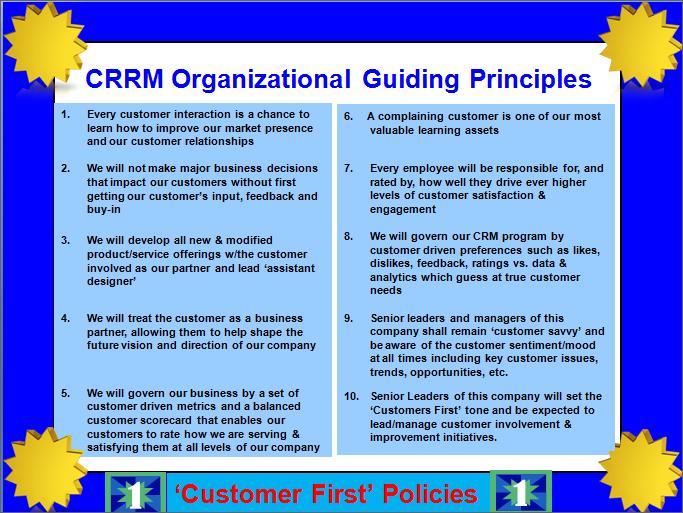
CRRM Customer First Policies & Organizational Principles

3B) The above chart “CRRM Organizational Guiding Principles” demonstrates the principles that must be in-place to be customer first culture. This culture is driven by management that is passionate about their customers and governs the company around a set of customer first policies.

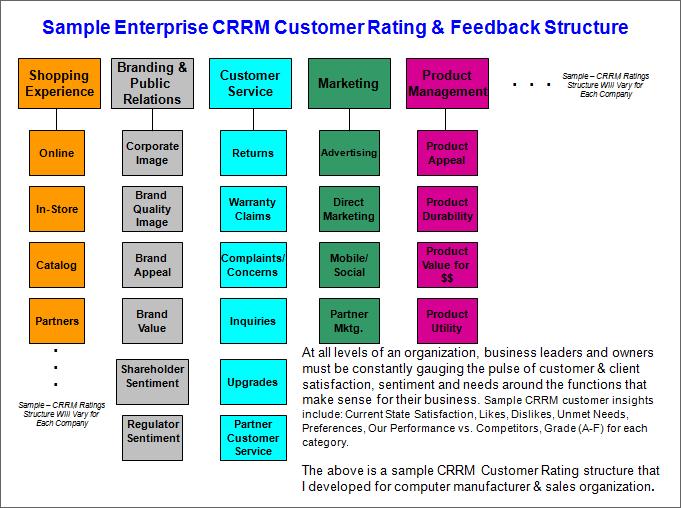
Sample Enterprise CRRM Customer Rating & Feedback Structure

3C) The above chart “Enterprise CRRM Customer Rating & Feedback Structure” illustrates a sample structure (will vary for each type of business) whereby customer feedback and preferences will be cultivated in order to develop 360° insights into customer needs, wants, likes, etc.

Enterprise CRRM Customer Feedback & Preferences Cultivation Process

3D) The above chart “CRRM Customer Ratings & Feedback Cultivation Process” illustrates a how customer feedback and preferences will be cultivated in order to develop 360° insights into customer needs, wants, likes, etc.

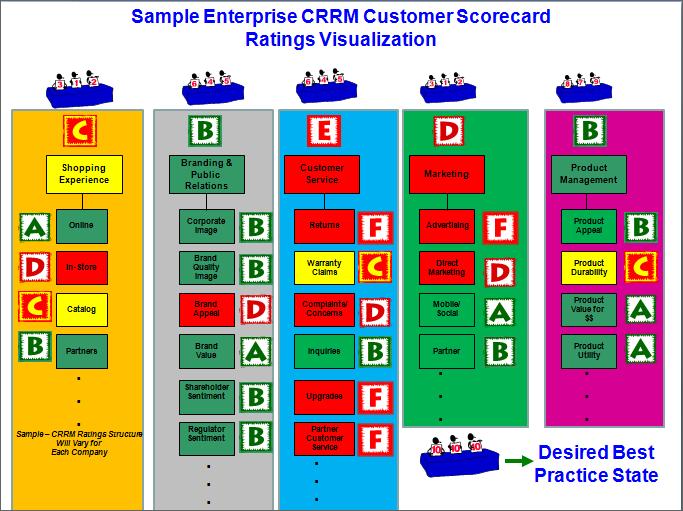
Sample Enterprise CRRM Customer Scorecard Ratings Visualization

3E) The above chart “Enterprise CRRM Customer Scorecard Ratings Visualization” illustrates a how customer feedback and preferences ratings will be visually represented in a scorecard. 

Sample Enterprise CRRM Customer Scorecard Metrics

3E-2) The above chart “Enterprise CRRM Customer Scorecard” illustrates a how customer feedback and preferences ratings will be rolled up into an analytical scorecard that provides insights into customer trends,  customer feedback, customer issues, core customer strengths and weaknesses, etc. 

This scorecard can also be used to manage a Continuous Customer Improvement Process (CCIP) that continually drives improvements to customer perceptions, ratings, satisfaction, etc. 

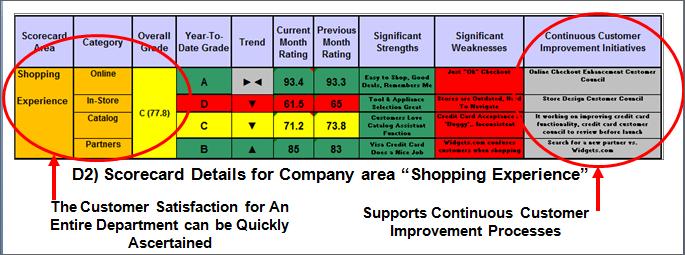
Sample Scorecard for “Shopping Experience”

The above depicts how analytics and metrics would be maintained for a business who had a retail or wholesale shopping function.

Sample Shopping Experience Scorecard – #2

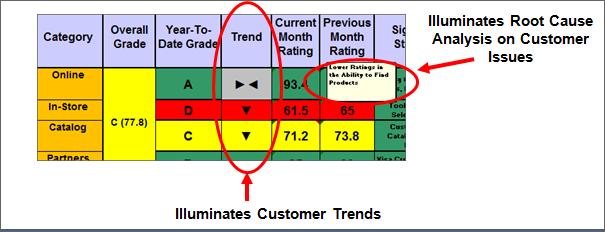
Robust Scorecard Analytics and Metrics should support Customer Trend Identification and Root Cause Analysis for Customer Issues.

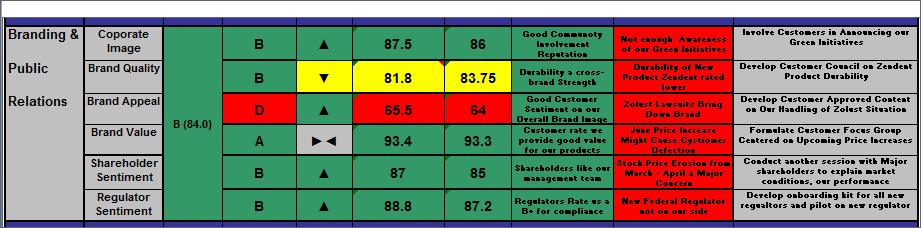
Sample Branding & Public Relations Scorecard

Sample Public Relations Scorecard Above gives you insights into how well your company and brands are perceived by customers, stakeholders, stockholders, etc.

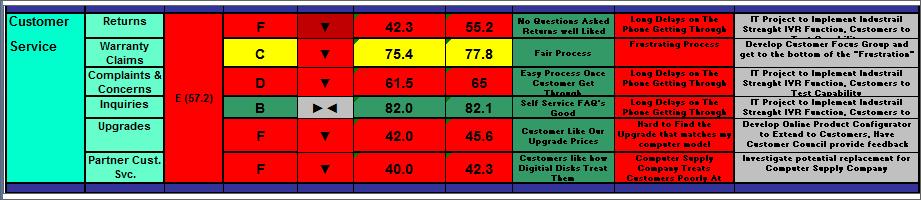
Sample Customer Service Scorecard

Sample Customer Scorecard Above from Customer Service tells how well you are serving your customers.

Sample Marketing Scorecard

Sample Marketing Scorecard Above Gives you insights into how well your Marketing Efforts are resonating with your customers.

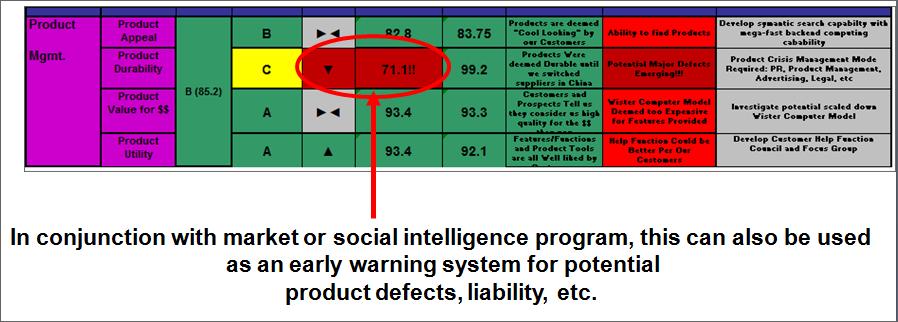
Sample Product Management Scorecard

The Sample Product Management Scorecard above gives you insights into how well perceived your products and services are with customers and prospects.

4) Company & Customer Benefits of Adopting the CRRM Model:

By treating customers as business partners (vs. commodities) and including them in the corporate decision making process, as well as allowing them to rate how well you are serving them from an array of customer facing areas, companies can reap huge rewards including the following:

1. Better insights into the types of products and services customers want & need

2. Fiercely loyal customers who feel part of the corporate team

3. Customers who are most likely to spend more, be retained longer and purchase at premium prices with higher profit margins

4. Customers who are very likely to be brand advocates and refer others to your company, brands, and services.

5. Customers who feel connected to the company and empowered to improve company operations

The following are actual customer comments from those who have participated in a customer feedback program to help shape products & services:

“I feel like xyz company cares about me since they ask my opinion”

“Finally a company that listens to us”

“It is so refreshing to have a company ask you your opinions on products and services vs. ramming something down our throats that we don’t like”

“Wow – this is fun. I enjoy providing my opinion”

“As silly as this might sound, xyz company is the only company that ever asked me what I wanted”

“In my opinion, xyz company is much more progressive than their competitors by seeking consumer opinions, what matters to them, etc.

 5) Conclusion:

More dynamic companies like Goodle, Zynga, Amazon, etc. are inviting customers to become part of the corporate decision making process and empowering them to provide feedback, insights and rate company operations in order to drive continous customer improvements. Companies who adopt this new CRRM model whereby company management is democratized by including stakeholders and customers into the decision making process will reap the rewards of ever higher customer acquisition, retention and spend – leading to ever higher profits and share price.