The Delivered Optimal Customer Satisfaction through Customer Relationship Management Best Practices
Major Stages of The Customer Relationship Life-cycle
The first step in developing the optimal customer relationship is to define the various major phases in your customer’s journey as they interact with your company (i.e. customer acquisition through customer retirement/closure).
The subsequent steps in the process are to define the phase objectives of each major customer relationship life-cycle stage and to determine the range of customer treatments, by customer segment, that exist within each phase. In addition, in order to arrive at accurate segmentation definitions, a segmentation approach and method must be defined in order to properly develop distinct and meaningful customer segments groups.
Balancing Customer Service Costs with Customer Needs & Satisfaction
Once customer value segments are properly determined, customer needs and appropriate service levels for those segments can be determined. This is important to delivering cost effective service levels that doesn’t over-deliver to customers and ensures a maximized customer satisfaction level for that particular customer segment group. Equilibrium is achieved when customer service costs are balanced with delivered customer satisfaction and customer value (i.e. a company would not want to expend a great deal to over-deliver to a traditionally frugal customer segment with a negative contribution (value) margin).
The Dynamics of a Changing Customer Relationship for Maximized Customer Satisfactions
Matching Customer Service Delivery Levels to Customer Value
As customers deliver greater value to the company, service and reward levels are adjusted to deliver increasing levels of customer value to maintain market equilibrium and prevent high value customer defection to competitors.
Architect The Cost Effective Customized Customer Experience Across All Touch Points
Each customer touch-point needs to be examined to determine the optimal customer treatment approach for each customer segment that interacts with that particular touch-point. Only then can an econometric model can be developed via a multi-dimensional matrix of customer touch-point, customer value segment and customer relationship life-cycle stage.
Developing The Optimal Customer Relationship across all touch-points, segments, customer life-cycle stages
The final multi-dimensional matrix developed should consist of 4 dimensions (comparable to a Rubik’s Cube) of 1) Customer touch-point; 2) Customer Needs/Preferences; 3) Customer value segment and 4) Customer relationship Life-cycle Stages (CRLS).
Developing the Optimal Customer Relationship Life-cycle
I have found that the best approach to determining the final multi-dimensional matrix developed to be through a series of cross-functional workshops with internal knowledge experts consisting of customer analytics, customer service, marketing, sales, warranty claims (if separate from service) and touch-point subject matter experts like website managers, multi-channel contact center managers, etc.
The above is the structure for determining the optimal customer relationship for each segment group per touch-point as they transit through the customer relationship life-cycle stages. The final outcome is your delivered customer treatment strategy across all touch-points, segments and stages in the customer relationship life-cycle.
The benefit of this requirements definition exercise is minimized customer service cost at a level that just meets (or slightly exceeds) customer expectations such that high levels of customer satisfaction is delivered at the ‘maximum bang for the buck’.
For Additional Information on this topic, please reference the following credible sources:
The following blog article will succinctly and effectively answer the following questions as related to developing and deploying an effective customer strategy:
What are the basic building blocks of an effective customer strategy ecosystem?
What is the function of each process in this customer delivery ecosystem?
What are the critical questions that must be answered by each function in this ecosystem?
How can you develop an effective customer strategy that delivers maximized customer satisfaction simultaneous to maximized profitability?
What is the checklist to ensuring your customer strategy and delivery is effective?
The Building Blocks of the Customer Strategy Life Cycle
Aboveare the basic building blocks to delivering an effective customer experience. Each process is designed to work in an ongoing continuous ecosystem (loop) in order to deliver a personalized customer experience that matches the customer’s current and future needs, preferences, etc.
Let’s examine each process and how it supports the overall infrastructure model.
Segment – the analogy for the segment process is that the more and differentiated customer knowledge you have, the better you will be able separate customers into unique needs groups in order to deliver a unique experience that they truly value.
Separate – Once you have effectively segmented your customers and prospects into unique needs groups, you can then start to separate them in order to deliver differentiated and 1-on-1 treatments that are uniquely valuable to each of those customer segment groups.
Satisfy – The next step in the process is to deliver content and programs that deliver value, not only to the needs of the overall segment group, but also delivers value to every customer sub-segment within the overall segment group via program sub-segment delivery structures. This is accomplished by delivering customized 1-to-1 customer programs that effectively leverage the unique customer insights gathered (history, needs, preferences, likes, dislikes, previous pain points, etc.).
Stratify – The last step in this foundational process is to develop program that migrate customers from low value segments to ever increasing higher value segments. The goal of this process to increase customer’s overall spend, overall share of wallet with the company and overall loyalty and brand ‘stickiness’ such that migrating to a competitor and defecting becomes increasingly difficult. In addition, the migration of customer to higher value segments should also increase the customer’s brand advocacy ranking such that there is a correlation between higher value customer segments and their likelihood to be more likely brand super-advocates {see blog on this topic titled “Achieving Market Leadership by Effectively Managing Customer Loyalty and Advocacy ” : Achieving Market Leadership by Effectively Managing Customer Loyalty and Advocacy }
The 4S Customer Capabilities
Critical Questions Answered by Each Process in the Above Customer Delivery Ecosystem:
Segment – What specific data elements and insights can we leverage or collect to increase our ability to develop unique customer treatment groups.
Separate – Which customer groups does it make sense to develop and deliver differentiated treatment strategies based on profitability models?
Satisfy – What are the optimal customer treatment strategies that can simultaneously optimize customer profitability, loyalty, brand advocacy and customer growth objectives?
Stratify – How do we deliver a progressive and tiered customer program to differentiate ourselves vs. our competitors and grow our market share?
Summary: You might read many complex articles on what a good customer strategy should be based on, but the above basic foundational building blocks are a simple way to start thinking about your customer ecosystem and what corporate capabilities need to be put in place to deliver effective customer and market success.
For Additional Information on This Topic
An effective customer strategy requires more than understanding customer needs. It requires aligning people, processes, technology, and organizational objectives around delivering value to customers. Organizations that successfully implement customer-centric strategies are often better positioned to improve customer satisfaction, increase customer retention, strengthen loyalty, and achieve sustainable business growth.
Building a successful customer strategy also requires a clear understanding of customer expectations, customer journeys, and the factors that influence purchasing decisions. By combining customer insights with strategic planning and execution, organizations can create differentiated experiences that drive long-term competitive advantage.
For additional information on customer strategy and customer-centric business practices, review these resources:
Organizations that place customers at the center of their business strategy are often better equipped to improve customer relationships, increase loyalty, and achieve long-term success in increasingly competitive markets.
Related Reading
Creating an effective customer strategy requires a clear understanding of customer needs, business objectives, and the processes required to consistently deliver value. Organizations seeking to strengthen their customer-centric approach may also benefit from exploring the foundational components of market understanding, customer engagement, and long-term customer relationship management.
Understanding market dynamics and customer expectations provides an important foundation for developing and implementing successful customer strategies that drive loyalty, growth, and sustainable competitive advantage.
Treating customers, clients and guests like your close relatives will create lasting customer loyalty lasting many generations.
Memorable Guest Experience Formula
Critical Mass Formula for Customer Excellence
Derived Benefits from the Customer-Relative Relativity Formula
Following the customer theory of relativity formula can net your company a distinctive customer competitive advantage
Family Like Customers
Critical Mass Formula for Customer Excellence
Listen Intently – Family & Customers
Listen intently to your customers for improvement gifts in order to improve upon your product and service delivery
Welcome – Family & CustomersFulfill Special Requests – Family & Customers
Discovering and fulfilling unmet customer needs is a golden opportunity for you to grow your business
Made to Feel Welcome – Family & Customers
Customer Loyalty Programs – Insights
Leveraging gathered insights can help you surprise & delight your customers by anticipating and pre-delivering (without having to be requested) on customer needs and preferences
Gather & Leverage Needs & Preferences to Surprise & Delight Your Guests
Make Your Guests Feel at Home – Family & Customers
Delivering on a company environment that drives a feeling of belonging, contentment, ‘connectedness’ will endear your customers to your company and brand and make them loyal for life
Customer Loyalty Treatment Strategies
Ensure the end-to-end guest experience ‘chain’ is optimal, memorable, etc.
Mapping, analyzing and applying continuous improvement to the end-to-end guest experience on an ongoing basis will ensure each step of that experience chain is high quality and optimal
Hire & Maintain World-Class (1-in-10,000) Customer Ambassadors who treat customers like family
Summary
Top 3 Keys to Delivering an Exceptional Customer Loyalty & Customer/Client Experience
Hire passionate ‘customer ambassadors’ and empower them to drive your customer & client experience. These ambassadors are typically extremely difficult to find and are generally a 1-in-1,000 find, but if you know you have found one when many of your public reviews mention this person by name as delivering exceptional (family like) customer service.
Adopt a customer/client first set of policies and practices that empower your entire team to make right any customer perceived imperfection, unmet need, etc. in the delivery of your products and/or services. This is similar of how you would go out of your way to ensure your relatives are comfortable when visiting as guests.
To support #2 above, develop a listening & learning system to collect, retain and then deliver on expressed customer/client needs, wishes, preferences, etc. Ritz-Carlton does this extremely well with their guests and it shows in terms of attained customer satisfaction levels.
Customer Loyalty Summary:
By employing an E=MC² formula and treating your customers comparable to your relatives, you will create a positive chain reaction experience unlike any other and enable your company to leapfrog your competitors. This formula has worked for numerous companies employing those 1-in-a-thousand customer ambassadors who care about customer with all their heart as they do they own relatives.
For Additional Information on This Topic
Creating a positive chain reaction with customers begins by consistently delivering value, building trust, and exceeding expectations throughout the customer journey. Organizations that focus on customer satisfaction, customer loyalty, and customer retention often benefit from stronger customer relationships, increased referrals, and higher lifetime customer value. When customers have positive experiences, they are more likely to become repeat buyers, recommend the organization to others, and serve as advocates for the brand.
A customer-centric approach requires more than simply meeting customer expectations. Leading organizations actively seek opportunities to improve customer experiences, strengthen engagement, and cultivate long-term relationships that benefit both the customer and the business. By focusing on relationship building rather than transaction management, companies can create a self-reinforcing cycle of loyalty, advocacy, and growth.
For additional information on customer loyalty and customer experience, review these resources:
Organizations that consistently create positive customer experiences are often better positioned to improve retention, generate customer advocacy, and achieve sustainable long-term growth.
Customer Relationship Management (CRM) Program Best Practices
1) Introduction:
In my previous blog, I covered what the new Customer Relevant Relationship Model (CRRM) is and the benefits of adopting this new model. In this blog, I will cover the components of the new CRRM model and what you need to put in place to make this new model a reality.
Ever wonder why companies like ESPN, Apple, Google, Zynga, Amazon, and Marriott dominate their respective markets? The reason is that they are ‘Customer First’ organizations and are passionate about listening to, understanding and then delighting their customers based on leveraging true customer insights. They treat their customers as business partners vs. commodities and include them in many critical decision making processes. They get this new CRRM model. Why/how ? – Read the rest of this blog to find out…
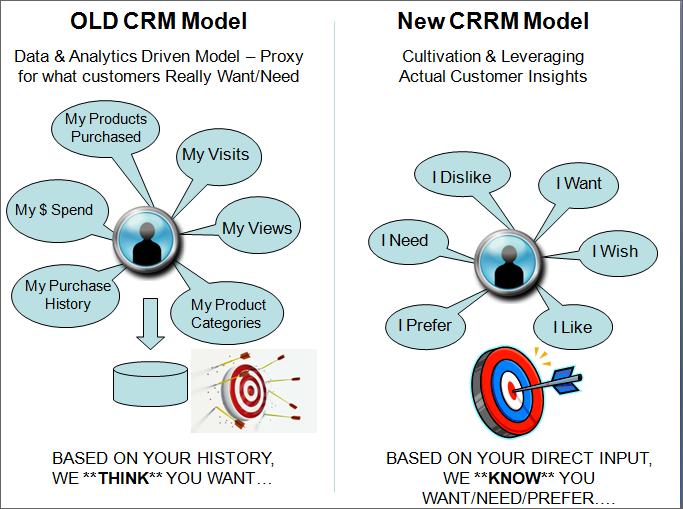
The differences between the old CRM model and how these companies are embracing the newer CRRM model are depicted in the following chart:
The Old CRM Model vs. New CRRM Model – Customers as Business Partners
2) Customers are fed up with old Dictatorial Management Style & Want to be Empowered as Business Partners
Customers and stakeholders today are longing for a company to partner with them and include them in the corporate decision making process. These same constituencies are sick and tired of political, corporate, and other organizations making unilateral decisions for them that are really not in-line with their needs, wants, etc. The backlash from this unwanted dictatorial management style of some companies can be seen in the Bank of America fee customer rebellion, the customer backlash from Netflix deciding to split their company without first consulting with their customers and HPs initial decision to exit the computer market.
3) Components of the New Customer Relationship Management CRRM Model:
In order to progress your organization from the old CRM model to the new CRRM model, a few key essentials must be put in place and are as follows:
A. New Customer Relationship Management CRRM Model that includes the 360° Cultivation of Customer & Market Insights. This model enables a 360° view of all customer and market insights including customer feedback, preferences, likes, dislikes, social sentiment, competitor activity, etc. This new model takes your insights to an entirely new level whereby you are now enabled to delight customers, stakeholders and stockholders by having insights that are light-years ahead of insights provided by a traditional CRM model.
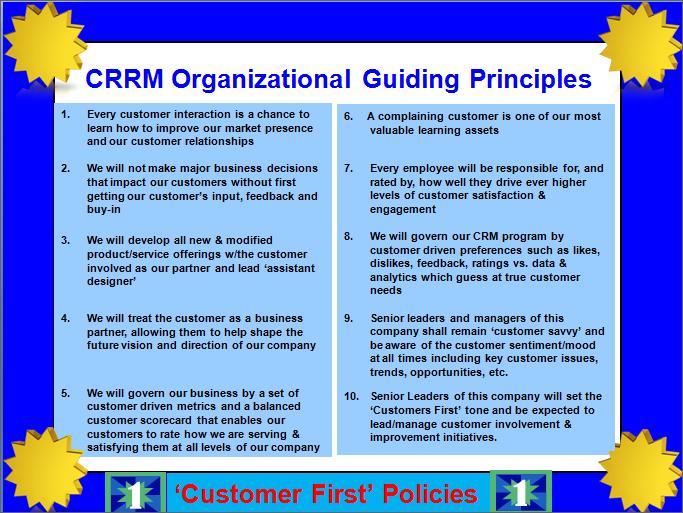
B. Customer First Culture driven by management that is passionate about their customers including a set of customer first principles and guidelines developed by company leaders
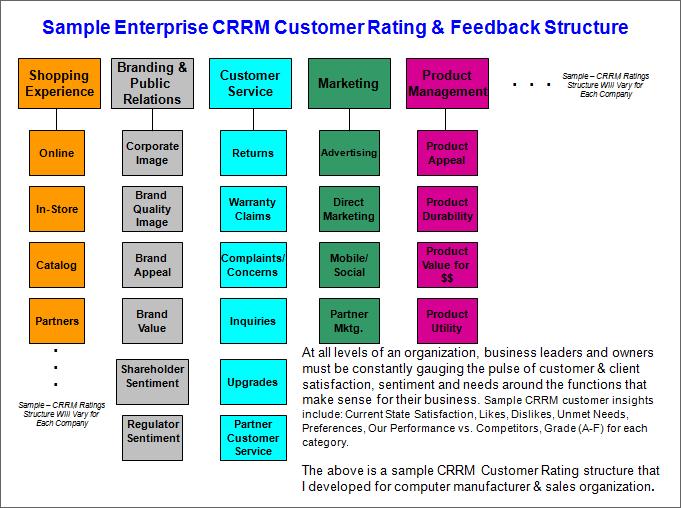
C. Customer Ratings & Feedback Structure that will identify areas where you will collect customer 360° feedback from customer and stakeholder interactions
D. Customer Feedback & Preferences Cultivation Process and corresponding infrastructure in order to allow your customers to continually rate how well you are serving them
E. Customer Health Scorecard that provides real-time insights on how well the customers, stakeholders and stockholders perceives you as serving them as well as insights into a Continuous Customer Improvement Process (CCIP) that enables you to continually improve your customer perceptions, satisfaction, brand loyalty, etc.
These components can apply to large enterprises as well as Small to Medium Businesses (SMBs).
The following graphics are all sample components from the list above (A-D) that need to be put in place to enable this new CRRM Model.
New CRRM Model – 360° Cultivation of Customer & Market Insights
3A)The above chart “New CRRM Model – 360 Cultivation of Customer & Market Insights” demonstrates the new insights model that must be put in place to deliver world-class stakeholder and customer programs.
These enhanced insights will enable you to deliver products and services that delight your customers, stakeholders and stockholders as well as enable you to leapfrog the competition in terms of market share if they continue to rely on their antiquated CRM data and analytics insights only model.
For Small to Medium sized Businesses (SMBs), some of the insights do not apply, but the following charts (3B-3E) most certainly apply and can be tracked via simple Microsoft Excel spreadsheets.
CRRM Customer First Policies & Organizational Principles
3B)The above chart “CRRM Organizational Guiding Principles” demonstrates the principles that must be in-place to be customer first culture.This culture is driven by management that is passionate about their customers and governs the company around a set of customer first policies.
3C) The above chart “Enterprise CRRM Customer Rating & Feedback Structure” illustrates a sample structure (will vary for each type of business) whereby customer feedback and preferences will be cultivated in order to develop 360° insights into customer needs, wants, likes, etc.
Enterprise CRRM Customer Feedback & Preferences Cultivation Process
3D) The above chart “CRRM Customer Ratings & Feedback Cultivation Process” illustrates a how customer feedback and preferences will be cultivated in order to develop 360° insights into customer needs, wants, likes, etc.
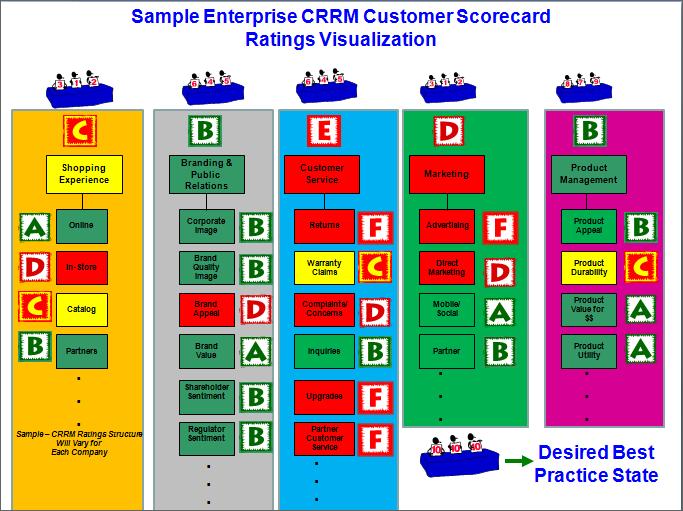
3E) The above chart “Enterprise CRRM Customer Scorecard Ratings Visualization” illustrates a how customer feedback and preferences ratings will be visually represented in a scorecard.
Sample Enterprise CRRM Customer Scorecard Metrics
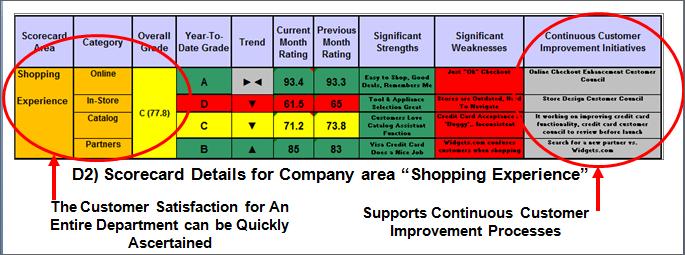
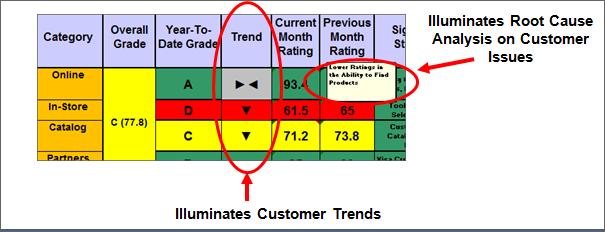
3E-2) The above chart “Enterprise CRRM Customer Scorecard” illustrates a how customer feedback and preferences ratings will be rolled up into an analytical scorecard that provides insights into customer trends, customer feedback, customer issues, core customer strengths and weaknesses, etc.
This scorecard can also be used to manage a Continuous Customer Improvement Process (CCIP) that continually drives improvements to customer perceptions, ratings, satisfaction, etc.
Sample Scorecard for “Shopping Experience”
The above depicts how analytics and metrics would be maintained for a business who had a retail or wholesale shopping function.
Sample Shopping Experience Scorecard – #2
Robust Scorecard Analytics and Metrics should support Customer Trend Identification and Root Cause Analysis for Customer Issues.
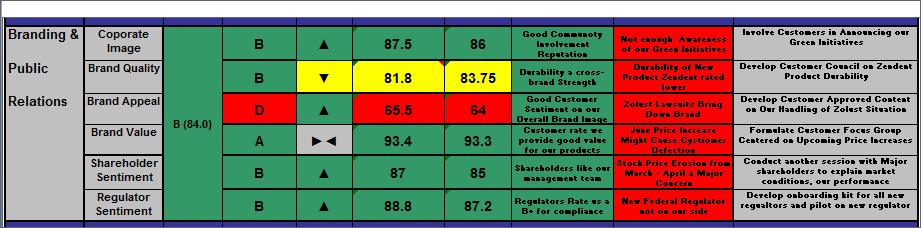
Sample Branding & Public Relations Scorecard
Sample Public Relations Scorecard Above gives you insights into how well your company and brands are perceived by customers, stakeholders, stockholders, etc.
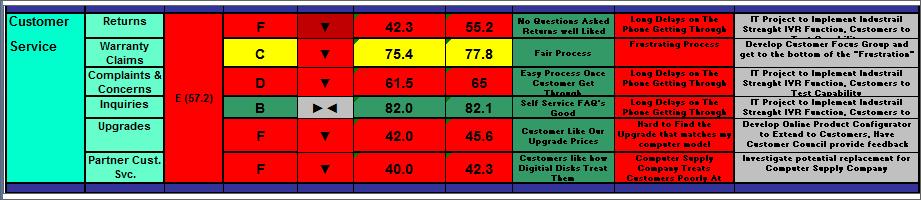
Sample Customer Service Scorecard
Sample Customer Scorecard Above from Customer Service tells how well you are serving your customers.
Sample Marketing Scorecard
Sample Marketing Scorecard Above Gives you insights into how well your Marketing Efforts are resonating with your customers.
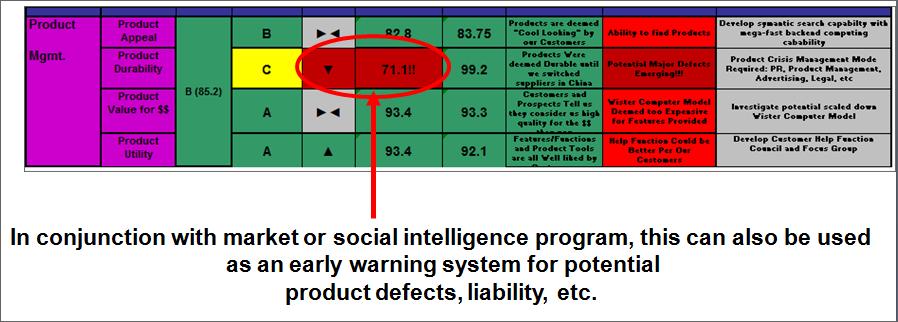
Sample Product Management Scorecard
The Sample Product Management Scorecard above gives you insights into how well perceived your products and services are with customers and prospects.
4) Company & Customer Benefits of Adopting the Customer Relationship Management CRRM Model:
By treating customers as business partners (vs. commodities) and including them in the corporate decision making process, as well as allowing them to rate how well you are serving them from an array of customer facing areas, companies can reap huge rewards including the following:
1. Better insights into the types of products and services customers want & need
2. Fiercely loyal customers who feel part of the corporate team
3. Customers who are most likely to spend more, be retained longer and purchase at premium prices with higher profit margins
4. Customers who are very likely to be brand advocates and refer others to your company, brands, and services.
5. Customers who feel connected to the company and empowered to improve company operations
The following are actual customer comments from those who have participated in a customer feedback program to help shape products & services:
“I feel like xyz company cares about me since they ask my opinion”
“Finally a company that listens to us”
“It is so refreshing to have a company ask you your opinions on products and services vs. ramming something down our throats that we don’t like”
“Wow – this is fun. I enjoy providing my opinion”
“As silly as this might sound, xyz company is the only company that ever asked me what I wanted”
“In my opinion, xyz company is much more progressive than their competitors by seeking consumer opinions, what matters to them, etc.
More dynamic companies like Goodle, Zynga, Amazon, etc. are inviting customers to become part of the corporate decision making process and empowering them to provide feedback, insights and rate company operations in order to drive continous customer improvements. Companies who adopt this new CRRM model whereby company management is democratized by including stakeholders and customers into the decision making process will reap the rewards of ever higher customer acquisition, retention and spend – leading to ever higher profits and share price.
For additional information on this topic, please reference the following credible resources:
What Is CRM? The Ultimate Guide to Customer Relationship Management – Excellent foundational resource covering CRM strategy, customer data management, sales, service, and relationship-building. Salesforce CRM Guide
What Is Customer Relationship Management (CRM)? This is a strong foundational source because the article positions CRRM as an evolution of traditional CRM. Salesforce CRM Guide
Customer Relationship Management (CRM) Best Practices, Trends, Tools and Techniques
Blow Away Your Competition by Replacing Your Old CRM Program with a more effective Customer Relevant Relationship Management (CRRM) Model
1)Introduction
Do you have a robust CRM program in-place, but you feel you are still missing the mark in terms of delivering what your customers really want & need?
Is your organization at risk of making market decisions that can cause a backlash and mass defection by your customers like the Bank of America $5 fee decision or the Netflix business split decision?
Do you have volumes of consumer data and analytics, but sales are declining or flat and customers are churning at an increasing rate?
Do you feel you could improve the quantity and quality of your customer insights including ascertaining critical consumer needs, preferences, likes/dislikes, interests, preferred communication channel for you to contact them, preferred timing and frequency for you to communicate with them, etc?
If you can say “Yes” to any of these questions, the rest of this post is a MUST READ for you and it is time to consider this more effective CRRM Model to replace your outdated CRM Model.
2)CRM vs. CRRM Model Overview
The following diagram depicts the major differences between the old CRM Model and the new CRRM Model including the problems associated with the old CRM model and benefits of the newer CRRM model.
Old CRM Model vs. Customer Relevant Relationship Management (CRRM)
Old CRM Model (left above):
Relies on historical data and analytics to determine what customers need, want, etc. by the analysis of sales history, types of products purchased, categories of products purchased, views on websites, stores visited, etc.
Customer activity information is a proxy to what customers really want and need. Example, you will seldom learn that a customer hates an in-store or web experience through this proxy for what they are wanting, feeling, needing, disliking, etc.
Companies are unlikely to gain insights into the impact that any future company decisions will have on customer loyalty, retention, acquisition.
New CRRM Model (right above):
Takes a more direct approach with customers and utilizes a systemic querying method to ascertain exactly what customer want/need/prefer/etc.
Embraces customer councils, customer forums, customer voting to drive future content, interactions, product/service offerings, etc.
Activity solicits ratings from customers on many aspects (marketing materials, web experience, in-store experience, product usability, quality of customer service, etc.) regarding the health of the overall customer relationship and continually asks “How well are we managing our relationship”
3) Example of CRM Model Gaps
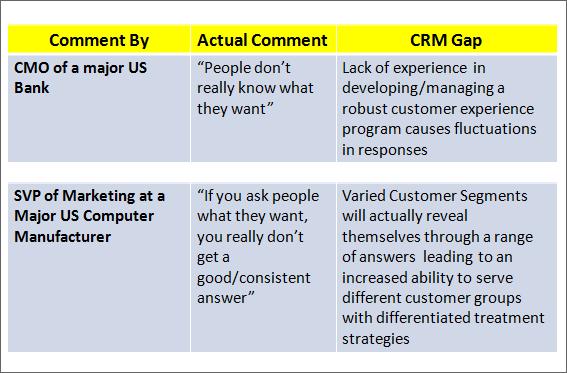
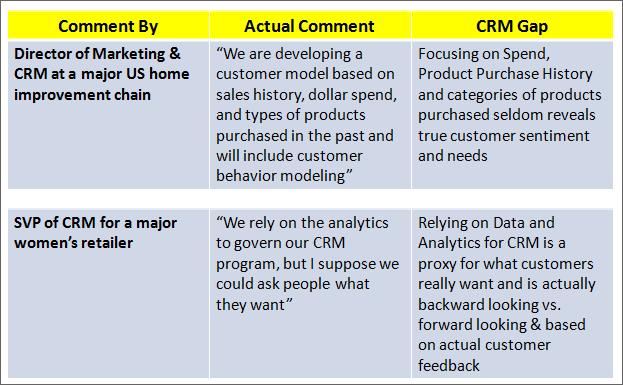
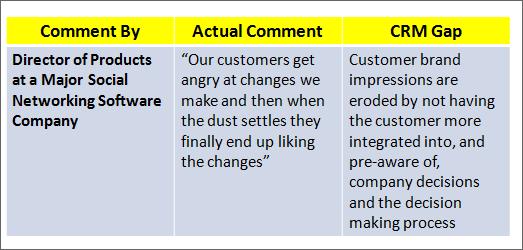
To illustrate how companies are struggling to really determine the real needs of their customers, I took selected comments from interactions with senior CRM executives from major US Corporations based on consulting engagements, job interviews, speaking to them in passing, etc. The following charts are their actual verbatim comments as well as my read on their CRM gap that prevents them from developing world-class relationships with their customers.
Traditional CRM Programs:
Organizational culture, operations, and go-to-market strategy does not put the customer and real customer insights into the center of CRM operations
Relies on data, analytics, and customer history to drive on-going customer interactions.
Puts the organization at extreme risk of missing the boat from a customer’s perspective – real needs, wants, concerns, preferences, experiences, etc.
Companies that rely on this model are at-risk of customer defections, decreased customer spend/loyalty, etc.
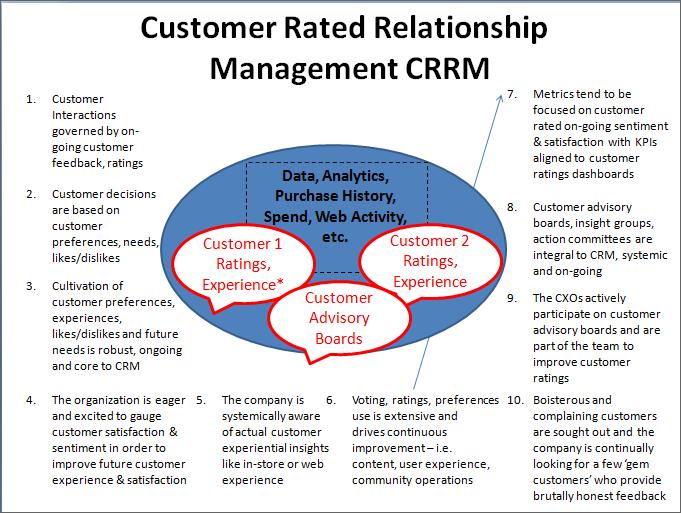
New CRRM Model – with Customers In The Center of Customer Operations
New CRRM Program:
The organizational culture, operations, and go-to-market strategy puts the customer and real customer insights into the center of CRM operations rather than rely on the proxies of what customers want, i.e. data, analytics, and customer history.
The customer becomes the actual judge, ‘rater’ of whether you are delivering quality, value and a good relationship to them.
The customer is put in charge of CRM operations and enables a bi-directional and on-going dialog with the customer whereby they tell you their real needs, wants, concerns, preferences, experiences, etc.
Companies that rely on this model are more likely to develop products, services, offers, communications that delight the customer and whereby they are more loyal, greater brand advocates, and likely to refer your company to their friends as a company who listens, cares and empowers their customers.
6)Companies That Get the Customer Relationship Management CRRM MODEL
The following are samples of companies that, in my opinion, get the CRRM model and details how/why each of them get this new go-to-market customer model.
Companies That ‘Get’ CRRM – 1 of 2
Companies That Get CRRM – 2 of 2
Phrases That Describe Companies who ‘Get’ the New CRRM Model
We don’t hide behind data and analytics to drive our customer & CRM operations, but rather we ask our customers what they want.
We are eager to ask our most disgruntled customers how we can improve our relationship with them and to determine who to improve our go-to-market strategy
Before we make any major market-facing decisions, we ask a cross-segment of our customers what they think about each of our proposed decisions and then ask them how to improve upon how these changes are implemented so we ensure a continued delighted customer base.
The bottom line of this post is that, if your company relies less on historical data and analytics to determine what customer want and actually builds methods, processes, and systems to put the customer in charge of rating CRM operations in order to provide you with ongoing and valuable real insights (needs, wants, likes dislikes, preferences, concerns, etc.), the customers will feel more valued and connected with your brands. The benefit of adopting this new CRRM model will be more loyal, empowered and delighted customers who will be brand advocates and brand referrers that will increase shareholder and company value.
As I have now built this new CRRM model for several major US brands, my next blog post will be on ‘how to’ develop this capability at the enterprise level.
For additional information on this topic, please reference the following credible resources:
What Is CRM? The Ultimate Guide to Customer Relationship Management – Excellent foundational resource covering CRM strategy, customer data management, sales, service, and relationship-building. Salesforce CRM Guide
What Is Customer Relationship Management (CRM)? This is a strong foundational source because the article positions CRRM as an evolution of traditional CRM. Salesforce CRM Guide