Aligning Market Insights & Trends to Customer Strategies & Priorities

Customer Strategy Best Practices, Tools, Techniques, Examples

  1. What is the size of the potential pool of new customers and which are the best customers to acquire?

  2. Which customers are your most profitable and how do you get other customers to grow and become part of your top ( and most profitable) customer segment group?

  3. What is your current customer share of wallet (SOW) as compared to your competitors and what does driving small incremental increases in your customer SOW do to your overall revenue?

  4. What are the shifting attitudinal and behavior patterns of your customer market and how do you develop a strategy that ‘gets in front of’ these trends?

  5. What are the shifting customer demographics of your marketplace as well as the underlying shift in spending habits

  6. What are the changes in customer preferred marketing channels as well as trends that might impact customer loyalty strategy


Customer Strategy: Market Insights and Trends Drive Customer Strategy, Programs
Market Insights and Trends Drive Customer Strategy, Programs


The above charts illustrate why it is critically important to have clear and accurate insights into your new customer market potential/pool as well as the current customer base and their share of wallet.

The chart above (right side) illustrates which customers drive the current percentage of revenue in order to understand how customer priorities and strategy should be defined.

Customer Strategy: Critical Insights: Top Customer, Top Profitable Customers and Customer Share of Wallet vs. Competitors
Critical Insights: Top Customer, Top Profitable Customers and Customer Share of Wallet vs. Competitors

Market Spend Insights Can Be Transformational in term of goal setting

The above graphic illustrates how share of wallet changes drive bottom line revenue as well as converting customers into more loyal top customers.

Customer Strategy: Customer Attitudinal Trends Insights Are Critical to Customer Strategy
Customer Attitudinal Trends Insights Are Critical to Customer Strategy

Understanding your market & customer behavior insights is crucial to your company’s survival

The above graphic demonstrates a deep understanding in the shifting attitudinal and behavior patterns of the customer market

Customer Strategy: Customer Market Buying Power Insights are Crucial For Developing a Coherent Customer Strategy
Customer Market Buying Power Insights are Crucial For Developing a Coherent Customer Strategy

The above chart illustrates a company capability to understand shifting demographics as well as the underlining shift in spending habits per demographic group

Customer Strategy: Understanding Key Customer Behavior & Preferences is a Customer Strategy Imperrative
Understanding Key Customer Behavior & Preferences is a Customer Strategy Imperrative
Customer Strategy: An Alignment of All Customer & Market Insights to Maximize Market Dominance & Profitability

Once Customer and Market Insights are fully embraced, an Effective Customer Strategy can be developed that includes optimizing market channel selection, as well as contact and loyalty strategy program components

Blog Summary: In order to achieve the above insights, your company must develop and deploy the following strategic capabilities and delivery programs:

  1. Market sizing & trend insights

  2. Customer revenue and profitability insights analysis

  3. Customer share of wallet and competitor spend insights delivery capability

  4. Market trend & consumer attitudinal and behavior change longitudinal analysis

  5. 360° customer needs and preference cultivation that enables a personalized customer experience strategy and delivery (i.e. preference portal customer selection of preferred channels, content types, offer types, frequency of content delivery by content type.)

Below is a list of companies where I have helped develop these programs and are considered world-class in Customer Strategy practices:

  • Johnson & Johnson

  • Capital One

  • Amazon

  • American Express

  • Kelloggs


For Additional Information on This Topic

Organizations that successfully align market insights with customer strategies are often better positioned to anticipate changing customer needs, identify emerging opportunities, and develop more effective business strategies. Market trends, customer behaviors, competitive activities, and industry developments can provide valuable information for refining customer priorities and improving decision-making across the organization.

The most successful organizations continuously monitor their markets and use customer insights to guide strategic planning, product development, service delivery, and customer experience initiatives. By combining market intelligence with a deep understanding of customer expectations, organizations can create more relevant value propositions, strengthen customer relationships, and improve long-term business performance.

For additional information on market research, customer insights, and strategic decision-making, review these resources:

Organizations that consistently align market insights, customer priorities, and business strategies are often better equipped to improve customer satisfaction, strengthen competitive positioning, and achieve sustainable growth.

How to Understand the “Market” in Marketing & How It Is Critical to Your Company’s Long-Term Success

Market Analysis Best Practices

Market Analysis Best Practices
                             Market Analysis Best Practice


{Click on Graphic for clearer/larger image}

Effective marketing must include leveraging an array of holistic market insights


Market Assessment Components
                                Market Assessment Components

{Click on Graphic for clearer/larger image}

dfdgdf

Market Analsis Client Example

fdfsgfsg

The following is an array of insights that I created for a client who represents one of the top luxury resort companies in the world. These insights were designed to accomplish the following:

  • Develop Financial and market Insights to Increase revenue while decreasing costs

  • Help understand the market dynamics of the target market

  • Assist in identifying root causes for customer purchases, repeat purchases and the opportunity they have to boost customer loyalty

  • Improve the effectiveness of current marketing efforts by more effectively leveraging market insights

  • Develop a 5-year transformation plan to enable new capabilities that allow them to fulfill their future vision state

Best Practice Market Trend Insights
                          Best Practice Market Trend Analysis

{Click on Graphic for clearer/larger image}


Market Capacity Analysis
                                Market Capacity Analysis

Best Practice Market Capacity/Growth Insights

{Click on Graphic for clearer/larger image}

3_title

Best Practice Market Supply & Demand Analysis
                Best Practice Market Supply & Demand Analysis

{Click on Graphic for clearer/larger image}

World-Class Market Supply & Demand Analysis including Market Trend Insights


4_title

Market & Competitor Price Analysis - Comparison
          Market & Competitor Price Analysis – Comparison

Market Competitive Pricing Analytics

{Click on Graphic for clearer/larger image}

5_title

Competitive Pricing Analysis
                             Competitive Pricing Analysis

Market & Brand Competitive Pricing Insights

{Click on Graphic for clearer/larger image}

6_title

Brand Pricing Consistency Analysis
                             Brand Pricing Consistency Analysis

Company Net Daily Revenue Analysis

{Click on Graphic for clearer/larger image}

Target Market Sizing Analysis
                                    Target Market Sizing Analysis

Market Profiling, Sizing & Penetration Analysis Example

{Click on Graphic for clearer/larger image}

Market & Marketing Loyalty Analysis
                           Market & Marketing Loyalty Analysis

Market & Brand Loyalty Insights: Likelihood to Purchase Again, Loyalty Opportunity

{Click on Graphic for clearer/larger image}

Best Practice Marketing Effectiveness Analysis
              Best Practice Marketing Effectiveness Analysis

Marketing Mix Optimization & Marketing Campaign Effectiveness Analysis

{Click on Graphic for clearer/larger image}

Return On Invested Capital (ROIC) Analysis
                   Return On Invested Capital (ROIC) Analysis

{Click on Graphic for clearer/larger image}

Return on Invested Capital Analysis (ROIC): Spread Growth, Competition’s Return on Invested Capital, etc.

Cost of Goods Sold (COGS) Competitive Analysis
              Cost of Goods Sold (COGS) Competitive Insights

{Click on Graphic for clearer/larger image}

Company & Competitive Margin, Cost of Goods Sold and Selling General & Administrative (SG&A) Analysis

Cost of Goods Sold (COGS) Trend Analysis
                  Cost of Goods Sold (COGS) Trend Analysis

{Click on Graphic for clearer/larger image}

Selling General & Administrative (SG&A) Projection & Trend Insights


Revenue Target Analysis
                                Revenue Target Analysis

{Click on Graphic for clearer/larger image}

Historical Revenue Analysis: Budget vs. Actual

Earnings Before Interest & Taxes (EBIT) Analysis
              Earnings Before Interest & Taxes (EBIT) Analysis

{Click on Graphic for clearer/larger image}

Earnings Before Interest & Taxes (EBIT) Target & Margin Analysis

EBIT Scenario Projection Analysis
                        EBIT Scenario Projection Analysis

Market Strategy & EBIT Analysis

{Click on Graphic for clearer/larger image}

Best Practice Transformation Plans
                       Best Practice Transformation Plans

{Click on Graphic for clearer/larger image}

Best Practice Transformation Plans: Balances Capability Development with Corporate Vision & Reality


World-Class Transformation Plan Inputs
                   World-Class Transformation Plan Inputs

{Click on Graphic for clearer/larger image}

A Best Practice Transformation Plan Includes a Multitude of Holistic Inputs


For Additional Information on The Topic of Market Analysis

Understanding the market is one of the most important responsibilities in marketing. Organizations that continuously monitor customer needs, competitive activity, market trends, and changing buyer behaviors are better positioned to identify growth opportunities and develop strategies that create sustainable competitive advantages. Effective market analysis helps companies align their products, services, messaging, and investments with the evolving needs of their target audiences.

A strong market orientation also enables organizations to make more informed decisions, reduce business risk, and improve long-term performance. By combining customer insights with market research and competitive intelligence, marketing leaders can better anticipate changes in the marketplace and adapt their strategies accordingly.

For additional information on understanding markets, customer needs, and market-driven strategy, review these resources:

Organizations that invest in understanding their markets are often better equipped to create customer value, improve competitive positioning, and achieve long-term business success.

Blow Away Your Competition by Replacing Your Old CRM Program with the New Customer Relevant Relationship Management (CRRM) Model

Customer Relationship Management (CRM) Best Practices, Trends, Tools and Techniques

Customer Relationship Management New CRRM model

Blow Away Your Competition by Replacing Your Old CRM Program with a more effective Customer Relevant Relationship Management (CRRM) Model

1)               Introduction

  1. Do you have a robust CRM program in-place, but you feel you are still missing the mark in terms of delivering what your customers really want & need?
  2. Is your organization at risk of making market decisions that can cause a backlash and mass defection by your customers like the Bank of America $5 fee decision or the Netflix business split decision?
  3. Do you have volumes of consumer data and analytics, but sales are declining or flat and customers are churning at an increasing rate?
  4. Do you feel you could improve the quantity and quality of your customer insights including ascertaining critical consumer needs, preferences, likes/dislikes, interests, preferred communication channel for you to contact them, preferred timing and frequency for you to communicate with them, etc?

If you can say “Yes” to any of these questions, the rest of this post is a MUST READ for you and it is time to consider this more effective CRRM Model to replace your outdated CRM Model.

2)               CRM vs. CRRM Model Overview

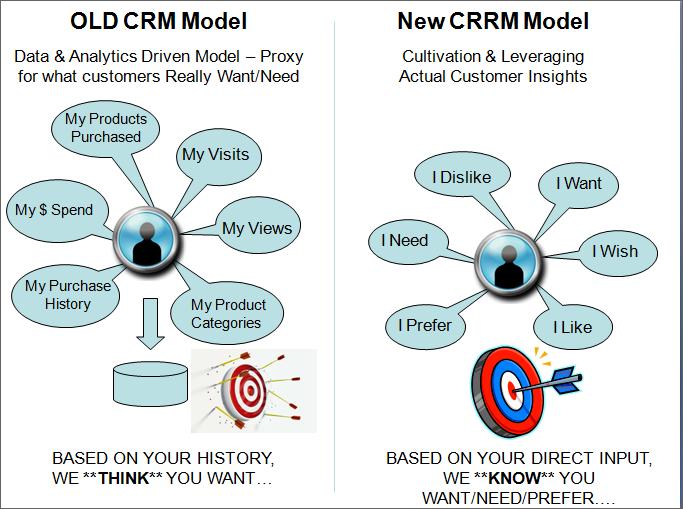
The following diagram depicts the major differences between the old CRM Model and the new CRRM Model including the problems associated with the old CRM model and benefits of the newer CRRM model.

Customer Relationship Management CRRM old vs. new model
Old CRM Model vs. Customer Relevant Relationship Management (CRRM)

Old CRM Model (left above):

  1. Relies on historical data and analytics to determine what customers need, want, etc. by the analysis of sales history, types of products purchased, categories of products purchased, views on websites, stores visited, etc.
  2. Customer activity information is a proxy to what customers really want and need. Example, you will seldom learn that a customer hates an in-store or web experience through this proxy for what they are wanting, feeling, needing, disliking, etc.
  3. Companies are unlikely to gain insights into the impact that any future company decisions will have on customer loyalty, retention, acquisition.

New CRRM Model (right above):

  1. Takes a more direct approach with customers and utilizes a systemic querying method to ascertain exactly what customer want/need/prefer/etc.
  2. Embraces customer councils, customer forums, customer voting to drive future content, interactions, product/service offerings, etc.
  3. Activity solicits ratings from customers on many aspects (marketing materials, web experience, in-store experience, product usability, quality of customer service, etc.) regarding the health of the overall customer relationship and continually asks “How well are we managing our relationship”

3)               Example of CRM Model Gaps

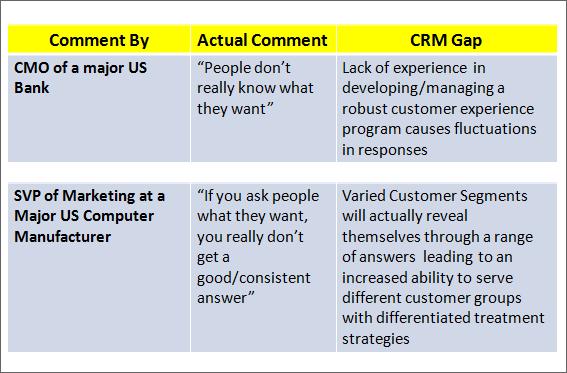
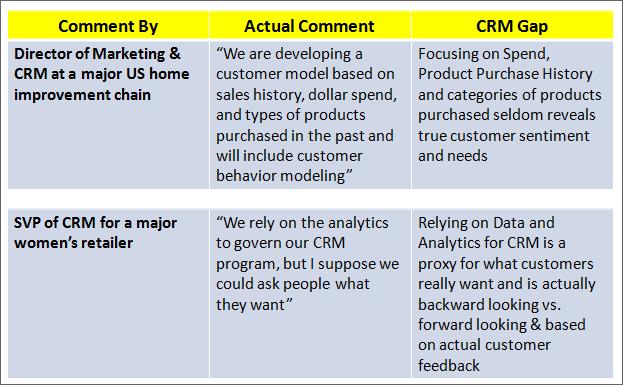
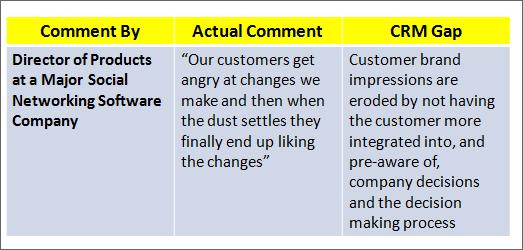
To illustrate how companies are struggling to really determine the real needs of their customers, I took selected comments from interactions with senior CRM executives from major US Corporations based on consulting engagements, job interviews, speaking to them in passing, etc. The following charts are their actual verbatim comments as well as my read on their CRM gap that prevents them from developing world-class relationships with their customers.

Customer Relationship Management Verbatims

Customer Relationship Management Verbatims

Customer Relationship Management Verbatims

Customer Relationship Management CRRM Model

Traditional CRM Programs:

  1. Organizational culture, operations, and go-to-market strategy does not put the customer and real customer insights into the center of CRM operations
  2. Relies on data, analytics, and customer history to drive on-going customer interactions.
  3. Puts the organization at extreme risk of missing the boat from a customer’s perspective – real needs, wants, concerns, preferences, experiences, etc.
  4. Companies that rely on this model are at-risk of customer defections, decreased customer spend/loyalty, etc.
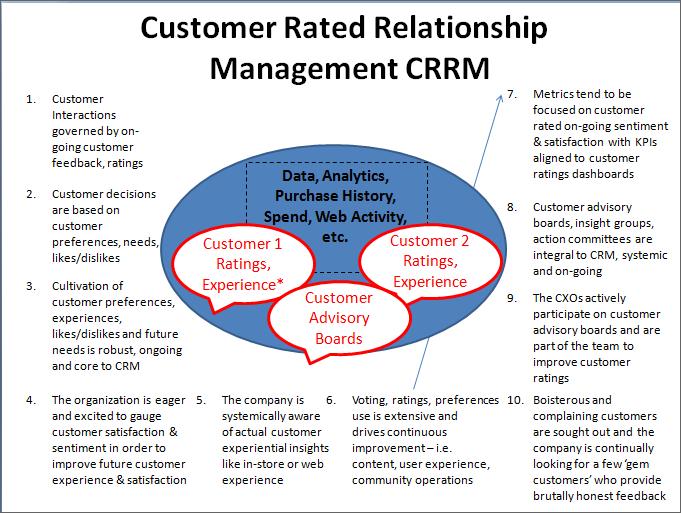
Customer Relationship Management CRRM Model
New CRRM Model – with Customers In The Center of Customer Operations

New CRRM Program:

  1. The organizational culture, operations, and go-to-market strategy puts the customer and real customer insights into the center of CRM operations rather than rely on the proxies of what customers want, i.e. data, analytics, and customer history.
  2. The customer becomes the actual judge, ‘rater’ of whether you are delivering quality, value and a good relationship to them.
  3. The customer is put in charge of CRM operations and enables a bi-directional and on-going dialog with the customer whereby they tell you their real needs, wants, concerns, preferences, experiences, etc.
  4. Companies that rely on this model are more likely to develop products, services, offers, communications that delight the customer and whereby they are more loyal, greater brand advocates, and likely to refer your company to their friends as a company who listens, cares and empowers their customers.
Customer Relationship Management Best Practice Companies

6)             Companies That Get the Customer Relationship Management CRRM MODEL

The following are samples of companies that, in my opinion, get the CRRM model and details how/why each of them get this new go-to-market customer model.

Companies That ‘Get’ CRRM – 1 of 2

Companies That Get CRRM – 2 of 2

Phrases That Describe Companies who ‘Get’ the New CRRM Model

  1. We don’t hide behind data and analytics to drive our customer & CRM operations, but rather we ask our customers what they want.
  2. We are eager to ask our most disgruntled customers how we can improve our relationship with them and to determine who to improve our go-to-market strategy
  3. Before we make any major market-facing decisions, we ask a cross-segment of our customers what they think about each of our proposed decisions and then ask them how to improve upon how these changes are implemented so we ensure a continued delighted customer base.

The bottom line of this post is that, if your company relies less on historical data and analytics to determine what customer want and actually builds methods, processes, and systems to put the customer in charge of rating CRM operations in order to provide you with ongoing and valuable real insights (needs, wants, likes dislikes, preferences, concerns, etc.), the customers will feel more valued and connected with your brands. The benefit of adopting this new CRRM model will be more loyal, empowered and delighted customers who will be brand advocates and brand referrers that will increase shareholder and company value.

As I have now built this new CRRM model for several major US brands, my next blog post will be on ‘how to’ develop this capability at the enterprise level.

Additional Customer Relationship Management Resources

For additional information on this topic, please reference the following credible resources:

  1. What Is CRM? The Ultimate Guide to Customer Relationship Management – Excellent foundational resource covering CRM strategy, customer data management, sales, service, and relationship-building. Salesforce CRM Guide
  2. What Is Customer Relationship Management (CRM)? This is a strong foundational source because the article positions CRRM as an evolution of traditional CRM. Salesforce CRM Guide