Best Practices in Customer Experience (CX) Measurement and Analytics
February 27, 2020 1 Comment
Top 10 customer experience measurement metrics
The following are the top 10 customer experience measurement & Metric concepts you will learn in this blog article:
- What are the most common set of metrics used to measure customer experience quality and effectiveness.
- What these common customer experience metrics are used for
- When are these best practice customer experience metrics best measured
- What a customer journey (a.k.a. customer life-cycle) is and how it related to customer experience metrics
- Why a balanced scorecard is better than any one single customer experience metric
- Why NPS is not sufficient to provide a comprehensive picture of your customer experience quality and effectiveness
- The top 10 best practices in developing a world-class customer experience measurement program and balanced scorecard
- Sample of what a customer journey looks like as well the customer experience analytics collected at each journey phase
- Examples of embedded detailed customer journey phase analytics paired with summary & executive level customer experience analytics
- How to develop customer experience analytics that also drive the development and support of a customer first, surprise and delight culture.
Peter Drucker once said “If you can’t measure it, you can’t manage it”. This ageless and famous quote applies to almost all situations and customer experience is no exception. There is virtually no way to determine how effectively your customers are being treated without a robust set of measures to gauge how well you are fulfilling their needs, wants, desires, etc. In this blog article, we will cover the specific metrics that best practice companies use to measure their customer experience delivery along with it is done.
Customer Experience Measurement is the discipline that allows organizations to objectively assess customer satisfaction, loyalty, retention, and overall experience effectiveness.

Most commonly used Customer Experience Measurment Metrics
The Chart below illustrates some of the more commonly used customer experience (CX) metrics and how/where they are used in the customer journey continuum.
These measures form the foundation of any effective Customer Experience Measurement program.

- Customer satisfaction (CSAT) – one of the most common uses of customer satisfaction ratings is on ratings websites like Yelp, TripAdvisor, Facebook, Google, etc. using the now famous five star rating system seen below. Other customer satisfaction feedback mechanisms are more sophisticated, querying customers on an array of customer experience topics that are multi-dimensional in nature.

Customer Churn Rate (CCR): Customer churn rate is almost always expressed in terms of a percentage and is a product of the number of lost customers divided by the number of retained customers for any given period (day, week, month, Quarter, Year).

- Customer Effort Score: Customer Effort Score is recorded to keep a pulse on how easy it is for a customer to accomplish certain transactions with your company (e.g. return a product, handle an issue, inquire about upgrades, etc.). It is obtained via surveying customers following a major interaction and is expressed in terms of a numeric, typically on a 1-10 or 1 to 7 scale. Here is a sample I developed for a client where the score is translated into a 1 to 7 scale (from “Strongly Disagree”=1 to “Strongly Agree”=7).

- Customer Average Time to Resolution (CATTR): This metric is a measure the average time it takes to resolve categories of customer interactions (inquiry, product issue, service issue, contract renewal, return, etc.). This is expressed in average time per interaction category as shown in this example

- First Contact Resolution (FCR): All companies should strive for what is called “one and done” customer service, enabling the customer to handle any need with one short effort. The benefits of achieving this are endless including the following: Research I have read has indicated that a 1% increase in FCR rates translate into decreasing operating costs by 1%, increases of both customer satisfaction and employee scores by 1-3% as well as increasing customer loyalty (up to 20%). How companies measure FCR vastly differs including surveying customers, tracking it in a CRM system, tracking it in a contact center database or querying the customer at the end of a call. Many companies sadly do not track this metric and lose out on the visibility and resulting benefits this provides.

- Contract Renewal Rates (CRR): This metric is more company specific but, when applicable and used in conjunction with the other metrics, provides a great barometer on the health of the contract oriented business. For example, you might be experiencing great FCR and customer average time to resolution, but contract renewal rates might be lagging due to a perceived lack of value by the customer for the price paid. By using this metric in a balanced scorecard along with CSAT, FCR, CATTR you have a much more comprehensive view of total customer satisfaction than with just a few measures, allowing you to reduce business risk and potential revenue surprises.

- Net Promoter Score (NPS): Net Promoter Score (NPS) is the most commonly used and simplest customer experience metric that exists. NPS is typically measured by asking the following question:
How likely are you to recommend [business, service, product] to a friend or colleague?
Customers rate your company, service, product, etc. on a scale of 0 to 10. Respondents are grouped in the following categories:
- Customer Promoters (Score 9-10)
- Customer Passives (Score 7-8)
- Customer Detractors (Score 0-6)
Calculate Net Promoter Score is typically calculated by subtracting the percentage of net detractors from net promoters. Here is a great illustration on how this is determined, calculated:

It has been found that only those customers who provide a rating of a 9 or 10 on the NPS scale are those who will truly become adjunct volunteer company sales and marketing agents and are a result of experiencing surprise and delight levels of customer service. These same elated customers are the ones who tell everyone they meet about your exceptional company and your amazing, services, products, customer service, etc. More on this in a future blog that will address the topic of “Delivering Consistent Surprise and Delight Customer Service”.
On this last point of NPS, there exist many misnomers about what to measure for customer experience effectiveness. Many professionals I have met in my consulting travels have the misconception that measuring one metric like Net Promoter Score (NPS) is sufficient to measure the quality of the customer experience you are delivering to their customers. This is equivalent to believing that taking your body temperature is sufficient to determine your overall health when in actuality there are many measures taken together that help make this healthy/not healthy determination. The same is true for measuring the quality of your customer experience. While NPS is a good measure for helping to determine the quality of your customer experience effectiveness when used correctly, similar to body temperature, it must be augmented with many other measures to determine its overall effectiveness.
Other customer experience metrics include employee turnover (a leading indicator of customer satisfaction), year-over-year same customer spend, customer loyalty and average longevity, customer acquisition rates over time, etc. I will go more into this when I cover the topic of customer journeys.

Top 10 best practices for Customer Experience Measurement
First, let’s examine my recommended top 10 best practices for Customer Experience Measurement and customer experience delivery effectiveness.
- Monitor Customer Experience Metrics in Real Time and continuously improve customer experience programs based on actual CX metrics/program performance.
- Track top level Customer Experience (CX) Metrics for all customers (i.e. average customer satisfaction) and for individual customer segments (i.e. price sensitive customers or high value customers).
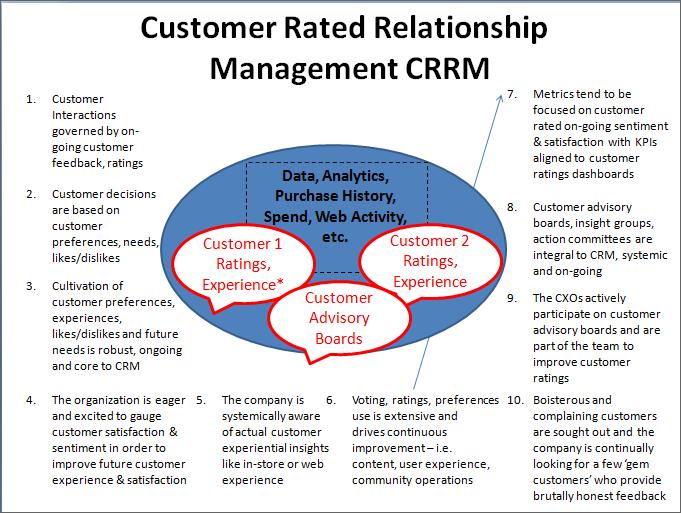
- Request both customer qualitative and quantitative ratings throughout the Customer Life-cycle during critical customer interactions. Accomplish this my providing a conduit for your customers to become brand partners who are invited to participate in providing program feedback prior to full launch, provide detailed focus group feedback on selected topics and for most valuable customers to participate in exclusive customer advisory boards.
- Ensure group appropriate customer experience metrics are being delivered to each layer of the organization (highest importance summary level for CEO – Chief Customer Experience officer, more granular metrics for tactical managers and line staff).
- Cultivate and measure your own internal customer metrics and calibrate against externally measured CX like the American Customer Satisfaction index or metrics collected by firms like the Service Management Group (Kansas City), Direct Opinions (Beachwood Ohio), C-Space (Boston), Engine Group (NYC), etc. For additional benchmarking information, refer to the American Customer Satisfaction Index (ACSI): https://www.theacsi.org/
- Track customer experience effectiveness via a balanced scorecard of Customer Experience Metrics including customer satisfaction, NPS, Customer Churn and renewal rates, customer spend per year and employee turnover (a proven leading indicator of customer satisfaction).
- Ensure the collection and dissemination of Customer Experience metrics meet the golden rules of being seamless to your customers, easy to obtain and are ingrained as part of normal business operations.
- Review customer experience metrics during key management reviews like operational reviews, leadership team reviews and financial reviews. Ensure action plans are developed for metrics above and below expected performance levels.
- Ensure that the company culture and training is supported and in-line with customer experience metrics by making everyone’s KPIs metrics align to the performance of key customer metrics.
- Develop customer journeys (a.k.a. customer life-cycles) and develop customer experience metrics for each major step in the customer journey.
Advanced Customer Experience Measurement programs integrate journey analytics directly into customer lifecycle management.
The last best practice is to identify key end-to-end customer journeys or paths of customer progression when engaging your company and then attach appropriate customer experience journey analytics along those customer paths. Once you understand the different touch-points and how they impact the overall customer journey, you will be in a far better position to pick the most appropriate metric to use at each touch-point. The best metric is company determined based on a developed set of customer experience standards and goals.
In my example in the introduction, Net Promoter Score (NPS – which answers the question, “How likely are you to recommend [business, service, product] to a friend or colleague?” and is rated on a 0 to 10 score), is not a total customer experience solution metric. The reason is that NPS works best when measured at the end of a customer journey (a.k.a. customer life-cycle), such as at contract renewal time. For example, if a customer is getting frustrated returning a product or trying to resolve a service issue, then they will likely defect long before they are queried on NPS. It is better to measure customer satisfaction right after an interaction to have real-time insights into a customer’s experience satisfaction and not wait until NPS query time
The following example demonstrates how Customer Experience Measurement can be deployed across multiple customer journey phases.
Here is a sample customer journey I developed from a recent client consulting engagement along with the metrics they decided to collect at an aggregate level as well as along this customer journey. Some of the metrics and customer journey names have been changed to protect my client’s identity. In addition, this client wanted to err on the side of measuring many metric points frequently and not all clients are this exhaustive in measuring their program. Some of these metrics were already in place before we added many others.

The above illustrates one of the main customer journeys (discover to renewal) in the life of a customer along with the Macro customer phases in that journey (i.e. 1-customer discovery, 2-customer sales & on-boarding, 3-customer support, 4-customer renewals) as well as the micro phases in that journey (product, service credibility evaluation).
The above chart also illustrates the fact that it is important to track global/summary metrics at the top of the organization (i.e. total customer satisfaction) in order to gauge overall customer experience health and to balance these with more granular measures along the customer journey phases (i.e. First Contact Resolution in the on-boarding and support phases). While there is a recommended set of best practice metrics to collect for standard customer journeys, each company will make a different selection of the mix of metrics. For example, if a company’s life blood is contract renewals then the metrics will be more geared toward gauging the customer’s satisfaction for the existing contract experience (value for contract price, value of contract to client’s business, contract terms & ease of doing business vs. perhaps product return rates).
One best practice embedded in the above is to report on the number of customer stars (in the 1st and 3rd phases above) per period whereby employees who have delivered exceptional “surprise and delight customer service” are recognized and rewarded. Customers of this company as well as executives from the company are provided incentives to recognize employees who went above and beyond in delivering exceptional customer service. This company tracks this via reports and recognizes top employee customer stars quarterly and annually with top company customer stars getting recognized, rewarded, etc. This helps build a culture of support for being customer exceptional with top stories being told over and over to teach employees what it means to be customer exceptional and encourage others to emulate this valued behavior
Summary of Customer Experience Measurment Metrics
In summary, effective Customer Experience Measurement must be guided by a set of best practices. The use of customer journeys as well as customer experience journey analytics, balanced by summary customer experience metrics comprises a customer experience balanced scorecard. By not measuring or under-measuring your customer experience delivery effectiveness, you are flying blind and having to take guesses as to whether your program is delivering exceptional customer service to your customers or not. Only when you reach the level of consistently delivering exceptional “surprise and delight” customer service will you reap bottom line benefits of accelerated customer acquisition, reduced sales and marketing costs, increased customer loyalty and increased employee and customer satisfaction.
With all this being true, there is no excuse to not actively work on creating the best customer experience program possible!!
If your organization is seeking experienced assistance in measuring and improving your customer service and customer experience, then give me a call or e-mail me at 518-339-5857 or stevenjeffes@gmail.com
Lastly, this is just one article of nearly 50 articles I have written on Customer strategy, customer experience, CRM, marketing, product management, competitive intelligence, corporate innovation, change management – all of which I have significant experience in delivering for Fortune 500 companies.