The IoT Revolution: Improving customer convenience & customer experience while reducing business cycle times and cost.

Topics covered in this blog:
1) The simple definitions for the Internet of Things (IoT) and Telematics
2) Illustration of IoT personal and business devices, uses
3) IoT Trends
4) IoT Growth in Spend and Market Size
5) IoT enablers and why IoT has become so pervasive
6) How does IoT work
7) The benefits of IoT
8) The positives and negatives of IoT
9) The most Popular IoT Architecture Platforms in 2021
10) The 10 Hottest Industrial IoT Platforms Of 2020
11) The most Popular IoT Services Companies for 2021
12) Sample IoT Use Cases that illustrate the Customer Experience Benefits
• Customer, Personal IoT Digital Assistants Use Case Benefits
• Business, Fleet Management IoT Benefits Use Case:
• IoT Dashboard Example with Customer Experience Benefits:
13) How to get started in improving your IoT driven Customer Experience

A) Simple Definitions of IoT and Telematics:

One new term I keep hearing about over and over is the “Internet of Things”, known shorthand as IoT. I thought this was a strange term at first and was puzzled about what it stood for. As a result, I set forth to research the topic and create a simple definition for IoT as well as “Telematics” which is frequently mentioned in the context of IoT.


1) IoT Definition: IoT is short for the Internet of Things and describes physically connected objects, that contain embedded sensors, processors, software, and other technologies, and that connect and exchange data with other devices and systems over the internet or by other communications networks.


2) Telematics Definition: Telematics is the practice of sending, receiving, and storing information using telecommunication devices to control remote IoT objects.
In other words, and more put more simply, Telematics is the practice of managing information collected from an array of IoT devices (i.e., connected thermostats, GPS in an automobile, Alexa, Siri, etc.). For the rest of this article, IoT and supporting Telematics I will simply refer to as IoT.

Consumer & Business IoT

{click on image to expand}

B) IoT Trends and why IoT has become so significant:

  1. With 1.3 billion projected subscriptions by 2023, IoT is about to experience another boost by the 5G technology.
  2. By 2021, 35 billion IoT devices will be installed around the world.
  3. The number of connected devices in 2021 will be 46 billion. (Juniper Research)
  4. Households have ten connected (IoT) devices on average and will rise to 50 in 2021, (Economic Times)
  5. Spending on IoT Endpoint Security solutions will reach $631M in 2021, (Gartner)
  6. The Smart Home IoT market will grow to $53.45 billion by 2022, (Statista)
  7. Worldwide IoT spending surpassed $1 trillion in 2020 alone, (Sdx central)
  8. Companies could invest up to $15 trillion in IoT by 2025, (Gigabit)
  9. The biggest reason for IoT investment is cost-reduction, (IoT Analytics)

1-4 above, source: https://techjury.net/blog/how-many-iot-devices-are-there/#gref
5-9 above, Source: https://findstack.com/internet-of-things-statistics/


C) What has made IoT possible:

The next set of questions you might have are:

1) What are the driving forces behind all this IoT growth?
2) Why has IoT usage grown so much now?
3) What has enabled IoTs to be integral in almost everything we do, touch, etc.?

The simple answer is that the rapid increase in technological capabilities, miniaturization of devices, increased computing capacity and 24x7x365 high bandwidth are the enablers. The real reason is that this drives multiple win-wins including the decreased business cost and cycle times coupled with increases in accuracy and customer experience delivery. The chart below sums up these trends very succinctly.

IoT Enablers, Why Now

D) How does IoT work

IoT systems consist of web-enabled smart devices that use embedded systems (that include processors, sensors, data storage/management hardware, and communication hardware, to collect, send and act on data they acquire from the surroundings where they are embedded. IoT devices either share the sensor data they collect to the cloud to be analyzed or the data is made available locally to be analyzed.

In certain instances, these IoT devices communicate with other related IoT devices and act on the information they compile and aggregate from each another. These IoT devices perform most of their own processing and decision making without the need for human intervention, although persons can interact with the devices to either install them, provide updated instructions, or access and monitor the data associated with the systems they are overseeing and/or controlling.

E) The benefits of IoT, the IoT Revolution

Never has there been such a win-win enabled by technology than with the explosion of the use of IoT. Businesses win by enabling greater efficiency and accuracy while driving costs and time to market simultaneously lower. At the same time, companies can increase the ease of doing business with them through increased customer convenience along with increased customer experiences (marketing, sales, customer service, products, services, etc.) by having greater IoT enabled insights into what customer really need and want. The following chart captures some of the IoT enabled win-wins both for business and customers.

Business and Consumer Benefits of IoT

F) The Balanced Positives and Negatives of IoT

To not just present benefits of implementing IoT in the above chart, I also developed the following chart to show additional IoT positives balanced with negatives. For example, for business the benefit is the decreased maintenance cost and equipment downtime, while a negative is the risk of hacking and hijacking of IoT devices connected data and systems, etc. for both customers and businesses.

Balanced Business and Customer Positives and Negatives of IoT

G) Most Popular IoT Architecture Platforms in 2021

Here is a list of the most popular IoT platforms In 2021 from SoftwareTestingHelp.

  1. Google Cloud Platform
  2. OpenRemote
  3. IRI Voracity
  4. Particle
  5. ThingWorx
  6. IBM Watson IoT
  7. Amazon AWS IoT Core
  8. Microsoft Azure IoT Suite
  9. Oracle IoT
  10. Cisco IoT Cloud Connect
  11. Altair SmartWorks
  12. Salesforce IoT Cloud

In the article from SoftwareTestingHelp, (source: https://www.softwaretestinghelp.com/best-iot-platforms/), there is a detailed description for each platform as well as high level pricing for each platform.

H) The 10 Hottest Industrial IoT Platforms Of 2020

If you’re a larger industrial company, you’ll also want to view this list of top enterprise level IoT platform providers listed below:

  1. Altizon Datonis
  2. Amazon Web Services IoT (also on the most popular list in G, 7) above
  3. Flutura Cerebra
  4. Hitachi Vantara Lumada (Listed in Gartner’s “Leader” Quadrant)
  5. IBM Watson IoT (also on the most popular list in G, 6) above
  6. Litmus Edge
  7. Microsoft Azure IoT (Listed in Gartner’s “Leader” Quadrant)
  8. Oracle IoT Cloud Service, (also on the most popular list in G, 9) above
  9. PTC ThingWorx (Listed in Gartner’s “Leader” Quadrant), also on the most popular list in G, 5) above
  10. Software AG Cumulocity

Source: https://www.crn.com/slide-shows/internet-of-things/the-10-hottest-industrial-iot-platforms-of-2020

I) Most Popular IoT Services Companies for 2021:

Enlisted below are some of the most popular IoT Software Solutions and Services Companies worldwide.


List of Best Internet of Things Companies

  1. ScienceSoft (USA & Europe)
  2. iTechArt (New York, US)
  3. Oxagile (New York, US)
  4. Indium Software (USA, UK, Singapore)
  5. Softeq (Houston, Texas, USA)
  6. Style Lab IoT Software Company (San Francisco, CA)
  7. HQ Software Industrial IoT Company (USA & Europe)
  8. PTC (Boston, Massachusetts)
  9. Cisco (San Jose, CA)
  10. ARM IoT Security Company (Cambridge, Cambs)
  11. Hawei (Shenzhen, Guangdong)
  12. GE Digital (San Ramon, California)
  13. Bosch IoT Sensor Company (Farmington Hills, MI)
  14. SAP (Walldorf, Germany)
  15. Siemens IoT Analytics Company (Berlin and Munich, Germany)
  16. IBM (New York, U.S.)
    Source: https://www.softwaretestinghelp.com/top-iot-companies/

I would also add to the top of the list Tata Consulting Services (TCS) as a company who excels in IoT strategy and integration consulting.

Tata Consulting Services (TCS)

J) Example Companies Going all In on IoT

While there are many companies embracing and adopting the concept of IoT, one stands out in particular. Honeywell has made IoT a centerpiece of their future company strategy and has developed a new IoT platform called Honeywell Forge. You may have seen some of the ads they are currently running online, on cable channels and in print. Honeywell plans to roll out versions of this IoT platform for the airline, industrials and buildings verticals.

I interviewed with Honeywell a while back for a Director of Customer Experience position and was impressed at how passionate they are was about IoT and how well they understood that it enabled much higher levels of customer experience. Other companies who have introduced IoT platforms include GE, Siemens and Johnson Controls (competitor to Honeywell).

K) Sample IoT Use Cases that illustrate the Customer Experience Benefits

1) Customer, Personal IoT Digital Assistants Use Case Benefits:

The user of at home personal digital IoT assistants like Amazon’s Alexa, Google’s Assistant, Apple’s Siri, Microsoft’s Cortana and Samsung’s Bixby have exploded in the past 5+ years. They have enabled an entire new level of convenience for consumers. The increased customer intimacy and insights gathering comes with the potential balanced decrease in privacy. Users of digital personal assistants are generally aware and ok with this tradeoff due to the delivered convenience and enhanced customer experience. The chart below illustrates a sample of delivered customer experiences based on the potential to learn about users/customers and the enabled delivery of great customer experiences based on leveraging these enhanced insights.

Personal Customer Experience Benefits of IoT, Personal Assistant Example

2) Business, Fleet Management IoT Benefits Use Case:

The user of IoT in fleet management has also increased dramatically in the past several years. The use of these fleet management IoT solutions have enabled an entire new level of convenience for both their business users as well as the customers they serve. The chart below illustrates a sample of delivered customer experiences based on the potential to learn about users/customers and the enabled delivery of great customer experiences based on leveraging these enhanced insights.

Business Customer Experience Benefits of IoT, Fleet Management Example

3) IoT Dashboard Example with Customer Experience Benefits:

IoT Dashboard Example

Source: https://www.sisense.com/dashboard-examples/manufacturing/iot-live-energy/

Above is a superb example of an IoT insights power management dashboard created via Sisense, a company that “Builds custom analytic experiences” and “Embeds actionable intelligence anywhere.” to “Transform the way you work.”

In this power management example, the Sisense enabled dashboard displays all the performance measures associated with the IoT monitoring devices such as the following:

1) Device A, B, C Power usage, voltage, frequency, and current
2) Average Power by device (A, B, C)
3) Energy Consumption over time by device (A, B, C)
4) Current over time by device (A, B, C)
5) Voltage over time by device (A, B, C)

In this example above, a customer user can remotely monitor systems and proactively watch for performance measures that show power supply or regulation degradation. In times past, instead of the IoT performing the monitoring, the monitoring would instead have to be accomplished by sending a person to manually monitor 3 devices (Device A, B, C) on a periodic schedule to ensure they are operating correctly and to manually intercede if they are malfunctioning.

In the same manner that businesses have benefitted by an increase in convenience and business (B2B) customer experience, IoT has enabled the consuming public to be able to interact with their vehicles, home security systems, personal assistants, smart phones, etc. to also improve their lives through increased convenience and improved personal (B2C) customer experiences. Smarter IoT devices become smarter in automating tasks, maintaining our needs, preventing malfunctions and breakdowns, ensuring we get what we need when we need it, increasing our safety and security, while bring us life’s needs at the sound of our voices while going about our normal routines.

L) Summary

  1. IoT stands for the “Internet Of Things” and is simply smart devices that monitor, control, and interact for a variety of functions that collect and transmit data from an array of IoT devices through telematics.
  2. IoT has emerged as one of the fastest growing technology segments in the last several years and will continue this pace of massive growth for the next 5-10 years.
  3. IoT rapid market diffusion has been enabled by even smaller and more powerful device level processing capacity, aided by IoT enabled cloud technology.
  4. IoT has been embedded in almost every aspect of our day-to-day lives including cars, homes, critical infrastructure, personal wearables, etc.
  5. IoT has delivered a tremendous amount of benefit to businesses in terms of reduced cycle times and costs.
  6. While IoT has delivered many benefits, there are a set of downsides to IoT that must be considered and actively managed like the increased risk of hacking and hijacking.
  7. While many businesses would point to the reduction in costs and cycle times as the major business case justification, the common denominator for both business and consumers is the increased convenience and improvement in customer experiences.

The bottom line for IoT is, as stated by the title of this article simultaneously improves customer convenience and customer experience while simultaneously decreasing business cycle times and overall cost. This statement clearly sums up why we are in the midst of an IoT revolution and why the market for IoT has and will continue to experience explosive growth.

M) Need help getting started in improving your IoT driven Customer Experience?

If your organization is seeking a proven resource in measuring and improving your customer service and experience via IoT, then give me a call or e-mail me at 518-339-5857 or stevenjeffes@gmail.com

Lastly, this is just one article of 50+ articles I have written on customer strategy, customer experience, CRM, marketing, product management, competitive intelligence, corporate innovation, change management – all of which I have significant experience in delivering for Fortune 500 companies. In fact, my blog is now followed by nearly 106,000 world-wide and was just named one of the top 100 CRM blogs on the planet by Feedspot, alongside Salesforce.com, Infor, Microsoft, SAS, etc. – Reference this informative site here: https://blog.feedspot.com/crm_blogs/

Leverage Customers as the Chief Customer Officer (CCO) While Increasing Customer Diversity and Inclusion

How & why top companies are inverting their organization charts and putting their own customers in charge of customer operations while increasing Customer Diversity & Inclusion (D&I).

How and why this practice also leads to the following ratings:

1) Higher NPS,
2) Increased customer loyalty,
3) Increased customer satisfaction levels & CSAT,
4) Growth in customer zealots that virally promote your brands and company,
5) Increased customer diversity and inclusion (D&I).

The top 10 things you will learn by reading this blog:
1) The spectrum of customer first cultures – find out where you stand on this spectrum.
2) The trends in developing customer insights and customer feedback via customer inclusionary programs and customer onramps.
3) How customer onramps support customer diversity and inclusion (i.e., customer D&I programs).
4) Customer Experience metrics from real companies who have developed and deployed these customer onramps.
5) Creative win-wins to make your customer experience more fun, engaging, educational, rewarding, and inclusive.
6) Innovations in creating customer communities that increase brand loyalty, customer referrals.
7) Market leading companies and their case studies in leveraging customers as the Chief Customer Officer (CCO).
8) The customer organization Inversion and customer empowerment of the future.
9) Quick & easy wins in getting started in the customer inversion that will create customer zealots and a customer experience 2nd to none.
10) The top 10 things you should immediately consider implementing to increase Customer Satisfaction (CSAT) levels, NPS and customer loyalty rates by double digits.

A) The Customer Organizational Inversion-Revolution:

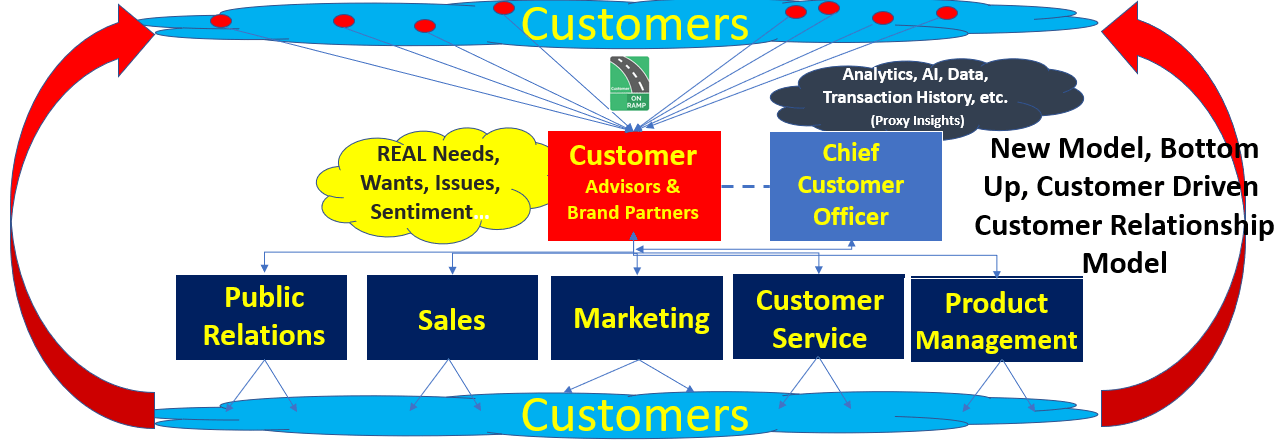
There is an organizational customer inversion-revolution going on and it will only accelerate in the future. What this revolution entails is a complete inversion of the customer decision making structure for companies, one where the customers (vs. the company) are in charge, leading the design of customer strategy and future customer programs. I call it the customer inversion revolution. This inversion looks something like the chart below. We will detail this customer organization inversion-revolution in following sections of this blog.

FROM:

Traditional Customer Service Organization

TO:

Customer Service Organization Inversion-Revolution

Key to implementing this customer organizational inversion-revolution is the development of customer inclusionary “on ramps” (shown in the green symbol above) that allows customers to participate and join the company team as brand partners, advocates, insights experts, advisors, etc. We will cover this more in depth in following sections but hence forward, customer on ramps will be designated by this symbol below:

Customer Inclusionary Onramp

These onramps detailed in the following blog increase customer inclusion by their very nature of creating an array of customer chosen methods for these customers to contribute to and participate in the company’s success. The enhanced diversity is derived from tapping into and leveraging the diverse set of perspectives and needs from existing customers that represent a cross-section of different cultures, races, genders, ages, political views, national origins and religions, etc. so that the best product and/or services are engaged in the marketplace.

Many companies have omitted these onramps in the vetting of new products, services, marketing campaigns, etc. and have ended up offending and alienating their own customers and potential prospects. A great web article points to how companies have fielded expensive and disastrous marketing campaigns and ads in the past only to have to quickly pull them from the market. These campaigns/ads are often a result of corporate myopathy and not taking into account a multitude of diverse perspectives enabled by an array of customer D&I onramps: “7 of the most controversial ads of our time” https://www.thedrum.com/news/2019/04/08/7-the-most-controversial-ads-our-time. A major West Coast bank vets all of it marketing concepts through a customer insights group (covered below) before ever releasing the ad and/or campaign into the market. Only after the CIG group (onramp) has weighed in and provided their approval and feedback will this bank to go market with their marketing concepts.

Bottom line, these onramps enable your customers to become brand and company partners/advocates who, through time and continued onramp participation, develop an ever increasing vested interest in the brand(s) and company success.

To be receptive to this change and to get onboard with customer leaders who are in the process of putting customers in charge and implementing the customer organizational inversion-revolution, you must first have a foundational customer centric culture. Companies that are implementing this customer centric change and building customer brand partners include Apple, Southwest Airlines, Ritz Carlton, Amazon, Marriott, Bank of America, Wells Fargo, etc. Let us first explore what a customer centric culture is and the spectrum of companies on the customer centric continuum.

B) The Customer First, Customer Centric Culture

To begin with, almost every company claims to be customer centric, that their customers are their most important asset, customer satisfaction is a priority, etc. In practice I have found that there is a spectrum of truth to these public statements ranging from treating customers as a necessary commodity to the other end of the spectrum and treating customers as equal and respected partners and treating customers as a true extension of the company-employee team.

Referring to the chart below, we can see that spectrum of company cultures and their treatment of customers based on these different company customer cultures. To simplify this illustration, I have only included 3 types of companies as follows (along top of chart):

Customer Centric Company Spectrum

  1. “Customers are our most valuable asset”: Companies that truly value their customers and view them as an integral part of their team and company’s success. This type of company also maintains a true customer first culture, policies, standards, etc. (right side of chart, spectrum).
  2. “We Value our Best Customers”: Companies that only strive to cater to their most valuable customers since these customers benefit the company the most (middle of chart, spectrum).
  3. “Customers are a Necessary Commodity”: Companies that interact and ‘deal with’ customers when it benefits them (they pay lip service to slogan ‘customers are their most important asset’), left side of chart, spectrum.

On the left side of the above chart, we have a number of customer facing dimensions including the following:

1) “Customer Input”: How the company views and approaches soliciting customers for insights, input on new programs, detailed feedback (i.e., focus groups, crowdsourcing, etc.), etc.
2) “Customer Complaints”: How the company views and approaches the handling of customers complaints.
3) “Customer Inclusion, Partnership”: How the company approaches being customer inclusive by offering customers ways to partner with the company including online communities, customer co-blogging, customer spotlights, etc.
4) “Customer Engagement”: How the company approaches customer communication and creates a rewarding and engaging customer experience.

Companies located on the far-right side of the chart have the following belief that is not only a slogan, but embodied in the company culture, operations, practices, standards, rewards systems, etc.:

“Customers are our Most Valuable Asset”.

For the first customer dimension on the left side of the chart, “Customer Input”, a comment that I heard from a CEO with this type of culture is as follows:

“We make no (major) decisions (that will impact the customer) without the customer’s direct input”.

For the first customer dimension of “Customer Complaints”, a company CEO said the following,

“Customer complaints are a valuable insight and gift to help us improve, beat our competition”.

You can read the comments for each type of company aligned to each customer dimension. Bottom line, without a foundational customer first mindset, rewards and incentive system and culture, you will be impeded on implementing the effective customer inclusion program with many possible customer onramps detailed in the remainder of this blog.

C) Mainstream Customer Inclusionary Programs & Onramps:

As I mentioned before, once you have established a totally customer centric culture, the 2nd step is to build customer incremental onramps for the customer to become a brand partner and an integral part of the customer team. These onramps invite the customer to participate in a number of activities that will increase customer satisfaction (CSAT), loyalty, NPS, viral referrals, etc. Based on my experience, building these customer inclusionary onramps can net your company huge increases in key customer measures as follows:

1) NPS: +14 to 49
2) Customer Loyalty: + 4% to 36%
3) Customer Positive Sentiment: +12% to 71%
4) Customer Viral Referrals: +11% to 26%

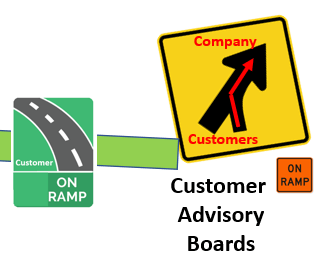
Customer On-Ramp: Customer Advisory Board Program

1) Customer Advisory Board Program:

A Customer Advisory Board (CAB) is the composition of a group of trusted, and generally top customers, who meet on a regular basis (i.e., Quarterly) to advise the company on strategic direction such as the product and/or service roadmap and on upcoming major new programs. Customer advisory boards (a.k.a. trusted customer advisors) can also be a conduit to award top customers for their input, loyalty, spend, referrals, etc.

At a top US automotive company, we invited our top and most open/honest customers to these focus group and advisory events, paid their travel expenses, hosted a nice dinner reception and, at the end of the session, gave them an appreciation gift for their continued participation and loyalty. We also had Platinum private customer events for our top 1% spend customers which were meetings with the EVP and above for open-ended candid feedback & insights gathering discussions.

Customer On-Ramp: Customer Insights Group Program

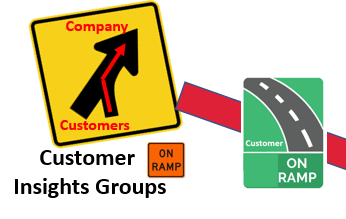
2) Customer Insights Group Program:

A Customer Insights Group (CIG) is the composition of a wider cross-section of customers or specific customer segment(s) who meet on a regular basis (i.e., weekly, quarterly) to advise the company on new tactical programs, proposed sales campaigns, and marketing concepts, provide feedback on existing program effectiveness, provide customer experience insights based on their own actual experience, etc. Customer insights groups are usually on a voluntary enrollment basis and typically come with some sort of incentive to participate (i.e., participate and be entered in a drawing for a gift certificate).

A top 5 US bank uses these extensively and there is a directive from the CMO that no new marketing programs/materials/etc. will be fielded without first getting the input of this insights group. After implementing this program, marketing effectiveness increased by an overall 27% and the loyalty of the group increased by a whopping 38% as compared to non-CIG participants. When surveyed, 92% of CIG members indicated that they told 26+ about their positive perception of this bank CIG program (survey choices were 0-5, 6-10, 11-15, 16-25 or 26+).

Amazingly enough, 5,000 participants volunteer up to 8 hours of their time per week to participate with another 5,000 eagerly waiting in the wings for their term to participate (participation is limited to a 2-year term).

In addition, by tapping into a diverse customer set, the bank was able to avoid potential marketing disasters by stopping the fielding of proposed marketing materials that were deemed offensive and culturally insensitive by members of the customer insights group.

Customer On-Ramp: Customer Co-blogging & Co-Authoring Program

3) Customer Co-Blogging & Co-Author Program:

Customers telling their story (the voice of the customer) about their success in using your product/service and their customer experiences are 5-7x more credible than coming from the company. In addition, customer authors bring with them an entirely new audience sphere (their friends, connection, relatives, etc.) which will result in a dramatically increasing your website traffic, SEO, referrals, etc. Customers love the opportunity to be spotlighted and write their own story (with helpful company editing of course) when it comes to their experience interacting with the company. Co-blogging can also be about customer stories with a human-interest side to it vs. always being business oriented. Customer co-authored articles can be about topics such as how to gain the most value from the product/service, tips/tricks they have learned, the value they have gained from using same, etc.

We recently used this for a struggling newsletter program that had only penetrated 27% of our customer base. Six months after I implemented the co-blogging program, the newsletter distribution grew to 56% of our customer base and we experienced a simultaneous increase of 17% in new visitor web traffic.

Customer On-Ramp: Top Customer Appreciation & Recognition Program

4) Top Customer Appreciation & Recognition Program:

Remember the movie “Up in the Air” with George Clooney? He was a top traveler who strived to be in the 1% club in terms of air miles flown per year on a particular airline whereby, if he achieved this distinction, he would then be invited to an awards dinner with the CEO of the airline and be showered with a whole host of flying perks after achieving that level of spend/loyalty. Banks, hotels, brokerage firms, etc. all have an array of top customer loyalty rewards programs.

For the very top customers, there are more hands-on personal perks like a dedicated/private concierge assigned to customers like for the American Express Black credit card which can only be obtained by direct invite by American Express (i.e. not via request). A top US air conditioning company I used to work for had top distributorship recognition events for the distributors who sold the highest revenue generating air conditioning units. While focused internally for a company, many salespersons have benefitted from such top achievement loyalty programs by achieving the distinction as top salespersons for their companies and being rewarded with trips, cash, luxury items, cars, etc. as a thank you for their contributions.

Customer On-Ramp: Customer Product/Service Beta Group Program

5) Customer Product/Service Beta Group Program:

Before top companies like Microsoft and Apple ever release a new product into the market, they first try these new products with limited volunteer beta groups. They gather feedback from these beta test groups and then continuously improve the beta product before releasing the product to mitigate potentially disastrous consequences of releasing products with potential flaws that internal testing failed to consider via their test cases.

Customer On-Ramp: Customer Success Program

6) Customer Success (Spotlight) Program:

Does your company have successful customers using your product and/or service? Why not showcase or spotlight this success by detailing what they did, how they did it and the value they were able to derive from doing so? Challenge customers to submit their success stories for selection to spotlight in the newsletter, website, articles, FAQs, consideration for prizes for the top stories, etc. The more customers witness real customer successes, the more other customers will want to figure out how to acquire your product/service to emulate the success of other customers.

Customer On-Ramp: Ambassador Program

7) Customer Ambassador Program:

The Syracuse University (SU) admissions and student success programs received a big boost with the adoption of its Alumni ambassador program whereby successful alumni would volunteer to host regional recruiting events, student college send-off events, and answer questions from interested students in their area. Alumni ambassador groups increased the level of excitement and enthusiasm for new students and families while simultaneously decreasing the levels of anxiety and confusion among students and families.

The entire ecosystem of a customer first, customer inclusive company that has inverted the customer organizational structure and has built a comprehensive set of customer onramps to be able to put customers in charge of customer operations would look something like the following chart:

Customer Inclusionary & Participatory Programs, Onramps

D) Other Customer Inclusionary Programs & Onramps:

In addition to the more popular and mainstream customer inclusionary programs above, there are several other programs that I have encountered that were effective by increasing the levels or customer loyalty and creating many customer-brand zealots (those who actively and aggressively advocate for the brand/company).

Customer On-Ramp: Creative Council Program

1) Customer Creative Council Program:

Many customers have a wide range of creative talents outside of simply being a customer. A company with a large customer base tends to have customers who are very creative such as artists, craftspeople, etc. A large SaaS software firm I consulted for would solicit creative ideas for new campaign concepts from the creative group among their customer base (and sometimes from their employees) to get the best creative concepts as possible. Many times, customers would develop far more appealing creative concepts than their own dedicated creative talent working within the company. Why not source from the best of the best, including creative customers?! This would allow the company to harness this creativity while allowing creative customers to be spotlighted for their hidden talents and feel valued by the company.

Customer On-Ramp: Talent Showcase
Program

2) Customer Talent Showcase Program:

Beyond just being creative, a company with a large customer base typically includes customers who are also poets, book authors, those with interesting and varied professions such as paramedics, volunteer firefighters, food bank volunteers, world travelers, iron men or women, triathletes, extreme cyclists, paragliders, scuba divers, treasure hunters, etc. Many companies I have worked with have conducted customer showcases that highlight the interesting lives of their customer base beyond merely being a customer. These personal story showcases add a human-interest side to the customer base and tend to make customers feel more connected to and understood-appreciated by the company.

Customer Journey Customer Co-Mapping

3) Customer Involved Customer Journey Mapping & Continuous Improvement Program:

Are you planning on creating a customer journey map and want to know what the important steps and metrics are in that journey? Why not invite the customer to join in on these development sessions to provide the team with some insights, feedback, important items to consider? I have used this approach quite effectively and have developed far more qualitative customer journeys as a result. I used this approach to develop a brand new and innovative customer journey map I have labeled “The Quantifiable Customer Journey Map”. Refer to my previous blog article for insights here: https://bit.ly/3bvPRal

The Quantifiable Customer Journey Map

Bottom line, without the customer’s input, the high quality achieved in the final customer journey map would have been much more difficult and time consuming to achieve.

Customer Diversity & Inclusion Council

4) Customer Diversity & Inclusion Council:

A few companies I have worked with in the past have managed and conducted employee diversity councils whereby employees would provide their perspective on how the company can be more diverse, culturally sensitive, and overall inclusive.

A few companies have taken this further and included their own customers into the diversity council along with their employees. In this manner, the company ensures that it is considering the widest possible perspective on D&I and not falling victim to company group think.

Regardless of whether you include a formal customer diversity council, what all the above illustrated customer onramps do in essence is help build a company culture that supports customer diversity and inclusion (D&I) as follows:

1) Enables the assembling of a diverse set of perspectives, based on unique and diverse set of customer experiences, needs, etc.
2) Provides diverse feedback on potential new customer programs, marketing, etc. that might be perceived as offensive and discriminatory to certain customer groups.
3) Enables customers to showcase their diverse backgrounds, talents, interests, viewpoints.
4) Enables a voice of the customer cultivation that represents the full cross section of diverse customers.
5) Enables the delivery of the best of the best solutions by allowing feedback on proposed programs from a wide and diverse set of customers.

If your organization is seeking experienced assistance in creating these customer onramps and a more diverse and inclusive and customer first organization where customers are leveraged to assist the insights Chief Customer Officer (CCO) and are transitioned to full brand-partners/advocates/participants/etc., then give me a call or e-mail me at 518-339-5857 or stevenjeffes@gmail.com. I am also a Certified CultureTalk (https://culturetalk.com/) consultant that can help you develop and/or improve a customer-oriented, customer first culture.

Steven Jeffes, Certified CultureTalk Consultant

Lastly, this is just one article of over 50 articles I have written on customer strategy, customer experience, CRM, sales excellence, marketing, product management, competitive intelligence, corporate innovation, change management – all of which I have significant experience in delivering for numerous Fortune 500 companies. In fact, my blog is now followed by nearly 107,000 world-wide and was just named one of the top 100 CRM blogs on the planet by Feedspot, alongside Salesforce.com, Infor, Microsoft, SAS, etc. – Reference this informative site here: https://blog.feedspot.com/crm_blogs/ .

Measuring Merger & Acquisition (M&A) Cultural Risk and Compatibility (Target, Acquirer)

In this blog article, you will quickly learn the following:

  • What is the #1 success factor for M&A deals to succeed?

  • What are the top reasons M&A deals fail in terms of delivering the expected ROI?

  • The typical best practice M&A process and how this misses and/or plants a culture compatibility “ticking time bomb” that leads to the deal’s eventual failure.

  • The underlying reasons M&A deal makers are actually trying to hide these hidden M&A cultural time bombs that will leave them making top $$$ while leaving you holding an empty bag of cash in which cultures collide and chaos ensues

  • How pre-deal cultural compatibility & risks can now be measured!!

  • Examples of pre-deal measurement of Cultural Risk in M&A Deals

  • How to identify acquirer & target pre-deal cultural types

  • How to identify pre-deal culture conflict points

  • How to identify pre-deal cultural synergies (acquirer-target)

  • How you can actually change your M&A process to include pre-deal measurement of cultural risk and compatibility prior to deal closure!

Top Factors for M&A Success

Culture is top factor in M&A Success

We all know in our gut or have heard that culture is a top factor that either makes or breaks a M&A deal. Above is the proof that it actually is #1.

Top Factors in M&A Failures

Culture is a Main Factor as to Why M&A Fails


We also all have heard numerous stories as to how Culture consistently has made mergers a disaster, resulting in minimal or negative M&A deal return! Above is proof that culture is a top reason for M&A failures (reasons #2, #3, #4 & #8).

Typical M&A Deal Lifecycle

Culture Is Typically Ignored Until Post M&A Deal

Yet, when we examine supposed best practice M&A process life-cycles as above, we are hard pressed to find where culture is even a consideration and cultural compatibility examination most likely comes post-deal closure when it is too late. Examining whether the two cultures will work well together post-deal is like trying to stop an accelerating train from crashing into the station at 150 MPH with less than a mile to go.

Measurable M&A Cultural Compatibility Analysis Now Available!

Enter the new Cultural Measurement Tool, CultureTalk

Many that I speak to say that the main reason culture is ignored vs. the financials is that the deal makers want to profit from the transaction and are opposed to alerting the acquiring company of the latent risks.  

It is therefore mostly assumed that cultural incompatibility can be ‘managed’ via heavy handed company directives post-deal.  It lastly assumes that the ability to measure and quantify pre-deal cultural (in)compatibility is not possible. That last statement was most certainly true until culture analysis tools like CultureTalk were recently introduced to the marketplace.

First, some background on how CultureTalk was formulated. CultureTalk, is based on the work of Swiss psychotherapist Carl G. Jung who believed that human behaviors are guided by the same inner roadmap and by shared Archetype patterns.  CultureTalk answers the question ‘Who are we?’ in terms of which specific Archetype (1 of 12) best defines our overall organization.  CultureTalk also offers a companion tool to measure the Archetypes of individuals, which takes the work deeper and allows leaders to understand how their personal styles are contributing to success or conflict.

There aren’t good or bad Archetypes, but each has a strength and shadow side that we need to understand in order to drive maximized organizational effectiveness and this is especially true when merging two different Archetypal cultures.

Here is an overview of each of the 12 Archetypes:

CultureTalk Assigns Organizations (and Individuals) to 1 of 12 Archetypes

Based on Analysis Insights, CultureTalk Assigns Organizations (and Individuals) to 1 of 12 Archetypes

*Above Graphic courtesy of CultureTalk

Each of the 12 Archtypes above comes with a set of predominant strengths (shown above) and shadows that need to be understood and managed.

CultureTalk Measures M&A Cultural "Behavioral Gaps"

M&A Acquiring Company & Acquired Company Cultural & Gap Analysis

*Above Graphic courtesy of CultureTalk

By performing an organizational CultureTalk assessment, M&A Deal makers and stakeholders can quickly determine the risks, compatibilities and behavior gaps that need to be managed.

M&A Culture Conflict Analysis

CultureTalk Identifies Potential (Pre-Deal) M&A Culture Conflicts that need to be Managed

*Above Graphic components courtesy of CultureTalk and Brand Foundations

By performing an organizational deep dive assessment, M&A Deal makers and stakeholders can unearth all potential train wrecks that typically cause M&A deals to fail and then develop an action plan on how to manage these pending collision points to win-win scenarios (target company, acquirer).

Potential M&A Culture Conflicts - Revealed, Pre-Deal

Actual Cultural Conflict Points for a Recent US M&A Deal

*Above Graphic courtesy of CultureTalk and Brand Foundations

By performing a culture quadrant conflict analysis, M&A Deal makers and stakeholders can identify and isolate the specific points where merging cultures are very likely going to collide. They can then develop an organizational mitigation design and organizational development road-map to carefully and judiciously manage to these conflict points. Without this, I have witnessed the meltdown of M&A deals and, most importantly – the death knell of companies, the rapid defection of customers at a non-sustainable long-term rate (hence my CRM connection to M&A and Culture).


CultureTalk Measures M&A Cultural Synergies or "Connections"

CultureTalk Measures M&A Cultural Synergies or “Connections”

*Above Graphic components courtesy of CultureTalk and BrandFoundations

By performing a culture quadrant synergy analysis, M&A Deal makers and stakeholders can develop a plan for accelerating mutually compatible cultural connection (or compatibility) points. By identifying and capitalizing these cultural synergies, the two companies can adopt a hybrid culture consisting of the best of the best blended cultural practices.

That concludes my overview of measuring and managing cultural risk  pre M&A deal and how it can optimize the value of the M&A transaction

If your organization is seeking experienced assistance in measuring the pre-deal M&A risk and then managing to this risk to optimize the merger investment, then give me a call or e-mail me at 518-339-5857 or stevenjeffes@gmail.com

Lastly, this is just one article of 40+ total I have written on Customer strategy, CRM, marketing, product management, competitive intelligence, corporate innovation, change management – all of which I have significant experience in delivering for Fortune 500 companies.  In fact, my blog is now followed by nearly 160,000 world-wide and was just named one of the top 100 CRM blogs on the planet by Feedspot, alongside Salesforce.com, Infor, Microsoft, SAS, etc. – Reference this informative site here: https://blog.feedspot.com/crm_blogs/

* CultureTalk is an organizational culture assessment and audit system that provides in-depth training and materials to deliver engagements with leaders and teams. (https://culturetalk.com/)


* Brand Foundations is a CultureTalk Certified Partner and utilizes the suite of assessments and tools to work with clients across diverse brand development and organizational culture projects. (http://www.brandfoundations.us/)

Tools & Techniques to Ensure Alignment of Corporate Activities and Initiatives with Overall Company Strategic Objectives

  1. Are your employees focused on driving toward your strategic objectives, day after day, week after week, quarter over quarter? Or are they focused on lesser important tactical tasks that don’t always support these strategic objectives?

  2. Can you specify which percentages of your team’s activities are spent working toward your strategic goals vs. the percent spent on tactical, non-strategic objectives?

  3. Do you have a set of tools to easily and simply track progress toward completion of strategic objectives, down to the initiative, project, and task?

  4. Do you have a set of world-class program and project management tools to leverage to ensure organizational alignment with company priorities?

If you answered “No” or I don’t know to any of the above questions, the rest of this blog is dedicated toward helping you get to “Yes” for all of the above 4 questions in 4 easy steps (my “4-in-4” delivery promise).

Develop and Prioritize Top Strategic Company Objectives

Develop and Prioritize Top Strategic Company Objectives

xxx

STEP 1 – Develop and Prioritize Top Strategic Company Objectives

Above is a set of strategic objectives I helped develop for a financial services client who was struggling with customer loyalty and experiencing higher than standard customer defection rates to their competitors.  Through a series of interviews, workshops and visioning sessions, we arrived at the top four (4) strategic CRM objectives above and then mapped out the major customer interaction outlets (a.k.a. touch-points) in order to map the stakeholder groups that would be involved in helping my client achieve these four strategic objectives.

Map Top Strategic Company Objectives to both Functional Areas and to Supporting Major Initiatives

Map Top Strategic Company Objectives to both Functional Areas and to Supporting Major Initiatives

xxx

STEP 2 – Map Top Strategic Company Objectives to both Functional Areas and to Supporting Major Initiatives

The next step in the process was to map the customer interaction outlets shown on the previous slide and then perform the following:

  • Overlay the stakeholder groups (shown on the outer part of the above diagram) that will be involved in helping achieve each of the four strategic initiatives shown in the center.

  • Map the strategic objectives that each of the stakeholder groups would be involved with implementing (i.e. bulleted items “Customer Information Profiles”, “Customer Needs Fulfillment”, etc.)

  • Develop a program and project plan with required resources from:

  1. From outside the company (consulting),

  2. From each of the stakeholder groups (subject matter experts, project liaisons, etc.)

  3. Technology Purchases

  4. Sourcing Agreements

  5. etc., etc.

Map Top Strategic Company Objectives to Supporting Major Initiatives, Projects and Activities

Map Top Strategic Company Objectives to Supporting Major Initiatives, Projects and Activities

xxx

STEP 3 – Map Top Strategic Company Objectives to Supporting Major Initiatives, Projects and Activities

The next step in the process is to develop a mapping from Strategic Objectives to the Supporting Initiatives and the projects/activities that support these major initiatives. It is important to develop a unique coding system (or Work Breakdown Structure (WBS)) for each strategic objective, major supporting imitative, project and activities within each project so they can be tracked within a time management system. Here is an example as partially illustrated in the above diagram.

WBS Level 1: Strategic Objective 4 = “Correct Action, Correct Time, Correct Customer”;

    WBS Level 2: Initiative 1 Supporting Objective 4 = 4CR1 or “Customer      Referrals”

      WBS Level 3: Project 1 Supporting Customer Referrals =                  xxxxx 4CRCCIFG1, “Conduct Customer Incentive Focus Group”

          WBS Level 4: Activity 1 Supporting Conduct Customer Incentive                Focus Group = 4CRCCIFG1A1, “Determine Focus Group                                  Participants”

Once you have determined the entire work breakdown structure for all strategic initiatives, tracked to initiatives, project and all activities, down to the 4th level (i.e. 4CRCCIFG1A1), you can then load these into your time management system to track how much time is being spent on these strategic objectives & tasks vs. all other time management tasks.

Related to the above topic, does your organization need world-class and experienced assistance with any of the following?:

  • Determining your next strategic direction?

  • Setting prioritized strategic goals?

  • Driving organizational efficiency?

  • Ensuring corporate strategic initiatives are aligned with current projects, activities and tasks?

If so, give me a call, I call help you achieve world-class strategic programs that enable you to surpass your competition and bring your organization to the next level of strategic goal development and attainment.

Lastly, this is just one article of 40+ total I have written on Customer strategy, CRM, marketing, product management, competitive intelligence, corporate innovation, change management – all of which I have significant experience in delivering for Fortune 500 companies.  In fact, my blog is now followed by nearly 160,000 world-wide and was just named one of the top 100 CRM blogs on the planet by Feedspot, alongside Salesforce.com, Infor, Microsoft, SAS, etc. – Reference this informative site here: https://blog.feedspot.com/crm_blogs/
360° Organizational Health Check & Strategic Plan for the Future

Organizational Health Check & Diagnostic

Organizational Health Check & Diagnostic

Does your company encounter any of the following, yet you are unable to determine the root cause?

  • Loss of Market Share vs. Competitors

  • Eroding Profit Margins

  • Employee Churn

  • High Cost of Goods Sold (COGS)

  • Sales and Marketing Ineffectiveness

  • Data & Information Gaps or errors

  • Lower Morale

  • Declining Productivity

  • Inefficient Processes, leading to ever growing labor costs

  • Lack of automation vs. competitors

If you answered “Yes” to any of the above, then perhaps you should consider conducting an organizational health check diagnostic to determine your company’s current state across a number of corporate capabilities.  This assessment will lead to the following valuable and actionable organizational insights:

  • Key organizational gaps

  • Management strengths & weaknesses including developmental needs

  • Organizational strengths

  • Organizational aspirations for future capabilities and performance

  • A set of prioritized future state capabilities

  • A 5-year road-map for building your future state capabilities including business case and ROI for each future-state road-map initiative

Process for Organizational Diagnostic & New Strategic Plan Development

Process for Organizational Diagnostic & 5-Year Strategic Plan Development

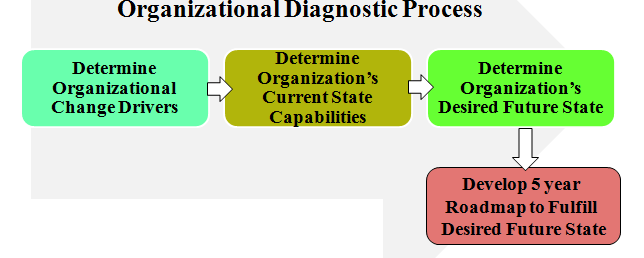
While the organizational health check and diagnostic is very extensive and comprehensive, the overall high level process used can be distilled down to four (4) easy steps as follows:

  1. Determine Organizational Change Drivers – Through a series of Key stakeholder interviews and work-shops, determine what the top line organizational issues and change drivers are in order to use them as input into diagnosing the organization’s current state

  2. Determine Organization’s Current State Health & Capabilities – Through a series of Key stakeholder interviews and current state assessment work-shops, holistically baseline the company’s top line organizational capabilities – sales, marketing, financial practices, organization, management practices, processes, etc.

  3. Determine Organization’s Desired Future State – While interviewing key stakeholders determine gaps in the current set of holistic capabilities and determine a consensus for key future state capabilities that need to be developed, implemented and/or evolved.

  4. Develop 5Year Future State Fulfillment Road-map – Logically and systemically develop a blueprint for when and how to implement the needed capabilities of the future determined in step #3

Business Change Drivers

Per step #1 of the process, above is an example of a set of high level organizational change drivers that were cultivated through a series of executive interviews.

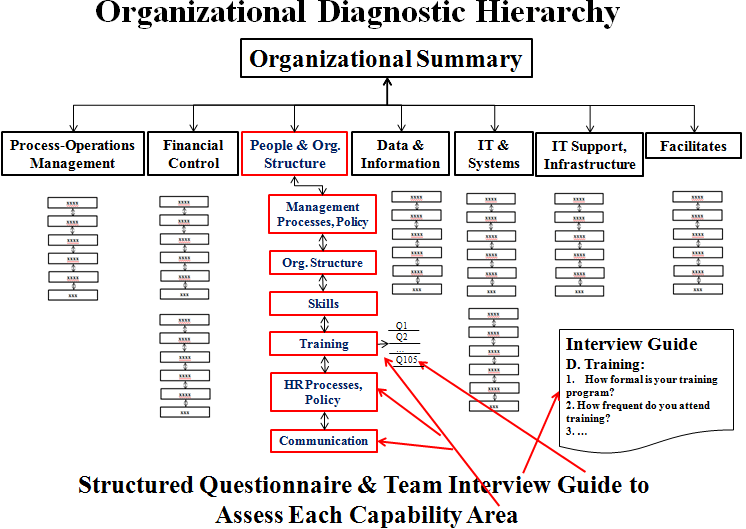
Organizational Capability Diagnostic Structure

In order to holistically assess an organization’s current state health and capability levels, I have developed a comprehensive and systemic diagnostic process along with structured questions and interview guides used to interview key stakeholders and to conduct assessment work-shops.

Sample Client Organizational Diagnostic Analysis Executive Summary

Sample Client Organizational Diagnostic Analysis Executive Summary

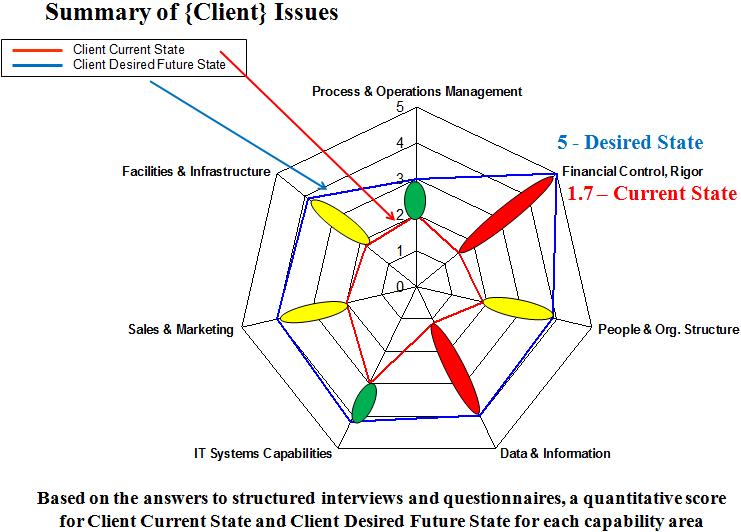
Above is a great tool I use to perform a final read-out summary of an organization’s current state health assessment. The chart is an Excel Spider Chart (Google it and how to create) and is used to benchmark an array of multi-dimensional capabilities. In this example, based on the summary of all interviews and workshops, the red line represents the summary score for seven (7) current state capability areas for a large pharmaceutical client.

The blue line is the summary consensus score for what the organization feels should be the capability levels for the future state for these same seven (7) capability areas.

A green oval represents a small gap between current and future state capability levels; a yellow represents a moderate gap; and, lastly, a red oval highlights a large or very large gap between current and future state capabilities (e.g. Financial Control, Rigor).

People & Organizational Structure Diagnostic

People & Organizational Structure Diagnostic

Above is a sample “deeper dive” into the analysis performed under the capability area “People & Organizational Structure” shown in the previous executive summary chart. In this example, we see that “Communication” and “Management Processes, Policy” have the largest capabilities gaps while “Skills” and “Organizational Structure” have the smallest capability deltas (difference between current state and desired future state).

This is just one article of 40+ I have written on Customer strategy, CRM, marketing, product management, competitive intelligence, corporate innovation, organization excellence & change management – all of which I have significant experience in delivering for Fortune 500 companies.  My blog is now followed by nearly 158,000+ world-wide and was just named one of the top 100 CRM blogs on the planet by Feedspot, alongside Salesforce.com, Infor, Microsoft, SAS, etc. – Reference this informative site here: https://blog.feedspot.com/crm_blogs/
 

Change Management Best Practices & World-Class Change Deployment Methodology


slide1

Best Practice Change Management Framework


Any change initiative should employ a proven & world-class change management implementation framework

slide2

Best Practice Change Management Project Approach & Plan – Define Goals, Obtain Buy-In

Change Management Methodology: Any change initiative should employ a proven & world-class change management implementation framework. Best Practice Steps to Define Change Goals and Obtain Buy-In for the Change

slide4

Best Practice Change Management Project Approach & Plan – Design Change Approach

Change Management Methodology: Best Practice Steps to Designing a Solid Change Approach

slide5

Best Practice Change Management Project Approach & Plan – Develop and Deploy Change

Change Management Methodology: Best Practice Steps to Developing and Deploying Change

slide6

Best Practice Change Management Project Approach & Plan – Deliver Change Results

Change Management Methodology: Best Practice Steps to Delivering Change Results

slide3

Management’s Crucial Role In Supporting Change

Management Must Have Clearly Articulated Roles in Facilitating and Supporting any Change

slide7

Organizational Change Alignment Possible Outcomes

The graphic above depicts the various change outcomes possible. Following a solid change methodology can ensure the optimal state of “total alignment”

slide8

Change Initiative Ranking Analysis Techniques

A best practice change approach includes proven methods and techniques to evaluate potential change initiatives to undertake

slide9

Typical & Critical Change Initiative Roles & Organizational Structure

A world-class change approach includes mapping out change roles and delivering sufficient training and role change orchestration. This approach ensures that aspect of the organization is pulling together in synergy on every level following the implementation of the change.

slide10

Change Management Initiative Resource Plan

A world-class change approach includes mapping out a change implementation organization including the organizational inter-relationships, special committees and groups as well as specific roles and responsibilities.

slide11

The Role of Middle Management in Change Management

A world-class change approach must include middle management inclusion strategies

slide12

Managing & Mitigating Organizational Change Resistance

Careful Considerations must be made to anticipate and mitigate change resistance, including from middle management

slide13

Executive Support for Change Management

A world-class change approach includes planning how executive support will be applied during any change initiative

slide14

Change Management Strategies for Institutionalizing Change

Best practice change methodologies and strategies can mitigate the pitfalls associated with not institutionalizing a change which risks, over time, organizational drift away from the desired change state.

Change Management 101 Primer for Senior Executives (CEOs, COOs, CSOs, CMOs, CFOs, CCOs, etc.)

The following blog was written to provide a simple primer on Change Management for Top Executives. It is written so you ‘get it’ in 15 minutes or less of reading this article.

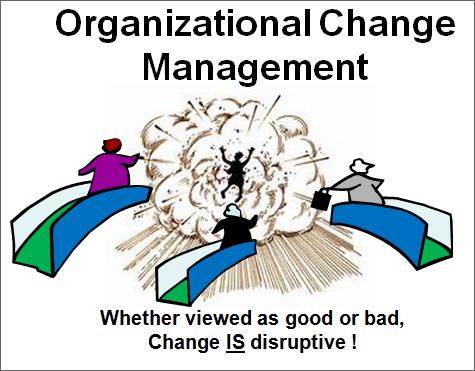
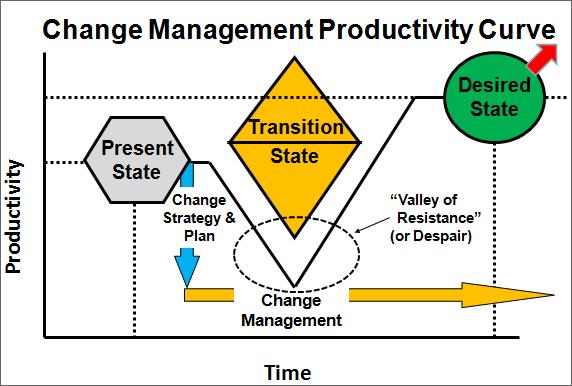
Change IS Disruptive, but Change Management Can Mitigate Impacts to Productivity

Change IS Disruptive, but Change Management Can Mitigate The Impact on Productivity

As a business leader, have you ever encountered the following challenges within your company:?

1. Implemented new technology or IT system and people failed to adopt & fully utilize it?

2. Implemented new processes and ways of doing business and your employees continued to follow the older methods?

3. Your competition continually seems to be evolving and innovating, developing new and more effective ways of doing business, while your company culture resists change and new ways of doing business?

The remainder of this blog is dedicated to sharing some of the techniques to get your organization to embrace and be supportive of change.  These change management techniques are based on my years of implementing change at organizations like Macy’s, American Express, Intuit, AT&T, Pfizer, Bristol-Myers Squibb, Oracle, CBS Interactive, Wells Fargo, and numerous other Fortune 500 companies.


Topics in this blog:

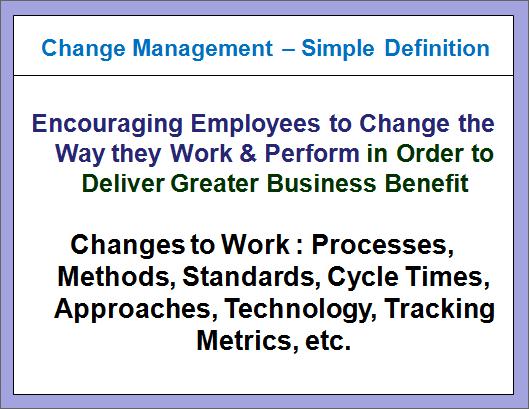
1)      What is Change Management – A Simple Definition

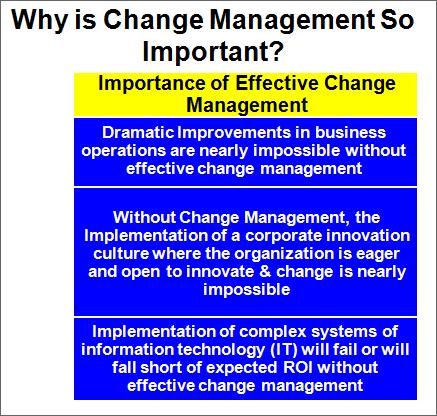
2)      Why is it Important?

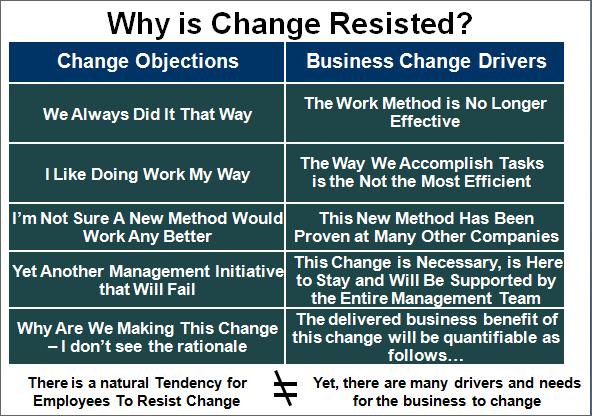
3)      Why is change resisted by so many employees?

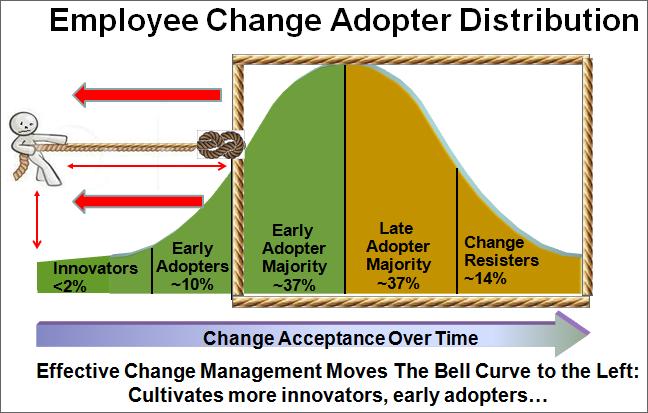
4)      Do all employees approach change the same way and how do you harness the power of the innovators and change ‘early adopters’?

5)      How Change Management Helps Accelerate Change

6)      Change Management Mitigates the Impact on Productivity while Implementing Change

7)      The Organizational Change Model Facilitates Change Success & Greater Business Results

8)      Steps in the Organizational Change Model Ensure Change Project Success

9)      The Importance of the eight (8) Change Management Steps

10)   Summary – Change Management & Innovation Requires a 360°, holistic approach driven by skilled and experienced change management professionals

1)    A simple definition of what change management is:

A Simple Definiton for Change Management

A Simple Definiton for Change Management

2)    Why is change management so important?

Why Is Change Management So Important?

Why Is Change Management So Important?

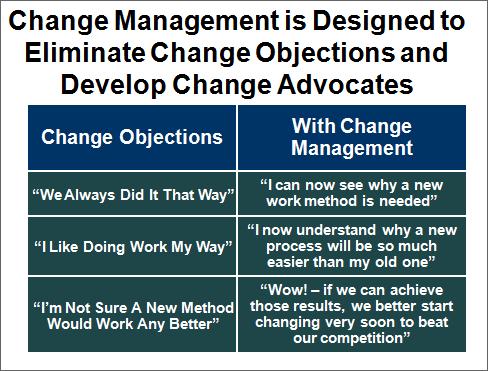
3)    Why is change resisted by many employees?

Why is change resisted by many employees?

Why is change resisted by many employees?

Bottom Line: Without proper education and motivation, change is naturally resisted within the workplace by all but a few.

4)    Do all employees approach change the same way?

Employee Change Adopter Curve

Employee Change Adopter Curve

As depicted by the above chart, employees range from ardent resisters to innovators. Change management solicits the support from innovators and early adopters to help diffuse organizational change to the remainder of the organization.   

5)    How Change Management Helps Accelerate Change

How Change Management Helps Accelerate Change

How Change Management Helps Accelerate Change

Change management not only removes obstacles to change, it helps develop enthusiasm and excitement for accelerated change in the future. 

6)    Change Management Mitigates the Impact on Productivity While Implementing Change

Change Management Productivity Curve

Change Management Productivity Curve

By having a robust change management methodology and plan, disruptions to business productivity can be minimized until the desired change state is achieved.  

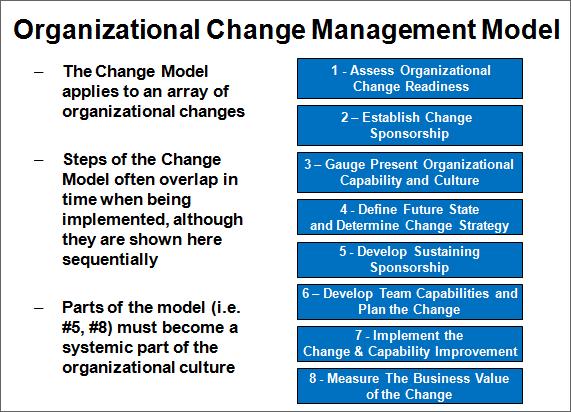
7)    The Organizational Change Model Facilitates Change Success & Greater Business Results

Organizational Change Management Model

Organizational Change Management Model

By having a robust change management methodology and model, change success and enhanced business performance can be nearly guaranteed.

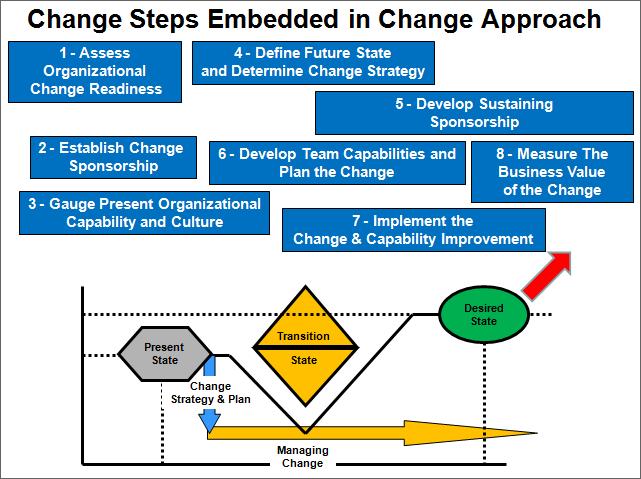
8)    Steps in the Organizational Change Model Ensure Change Project Success

Change Steps in The Change Management Approach

Change Steps in The Change Management Approach

Change projects must have clearly defined and measurable steps that align with the overall change methodology.  This approach greatly enhances the chance that the change project will be successful as well as facilitates the achievement of desired-positive business outcomes.

9)    The Importance of the eight (8) Change Management Steps

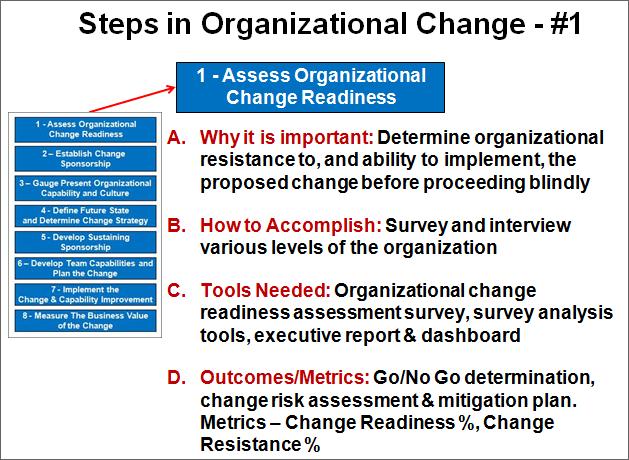
The next set of graphs highlight the importance of each step in the change management (project) process:

Step #1

Change Management - Step #1

Change Management – Step #1

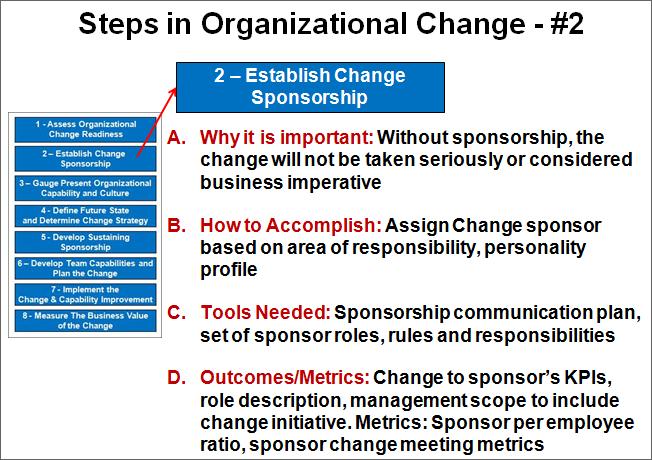
Step #2:

Change Management - Step #2

Change Management – Step #2

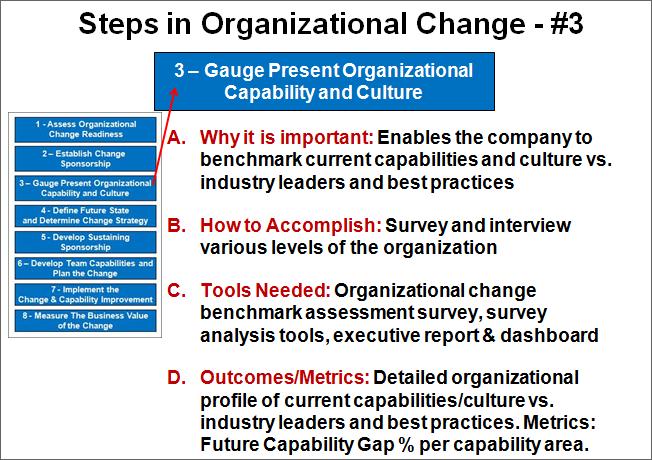
Step #3:

Change Management - Step #3

Change Management – Step #3

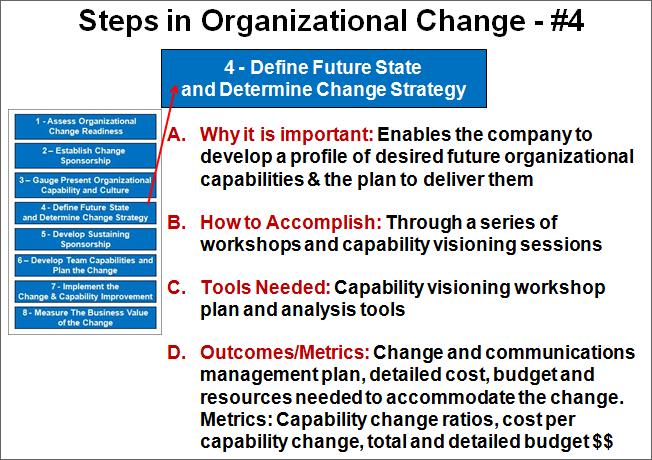
Step #4:

Change Management - Step #4

Change Management – Step #4

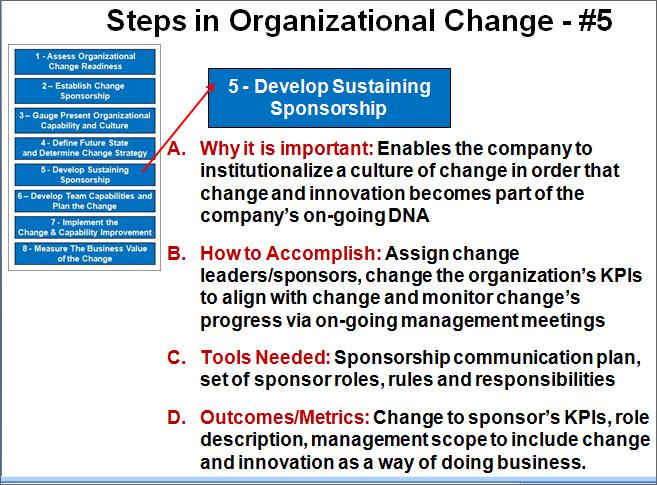
Step #5:

Change Management - Step #5

Change Management – Step #5

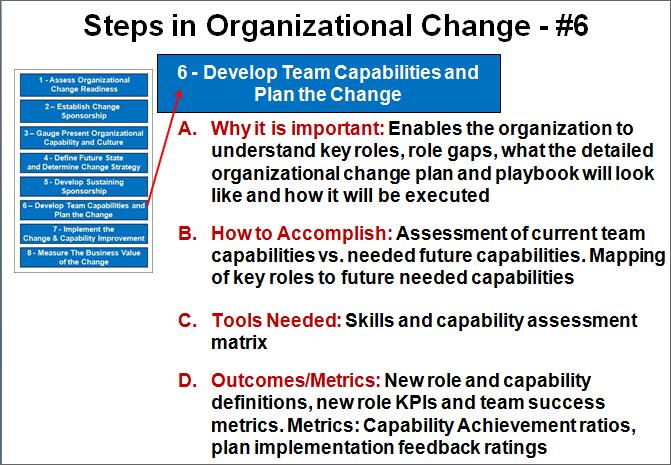
Step #6:

Change Management - Step #6

Change Management – Step #6

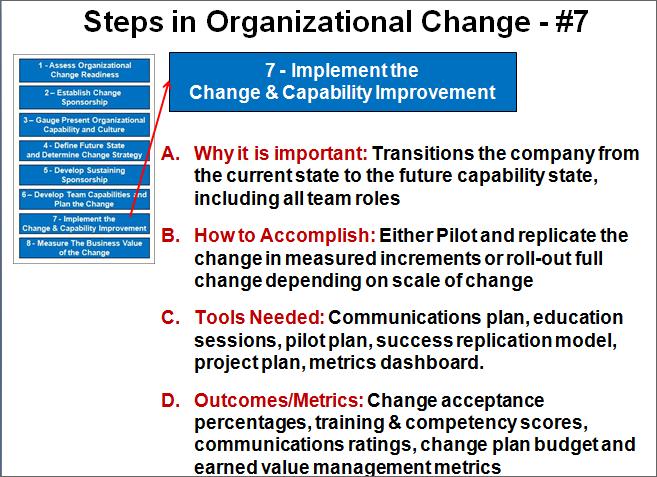
Step #7:

Change Management - Step #7

Change Management – Step #7

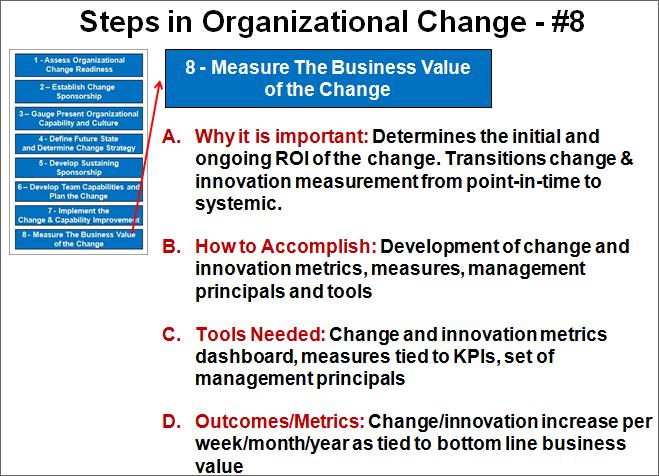
Step #8:

Change Management - Step #8

Change Management – Step #8

10)         Summary – Change Management & Innovation Requires a 360°, holistic approach

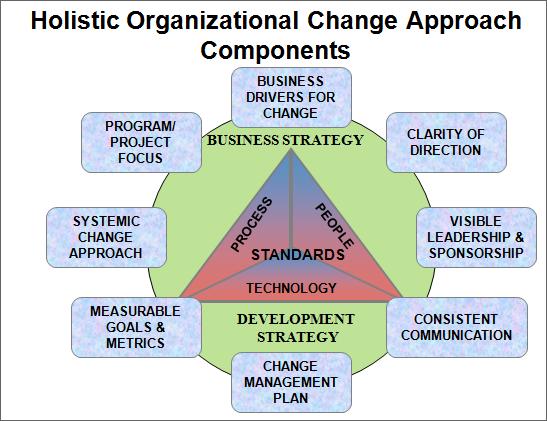
Holistic Organizational Change Components

Holistic Organizational Change Components

In summary, change management requires leveraging a proven change methodology, skilled change management practitioners and a holistic approach to implementing corporate innovation and change. The above is a simple depiction of a best practice approach I have used on many change management projects at many of the Fortune 500 companies in the US.