360° Organizational Health Check & Strategic Plan for the Future
June 15, 2018 Leave a comment
Strategic Planning Best Practices, Tools, Techniques

Does your company encounter any of the following, yet you are unable to determine the root cause?
Loss of Market Share vs. Competitors
Eroding Profit Margins
Employee Churn
High Cost of Goods Sold (COGS)
Sales and Marketing Ineffectiveness
Data & Information Gaps or errors
Lower Morale
Declining Productivity
Inefficient Processes, leading to ever growing labor costs
Lack of automation vs. competitors
- Ineffective Strategic Planning
If you answered “Yes” to any of the above, then perhaps you should consider conducting an organizational health check diagnostic to determine your company’s current state across a number of corporate capabilities. This assessment will lead to the following valuable and actionable organizational insights:
Key organizational gaps
Management strengths & weaknesses including developmental needs
Organizational strengths
- Strategic Planning Deficiencies
Organizational aspirations for future capabilities and performance
A set of prioritized future state capabilities
A 5-year road-map for building your future state capabilities including business case and ROI for each future-state road-map initiative
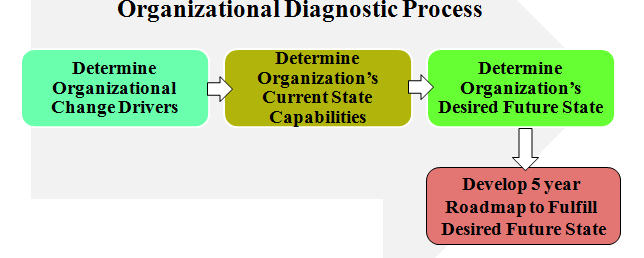
While the organizational health check and diagnostic is very extensive and comprehensive, the overall high level process used can be distilled down to four (4) easy steps as follows:
Determine Organizational Change Drivers – Through a series of Key stakeholder interviews and work-shops, determine what the top line organizational issues and change drivers are in order to use them as input into diagnosing the organization’s current state
- Determine Organization’s Current State Health & Capabilities – Through a series of Key stakeholder interviews and current state assessment work-shops, holistically baseline the company’s top line organizational capabilities – sales, marketing, financial practices, organization, management practices, processes, etc.
Determine Organization’s Desired Future State via Strategic Planning– While interviewing key stakeholders determine gaps in the current set of holistic capabilities and determine a consensus for key future state capabilities that need to be developed, implemented and/or evolved.
Develop 5–Year Future State Fulfillment Road-map – Logically and systemically develop a blueprint via Strategic Planning for when and how to implement the needed capabilities of the future determined in step #3

Per step #1 of the process, above is an example of a set of high level organizational change drivers that were cultivated through a series of executive interviews.
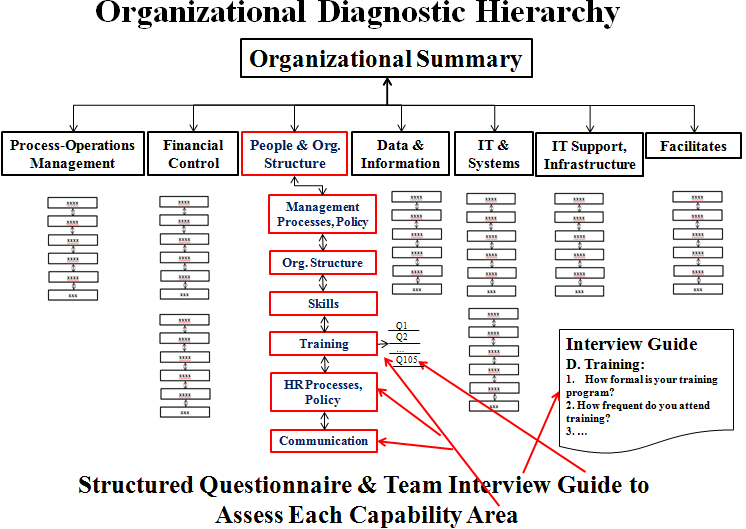
In order to holistically assess an organization’s current state health and strategic planning capability levels, I have developed a comprehensive and systemic diagnostic process along with structured questions and interview guides used to interview key stakeholders and to conduct assessment work-shops.
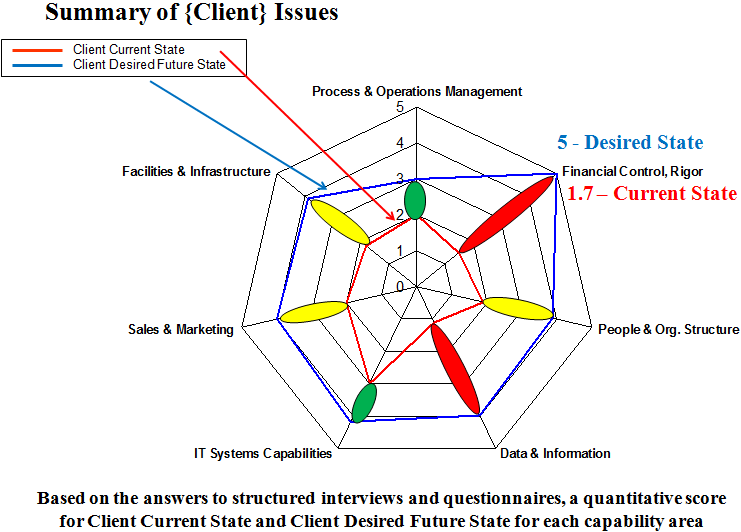
Above is a great tool I use to perform a final read-out summary of a the current state health assessment of the strategic planning results. The chart is an Excel Spider Chart (Google it and how to create) and is used to benchmark an array of multi-dimensional capabilities. In this example, based on the summary of all interviews and workshops, the red line represents the summary score for seven (7) current state capability areas for a large pharmaceutical client.
The blue line is the summary consensus score for what the organization feels should be the capability levels for the future state for these same seven (7) capability areas.
A green oval represents a small gap between current and future state capability levels; a yellow represents a moderate gap; and, lastly, a red oval highlights a large or very large gap between current and future state capabilities (e.g. Financial Control, Rigor).

Above is a sample “deeper dive” into the analysis performed under the capability area “People & Organizational Structure” shown in the previous executive summary chart. In this example, we see that “Communication” and “Management Processes, Policy” have the largest capabilities gaps while “Skills” and “Organizational Structure” have the smallest capability deltas (difference between current state and desired future state).
This is just one article of 60+ I have written on Customer strategy, CRM, marketing, product management, competitive intelligence, corporate innovation, organization excellence & change management – all of which I have significant experience in delivering for Fortune 500 companies. My blog is now followed by nearly 158,000+ world-wide.
For Additional Information on Strategic Planning Best Practices:
Organizational health is a critical factor in determining an organization’s ability to execute strategy, adapt to changing market conditions, and achieve long-term success. High-performing organizations regularly evaluate leadership effectiveness, organizational alignment, customer focus, operational performance, employee engagement, and strategic readiness to identify strengths, weaknesses, opportunities, and risks.
A comprehensive organizational health assessment provides leadership with valuable insights that can be used to improve decision-making, strengthen alignment across departments, increase organizational agility, and enhance overall business performance. When combined with strategic planning, these assessments can help organizations establish clear priorities, allocate resources more effectively, and develop actionable plans for sustainable growth.
For additional information on organizational health and strategic planning, review these resources:
- What Is Organizational Health?
McKinsey Organizational Health Index - Strategic Planning Basics
Balanced Scorecard Institute Strategic Planning Resources
Organizations that continuously evaluate their organizational health and align their strategic Strategic Planning with evolving business, customer, and market requirements are often better positioned to improve performance, strengthen competitive advantage, and achieve long-term success.
