Leverage Customers as the Chief Customer Officer (CCO) While Increasing Customer Diversity and Inclusion

How & why top companies are inverting their organization charts and putting their own customers in charge of customer operations while increasing Customer Diversity & Inclusion (D&I).

How and why this practice also leads to the following ratings:

1) Higher NPS,
2) Increased customer loyalty,
3) Increased customer satisfaction levels & CSAT,
4) Growth in customer zealots that virally promote your brands and company,
5) Increased customer diversity and inclusion (D&I).

The top 10 things you will learn by reading this blog:
1) The spectrum of customer first cultures – find out where you stand on this spectrum.
2) The trends in developing customer insights and customer feedback via customer inclusionary programs and customer onramps.
3) How customer onramps support customer diversity and inclusion (i.e., customer D&I programs).
4) Customer Experience metrics from real companies who have developed and deployed these customer onramps.
5) Creative win-wins to make your customer experience more fun, engaging, educational, rewarding, and inclusive.
6) Innovations in creating customer communities that increase brand loyalty, customer referrals.
7) Market leading companies and their case studies in leveraging customers as the Chief Customer Officer (CCO).
8) The customer organization Inversion and customer empowerment of the future.
9) Quick & easy wins in getting started in the customer inversion that will create customer zealots and a customer experience 2nd to none.
10) The top 10 things you should immediately consider implementing to increase Customer Satisfaction (CSAT) levels, NPS and customer loyalty rates by double digits.

A) The Customer Organizational Inversion-Revolution:

There is an organizational customer inversion-revolution going on and it will only accelerate in the future. What this revolution entails is a complete inversion of the customer decision making structure for companies, one where the customers (vs. the company) are in charge, leading the design of customer strategy and future customer programs. I call it the customer inversion revolution. This inversion looks something like the chart below. We will detail this customer organization inversion-revolution in following sections of this blog.

FROM:

Traditional Customer Service Organization

TO:
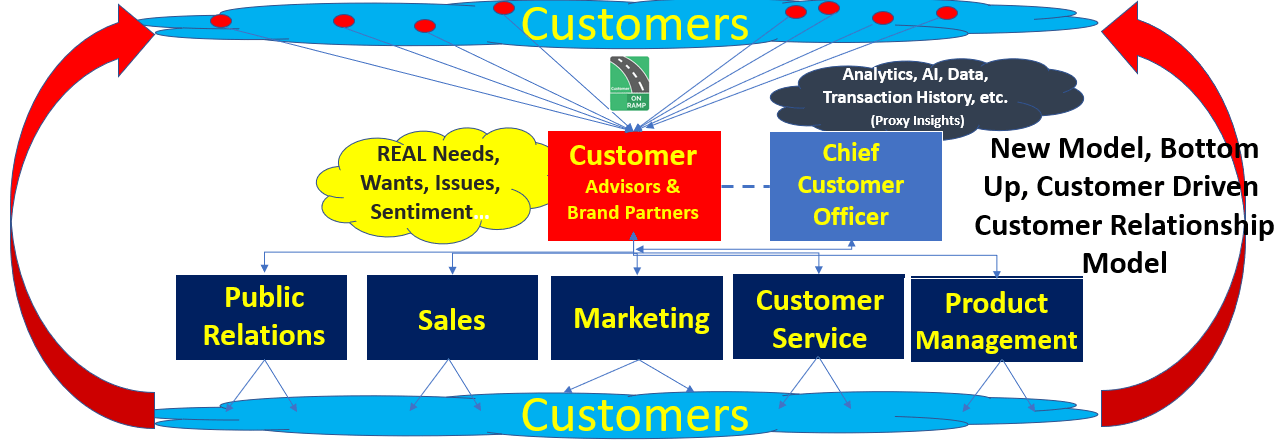
Customer Service Organization Inversion-Revolution

Key to implementing this customer organizational inversion-revolution is the development of customer inclusionary “on ramps” (shown in the green symbol above) that allows customers to participate and join the company team as brand partners, advocates, insights experts, advisors, etc. We will cover this more in depth in following sections but hence forward, customer on ramps will be designated by this symbol below:

Customer Inclusionary Onramp

These onramps detailed in the following blog increase customer inclusion by their very nature of creating an array of customer chosen methods for these customers to contribute to and participate in the company’s success. The enhanced diversity is derived from tapping into and leveraging the diverse set of perspectives and needs from existing customers that represent a cross-section of different cultures, races, genders, ages, political views, national origins and religions, etc. so that the best product and/or services are engaged in the marketplace.

Many companies have omitted these onramps in the vetting of new products, services, marketing campaigns, etc. and have ended up offending and alienating their own customers and potential prospects. A great web article points to how companies have fielded expensive and disastrous marketing campaigns and ads in the past only to have to quickly pull them from the market. These campaigns/ads are often a result of corporate myopathy and not taking into account a multitude of diverse perspectives enabled by an array of customer D&I onramps: “7 of the most controversial ads of our time” https://www.thedrum.com/news/2019/04/08/7-the-most-controversial-ads-our-time. A major West Coast bank vets all of it marketing concepts through a customer insights group (covered below) before ever releasing the ad and/or campaign into the market. Only after the CIG group (onramp) has weighed in and provided their approval and feedback will this bank to go market with their marketing concepts.

Bottom line, these onramps enable your customers to become brand and company partners/advocates who, through time and continued onramp participation, develop an ever increasing vested interest in the brand(s) and company success.

To be receptive to this change and to get onboard with customer leaders who are in the process of putting customers in charge and implementing the customer organizational inversion-revolution, you must first have a foundational customer centric culture. Companies that are implementing this customer centric change and building customer brand partners include Apple, Southwest Airlines, Ritz Carlton, Amazon, Marriott, Bank of America, Wells Fargo, etc. Let us first explore what a customer centric culture is and the spectrum of companies on the customer centric continuum.

B) The Customer First, Customer Centric Culture

To begin with, almost every company claims to be customer centric, that their customers are their most important asset, customer satisfaction is a priority, etc. In practice I have found that there is a spectrum of truth to these public statements ranging from treating customers as a necessary commodity to the other end of the spectrum and treating customers as equal and respected partners and treating customers as a true extension of the company-employee team.

Referring to the chart below, we can see that spectrum of company cultures and their treatment of customers based on these different company customer cultures. To simplify this illustration, I have only included 3 types of companies as follows (along top of chart):

Customer Centric Company Spectrum

  1. “Customers are our most valuable asset”: Companies that truly value their customers and view them as an integral part of their team and company’s success. This type of company also maintains a true customer first culture, policies, standards, etc. (right side of chart, spectrum).
  2. “We Value our Best Customers”: Companies that only strive to cater to their most valuable customers since these customers benefit the company the most (middle of chart, spectrum).
  3. “Customers are a Necessary Commodity”: Companies that interact and ‘deal with’ customers when it benefits them (they pay lip service to slogan ‘customers are their most important asset’), left side of chart, spectrum.

On the left side of the above chart, we have a number of customer facing dimensions including the following:

1) “Customer Input”: How the company views and approaches soliciting customers for insights, input on new programs, detailed feedback (i.e., focus groups, crowdsourcing, etc.), etc.
2) “Customer Complaints”: How the company views and approaches the handling of customers complaints.
3) “Customer Inclusion, Partnership”: How the company approaches being customer inclusive by offering customers ways to partner with the company including online communities, customer co-blogging, customer spotlights, etc.
4) “Customer Engagement”: How the company approaches customer communication and creates a rewarding and engaging customer experience.

Companies located on the far-right side of the chart have the following belief that is not only a slogan, but embodied in the company culture, operations, practices, standards, rewards systems, etc.:

“Customers are our Most Valuable Asset”.

For the first customer dimension on the left side of the chart, “Customer Input”, a comment that I heard from a CEO with this type of culture is as follows:

“We make no (major) decisions (that will impact the customer) without the customer’s direct input”.

For the first customer dimension of “Customer Complaints”, a company CEO said the following,

“Customer complaints are a valuable insight and gift to help us improve, beat our competition”.

You can read the comments for each type of company aligned to each customer dimension. Bottom line, without a foundational customer first mindset, rewards and incentive system and culture, you will be impeded on implementing the effective customer inclusion program with many possible customer onramps detailed in the remainder of this blog.

C) Mainstream Customer Inclusionary Programs & Onramps:

As I mentioned before, once you have established a totally customer centric culture, the 2nd step is to build customer incremental onramps for the customer to become a brand partner and an integral part of the customer team. These onramps invite the customer to participate in a number of activities that will increase customer satisfaction (CSAT), loyalty, NPS, viral referrals, etc. Based on my experience, building these customer inclusionary onramps can net your company huge increases in key customer measures as follows:

1) NPS: +14 to 49
2) Customer Loyalty: + 4% to 36%
3) Customer Positive Sentiment: +12% to 71%
4) Customer Viral Referrals: +11% to 26%
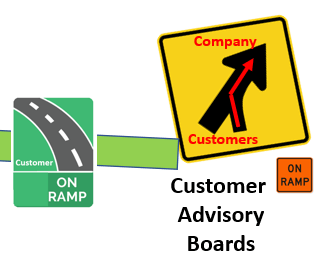
Customer On-Ramp: Customer Advisory Board Program

1) Customer Advisory Board Program:

A Customer Advisory Board (CAB) is the composition of a group of trusted, and generally top customers, who meet on a regular basis (i.e., Quarterly) to advise the company on strategic direction such as the product and/or service roadmap and on upcoming major new programs. Customer advisory boards (a.k.a. trusted customer advisors) can also be a conduit to award top customers for their input, loyalty, spend, referrals, etc.

At a top US automotive company, we invited our top and most open/honest customers to these focus group and advisory events, paid their travel expenses, hosted a nice dinner reception and, at the end of the session, gave them an appreciation gift for their continued participation and loyalty. We also had Platinum private customer events for our top 1% spend customers which were meetings with the EVP and above for open-ended candid feedback & insights gathering discussions.
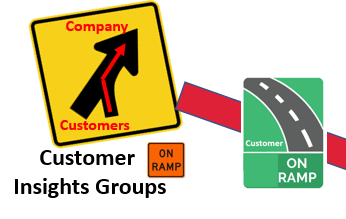
Customer On-Ramp: Customer Insights Group Program

2) Customer Insights Group Program:

A Customer Insights Group (CIG) is the composition of a wider cross-section of customers or specific customer segment(s) who meet on a regular basis (i.e., weekly, quarterly) to advise the company on new tactical programs, proposed sales campaigns, and marketing concepts, provide feedback on existing program effectiveness, provide customer experience insights based on their own actual experience, etc. Customer insights groups are usually on a voluntary enrollment basis and typically come with some sort of incentive to participate (i.e., participate and be entered in a drawing for a gift certificate).

A top 5 US bank uses these extensively and there is a directive from the CMO that no new marketing programs/materials/etc. will be fielded without first getting the input of this insights group. After implementing this program, marketing effectiveness increased by an overall 27% and the loyalty of the group increased by a whopping 38% as compared to non-CIG participants. When surveyed, 92% of CIG members indicated that they told 26+ about their positive perception of this bank CIG program (survey choices were 0-5, 6-10, 11-15, 16-25 or 26+).

Amazingly enough, 5,000 participants volunteer up to 8 hours of their time per week to participate with another 5,000 eagerly waiting in the wings for their term to participate (participation is limited to a 2-year term).

In addition, by tapping into a diverse customer set, the bank was able to avoid potential marketing disasters by stopping the fielding of proposed marketing materials that were deemed offensive and culturally insensitive by members of the customer insights group.
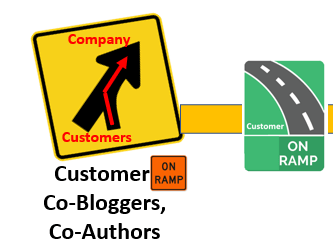
Customer On-Ramp: Customer Co-blogging & Co-Authoring Program

3) Customer Co-Blogging & Co-Author Program:

Customers telling their story (the voice of the customer) about their success in using your product/service and their customer experiences are 5-7x more credible than coming from the company. In addition, customer authors bring with them an entirely new audience sphere (their friends, connection, relatives, etc.) which will result in a dramatically increasing your website traffic, SEO, referrals, etc. Customers love the opportunity to be spotlighted and write their own story (with helpful company editing of course) when it comes to their experience interacting with the company. Co-blogging can also be about customer stories with a human-interest side to it vs. always being business oriented. Customer co-authored articles can be about topics such as how to gain the most value from the product/service, tips/tricks they have learned, the value they have gained from using same, etc.

We recently used this for a struggling newsletter program that had only penetrated 27% of our customer base. Six months after I implemented the co-blogging program, the newsletter distribution grew to 56% of our customer base and we experienced a simultaneous increase of 17% in new visitor web traffic.

Customer On-Ramp: Top Customer Appreciation & Recognition Program

4) Top Customer Appreciation & Recognition Program:

Remember the movie “Up in the Air” with George Clooney? He was a top traveler who strived to be in the 1% club in terms of air miles flown per year on a particular airline whereby, if he achieved this distinction, he would then be invited to an awards dinner with the CEO of the airline and be showered with a whole host of flying perks after achieving that level of spend/loyalty. Banks, hotels, brokerage firms, etc. all have an array of top customer loyalty rewards programs.

For the very top customers, there are more hands-on personal perks like a dedicated/private concierge assigned to customers like for the American Express Black credit card which can only be obtained by direct invite by American Express (i.e. not via request). A top US air conditioning company I used to work for had top distributorship recognition events for the distributors who sold the highest revenue generating air conditioning units. While focused internally for a company, many salespersons have benefitted from such top achievement loyalty programs by achieving the distinction as top salespersons for their companies and being rewarded with trips, cash, luxury items, cars, etc. as a thank you for their contributions.

Customer On-Ramp: Customer Product/Service Beta Group Program

5) Customer Product/Service Beta Group Program:

Before top companies like Microsoft and Apple ever release a new product into the market, they first try these new products with limited volunteer beta groups. They gather feedback from these beta test groups and then continuously improve the beta product before releasing the product to mitigate potentially disastrous consequences of releasing products with potential flaws that internal testing failed to consider via their test cases.
Customer On-Ramp: Customer Success Program

6) Customer Success (Spotlight) Program:

Does your company have successful customers using your product and/or service? Why not showcase or spotlight this success by detailing what they did, how they did it and the value they were able to derive from doing so? Challenge customers to submit their success stories for selection to spotlight in the newsletter, website, articles, FAQs, consideration for prizes for the top stories, etc. The more customers witness real customer successes, the more other customers will want to figure out how to acquire your product/service to emulate the success of other customers.
Customer On-Ramp: Ambassador Program

7) Customer Ambassador Program:

The Syracuse University (SU) admissions and student success programs received a big boost with the adoption of its Alumni ambassador program whereby successful alumni would volunteer to host regional recruiting events, student college send-off events, and answer questions from interested students in their area. Alumni ambassador groups increased the level of excitement and enthusiasm for new students and families while simultaneously decreasing the levels of anxiety and confusion among students and families.

The entire ecosystem of a customer first, customer inclusive company that has inverted the customer organizational structure and has built a comprehensive set of customer onramps to be able to put customers in charge of customer operations would look something like the following chart:

Customer Inclusionary & Participatory Programs, Onramps

D) Other Customer Inclusionary Programs & Onramps:

In addition to the more popular and mainstream customer inclusionary programs above, there are several other programs that I have encountered that were effective by increasing the levels or customer loyalty and creating many customer-brand zealots (those who actively and aggressively advocate for the brand/company).
Customer On-Ramp: Creative Council Program

1) Customer Creative Council Program:

Many customers have a wide range of creative talents outside of simply being a customer. A company with a large customer base tends to have customers who are very creative such as artists, craftspeople, etc. A large SaaS software firm I consulted for would solicit creative ideas for new campaign concepts from the creative group among their customer base (and sometimes from their employees) to get the best creative concepts as possible. Many times, customers would develop far more appealing creative concepts than their own dedicated creative talent working within the company. Why not source from the best of the best, including creative customers?! This would allow the company to harness this creativity while allowing creative customers to be spotlighted for their hidden talents and feel valued by the company.

Customer On-Ramp: Talent Showcase
Program

2) Customer Talent Showcase Program:

Beyond just being creative, a company with a large customer base typically includes customers who are also poets, book authors, those with interesting and varied professions such as paramedics, volunteer firefighters, food bank volunteers, world travelers, iron men or women, triathletes, extreme cyclists, paragliders, scuba divers, treasure hunters, etc. Many companies I have worked with have conducted customer showcases that highlight the interesting lives of their customer base beyond merely being a customer. These personal story showcases add a human-interest side to the customer base and tend to make customers feel more connected to and understood-appreciated by the company.

Customer Journey Customer Co-Mapping

3) Customer Involved Customer Journey Mapping & Continuous Improvement Program:

Are you planning on creating a customer journey map and want to know what the important steps and metrics are in that journey? Why not invite the customer to join in on these development sessions to provide the team with some insights, feedback, important items to consider? I have used this approach quite effectively and have developed far more qualitative customer journeys as a result. I used this approach to develop a brand new and innovative customer journey map I have labeled “The Quantifiable Customer Journey Map”. Refer to my previous blog article for insights here: https://bit.ly/3bvPRal

The Quantifiable Customer Journey Map

Bottom line, without the customer’s input, the high quality achieved in the final customer journey map would have been much more difficult and time consuming to achieve.

Customer Diversity & Inclusion Council

4) Customer Diversity & Inclusion Council:

A few companies I have worked with in the past have managed and conducted employee diversity councils whereby employees would provide their perspective on how the company can be more diverse, culturally sensitive, and overall inclusive.

A few companies have taken this further and included their own customers into the diversity council along with their employees. In this manner, the company ensures that it is considering the widest possible perspective on D&I and not falling victim to company group think.

Regardless of whether you include a formal customer diversity council, what all the above illustrated customer onramps do in essence is help build a company culture that supports customer diversity and inclusion (D&I) as follows:

1) Enables the assembling of a diverse set of perspectives, based on unique and diverse set of customer experiences, needs, etc.
2) Provides diverse feedback on potential new customer programs, marketing, etc. that might be perceived as offensive and discriminatory to certain customer groups.
3) Enables customers to showcase their diverse backgrounds, talents, interests, viewpoints.
4) Enables a voice of the customer cultivation that represents the full cross section of diverse customers.
5) Enables the delivery of the best of the best solutions by allowing feedback on proposed programs from a wide and diverse set of customers.

If your organization is seeking experienced assistance in creating these customer onramps and a more diverse and inclusive and customer first organization where customers are leveraged to assist the insights Chief Customer Officer (CCO) and are transitioned to full brand-partners/advocates/participants/etc., then give me a call or e-mail me at 518-339-5857 or stevenjeffes@gmail.com. I am also a Certified CultureTalk (https://culturetalk.com/) consultant that can help you develop and/or improve a customer-oriented, customer first culture.

Steven Jeffes, Certified CultureTalk Consultant

Lastly, this is just one article of over 50 articles I have written on customer strategy, customer experience, CRM, sales excellence, marketing, product management, competitive intelligence, corporate innovation, change management – all of which I have significant experience in delivering for numerous Fortune 500 companies. In fact, my blog is now followed by nearly 107,000 world-wide and was just named one of the top 100 CRM blogs on the planet by Feedspot, alongside Salesforce.com, Infor, Microsoft, SAS, etc. – Reference this informative site here: https://blog.feedspot.com/crm_blogs/ .

Company Market Leadership via ABC Alignment: Archetype, Brand, Customer

How a company’s primary Archetype drives an authentic brand and the delivery of exceptional customer service and customer experiences

After being hired as a consultant and researching numerous companies, I have discovered the following as to why some achieve market leadership while others do not. What I have discovered is that market leading companies like Amazon, Intuit, American Express, Apple, Southwest Airlines, Wegmans, Gartner, Nielsen, Lego, Hallmark, Disney, etc., have all achieved a high degree of alignment between their ABCs – their organizational Archetype, their corporate Brand and their Customer presence. They are all authentically aligned, in-synch and balanced both internally through the experienced corporate culture as well as externally through the brand and customer experience. Through my experience with many companies and brands I have also found that when these items are misaligned or not balanced, there is a negative reaction to company by the employees, customers and stakeholders.

To draw an analogy to people you meet, ask yourself, if you have ever meet or run into someone who meets the following characteristics:

1) Is a self-proclaimed advocate for protecting against sexual harassment and then makes inappropriate glances or comments as an attractive person passes by?
2) Describes themselves as a person of tolerance and acceptance but speaks in a manner that is condescending or hurtful to others, etc.?
3) Maintains they are for protecting the environment, global warming, etc. but in practice they throw litter onto the sidewalk or out of their car window and have a older automobile that pollutes a great deal?

If you have, you might walk away saying the following:

“That was totally unexpected!”
“They are a phony, fake”
“That person was totally disingenuous, not authentic!”

Not surprisingly, the same thing happens upon interacting with inauthentic companies as follows:

1 The company states that their customers are their #1 focus yet their delivered customer service is horrible and totally frustrates their customers.
2 The company indicates that they are for the environment from a corporate culture perspective, but print many of their marketing and other materials on physical paper stock and is not recycling on a systemic and/or widespread basis.
3 The company’s advertisements are very funny, engaging and/or professional, yet customers are offended and upset when they interact with the company’s rude and apathetic customer service representatives.
4 The company states that their culture promotes employee work life balance, but as an employee, you hardly ever see you family due to crushing workloads.

As a customer or as an employee, you’re likely to have the same reflex as when you encounter an inauthentic person. You would probably react by registering your displeasure with the company and avoid the next interaction or defect from the company as soon as possible.  

In stark contrast, companies who are market leaders achieve what I call authentic ABC alignment. In this, there is perfect alignment and synergy between their ABCs as follows:
1) Archetype (company’s main personality, attributes)
2) Brand (projected company image (external) and reflected culture (internal))
3) Customer service and experience delivery (company attitude, manners, empathy, etc.)

The following chart illustrated this perfect ABC alignment:

ABC Alignment, Balance, Authenticity

Organizational Archetypes represents a company’s dominant personality types, sometimes driven disproportionally by the CEO or CxO team in the case of smaller companies. The organization’s archetype is the true identity and personality of the company, who they truly are, what makes them go from a strengths perspective, what shadows hold them back, etc. These archetype traits are hidden to an organization until revealed through the lens of analysis tools like “CultureTalk” (https://culturetalk.com/). Performing a “CultureTalk” Analysis applies a set of lenses to be able to clearly reveal, in 20/20 clarity, a set of a company’s main personality types. Below is a chart that reveals the 12 Archetypes that a company can align to as well as examples of companies that align to each Archetype.

12 CultureTalk Archetypes, with Organizational Examples

Above Graphic courtesy of CultureTalk

Swiss psychologist Carl Jung used the word “archetype” to refer to the recurring patterns found in our universal stories. He identified the themes, symbols, and imagery as part of the human psyche. More recently, Dr. Carol Pearson built out Jung’s work with a body of research that examined archetypal attributes within organizations. CultureTalk, based on the work of Jung and Pearson, takes centuries of understanding and translates it for today’s business leaders. The result is a framework of 12 Archetypes that a company can align to in terms of its dominant personality type(s).

Organizationally, CultureTalk assessments answers the questions: What type of company are we, what do we stand for, what dominant traits represent the authentic company? There aren’t good or bad Organizational Archetypes, but each has a strength and shadow side that we need to understand in order to drive maximized organizational effectiveness.

12 CultureTalk Archetypes, Highlight: Lego Organizational Example

Lego Creator Archetype

Above Graphic courtesy of CultureTalk

As an illustration, the Creator Archetype above is described in the graphic below is focused on “the creation of things, ideas, approaches, experiences, art work and solutions” and is well represented by the very familiar and popular company Lego. Below is a more detailed description of the main characteristics (strengths) of this Creator Archetype.

The Creator Organizational Archetype

Above Graphic courtesy of CultureTalk

Lego is in perfect alignment and balance with this Archetype, driven by invention, creation, designing, dreaming, etc.

The shadows of a creator Archetype company like Lego are as follows:

Creator Organizational Archetype Shadows

Above Graphic courtesy of CultureTalk.

The full list of strengths and shadows of a creator Archetype company like Lego are as follows:

Full List of Creator Archetype Strengths and Shadows

Above Graphic courtesy of CultureTalk

It is important that a company’s Brand image be in authentic alignment with their main Archetypes, otherwise they are striving to portray an image that is out of alignment with their main personality type – trying to portray as something they are inherently not, being inauthentic to the world. This brand image is manifested in two different dimensions as follows:


1) Outside the company: The image that is being presented to the world, it stakeholders, employees, customers, etc.
2) Inside the company: The image reflected via its experienced company culture

In order to be an authentic company, it is important for a company to have its brand in alignment with its dominant Archetypes, otherwise they are portraying themselves as something they are not truly comfortable with, something they are not, being inauthentic to their main personality types and strengths.

Continuing the Lego example, we see perfect and authentic alignment with their main archetype and their brand messaging.

About the Lego Brand

Source: https://www.lego.com/en-us/aboutus/lego-group

The Lego Brand supports driving of innovation and creativity to their customer base which encourages the creator individual archetypes. For the public to be comfortable with the brand they have to be truly and heartfelt dedicated toward driving the creativity and the passions of their customer’s creator archetypes.

About the Lego Culture

Source: https://www.lego.com/en-us/aboutus/lego-group/the-lego-brand

The C stands for the manner in which a company delivers its Customer service and Customer experiences. Continuing with the previous Lego Creator Archetype, here is a customer service example of how the Lego Customer Brand and Culture is driving an equally consistent and authentic creator customer experience.

Here is a letter sent to Lego by a 7 year old boy named Luka who is a Lego customer regarding him losing one of his Lego figures.

Letter to Lego Customer Service

Source: “https://beloved-brands.com/2016/06/18/lego-letter”

Here is the skillfully crafted reply to Luka, written in a manner that is completely in alignment with and, appealing to, Luka’s creator archetype.

Letter from Lego Customer Service

Source: “https://beloved-brands.com/2016/06/18/lego-letter”

The article from Beloved Brands, where this information was sourced from, notes:

“For Lego, in the world of social media, this type of story does wonders for continuing the magic of their brand. And it’s a great example of going above and beyond. What I like in the letter is how they please the boy, but also give a solid wink to the parent who is likely the bigger target of this letter. The dad ended up tweeting about the story, lots of viral hits and then picked up in the mainstream media including TV and newspapers in the UK, US, and Canada. And now millions are reading about this story (including you right now.)”

Equally important as the exceptional “surprise and delight” customer service going viral and generating a great deal of positive company and brand buzz, is that the tone and manner in which the customer service letter is written. The letter was masterfully crafted to be in perfect alignment with the organization’s primary Creator archetype, but simultaneously encourages and supports the customer’s (Luka’s) creator Archetype.

Here are additional examples of authentic alignment between an organization’s primary archetype and their brand and/or customer service and experience delivery;

1) When interacting with Disney, we expect authentic customer interactions to deliver magical and exciting customer experiences due to their primary organizational archetype being a Magician.

Source: The Disney Institute, Service Policy

The above service guidelines could have been written in the typical boring manner like many other company directives as follows:

1) We will make eye contact and smile when encountering any of our guests.
2) We will welcome each Disney guest with the following greeting “xxxx” upon meeting them.
3) Etc., etc.

Disney instead wrote these in a way to communicate the service standard, but did so in a way consistent with the Magician Archetype by illustrating the Magic of the Disney characters and how they bring magical experiences to the children who visit their venues.

The service guideline that illustrates the consistency with Magician Archetype the best above is #6. This service guideline specifically references the delivery a “magical guest experience” and reinforces the concept that Disney delivers magic (as you would expect from a Magician Archetype) via both their company brand and through their customer delivered experiences.

Magician Organizational Archetype Strengths

Above Graphic courtesy of CultureTalk

Wegmans Everyperson Archetype

2) When interacting with Wegmans food markets, we would expect all branding and employee/customer communications to be authentically in alignment with the Everyperson archetype. Indeed their values reflect this and even display the words in the values “every person”.

Wegmans Values

Source: “https://www.wegmans.com/about-us/company-overview”

Colleen Wegman, Wegmans Letter

Source: “https://thezebra.org/2020/06/01/wegmans-is-increasing-their-hours-of-operation-as-they-adapt-to-phase-i”

This employee communication from CEO Colleen Wegman is also in perfect alignment with the Everyperson archetype with the above telltale words “all of you”, “trying time for everyone”, “people – our suppliers, employees, customers, community partners -…”, “every one of you”. Again, Wegmans is a great example where they have perfect ABC alignment, authenticity.

Everyperson Organizational Archetype Strengths

Above Graphic courtesy of CultureTalk

3) When calling Nielsen or Gartner for B2B expert research or insights, we expect the brand and customer experience to be highly insightful, informed, based on analytical research – all characteristics of the Sage organizational Archetype.

Gartner Products

Source: https://www.gartner.com/en/products

About Gartner

https://www.gartner.com/en/products

About Nielsen 1

About Nielsen 2

https://www.nielsen.com/us/en/about-us/

Both Gartner and Nielsen also demonstrate that they are authentic to their archetype and maintain ABC alignment and authenticity.

Sage Organizational Archetype Strengths

Above Graphic courtesy of CultureTalk

4) When interacting with the Apple Brand, we would expect the customer interactions to be reflective of a culture that is about inventing new and radically different/innovative products and experiences by challenging the status quo. These innovative and inventive characteristics are all telltale signs of the Revolutionary organizational Archetype.

About Apple 1

Source: https://www.apple.com/jobs/us/about.html

About Apple 2

Source: https://www.apple.com/jobs/us/about.html

The way Apple has reflected the Revolutionary Archetype is via its release of new and innovative products we previously thought weren’t possible. It started with the Apple I and Apple II computers and went onto the LaserWriter, the iPod, the iTunes Store, iPhone, ipad, Apple Watch, Apple TV, etc. The release of these was accomplished with total alignment to their Brand and to the customer experience standards.  

Sample Apple New Product Innovations

Source: https://www.cnet.com/news/apples-origins-an-oral-history-from-inside-the-loop/

Revolutionary Organizational Archetype Strengths

Above Graphic courtesy of CultureTalk

Hallmark Lover Archetype

5) Hallmark, per their culture statement, believes that “care” and creating an “emotionally connected world” are the driving forces behind their delivered customer experiences and are the passions of the Lover Archetype.

About the Hallmark Company

Source: “https://corporate.hallmark.com/about/hallmark-cards-company/”

About the Hallmark Culture

Source: “https://corporate.hallmark.com/culture/hallmark-family/”

Lover Organizational Archetype Strengths

Above Graphic courtesy of CultureTalk

What all of this demonstrates is the rule of customer service cultural archetype delivery, stated as follows:

Top Customer Service Companies –> Culture Alignment

Once you have determined your corporate Archetype via a tool like CultureTalk, the best way to ensure that both your brand and customer experience is in alignment is by direct measurement. For this measurement, I recommend a solution category called “Experience Management Measurement”. This enables companies to measure the experience for brand-products as well as the customer. One market leading tool I have encountered and recommend highly is Qualtrics (https://www.qualtrics.com/). Qualtrics was Named #1 Leader in Experience Management Measurement in Industry-Leading Product Rankings*. Qualtrics can assist you in the measurement of both brand and customer alignment by simply querying both your market and customers on their perceptions on brand and customer authenticity, perceived consistency, etc.

*Source: https://www.qualtrics.com/news/qualtrics-named-1-leader-in-experience-management-in-industry-leading-product-ranking/

Summary/Conclusion:

Just like successful people who are inherently highly consistent and authentic: values, personality, interests, actions, manners, spoken language, etc., the same consistency-authenticity driven success applies to companies. Companies that drive a totally consistent and authentic market presence tend to achieve ABC alignment: Archetype, Brand messaging, and Customer presence.

Without ABC alignment, the company appears to be disingenuous to the public and to their customers – trying to be something they are not per their primary Archetype. Only those achieving perfect alignment become market leaders as in our examples of Lego, Gartner, Nielsen, Disney, Apple, Wegmans, Hallmark, etc.

If your organization is seeking experienced assistance in deploying legendary levels of culturally aligned customer service, then give me a call or e-mail me at 518-339-5857 or stevenjeffes@gmail.com. I have also recently become a certified CultureTalk consultant, ready to help your company transform into a high performing and market leading (legendary) customer focused culture http://www.legendarycx.com

Lastly, this is just one article of over 50 articles I have written on customer strategy, customer experience, CRM, marketing, product management, competitive intelligence, corporate innovation, change management – all of which I have significant experience in delivering for Fortune 500 companies. In fact, my blog is now followed by nearly 107,000 world-wide and was just named one of the top 100 CRM blogs on the planet by Feedspot, alongside Salesforce.com, Infor, Microsoft, SAS, etc. – Reference this informative site here: https://blog.feedspot.com/crm_blogs/

The Corporate Culture Top 5: Benefits, CxO Roadblocks, Myths, Trends, Best Practice Companies, Measurement Tools/Vendors, Best Approaches to start Improving

What you will learn in this blog article:

  1. What exactly is corporate culture – simple definition?

  2. The top 5 benefits of having an optimal corporate culture.

  3. The top 5 reasons CxOs put up roadblocks toward improving company culture.

  4. The top 5 myths associated with improving a company’s culture.

  5. The top 5 trends in corporate culture – a true (corporate) cultural revolution.

  6. Five (5) familiar sample companies that have great company cultures & why.

  7. The top 5 vendors & technologies to support corporate cultural measurement & improvement.

  8. Five (5) ways to get started, pilot some smaller and cost effective culture improvement programs.

best-company-cultures.jpg

Top Company Cultures

1. What exactly is corporate culture – simple definition?

Corporate culture simply put is a company’s beliefs and behaviors that determine how a company’s employees and management treat and interact with each other and all of their stakeholders – employees, customers, suppliers, regulators, influencers, etc.  A corporate culture is implied, not usually expressly defined, and develops organically over time from the cumulative traits of, and interactions with, company employees and stakeholders.  A company’s culture is reflected in, but not defined by, its dress code, quality of work-life, quality of office accommodations, employee perks and benefits, turnover rate, hiring, treatment of customers/employees, customers/employee satisfaction and every other aspect of company operations.  It not about any one specific corporate program like longevity awards, benefit packages, etc., but a totality of all programs and actual treatment (not words or slogans).

2. The top 5 benefits of having a optimal company culture

A. Provides the ability to attract & retain the top talent in the marketplace. Google is legendary in terms of culture and the number of people that line up who want to work there. For example, Google receives over 3 million high quality applicants each year! Only 7,000 of the 3 million are hired which gives candidates only a 0.2% chance of getting hired. Obtaining a job at Google is reportedly 10x-15x more difficult than being admitted to an institution of higher learning like Harvard, Yale, MIT and Wharton.

B. You create 24/7 advocates worth millions (or billions) in equivalent marketing spend: With a great company culture, everybody transitions from an employee, stakeholder and observer into a 24/7 advocate, igniting a marketing buzz worth 10’s of millions, if not billions of dollars. From the 30’s to the 80’s everyone I knew spoke glowing reviews of IBM, GE, AT&T, etc. and how great it was to work there, their products, their culture, management’s prowess, etc. They would have had to spend billions in marketing to replicate the free market buzz they received simply as a result of having a great company culture.

C. Sales and Marketing Improves dramatically: Sales prospects, marketing acquisition targets, and existing clients are all easier to sell and acquire since, due to the positive brand buzz, they feel more comfortable buying, buying more, spending more, referring associates, etc. since the company is perceived as a solid company, “doing the right thing”. These sales benefits are also worth their weight in gold vs. the paid branding and PR that would have to be done to try to replicate it (paid PR and marketing are not as trusted nearly as much as word-of-mouth, genuine advocacy by customers, employees, etc.).

D. You are perceived as great company leaders who truly care, inspiring employees to go the extra mile: You create an environment where employees can spend more time with the family, sleep well at night, are not stressed to the max as a result of working in a toxic work environment. They also just feel good about the company and its leaders to reach out to offer help to their co-workers unsolicited (vs. undermining them in toxic cultures), spend time on company improvements that weren’t asked for (vs. counting the hours where it is acceptable to leave for the day in toxic cultures), etc.  I once worked for an amazing boss who maintained a great company culture and everyone in the company would do anything for this boss and his company (stay very late, work most weekends, etc.) without giving it a thought. Contrast this to clock watching until quitting time in toxic work cultures.

E. Improves quality standards, customer service and ethical standards. It teaches the most valuable lesson of doing the right thing, doing right by people, employees and most importantly – customers. With a great company culture, you create an environment whereby employees feel that they are cared for and work for a company with high ethical standards and ideals. This translates into higher quality standards, greater regard for customers, vendors, alliance partners, suppliers and doing the right thing by all of them (employees feel this is fair reciprocation since you are doing the right thing by them as employees).

3. The top 5 myths associated with improving a company’s culture:

A. Myth #1 – Improving the company culture is going to cost a great deal. False. Simple and low cost things can be done like initiating participation contests to name campaigns, logos, newsletters, etc. as well as performing team member spotlights that showcase their abilities and interests outside of work.

B. Myth #2 – Improving the company culture is a futile exercise since we can’t really measure it. False. New quantitative tools in the marketplace now make this possible. Refer to section 7 below.

C. Myth #3 – It is the job of HR and organizational development to improve the company culture. False. Without the support and sponsorship of the CEO, leadership team and mid-level managers, any attempts to improve the company are likely to fail.

D. Myth #4 – Improving the company culture is a pure cost exercise and will likely only make our management jobs more difficult. False. Improved company cultures usually pays back the initial improvement investment in multiples of anywhere between 2x and up to 10x, depending on numerous factors like program cost and implementation effectiveness.

E. Myth #5 – Great company cultures are only for the ‘neuvo’ high tech companies full of Millennials. False. Even some of the traditionally stodgy organizations like accounting and tax firms have made their cultures so unique, fun and rewarding to work for, they are breaking the stereotypes of their industries and are becoming ‘the place to work’ for top talent and the place to bring your business to for customers.

4. The top 5 reasons some executives (CxO’s) put up roadblocks and push-back at the idea of improving their company culture:

A. The company’s existing leadership is dominated by left side brain thinkers who are good in math, science, logic, accounting, science, etc. and cringe at the thought of how employees feel, the corporate atmosphere and the “touchy feely side of the business” (actual CEO quote). These leaders would rather leave this to their HR staff if they are also not left brain thinkers, otherwise culture improvement is likely doomed at those ‘group think’ left brain companies.

B. They are extremely bottom line oriented and frugal; hence, any talk of improving the company culture is viewed as a potential expense and an attack on the bottom line (i.e. the owner’s profits). The truth is that culture can be improved with zero expense (if needed) and impact on the bottom line. Culture is just seen “as a way for employees to get more benefits” (yet another CEO quote).

C. The executives feel that the existing culture is immeasurable and “hard to wrap your arms around” (another CEO quote), so they don’t know where to start. This was a valid objection until recently with the advent of new cultural measurement tools (refer to section 7 below).

D. Following on C above, since there are few ways to determine how good or bad the current culture is, there is no burning platform or business case to improve. In this case, if the culture isn’t (confirmed) broken, there is no need to fix culture.

E. The leaders are arrogant, myopic or clueless in that, while there are glaring gaps in customer service & satisfaction, employee satisfaction (i.e. Glassdoor employee reviews), product and/or service quality, etc, they continue to delude themselves into believing their company and its operations are excellent or world-class, customers are elated, etc. without any empirical evidence to support these beliefs and claims.

5. The Top 5 Trends in culture, how the corporate culture revolution is upon us

A. The new workforce is much more geared toward and attracted to a positive work experience and the quality of work-life vs. being more compensation driven as were the baby boomers and before.

B. Learning, personal development and working in a healthy environment (mentally and physically) are keys to making the overall employee experience more fulfilling and rewarding. It is as simple as, if employees have a pathway to learn and grow with a company, the more likely they are going to find the overall experience, per #1 above, more engaging, enjoyable, etc.

C. The new workforce of today wants to connect and build relationships with their co-workers. If the proper environment is prevalent, this will happen. Otherwise, a toxic and back-stabbing culture is one where co-workers are forced to distrust, despise and grow a disdain for fellow team mates. People tend to stay longer and remain company loyal within company environments where they have friends as co-workers vs. fakes and backstabbers.

D. Employees of today want to work for an organization that has a deep and significant purpose they can connect with such that their contributions are more meaningful than just collecting a paycheck. Today’s employees want their work to mean something significant to society, their country, the world and their families.

E. Employees more and more require and even demand company and leadership ‘genuineness’. This means that the rhetoric of company slogans need to match up with company and leader actions and follow-through. For example, if a company lauds its treatment of employees and work-life balance, there better be that feeling that this is genuine with a vast majority of employees. If not, it would be like marrying someone (employee-company) that you can’t trust. After a while, the relationship is guaranteed to sour.

6. Top 5 Companies that have superb corporate cultures:

A. Intuit (previous consulting client)- Intuit recently ended up on “People’s 50 Companies That Care” list. People highlighted our 32 hours of paid time off to volunteer, as well as pet insurance and paid time off whenever a beloved furry friend passes away. In addition, they embrace diversity more than many companies; help support the community, the environment, veterans, etc. When I consulted with Inuit, many employees shared with me that they really enjoy working for Intuit and you could feel the positive vibe in meetings, speaking to executives, etc. Intuit also recently earned a 4.2 on Glassdoor from their employee reviews at the time of this blog development. Check out their blog on “People and culture”: https://www.intuit.com/blog/category/intuitlife/people-culture/

B. American Express (previous consulting client)– I have consulted with American Express for many years, helping to provide expertise and insights that would help take their marketing, sales and customer service to the next level. Everyone I interacted with at American Express was truly professional, a cut above talent that I typically encounter at other companies and people seemed to really enjoy their work experience. American Express also earned a 4.0 on Glassdoor from their employee reviews at the time of this blog development. Check out their blog on “Company Culture”: https://www.americanexpress.com/en-us/business/trends-and-insights/topics/company-culture/

C. Southwest Airlines (previous consulting client)– The culture at Southwest Airlines is more than legendary. They recently earned a very high 4.3 on Glassdoor for employee reviews about “working at Southwest”. They have been written up for Culture by numerous publications like “Company Culture Soars At Southwest Airlines” by Forbes. In addition, when I was on a consulting project there, you could tell that employees genuinely enjoy working for the company and many told me they had fun.  Ironically enough, their CEO has a Jester Archetype which means he likes to joke, have fun, encourage a light and fun company culture (as you can tell when on many Southwest flights (attendants making jokes, signing songs, tricking out passengers – all in an attempt to get the passengers feel more at ease, laugh, etc.. Read more here: https://careers.southwestair.com/culture

D. Adobe (previous consulting client)– Adobe recently earned a high 4.1 on Glassdoor for employee reviews about “working at Adobe”. From what I have seen and heard from those working there in the past, the culture is “electrifying”, “motivating”, “exciting”, etc. Don’t take my word for it, read here what actual employees have said in Adobe blog #AdobeLife (http://blogs.adobe.com/adobelife/) – small sample of many:

  • “I have never worked for a company who has such a strong brand for which many customers are so passionate. The brand and our commitment to maintaining that brand contribute greatly to the pride I feel when saying I work at Adobe.”

  • “The culture here is real. This is the most professional and positive company I have ever worked for. Nearly every single person treats, and communicates with each other, with respect. This is unusual because we are a fast growing, high tech company. Even with our exponential growth, respect remains.”

  • “The largest trait that makes Adobe unique is that you get a genuine feel that the company cares about you as an employee. The amount of effort that Adobe takes to make sure employees have a safe and comfortable working environment as well as the large amount of great benefits is astounding.”

E. Wegmans Food Markets (not a previous consulting client, but rather I am a huge Wegmans brand advocate/zealot) – First Danny and now Colleen Wegman have done a wonderful job in shaping a market that not only provides exceptional service to its customers, but also delivers a world-class internal corporate culture. I have shopped and continue to shop at Wegmans and find it an experience to look forward to. As opposed to some of my local grocery markets where I have to deal with grumpy and gruff store associates and even managers, Wegmans employees appear to really enjoy their working experience. Consistently Wegmans has be written up as one of the top workplaces in America. In addition, Wegmans recently earned a very high 4.2 on Glassdoor for working there, a great and a consistent score for companies that have an excellent corporate culture. Read more here on CBS News – https://www.cbsnews.com/news/could-this-be-the-best-company-in-the-world/

7. The top 5 technologies & vendors to support corporate cultural measurement & improvement

Refer to “Vendor Ratings Disclaimer” below*. 

CultureIQ, CultureTalk  and Denison (listed alphabetically) are the cultural improvement pure plays leading the charge:

Until recently, CEOs could use the excuse and easily erect the all too common roadblock of “how do we get our arms around culture”, “it is hard to measure”, “that is so ambiguous, how do even know what our culture is, let alone improve it?” per section 3 of this article .  These would all be quasi-valid excuses today if it were not for the advent of a new category of cultural measurement software tools that make this excuse obsolete. While there are not many “cultural accelerator tools” on the market as of yet,  these tools/vendors enable a quantum leap in the measurement and quantification of corporate cultures (if you dare to ask).  As I have explored several of these new cultural measurement and improvement tools, three in particular have really caught my attention as a high potentials to become a market leaders.  These new culture improvement pure play* tools I will specifically focus in on is CultureIQ (https://cultureiq.com/), CultureTalk (https://culturetalk.com/) and Denison (https://www.denisonconsulting.com/)  for the reasons you will learn below.

*Culture improvement pure play tools/vendors are defined as those companies that were founded on and primarily focused on improving company cultures (vs. being part of a larger mix of tools/services).

1. CultureIQ:

A. CultureIQ background – CultureIQ started by providing culture improvement consulting services about 40 years ago qualifying the company to be an early pioneer in this space along with Global consultancies like Accenture, Deloitte, KPMG, etc. The technology to support their consulting arm is a relatively recent development since this part of their business was founded in 2013 and launched formally in 2014. The launch of the technology platform is backed by a venture capital firm and has helped fund a jump start of this platform into the marketplace in a major way.

B. CultureIQ Key Differentiator: CultureIQ’s key differentiator is that they provide the consulting expertise from within their own company vs. leveraging 3rd party consultants to drive their technology platform, making a great choice for one-stop shopping of a comprehensive vendor – technology with consulting.

C. CultureIQ Approach:  The most positive impact and yet another key differentiator of this vendor is that they lead with consulting services first to determine the business requirements for culture improvement. Only then do they configure the technology solution that addresses these specific needs. CultureIQ addresses many aspects of cultural improvement, with the only difference being that they do not assess and profile and individual’s culture type and fit like CultureTalk below. If you are not seeking this aspect of insights, CultureIQ is also a good choice.

CultureIQ Approach Overview

CultureIQ Approach Overview

D. CultureIQ Platform – CultureIQ’s diagnostic solution set is specifically configured to address individual business needs as determined by the lead-in consulting discovery phase. CultureIQs platform holistically aggregates insights from an array of heterogeneous sources. Per their website -“consolidates all types of feedback from annual, pulse, and employee life-cycle surveys (e.g., on-boarding and exit surveys) — across the enterprise.” In essence, CultureIQ aggregates an an array of culture insights and then drives an actionable improvement plan based on these continuous insights.

E. CultureIQ Consulting Services: CultureIQs consulting services is delivered via their own consultancy which has had over 40 years of experience helping improve company cultures. Their consulting services are very holistic and comprehensive per the CultureIQ website: “Our data scientists, organizational psychologists and business strategists become an integral part of your team.”  This consulting model is an ongoing presence of their consultants to help you improve your company’s culture.  For example, CultureIQ provides the following type of consulting services :

  1. Designing a Global Listening Program

  2. Conducting Executive Briefings (culture readouts)

  3. Providing Total Rewards Optimization

  4. Conducting Culture Focus Groups

  5. Culture Design and Evaluation

  6. Key Sales audience for CultureIQ: The primary audience for CultureIQ’s platform, as evidenced by their website, is HR professionals.

  7. CultureIQ’s Key competitors: Perceptyx, CultureAmp and Glint.

At the time of this writing, CultureIQ was launching “an updated culture model called “CultureAdvantage”. Check it out here: CultureAdvantage Model.  Due to the velocity in updating their solution as well as their longevity in providing consulting services as well as M&A culture analysis, CultureIQ is definitely a vendor/tool to keep watch on and consider.

A special thank you to Sheridan Orr from CultureIQ for assisting me and pointing me to Brady Loeck, a CultureIQ Account Director who I interviewed for this article!

2. CultureTalk:

A. CultureTalk Background:

First, some background on how CultureTalk was formulated. CultureTalk, is based on the work of Swiss psychotherapist Carl G. Jung and Dr. Carol Pearson who believe that human behaviors are guided by the same inner road-map and by a set number of (12) common Archetype patterns.  CultureTalk answers the questions Who am I? and Who are we? in terms of which specific Archetype (1 of 12) each of our organization’s team members associate most with as well as which specific Archetype best defines our overall organization.

There aren’t good or bad Archetypes, but each has a strength and shadow side that we need to understand in order to drive maximized organizational effectiveness and this is especially true when merging two different Archetypal cultures.

Here is an overview of each of the 12 types of Archetypes:

The 12 Cultural Archetypes of CultureTalk

The 12 Cultural Archetypes of CultureTalk

*Above Graphic courtesy of CultureTalk

Each of the 12 Archetypes above comes with a set of predominant traits (shown above) and shadows that need to be understood and managed.

B. CultureTalk’s Key Differentiator:

The most important  and differentiating feature of CultureTalk’s is that it addresses both the culture type of the individual as well as the overall organization simultaneously which is critical in a holistic cultural assessment initiative.  Here is the holistic and 360° corporate eco-system CultureTalk covers:

CultureTalk's Culture Focus Areas

CultureTalk’s Culture Focus Areas

C. CultureTalk’s focus areas:

  1. Individual (left above, from top to bottom):

  • Establishes an Individual Archetype Profile – helps employees understand their most optimal roles and assignments

  • Enables Hiring for Cultural Fit – Enables both the company and the candidate to make an optimal choice when selecting an employee to hire and company to work for

  • Articulate personal brand – makes it easier for team members and management to understand and manage to key strengths and motivations

  • Develop coaches, career plans, success and performance – Enables employees and manager to migrate to the right roles based on their specific archetype(s).

  • Enables enhanced collaboration and minimizes conflicts – By enhancing understanding of personal brands, archetypes and key motivators, it allows for team members to better communicate and empathize with fellow team members

2. Organization (right above, from top to bottom):

  • Establishes an Organizational Archetype Profile – helps the organization understand their key strengths, characteristics, blind spots, development needs, etc.

  • Mergers, Acquisitions, Partnerships, Alliances – Enables the company to understand key differences, risks, potential contention points and synergies for each of these potential partners, acquisitions.

  • Evolve based on Market Changes – enables better and more effective organizational changes based on changing market demands by knowing what the organization is (where we are) and where they need to go (quantifiable).

  • Company and Organization Brand – Allows the company to better define and articulate the brand to all external and internal stakeholders so that people ‘get the company’.

  • Team and Sub-Team Collaboration Improvement – This allows the company to understand the inner and sub-dynamics that exist within the realm of the company to enable more effective inter-team cooperation and communications.

D. CultureTalk Platform: The CultureTalk platform consists of two different culture surveys, one for the individual and one for the organization. The insights from these culture platform surveys then drive the holistic cultural improvement plan that is developed by their network of independent 3rd party consultants. While the leader survey is not specifically geared toward individual cultural analysis as is CultureTalk, the results of the leadership development 360 survey is used to drive leadership improvement in helping shape a more improved culture.

E. CultureTalk Consulting Services: Unique to CultureTalk is that the network of independent 3rd party culture improvement consultants from across the globe buy their surveys from CultureTalk and then deliver the culture assessment (via the individual and organizational CultureTalk surveys). They then add their own consultant’s expertise, using the cultural assessment results to start to improve the culture. CultureTalk does occasionally take on a consulting role and assists their consultants delivering consulting services, but the majority of services are delivered via a network of independent consultants that have been certified as CultureTalk capable consultants.

F. Key Sales audience for CultureTalk: CultureTalk is sold to a network of Independent 3rd party consultants who buy survey packages in varying numbers from CultureTalk as the licensing survey vendor (similar to DISC and MBTI).

G. CultureTalk’s Competitors: CultureTalk considers its competitors to be Strength Finder, MBTI, Insights, Kolbe Index, OCAI, Denison, DISC and Culture AMP.

Due to their unique capability to analyze both the individual and organization as well as M&A situations in the cultural analysis phases, CulureTalk is a vendor to consider and watch.

A special thank you to Theresa Agresta, a Founder at CultureTalk, for supplying the above charts and for speaking with me for this article!

3. Denison:

A. Background – Denison, led by Daniel Denison, got its start nearly 30 years ago, born out of Corporate Culture research driven by several universities like University of Michigan in determining the effect of corporate culture on corporate performance. Denison determined via this research that a company’s culture quality rating was a leading indicator of future performance in that the culture quality today will determine how well a company will perform in the future; say 1-3 years from now. The survey and technology/system developed in the 1990’s by Denison to support their consulting arm was influenced by early pioneers in survey design and theory including Rensis Likert. Denison has grown steadily to now having nearly 40 cultural improvement professionals on staff in the US and Europe.

B. Denison’s Key Differentiator:

Denison ‘s key differentiators are that it has several Fortune 500 global cultural improvement clients including a large multi-national energy client and a Japanese manufacturing and technology giant.  Dension also has a unique mix whereby half of their clients are in the US and the other half outside the US (Europe, Asia, etc.). Denison also teams holistically with other firms (Tier 1 consulting firms, research firms, etc.) across the globe to deliver the best client experience possible based on client needs. Denison also helps assess two cultures when facing an M&A situation, the only leading tool in addition to CultureTalk, that performs this analysis function.

C. Denison’s focus areas: Denison’s model of organization culture focuses on taking a balanced scorecard approach to measuring culture along four major dimensions: Adaptability, Mission, Consistency and Involvement as shown by this graphic that explains their measurement rubric.

Denison Model Overview

Denison Model Overview

E. Denison platform: The Denison platform consists of two different surveys, one for the organization and one for company’s leaders which is called the leadership development 360 survey. The insights from these culture platform surveys then drive the holistic culture and leadership improvement plans that are developed by Denison consultants, in conjunction with the client.

F. Denison Consulting Services: Denison, while providing the preponderance of consulting services via their own team of cultural improvement consultants, also teams when client appropriate, with other consulting firms like KPMG, Deliotte, RHR company, etc. Denison leads the client engagement to determine client needs and then develops a custom and client tailored approach and set of services (similar to CultureIQ). This initial analysis includes a set of key client questions that help determine the client’s specific needs and requirements.

G. Key Sales audience for Denison: Denison is sold to any array of stakeholders seeking to improve their corporate culture including HR professionals, learning & development professionals, communications professionals, strategy/operations professionals, c-suite executives, etc.

H. Denison’s Competitors (non pure plays): While the focus of this article is on cultural improvement pure play vendors (those firms that were founded upon and primarily focused on, corporate cultural improvement) Denison considers it closest competitors to be McKinsey, Gallup, Glint.

Lastly, Dension has a really interesting book out titled “Leading Culture Change in Global Organizations” written by Daniel Denison, Robert Hooijberg, Nancy Lane and Colleen Lief.

Denison's Cultural Change Book

Denison’s Cultural Change Book

Due to their longevity in the market with both the consulting and technology solutions, combined with their proven ability to service large/multinational corporations, Denison is a vendor to definitely consider and watch.

A special thank you to Dan Denison, Chairman and Founding Partner of Denison and Nabil Sousou, VP of Global Business Development at Denison, for supplying the above chart and for agreeing to be interviewed for this article!

On a side note, some consultants have noted that CultureTalk and Denison can actually be used together and are complimentary to each other, but I have not validated this claim.

Two Other non-pure play Culture Accelerator tools to consider beyond CultureIQ, CultureTalk and Denison are DISC and MBTI (also listed alphabetically):

4. DISC:

DISC started out as a tool to help define communication types within an organization and how to best communicate with different communication styles.  During a recent partner conference, DISC announced they are now applicable for assessing culture and more in-line with the trend of helping organizations figure out and improve their culture. At the time of writing this blog, the DISC website is proportionally under-representing cultural assessment and improvement vs. CultureTalk, CultureIQ, Denison as these are solely focused on corporate culture, what I call “Culture Pure Play Companies”. Just a mismatch of capabilities and website? Not sure, you decide. I would say if you already use DISC as a tool for communication type assessment, I could see using it as an extension for cultural analysis, improvement, etc.

Advantages of DISC: Clear definition of communication styles and how best to foster cultural communication improvement.

Disadvantages of DISC: Lack of overall organizational assessment out of the box that is driven by an organizational assessment, survey, etc. as is the case with CultureTalk, CultureIQ and Denison.

5. MBTI – Myers-Briggs®:

Myers-Briggs® is a survey based system that defines individual types of team members and leaders as well as defining what they call function pairs. The cultural discovery comes when Myers-Briggs® function pairs are then mapped to cultural patterns within an organization and common organization cultural practices. Here are the 4 cultural pairs as shown from the Myers-Briggs website (https://www.myersbriggs.org/my-mbti-personality-type/understanding-mbti-type-dynamics/function-pairs.htm?bhcp=1)

  • Sensing plus Thinking (ST) – STs tend to approach life and work in an objective and analytical manner, and like to focus on realities and practical applications in their work. They are often found in careers that require a technical approach to things, ideas, or people, and tend to be less interested in careers that require nurturing of others or attending to their growth and development. STs are often found in business, management, banking, applied sciences, construction, production, police, and the military.

  • Sensing plus Feeling (SF) – SFs tend to approach life and work in a warm people-oriented manner, liking to focus on realities and hands-on careers. They are often found in human services and in careers that require a sympathetic approach to people. They tend to be less interested in careers that require an analytical and impersonal approach to information and ideas. SFs are often found in the clergy, teaching, health care, child care, sales and office work, and personal services.

  • Intuition plus Feeling (NF) – NFs tend to approach life and work in a warm and enthusiastic manner, and like to focus on ideas and possibilities, particularly “possibilities for people.” They are often found in careers that require communication skills, a focus on the abstract, and an understanding of others. They tend to be less interested in careers that require an impersonal or technical approach to things and factual data. NFs are often found in the arts, the clergy, counseling and psychology, writing, education, research, and health care.

  • Intuition plus Thinking (NT) – NTs tend to approach life and work in a logical and objective manner, and like to make use of their ingenuity to focus on possibilities, particularly possibilities that have a technical application. They are often found in careers that require an impersonal and analytical approach to ideas, information and people, and they tend to be less interested in careers that require a warm, sympathetic, and hands-on approach to helping people. NTs are often found in the sciences, law, computers, the arts, engineering, management, and technical work.

Advantages of Myers-Briggs: Detailed profiling of individual traits which can be mapped to organizational cultural patterns.

Disadvantages of Myers-Briggs: Lack of overall organizational assessment out of the box that is driven by an organizational assessment, survey, etc. as is the case with CultureTalk, CultureIQ and Denison .

Below is a grid that summarizes the information I was able to learn about each of the above five (5) vendors:

Culture Top 5 Tool/Vendor Capability Chart

Culture Top 5 Tool/Vendor Capability Chart

8. Five (5) ways to get started, pilot some smaller and cost effective programs

As with any quick-wins program, I always advocate letting the cultural analysis and identification of high priority needs drive which program you decide to use as a cultural improvement jump-start. The five suggestions below should only be selected based on company cultural analysis to determine which of the five are appropriate (or not). These example simply illustrate that getting started can be easy, inexpensive and designed to drive early company/employee excitement. Once this excitement and enthusiasm for cultural improvement is secured, a  larger cultural improvement program becomes easier to implement due to having some excited cultural change advocates on-board.

  • Conduct round-table meetings with employees, customers, suppliers, etc. to determine where quick-hit and east fix cultural improvements can be made. Surveys also work and are cost effective.

  • Complimentary to #1 above, take a pulse on, and measure, the company culture via some of the new tools that are available in the marketplace (per section 7 above) – you can’t fix what you haven’t quantified.

  • Implement some simple recognition programs that reward employees for going the extra mile. At GE under Jack Welch, I was part of a “tiger team” that developed and implemented a program called RAVE which stood for Recognition Award for Valued Employees. We would recognize people and teams for contributions above and beyond their normal duties.

  • Implement on-ramp participation programs that enable employees, customers, stakeholders excited and feeling more like their opinions and thoughts count. One recent example I recall was when we developed a new product and, instead of keeping the decision with the branding team, we turned into a contest for all employees to name the new product. The top 3 would be recognized with an award and a photo in the company news letter.  Another way to do this is developing customer feedback and idea programs to enable your customers to have a voice in the company, brand, marketing, etc. For example, Wells Fargo and many other banks now vets many of its product and marketing concepts through a customer feedback group prior to launch in order to increase market acceptance. These are all great examples of relatively low cost, high impact programs that can be developed to help start improving the company’s culture.

  • There are a number of other programs that can be implemented that are also low cost, but mean a great deal to employees. Here are some simple suggestions:

  • Invite a dry cleaner to come on-site one day a week so that employees can bring their dry cleaning to work to save time

  • Conduct periodic “bring your (child, dog, relative, significant other, etc.) to work” days

  • Hold contests that allow employees to showcase their talents outside of work (art day, sports accomplishment day, writers spotlight, etc.)

  • Hold vendor showcase days, allowing employees to buy from vendors onsite or nearby (craft vendor days, tool days, artisan days, gourmet food vendor days, food truck days, sporting equipment days, etc.)

Summary:

In summary, corporate culture improvement doesn’t have to cost a great deal, can start slowly, can now be measured and the return on investment is generally in multiples (2-10x+) of the cost. Without a great company culture you will be unable to acquire and retain great employees, will have more costly sales and marketing efforts, have distrusting and unenthusiastic employees and you will experience a great deal of dissatisfied customer churn due to constantly eroding customer loyalty. With all this being true, there is no excuse to not actively work on creating the best company culture possible?!

Lastly, if your organization is seeking experienced assistance in measuring and improving your corporate culture, then give me a call or e-mail me at 518-339-5857 or stevenjeffes@gmail.com

Lastly, this is just one article of 40+ total I have written on Customer strategy, CRM, marketing, product management, competitive intelligence, corporate innovation, change management – all of which I have significant experience in delivering for Fortune 500 companies.  In fact, my blog is now followed by nearly 121,000 world-wide and was just named one of the top 100 CRM blogs on the planet by Feedspot, alongside Salesforce.com, Infor, Microsoft, SAS, etc. – Reference this informative site here: https://blog.feedspot.com/crm_blogs/

*Vendor Ratings Disclaimer
Mr. Jeffes does not endorse any vendor, product or service depicted in this blog article, and does not advise technology users to select only those vendors with the highest ratings or other designation. Mr. Jeffes’ research based blogs consist of the opinions of Mr. Jeffes’ research to the best of his ability and time constraints and should not be construed as statements of fact. Mr. Jeffes disclaims all warranties, expressed or implied, with respect to this research, including any warranties of merchantability or fitness for a particular purpose. Mr. Jeffes’ research and brand may not be used to endorse a vendor, product or service, or to criticize another company. Forbidden use includes recopying text, graphs or reports in their entirety, or excepted without express written permission. All excerpts must be lifted verbatim, in their entirety, and appear accurately with all relevant context. Paraphrasing is not allowed. This article represents Mr. Jeffes’ viewpoint only and is open to listening to other viewpoints and research based input. Mr. Jeffes is not responsible for oversights, omissions, inadvertent typos and other mistakes that might have occurred in the development of this article.

Measuring Merger & Acquisition (M&A) Cultural Risk and Compatibility (Target, Acquirer)

In this blog article, you will quickly learn the following:

  • What is the #1 success factor for M&A deals to succeed?

  • What are the top reasons M&A deals fail in terms of delivering the expected ROI?

  • The typical best practice M&A process and how this misses and/or plants a culture compatibility “ticking time bomb” that leads to the deal’s eventual failure.

  • The underlying reasons M&A deal makers are actually trying to hide these hidden M&A cultural time bombs that will leave them making top $$$ while leaving you holding an empty bag of cash in which cultures collide and chaos ensues

  • How pre-deal cultural compatibility & risks can now be measured!!

  • Examples of pre-deal measurement of Cultural Risk in M&A Deals

  • How to identify acquirer & target pre-deal cultural types

  • How to identify pre-deal culture conflict points

  • How to identify pre-deal cultural synergies (acquirer-target)

  • How you can actually change your M&A process to include pre-deal measurement of cultural risk and compatibility prior to deal closure!

Top Factors for M&A Success

Culture is top factor in M&A Success

We all know in our gut or have heard that culture is a top factor that either makes or breaks a M&A deal. Above is the proof that it actually is #1.

Top Factors in M&A Failures

Culture is a Main Factor as to Why M&A Fails


We also all have heard numerous stories as to how Culture consistently has made mergers a disaster, resulting in minimal or negative M&A deal return! Above is proof that culture is a top reason for M&A failures (reasons #2, #3, #4 & #8).

Typical M&A Deal Lifecycle

Culture Is Typically Ignored Until Post M&A Deal

Yet, when we examine supposed best practice M&A process life-cycles as above, we are hard pressed to find where culture is even a consideration and cultural compatibility examination most likely comes post-deal closure when it is too late. Examining whether the two cultures will work well together post-deal is like trying to stop an accelerating train from crashing into the station at 150 MPH with less than a mile to go.

Measurable M&A Cultural Compatibility Analysis Now Available!

Enter the new Cultural Measurement Tool, CultureTalk

Many that I speak to say that the main reason culture is ignored vs. the financials is that the deal makers want to profit from the transaction and are opposed to alerting the acquiring company of the latent risks.  

It is therefore mostly assumed that cultural incompatibility can be ‘managed’ via heavy handed company directives post-deal.  It lastly assumes that the ability to measure and quantify pre-deal cultural (in)compatibility is not possible. That last statement was most certainly true until culture analysis tools like CultureTalk were recently introduced to the marketplace.

First, some background on how CultureTalk was formulated. CultureTalk, is based on the work of Swiss psychotherapist Carl G. Jung who believed that human behaviors are guided by the same inner roadmap and by shared Archetype patterns.  CultureTalk answers the question ‘Who are we?’ in terms of which specific Archetype (1 of 12) best defines our overall organization.  CultureTalk also offers a companion tool to measure the Archetypes of individuals, which takes the work deeper and allows leaders to understand how their personal styles are contributing to success or conflict.

There aren’t good or bad Archetypes, but each has a strength and shadow side that we need to understand in order to drive maximized organizational effectiveness and this is especially true when merging two different Archetypal cultures.

Here is an overview of each of the 12 Archetypes:

CultureTalk Assigns Organizations (and Individuals) to 1 of 12 Archetypes

Based on Analysis Insights, CultureTalk Assigns Organizations (and Individuals) to 1 of 12 Archetypes

*Above Graphic courtesy of CultureTalk

Each of the 12 Archtypes above comes with a set of predominant strengths (shown above) and shadows that need to be understood and managed.

CultureTalk Measures M&A Cultural "Behavioral Gaps"

M&A Acquiring Company & Acquired Company Cultural & Gap Analysis

*Above Graphic courtesy of CultureTalk

By performing an organizational CultureTalk assessment, M&A Deal makers and stakeholders can quickly determine the risks, compatibilities and behavior gaps that need to be managed.

M&A Culture Conflict Analysis

CultureTalk Identifies Potential (Pre-Deal) M&A Culture Conflicts that need to be Managed

*Above Graphic components courtesy of CultureTalk and Brand Foundations

By performing an organizational deep dive assessment, M&A Deal makers and stakeholders can unearth all potential train wrecks that typically cause M&A deals to fail and then develop an action plan on how to manage these pending collision points to win-win scenarios (target company, acquirer).

Potential M&A Culture Conflicts - Revealed, Pre-Deal

Actual Cultural Conflict Points for a Recent US M&A Deal

*Above Graphic courtesy of CultureTalk and Brand Foundations

By performing a culture quadrant conflict analysis, M&A Deal makers and stakeholders can identify and isolate the specific points where merging cultures are very likely going to collide. They can then develop an organizational mitigation design and organizational development road-map to carefully and judiciously manage to these conflict points. Without this, I have witnessed the meltdown of M&A deals and, most importantly – the death knell of companies, the rapid defection of customers at a non-sustainable long-term rate (hence my CRM connection to M&A and Culture).


CultureTalk Measures M&A Cultural Synergies or "Connections"

CultureTalk Measures M&A Cultural Synergies or “Connections”

*Above Graphic components courtesy of CultureTalk and BrandFoundations

By performing a culture quadrant synergy analysis, M&A Deal makers and stakeholders can develop a plan for accelerating mutually compatible cultural connection (or compatibility) points. By identifying and capitalizing these cultural synergies, the two companies can adopt a hybrid culture consisting of the best of the best blended cultural practices.

That concludes my overview of measuring and managing cultural risk  pre M&A deal and how it can optimize the value of the M&A transaction

If your organization is seeking experienced assistance in measuring the pre-deal M&A risk and then managing to this risk to optimize the merger investment, then give me a call or e-mail me at 518-339-5857 or stevenjeffes@gmail.com

Lastly, this is just one article of 40+ total I have written on Customer strategy, CRM, marketing, product management, competitive intelligence, corporate innovation, change management – all of which I have significant experience in delivering for Fortune 500 companies.  In fact, my blog is now followed by nearly 160,000 world-wide and was just named one of the top 100 CRM blogs on the planet by Feedspot, alongside Salesforce.com, Infor, Microsoft, SAS, etc. – Reference this informative site here: https://blog.feedspot.com/crm_blogs/

* CultureTalk is an organizational culture assessment and audit system that provides in-depth training and materials to deliver engagements with leaders and teams. (https://culturetalk.com/)


* Brand Foundations is a CultureTalk Certified Partner and utilizes the suite of assessments and tools to work with clients across diverse brand development and organizational culture projects. (http://www.brandfoundations.us/)