Any Change Managementinitiative should employ a proven & world-class change management implementation framework
Best Practice Change Management Project Approach & Plan – Define Goals, Obtain Buy-In
Change Management Methodology: Any change initiative should employ a proven & world-class change management implementation framework. Best Practice Steps to Define Change Goals and Obtain Buy-In for the Change
Best Practice Change Management Project Approach & Plan – Design Change Approach
Change Management Methodology: Best Practice Steps to Designing a Solid Change Approach
Best Practice Change Management Project Approach & Plan – Develop and Deploy Change
Change Management Methodology: Best Practice Steps to Developing and Deploying Change
Best Practice Change Management Project Approach & Plan – Deliver Change Results
Change Management Methodology: Best Practice Steps to Delivering Change Results
Management’s Crucial Role In Supporting Change
Management Must Have Clearly Articulated Roles in Facilitating and Supporting any Change
Organizational Change Alignment Possible Outcomes
The graphic above depicts the various change outcomes possible. Following a solid change methodology can ensure the optimal state of “total alignment”
Change Initiative Ranking Analysis Techniques
A best practice change approach includes proven methods and techniques to evaluate potential change initiatives to undertake
A world-class change approach includes mapping out change roles and delivering sufficient training and role change orchestration. This approach ensures that aspect of the organization is pulling together in synergy on every level following the implementation of the change.
Change Management Initiative Resource Plan
A world-class change approach includes mapping out a change implementation organization including the organizational inter-relationships, special committees and groups as well as specific roles and responsibilities.
The Role of Middle Management in Change Management
A world-class change approach must include middle management inclusion strategies
Careful Considerations must be made to anticipate and mitigate change resistance, including from middle management
Executive Support for Change Management
A world-class change approach includes planning how executive support will be applied during any change initiative
Change Management Strategies for Institutionalizing Change
Best practice change methodologies and strategies can mitigate the pitfalls associated with not institutionalizing a change which risks, over time, organizational drift away from the desired change state.
The following blog was written to provide a simple primer on Change Management for Top Executives. It is written so you ‘get it’ in 15 minutes or less of reading this article.
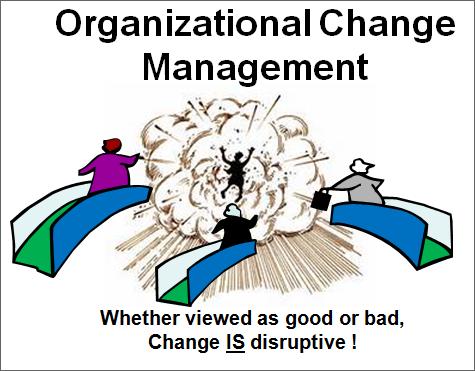
Change IS Disruptive, but Change Management Can Mitigate Impacts to Productivity
As a business leader, have you ever encountered the following challenges within your company:?
1. Implemented new technology or IT system and people failed to adopt & fully utilize it?
2. Implemented new processes and ways of doing business and your employees continued to follow the older methods?
3. Your competition continually seems to be evolving and innovating, developing new and more effective ways of doing business, while your company culture resists change and new ways of doing business?
The remainder of this blog is dedicated to sharing some of the techniques to get your organization to embrace and be supportive of change. These change management techniques are based on my years of implementing change at organizations like Macy’s, American Express, Intuit, AT&T, Pfizer, Bristol-Myers Squibb, Oracle, CBS Interactive, Wells Fargo, and numerous other Fortune 500 companies.
Topics in this blog:
1)What is Change Management – A Simple Definition
2)Why is it Important?
3)Why is change resisted by so many employees?
4)Do all employees approach change the same way and how do you harness the power of the innovators and change ‘early adopters’?
5)How Change Management Helps Accelerate Change
6)Change Management Mitigates the Impact on Productivity while Implementing Change
7)The Organizational Change Model Facilitates Change Success & Greater Business Results
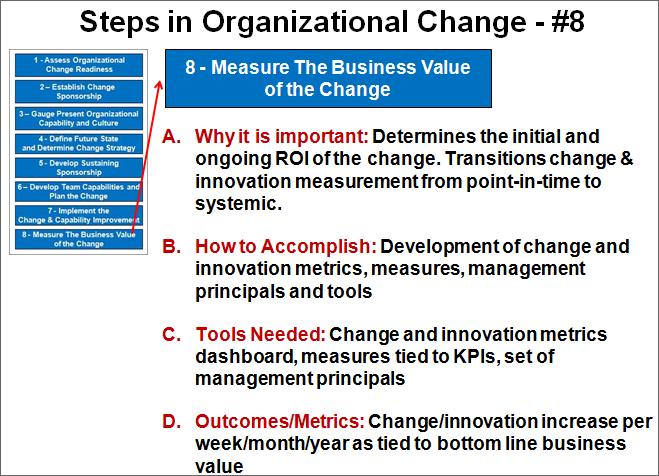
8)Steps in the Organizational Change Model Ensure Change Project Success
9)The Importance of the eight (8) Change Management Steps
10)Summary – Change Management & Innovation Requires a 360°, holistic approach driven by skilled and experienced change management professionals
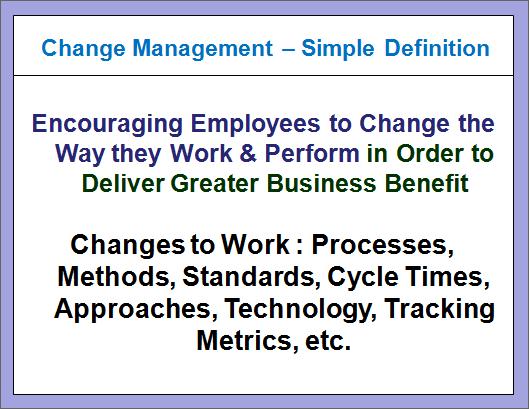
1) A simple definition of what change management is:
A Simple Definiton for Change Mgmt.
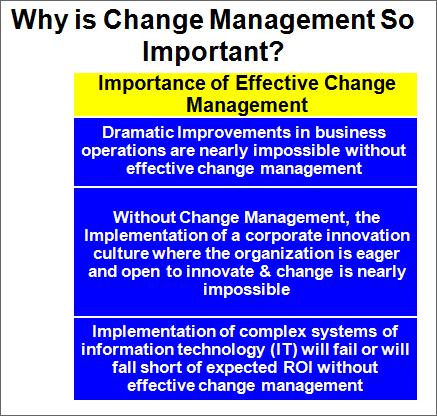
2)Why is change management so important?
Why Is Change Mgmt. So Important?
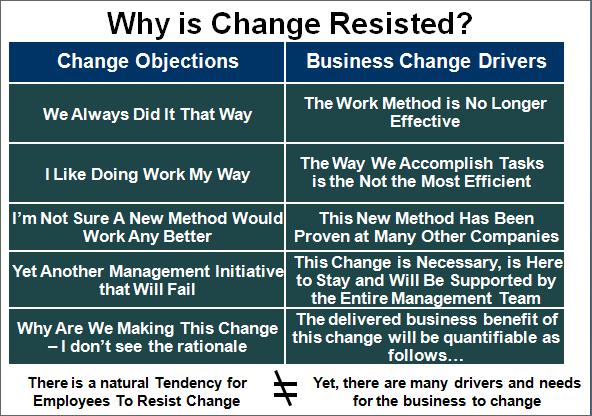
3)Why is change resisted by many employees?
Why is change resisted by many employees?
Bottom Line: Without proper education and motivation, change is naturally resisted within the workplace by all but a few.
4)Do all employees approach change the same way?
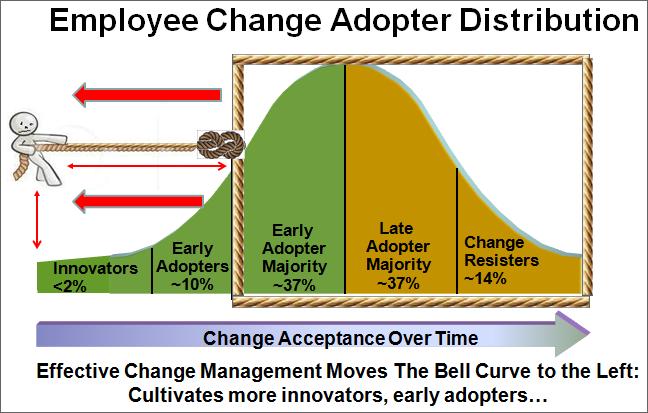
As depicted by the below chart, employees range from ardent resisters to innovators. Change solicits the support from innovators and early adopters to help diffuse organizational change to the remainder of the organization.
Employee Change Adopter Curve
5)How Change Mgmt. Helps Accelerate Change
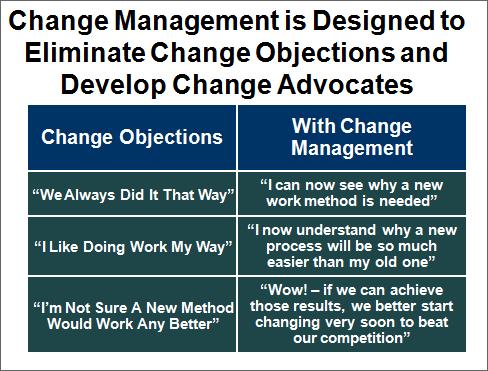
Change not only removes obstacles to change, it helps develop enthusiasm and excitement for accelerated change in the future.
How Change Mgmt. Helps Accelerate Change
6)Change Mgmt. Mitigates the Impact on Productivity While Implementing Change
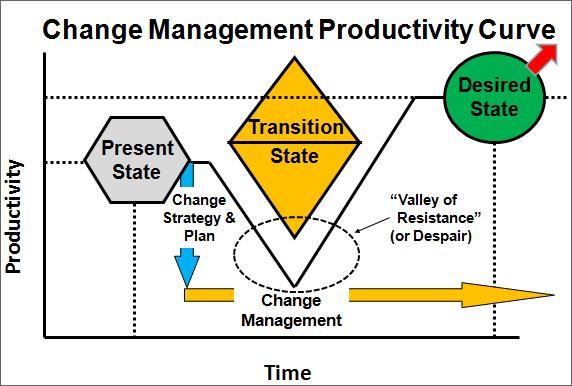
By having a robust change mgmt. methodology and plan, disruptions to business productivity can be minimized until the desired change state is achieved.
Change Mgmt. Productivity Curve
7)The Organizational Change Model Facilitates Change Success & Greater Business Results
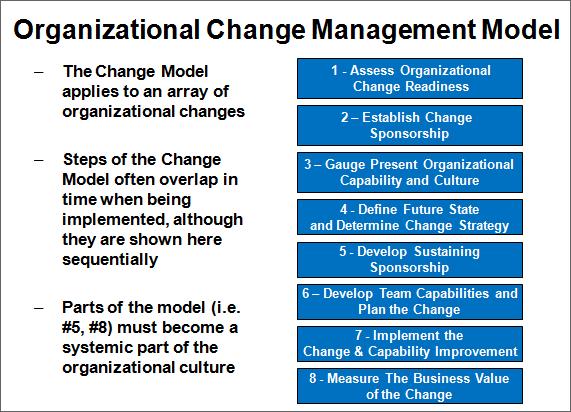
By having a robust change management methodology and model, change success and enhanced business performance can be nearly guaranteed.
Organizational Change Mgmt. Model
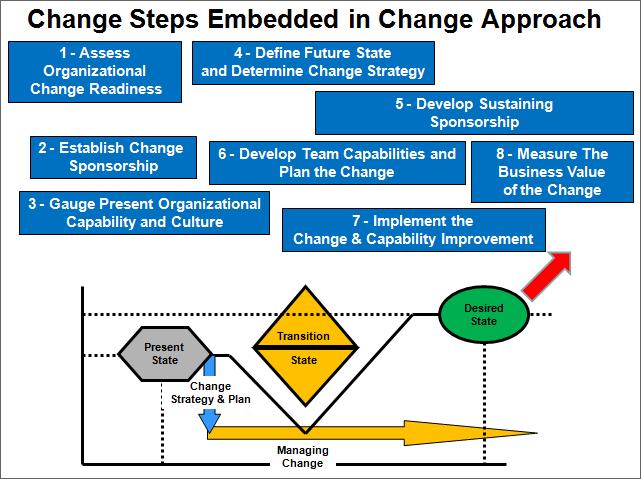
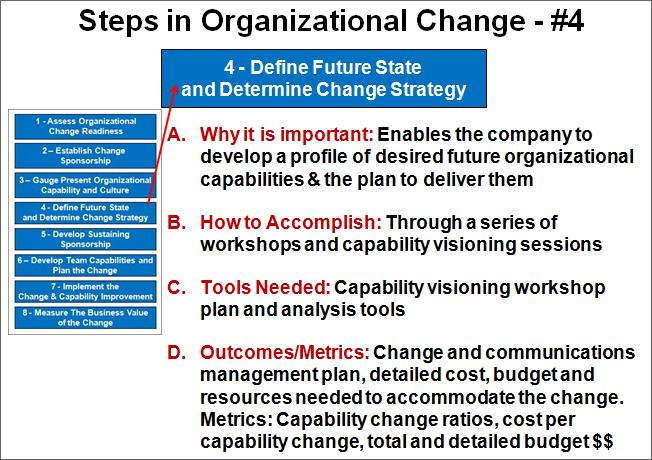
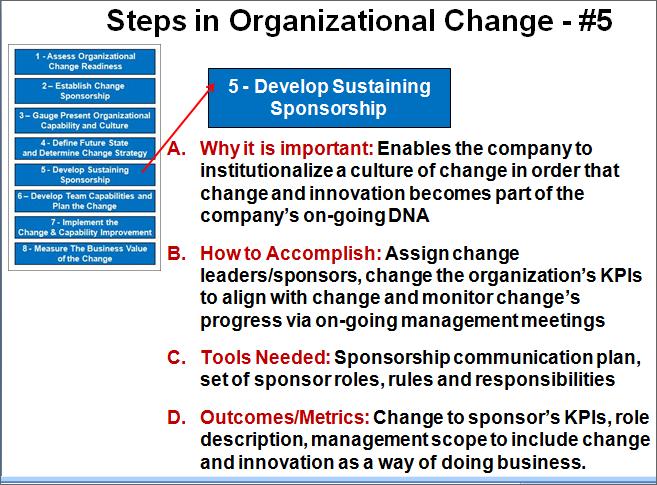
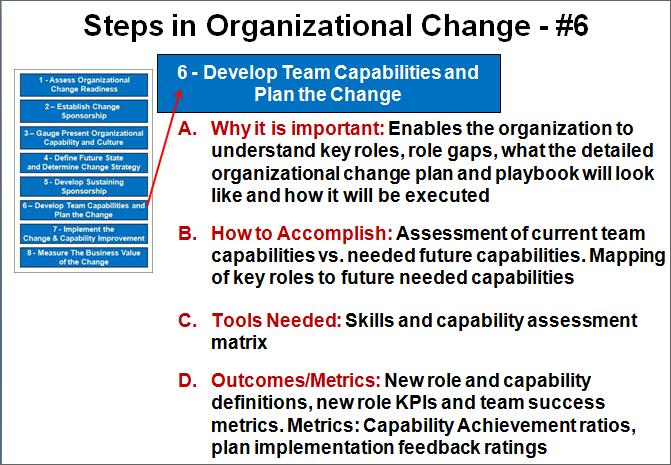
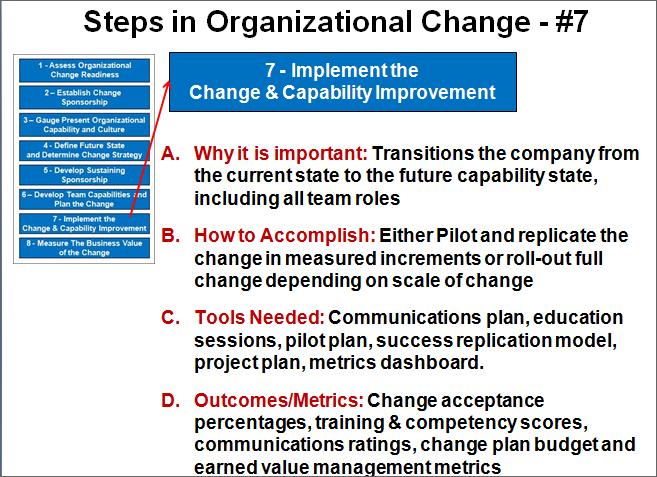
8)Steps in the Organizational Change Model Ensure Change Project Success
Change projects must have clearly defined and measurable steps that align with the overall change methodology. This approach greatly enhances the chance that the change project will be successful as well as facilitates the achievement of desired-positive business outcomes.
Change Steps in The Change Mgmt. Approach
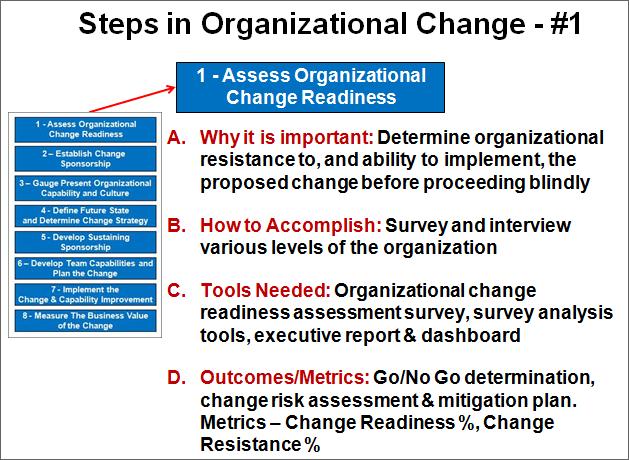
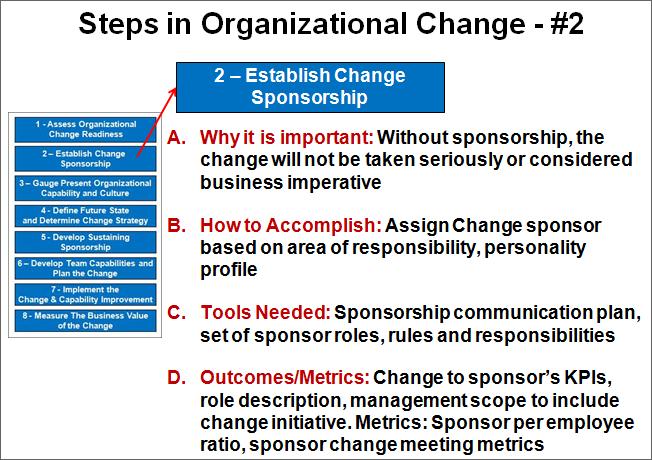
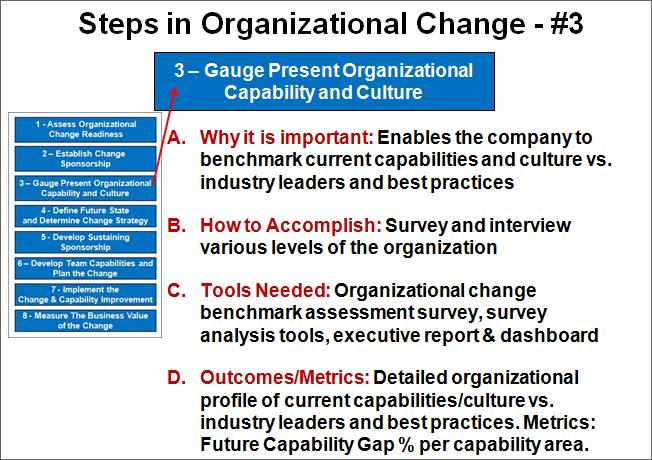
9)The Importance of the eight (8) change mgmt. steps
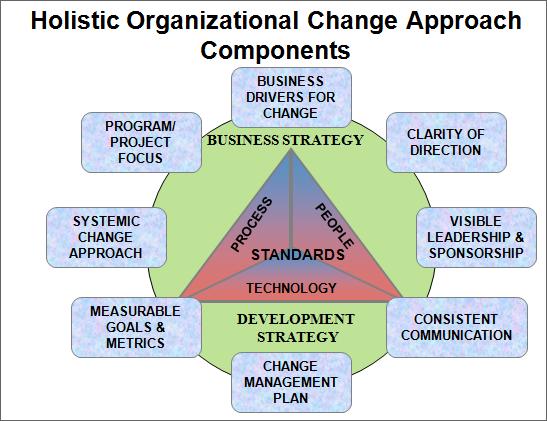
10)Summary – Change & Innovation Requires a 360°, holistic approach
In summary, change requires leveraging a proven change methodology, skilled change management practitioners and a holistic approach to implementing corporate innovation and change. The above is a simple depiction of a best practice approach I have used on many change management projects at many of the Fortune 500 companies in the US.
Holistic Organizational Change Components
For addtional information on this topic, reference the following:
How to Win Key Strategic Sales Deals through Sales Power Mapping, Management and Improvement – in 5 Easy Steps !
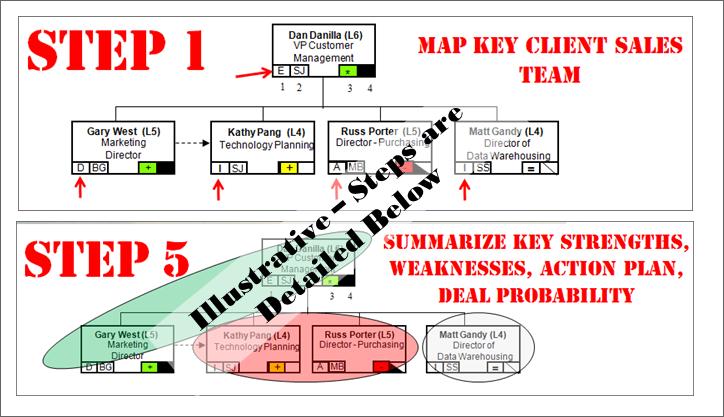
Illustrative of the 5 Step to Power Mapping (Ilustrative – Covered Below}
Analysis and Management of the key decision makers and influencers in any strategic and long-term sale is crucial for success and for obtaining that BIG SALES CONTRACT WIN. This type of analysis of multi-million dollar & strategic sales deals is a common practice of the top revenue generating firms throughout the world including Accenture, IBM, PricewatehouseCoopers, McKinsey, General Electric, Deliotte, KPMG, etc. Through this proven sales analysis technique called Sales Influencer Mapping or Power mapping, you can quickly ascertain the following:
How likely you are to win the deal based on the status of your relationships with the various client company team members?
Who at your client company are for or against you and your firm winning this sale?
Who from your client company has a pre-existing positive or negative perception of your company?
What is the nature of your relationship with all of the key decision makers and influencers that must approve and/or condone this sale to your firm?
{Click on Chart for a larger/clearer image}:
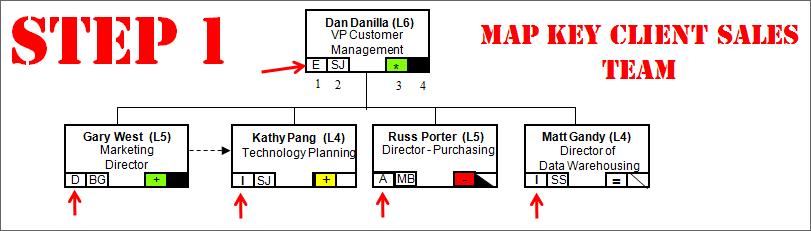
Step #1 – Map Key Client Sales Team
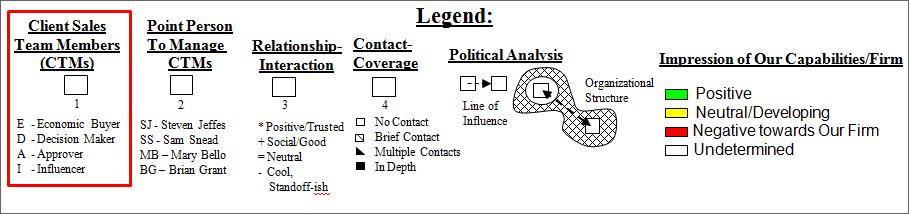
Step #1 Legend
Directly related to the last bullet (#4) above, the first and key step to influencer mapping for longer-term strategic sales is determining the sales influencer landscape as follows:
Who is the economic buyer(s) that has an allocated budget for the item you are selling and who will ultimately make the final decision for the sale? It is the economic buyer’s budget that will fund your sale of your product/service.
Who are the decision maker(s) who the economic buyer must get to concur (sign-off) that they are selecting the right firm, solution, products for this sale? Decision makers are the people who are putting their reputations and careers on the line for selecting you and your firm for this sale.
Who are the key influencer(s) that will influence the opinions and impressions of your company with both the economic buyer and the decision makers? It is the key influencer(s) who can help or hurt the chances of your sale with the economic buyer(s) and the decision makers.
Take Chart #1 below that represents a strategic sale of over $1.2MM to a potential pharmaceutical client. Our strategic sales team consisted of four of us attempting to sell a strategic roadmap for our client to enable an enhanced direct to consumer (DTC) pharmaceutical marketing model.
{Click on Chart for a larger/clearer image}:
Step #1 – Map Key Client Sales Team
Step #1 Legend
In step one, we carefully analyzed the client company organization and quickly determined that Dan Danilla, as VP of Customer Management, was the Economic Buyer for this sale and had adequate allocated budget to actually buy our services. You will notice the “E” noted below his name in box #1 for Economic buyer per the above power mapping legend.
Gary West was determined to be responsible for the project’s delivery and success, so he was labeled at the Decision Maker “D” in box #1 below his name/organizational box.
Russ Porter was determined as being one of the signatories of the contract, so he is marked with an “A” for being a contract Approver in box #1 below his name/organizational box.
Lastly, since Matt Gandy has a great social relationship with both Dan Danilla (Economic Buyer) and Gary West and is often called for professional advice by both, we marked him as a key influencer for this sales deal with an “I” in box #1 below his name/organizational box.
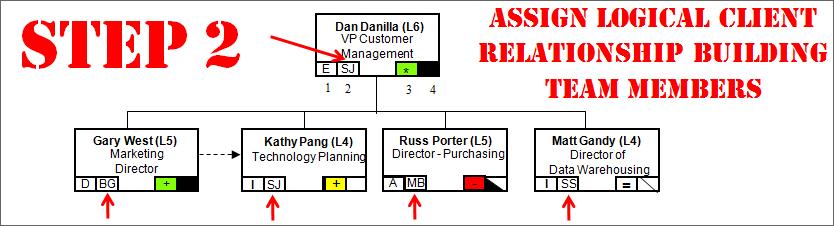
Chart #2 represents Step #2 in Sales Power Mapping {Click on Chart for a larger/clearer image}::
Step #2 – Assign Logical Client Relationship Building Team Members
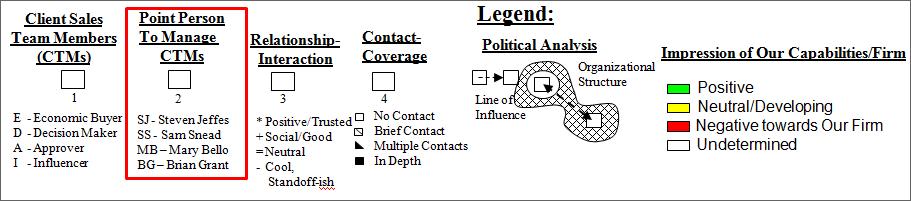
Power Mapping Step #2 Legend
In this step we assign our company team members to effectively manage the key influencer client relationships based on personality matching and previous interaction history.
In the above example, I (Steven Jeffes-SJ) was assigned to cover Dan Danilla (Economic Buyer) as I have had very good previous interactions with him and he seemed to like my ideas/insights.
Likewise Brian Grant (BG) was assigned to Gary West (Decision Maker), Me assigned also to Kathy Pang (Influencer), Mary Bello (MB) to Russ Porter (Approver) and Sam Snead (SS) to Matt Gandy as they head out for drinks together occasionally and have a budding social relationship.
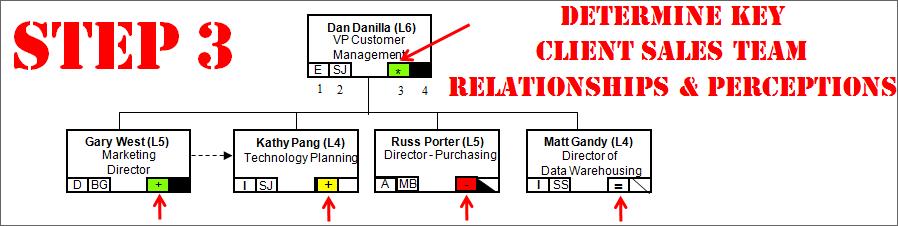
Sales Power Mapping Step: Determine Key Client Sales Team Relationships & Perceptionss
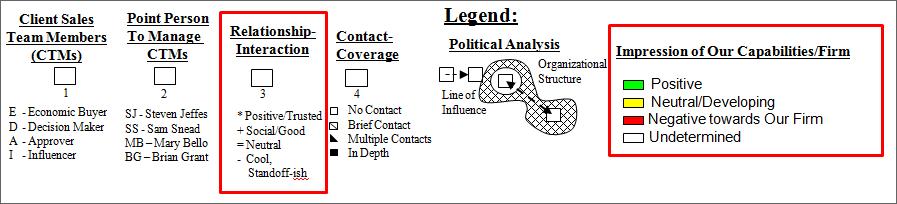
Chart #3 represents Step #3 in Sales Power Mapping {Click on Chart for a larger/clearer image}::
In this step we accomplish two bits of sales analysis as follows:
1)We determine what our previous interaction with each person has been like and how have they reacted to our team members in the past (on average). This is represented by box #3 above “Relationship Interaction”. In box 3 for each client team member, we noted “*” for having a positive/trusted relationship with Dan Danilla, a “+” for having a good relationship with Gary West, a “+” also for Kathy Pang as she has a good relationship with Steve Jeffes, and “-“ with Russ Porter as he has been cool and stand-offish with team members and a “=” with Matt Gandy as he has been neutral in our previous interactions with him.
2)Our second step in this phase is to determine what each person’s impressions are of our Firm’s capabilities based on any previous statements. We color the same box #3 with colors Green for Positive, Yellow for Neutral, Red for the person having negative impressions of our firm. These colors are noted above in box #3 for each client team member – Dan Danilla (Green), Gary West (Green), Kathy Pang (Yellow), Russ Porter (Red), and Matt Gandy (White for undetermined).
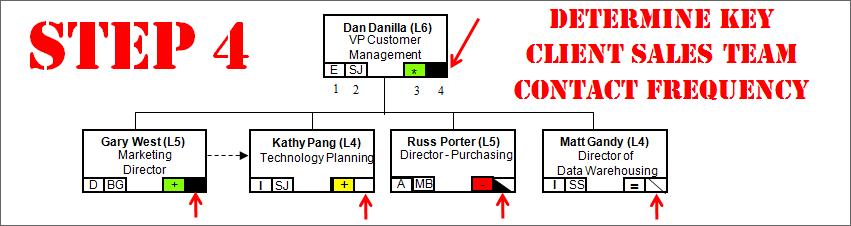
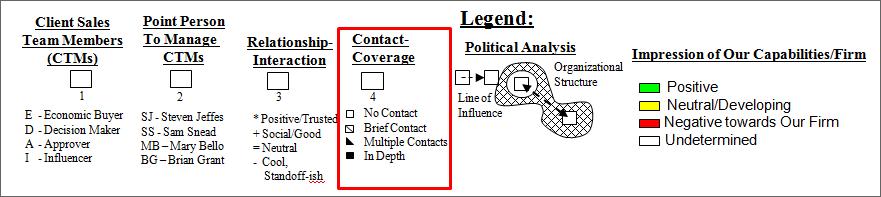
Chart #4 represents Step #4 in Sales Power Mapping {Click on Chart for a larger/clearer image}::
Step #4 – Determine Key Client Sales Team Contact Frequency
Power Mapping Step #4 – Legend
In this fourth step we accomplish the following:
Determine the extent to which we have had contact with each client sales team member. This step is critically important in order to be able to develop an effective action plan to help develop better relationships with each client team member. In addition to noting the frequency of contact, detailed notes must be cultivated from each strategic sales team member to determine the following for each client team member:
1)What previous concerns has the client team member mentioned when dealing with our team or when our potential solution was presented?
2)What previous likes or preferences has the client team member mentioned when dealing with our team or when our potential solution was presented?
3)What type of personality type is this client team member – analytical, introverted, social, extroverted, etc. (Should also be used in matching team members in step #2 above)
4)What checkpoints or process steps is this client team member looking to ‘check off’ as part of this product/solution evaluation?
5)Are there any other team stakeholders missing in developing the above organization chart that should now be added?
In the fifth and final step of this process, we perform the following:
A)Aggregate and summarize the above sales analysis including deal strengths & weaknesses
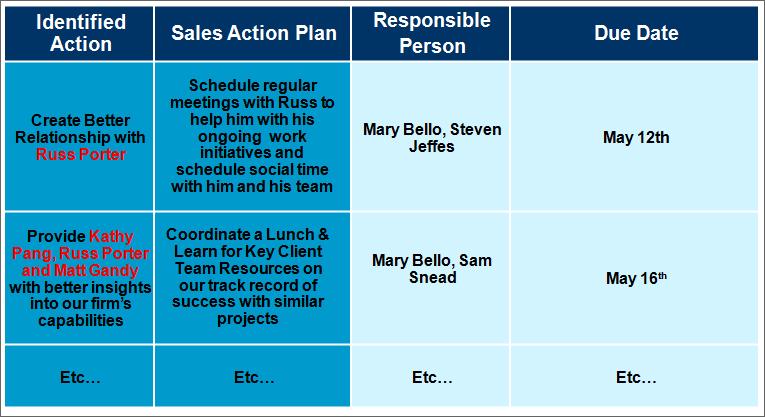
B)Develop a Sales Action Plan
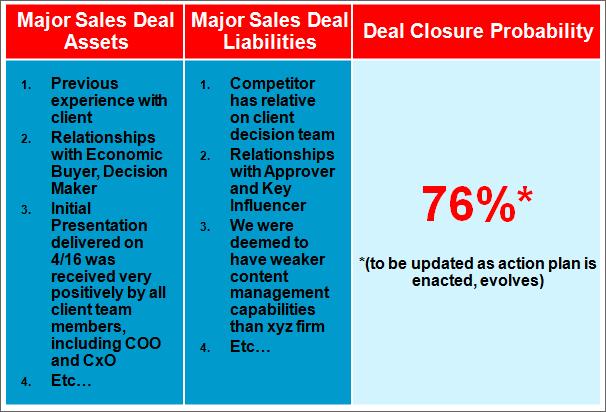
C)Estimate Deal Probability Closure %
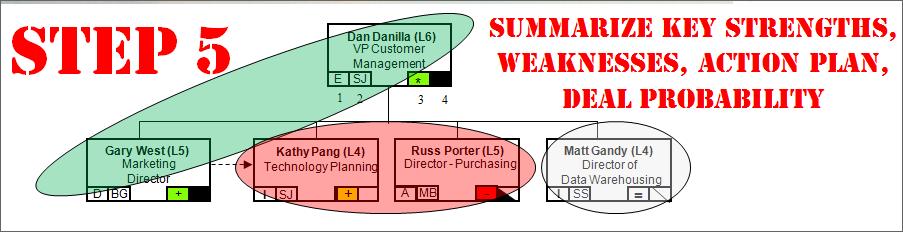
The picture that summarizes the sales analysis can be shown as follows {Click on Chart for a larger/clearer image}::
The summary of our sales analysis (as depicted in Chart #5 above) for this sale deal is as follows:
We have goodand strong relationships with Dan Danilla (Economic Buyer) and Gary West (Decision Maker) putting us in a good position to win the deal.
We have weaker relationships with Kathy Pang (Deal Influencer) and Russ Porter (Deal Approver) and these relationships need to be strengthened via our sales action plan. They also have either neutral or negative impressions of our firm as compared to our competitors.
Matt Gandy (Deal Influencer) has a neutral position in terms of relationships with our team members and impression of our firm’s solutions and capabilities.
B)Develop a Sales Action Plan (Sample):
The action plan that aligns to our above sales analysis for this sales deal is as follows {Click on Chart for a larger/clearer image}::
Sales Power Mapping – Action Plan
C)Estimate Deal Probability Closure %:
The final step is to estimate, utilizing all of the above insights, as well as major sales deal assets and liabilities, the probability that this sales deal will close favorably (as a win) for our firm as follows {Click on Chart for a larger/clearer image}::
Sales Power Mapping – Sales Deal Summary Assets, Liabilities, Closure Probability %
The bottom line to sales power (influencer) mapping is that the best sales companies and your most formidable competitors are using this level of sales analysis and action planning in order to win that strategic multi-million $$$ deal.
Your organization will be at a competitive disadvantage if you do not employ this level of rigor in your sales pursuits. Trust me, it works and I have closed many large multi-million $$$$ deals (including this one – YES, the above example was A WIN!) using this technique at many of the world’s leading firms.
For additional information on this topic, referece the following