Blow Away Your Competition by Replacing Your Old CRM Program with a more effective Customer Relevant Relationship Management (CRRM) Model
1) Introduction
- Do you have a robust CRM program in-place, but you feel you are still missing the mark in terms of delivering what your customers really want & need?
- Is your organization at risk of making market decisions that can cause a backlash and mass defection by your customers like the Bank of America $5 fee decision or the Netflix business split decision?
- Do you have volumes of consumer data and analytics, but sales are declining or flat and customers are churning at an increasing rate?
- Do you feel you could improve the quantity and quality of your customer insights including ascertaining critical consumer needs, preferences, likes/dislikes, interests, preferred communication channel for you to contact them, preferred timing and frequency for you to communicate with them, etc?
If you can say “Yes” to any of these questions, the rest of this post is a MUST READ for you and it is time to consider this more effective CRRM Model to replace your outdated CRM Model.
2) CRM vs. CRRM Model Overview
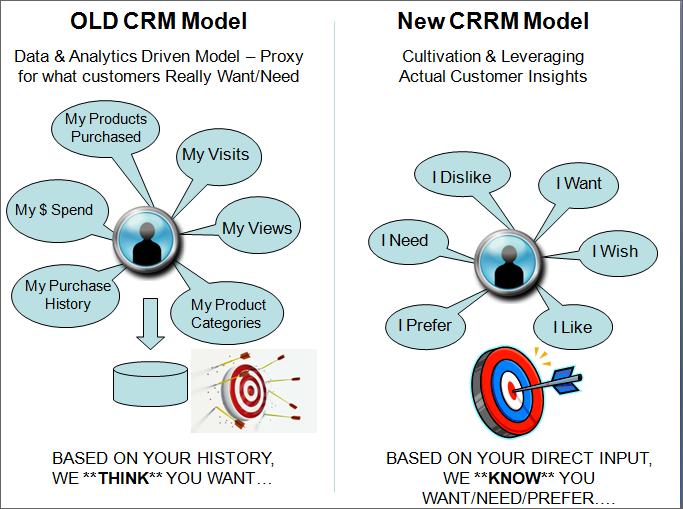
The following diagram depicts the major differences between the old CRM Model and the new CRRM Model including the problems associated with the old CRM model and benefits of the newer CRRM model.

Old CRM Model vs. Customer Relevant Relationship Management (CRRM)
Old CRM Model (left above):
- Relies on historical data and analytics to determine what customers need, want, etc. by the analysis of sales history, types of products purchased, categories of products purchased, views on websites, stores visited, etc.
- Customer activity information is a proxy to what customers really want and need. Example, you will seldom learn that a customer hates an in-store or web experience through this proxy for what they are wanting, feeling, needing, disliking, etc.
- Companies are unlikely to gain insights into the impact that any future company decisions will have on customer loyalty, retention, acquisition.
New CRRM Model (right above):
- Takes a more direct approach with customers and utilizes a systemic querying method to ascertain exactly what customer want/need/prefer/etc.
- Embraces customer councils, customer forums, customer voting to drive future content, interactions, product/service offerings, etc.
- Activity solicits ratings from customers on many aspects (marketing materials, web experience, in-store experience, product usability, quality of customer service, etc.) regarding the health of the overall customer relationship and continually asks “How well are we managing our relationship”
3) Example of CRM Model Gaps
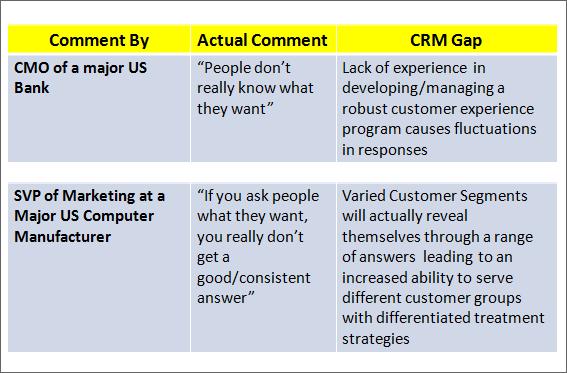
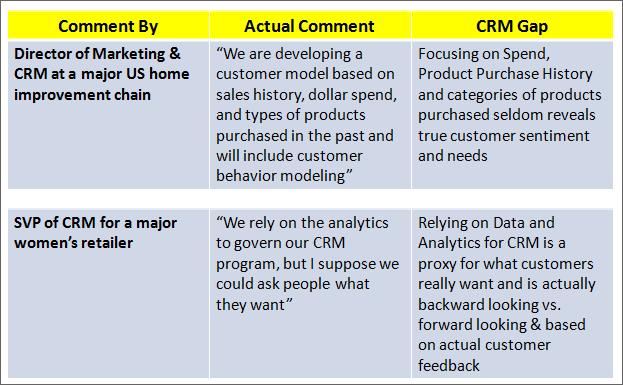
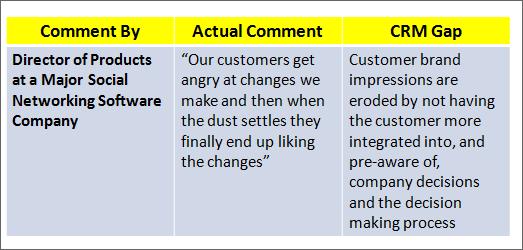
To illustrate how companies are struggling to really determine the real needs of their customers, I took selected comments from interactions with senior CRM executives from major US Corporations based on consulting engagements, job interviews, speaking to them in passing, etc. The following charts are their actual verbatim comments as well as my read on their CRM gap that prevents them from developing world-class relationships with their customers.


Traditional CRM Programs:
- Organizational culture, operations, and go-to-market strategy does not put the customer and real customer insights into the center of CRM operations
- Relies on data, analytics, and customer history to drive on-going customer interactions.
- Puts the organization at extreme risk of missing the boat from a customer’s perspective – real needs, wants, concerns, preferences, experiences, etc.
- Companies that rely on this model are at-risk of customer defections, decreased customer spend/loyalty, etc.

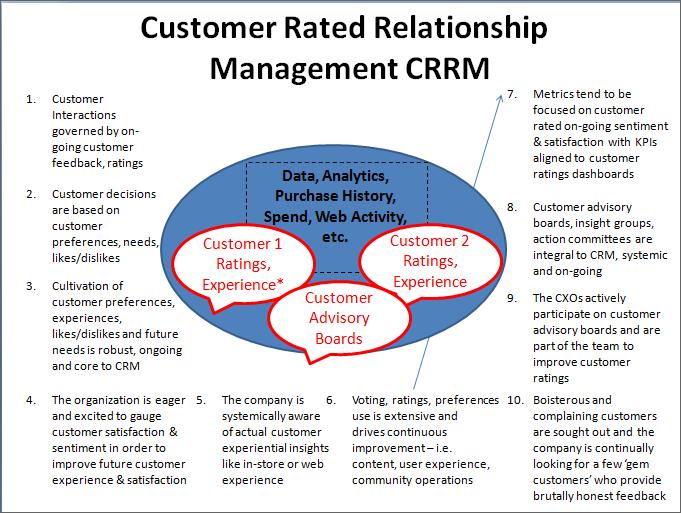
New CRRM Model – with Customers In The Center of Customer Operations
New CRRM Program:
- The organizational culture, operations, and go-to-market strategy puts the customer and real customer insights into the center of CRM operations rather than rely on the proxies of what customers want, i.e. data, analytics, and customer history.
- The customer becomes the actual judge, ‘rater’ of whether you are delivering quality, value and a good relationship to them.
- The customer is put in charge of CRM operations and enables a bi-directional and on-going dialog with the customer whereby they tell you their real needs, wants, concerns, preferences, experiences, etc.
- Companies that rely on this model are more likely to develop products, services, offers, communications that delight the customer and whereby they are more loyal, greater brand advocates, and likely to refer your company to their friends as a company who listens, cares and empowers their customers.


6) Companies That ‘Get ‘CRRM
The following are samples of companies that, in my opinion, get the CRRM model and details how/why each of them get this new go-to-market customer model.

Companies That ‘Get’ CRRM – 1 of 2

Companies That Get CRRM – 2 of 2
Phrases That Describe Companies who ‘Get’ the New CRRM Model
- We don’t hide behind data and analytics to drive our customer & CRM operations, but rather we ask our customers what they want.
- We are eager to ask our most disgruntled customers how we can improve our relationship with them and to determine who to improve our go-to-market strategy
- Before we make any major market-facing decisions, we ask a cross-segment of our customers what they think about each of our proposed decisions and then ask them how to improve upon how these changes are implemented so we ensure a continued delighted customer base.
The bottom line of this post is that, if your company relies less on historical data and analytics to determine what customer want and actually builds methods, processes, and systems to put the customer in charge of rating CRM operations in order to provide you with ongoing and valuable real insights (needs, wants, likes dislikes, preferences, concerns, etc.), the customers will feel more valued and connected with your brands. The benefit of adopting this new CRRM model will be more loyal, empowered and delighted customers who will be brand advocates and brand referrers that will increase shareholder and company value.
As I have now built this new CRRM model for several major US brands, my next blog post will be on ‘how to’ develop this capability at the enterprise level.
Filed under CRM
Tagged with Alex Lintner, Amtrak, Amtrak CEO, Amtrak Customer service, Amy C. McPherson, Anne B. Ireland, Arne M. Sorenson, AVID MODJTABAI, Bank of America, Bill Campbell, Brad Smith, Brian Boardman, Caroline Donahue, Carrie L. Tolstedt, CDW, CeCe Morken, Chairman of the Board, Christina M. Corley, Communispace, Computer Discount Warehouse, consumer analytics, consumer backlash, consumer councils, consumer data, consumer data mining, consumer data warehouse, consumer feedback, Consumer focus groups, consumer information, consumer insight mining, consumer insights, Consumer Intelligence, consumer loyalty, consumer needs, consumer preferences, consumer sentiment, Consumer trends, CRM, CRM Excellence, CRM model, CRM Operating model, CRM Operations, CRM process, customer acquisition, customer analytics, customer backlash, customer brand advocate, customer brand referrer, customer churn, customer concerns, customer councils, customer data, customer data mining, customer data warehouse, customer defection, customer dissatisfaction, customer driven design, customer driven operations, customer driven requirements, Customer Experience, customer feedback, Customer focus groups, customer hate, customer hates, customer information, customer insight mining, customer insights, customer insights group, customer intelligence, customer ire, Customer Loyalty, customer management, customer needs, customer oriented, customer oriented culture, customer preferences, customer products group, Customer Relationship Management, customer satisfaction, customer service excellence, customer service feedback, customer strategy, customer strategy development, Customer Trends, customers are always right, Customers first, customers suck, Dan Maurer, DAVID A. HOYT, David J. Grissen, DAVID M. CARROLL, Dennis G. Berger, Douglas E. Eckrote, Eric Dunn, Executive Vice President, Facebook, Federal Emergency Management Administration, FEMA, frustrated customer, Ginny T. Lee, Godiva, Godiva Chocolate, Intuit, Intuit CEO, Intuit Software, J.W. Marriott, JAMES M. STROTHER, Jill Ward, John A. Edwardson, John G. Stumpf, Jonathan J. Stevens, Jr, KEVIN A. RHEIN, Kiran Patel, Laura Fennell, Macys, Macys Corporate Marketing, Macys Marketing, Maria M. Sullivan, market insights, Market Intelligence, Marriott, Matthew A. Troka, Michael J. Loughlin, Mr. Don Gould, Mr. Gene Dunkin, Mr. James A. Goldman, Mr. Michael Simon, Mr. Richard M. Paschal, Neal J. Campbell, Netflix, Nora Denzel, PATRICIA R. CALLAHAN, Per-Kristian (Kris) Halvorsen, poor customer service, product councils, R. Neil Williams, RICHARD D. LEVY, Sasan Goodarzi, Scott Cook, Sears Holdings, Senior VIce President, Sherry Whiteley, Social Listening, Social Listening Programs, Social Sentiment, Steve Malik, Steven Jeffes, Tayloe Stansbury, Terry Lundgren, Thomas E. Richards, Timothy J. Sloan, Volvo, Volvo North America, Wells Fargo, Wells Fargo CEO