Developing an Enterprise Level Customer Relationship Management (CRM) Strategy & Road-map

Enterprise CRM Strategy Development Framework
Enterprise Customer & CRM Strategy Development Framework

The chart above is a CRM Strategy framework I have used to guide the development and future operational model of a customer relationship management (CRM) strategy and roadmap for a large multi-national company. This framework is comprised of the following major components that must be taken into account in developing a customer strategy & roadmap (from bottom to top) :

  1. Major customer segments that exist comprise the foundation of the framework. These need to be taken into consideration as the major customer stakeholders that either are in place, or need to be defined as part of the future-state strategy.

  2. The customer channel content that exists and will be needed moving forward once the major customer segments have been determined.

  3. The partner matrix and partner relationship model that exists and will be needed – types of partners, partner distribution model, partner communications methods, partner acquisition model, etc.

  4. The current and future customer touch-points specifications – usage, volume, delivery method, cost structure, etc.

  5. Major customer, partner and market insights that exist and that are needed in the future.

  6. The current and needed future state model for customer facing operations and capabilities that exist within each functional area.

  7. The existing and future engagement model that will operate through the customer channels, utilizing the information/insights and channel and customer specific content, etc. – cost structure, automation, key strategies in each (sell in service, one and done customer service, etc.)

  8. Finally the top of the pyramid, the customer and CRM strategy that drives all other structure capabilities and operating models as defined through a series of workshops shown later in this article.


graphic2
High Level Enterprise CRM Transformation Approach

The chart above is a depiction of the transformation approach I have used to guide the development of the actual CRM strategy shown on the top of the pyramid from the last chart. In this chart we have the following:

  1. Left side, “Synthesize Insights” – Depicts sample insights that need to be gathered and synthesized on the left in order to determine a realistic future state customer strategy and roadmap.

  2. Top, under “CRM Transformation Approach” – The delivery, governance and oversight structures that must oversee and manage the delivery of a final customer strategy and 5+ year roadmap.

  3. Middle, under “CRM Transformation Approach” – The major program phases in the delivery of the future state customer strategy and roadmap as well as the major goals and deliverables from each phase.

  4. Right side, under “Net Positive Impact” – The major positive impacts from the development of a customer strategy and 5+ year roadmap stated in both quantitative measures (via a business case) and qualitative dimensions.


CRM Opportunity Assessment Process

The chart above is the high level process (level 0) I have used to assess the CRM (future-state) opportunities at a large multi-national company. While I start with this CRM process flow to accelerate the delivery of a customer strategy and roadmap, each is tailored to each client situation and set of requirements. This also includes a detailed approach and plan for conducting a series of “CRM Opportunity Assessment Workshops” attended by key executives and stakeholders whereby many of the components listed in the above flowchart are actually defined.

 “To Be”, Future-State CRM Strategy Definition
“To Be”, Future-State CRM Strategy Definition

The chart above details a small sample of the steps details that exist within the “CRM Opportunity Assessment” processes step. In this particular example, we must define the major customer strategies we want moving forward as well as the supporting details to successfully deliver the strategy:

  1. Performance metrics that will be put in place to monitor the success of the overall program once the customer/CRM strategy is implemented

  2. Budget & governance structure that will manage both the implementation of the strategy as well its ongoing operation of the program

  3. Program success criteria for the strategy to be considered a success

  4. Specific programs and projects to deliver the strategy

  5. The stated strategic goals for each defined customer strategy


CRM Strategy & Roadmap Development Process

The chart above is the high level process (level 0) I have used to develop a future operational model of a customer relationship management (CRM) strategy and roadmap for a large multi-national company. I full project plan that includes task dependencies, project critical path, logical sequencing of project tasks, resourcing plan, etc. accompanies the above chart during an actual client project. This also includes a detailed approach and plan for conducting a series of “CRM Definition Workshops” attended by key executives and stakeholders that provide direct input into the future-state CRM strategy & road-map.

Strategic CRM Goals Definition Process

The chart above highlights the details associated with developing the specific and measurable objectives for a future state CRM & customer strategy. These details are highly variable and need to be tailored based on the specifics associated with the client’s market & requirements, budget, competition, market/customer gaps, etc.

This is just one article of 60+ total I have written on Customer strategy, CRM, marketing, product management, competitive intelligence, corporate innovation, change management – all of which I have significant experience in delivering for Fortune 500 companies.

In fact, my blog is now followed by nearly 160,000 world-wide.


Aligning Market Insights & Trends to Customer Strategies & Priorities

Customer Strategy Best Practices, Tools, Techniques, Examples

  1. What is the size of the potential pool of new customers and which are the best customers to acquire?

  2. Which customers are your most profitable and how do you get other customers to grow and become part of your top ( and most profitable) customer segment group?

  3. What is your current customer share of wallet (SOW) as compared to your competitors and what does driving small incremental increases in your customer SOW do to your overall revenue?

  4. What are the shifting attitudinal and behavior patterns of your customer market and how do you develop a strategy that ‘gets in front of’ these trends?

  5. What are the shifting customer demographics of your marketplace as well as the underlying shift in spending habits

  6. What are the changes in customer preferred marketing channels as well as trends that might impact customer loyalty strategy


Customer Strategy: Market Insights and Trends Drive Customer Strategy, Programs
Market Insights and Trends Drive Customer Strategy, Programs


The above charts illustrate why it is critically important to have clear and accurate insights into your new customer market potential/pool as well as the current customer base and their share of wallet.

The chart above (right side) illustrates which customers drive the current percentage of revenue in order to understand how customer priorities and strategy should be defined.

Customer Strategy: Critical Insights: Top Customer, Top Profitable Customers and Customer Share of Wallet vs. Competitors
Critical Insights: Top Customer, Top Profitable Customers and Customer Share of Wallet vs. Competitors

Market Spend Insights Can Be Transformational in term of goal setting

The above graphic illustrates how share of wallet changes drive bottom line revenue as well as converting customers into more loyal top customers.

Customer Strategy: Customer Attitudinal Trends Insights Are Critical to Customer Strategy
Customer Attitudinal Trends Insights Are Critical to Customer Strategy

Understanding your market & customer behavior insights is crucial to your company’s survival

The above graphic demonstrates a deep understanding in the shifting attitudinal and behavior patterns of the customer market

Customer Strategy: Customer Market Buying Power Insights are Crucial For Developing a Coherent Customer Strategy
Customer Market Buying Power Insights are Crucial For Developing a Coherent Customer Strategy

The above chart illustrates a company capability to understand shifting demographics as well as the underlining shift in spending habits per demographic group

Customer Strategy: Understanding Key Customer Behavior & Preferences is a Customer Strategy Imperrative
Understanding Key Customer Behavior & Preferences is a Customer Strategy Imperrative
Customer Strategy: An Alignment of All Customer & Market Insights to Maximize Market Dominance & Profitability

Once Customer and Market Insights are fully embraced, an Effective Customer Strategy can be developed that includes optimizing market channel selection, as well as contact and loyalty strategy program components

Blog Summary: In order to achieve the above insights, your company must develop and deploy the following strategic capabilities and delivery programs:

  1. Market sizing & trend insights

  2. Customer revenue and profitability insights analysis

  3. Customer share of wallet and competitor spend insights delivery capability

  4. Market trend & consumer attitudinal and behavior change longitudinal analysis

  5. 360° customer needs and preference cultivation that enables a personalized customer experience strategy and delivery (i.e. preference portal customer selection of preferred channels, content types, offer types, frequency of content delivery by content type.)
Below is a list of companies where I have helped develop these programs and are considered world-class in Customer Strategy practices:

  • Johnson & Johnson

  • Capital One

  • Amazon

  • American Express

  • Kelloggs


For Additional Information on This Topic

Organizations that successfully align market insights with customer strategies are often better positioned to anticipate changing customer needs, identify emerging opportunities, and develop more effective business strategies. Market trends, customer behaviors, competitive activities, and industry developments can provide valuable information for refining customer priorities and improving decision-making across the organization.
The most successful organizations continuously monitor their markets and use customer insights to guide strategic planning, product development, service delivery, and customer experience initiatives. By combining market intelligence with a deep understanding of customer expectations, organizations can create more relevant value propositions, strengthen customer relationships, and improve long-term business performance.

For additional information on market research, customer insights, and strategic decision-making, review these resources:

Organizations that consistently align market insights, customer priorities, and business strategies are often better equipped to improve customer satisfaction, strengthen competitive positioning, and achieve sustainable growth.

Customer Emotions that Drive Buying Behavior

Consumer Behavior Sales Best Practices – Tools, Techniques, Examples

Find out why most companies miss the mark in terms of focusing on generating positive consumer behavior

Consumer Behavior - Conditions
Solutions to Problems AND Good Customer Emotions Need to Exist for Long-Term Loyalty

Good products and services are only part of the equation in terms of generating customer repeat business, loyalty, long-term retention

Consumer Behavior - Customer Emotions
Some Customers Will Work to Destroy Your Business While Others Are Willing Partners in Helping You Grow, Be More Successful

Some customers will actually work to kill your company and brand(s), namely dissenters and defectors, while others will work tirelessly to bolster your sales, reputation, customer acquisition efforts, etc.

Consumer Behavior - Emotions That Drive Buying
Guidelines for Generating Positive Customer Emotions and Relations

It is essential that all of your customer facing team members are representing the company and brand well, and that they adhere to your stated customer principles

Consumer Behavior - Selling Environments
Sample Steps to Developing an Environment Where Customers Are Motivated to Buy from Your Company

Your customer facing team members need to develop a customer interaction playbook that is consistent with your brand and customer mantra

Consumer Behavior - Win-Win Triad
Alignment of the customer delivery ‘value chain’ is Crucial

Every aspect of your customer delivery ‘value chain’ needs to be synchronized to deliver a highly consistent and high quality (emotional) experience as rated by your customers

Consumer Behavior - Chief Customer Officer
A Chief Customer Officer’s (CCO) role is to Advocate for the Customer within the CxO suite

** Refer to previous blog article on the 5 R’s of customer loyalty – https://goo.gl/L4IA3q

If you rate customer satisfaction and loyalty as a high company priority, then they must be represented by a Chief Customer Officer (CCO) that will truly advocate for customers and set the customer standards that drive positive consumer behavior

Consumer Behavior Summary:  The following points summarize the content of this blog as follows:

  • In order to develop customer loyalty you must have both great products and services as well as the ability to generate positive customer emotions (customer delight, feeling connected to the company)

  • Segments of your customer base will work to destroy your attempt at market success while others are your partners in helping your company become even more successful.

  • In order to drive positive consumer behavor and convert your customers into advocates and super-advocates, you must develop an internal customer relations playbook (develop customer vision, code of customer interaction conduct, etc.)

  • Every aspect of your customer delivery ‘value chain’ needs to be in-synch in order to deliver an end-to-end superb and fulfilling customer experience

  • Every company should have the equivalent of a Chief Customer Officer (CCO) in order to set the customer vision and standards and be the ultimate advocate for all of your customers.


For Additional Information on The Topic of Consumer Bahavior

Customer emotions play a significant role in influencing buying behavior and purchase decisions. While product features, pricing, and convenience remain important factors, emotional connections often determine which brands customers trust, recommend, and remain loyal to over time. Organizations that understand the emotional drivers behind customer behavior are often better positioned to create meaningful customer experiences, strengthen brand loyalty, and improve long-term business performance.

Research continues to demonstrate that purchasing decisions are influenced by both rational and emotional factors. Successful organizations seek to understand customer motivations, reduce purchasing barriers, build trust, and create positive experiences throughout the customer journey. By aligning products, services, messaging, and customer experiences with customer needs and emotions, companies can improve engagement, increase customer satisfaction, and strengthen competitive differentiation.

For additional information on customer emotions and buying behavior, review these resources:

Organizations that better understand the emotional factors that influence customer decisions are often better equipped to improve customer experiences, strengthen customer loyalty, and drive sustainable business growth.

Win a Customer for Life by Employing the 5 R’s of Customer Loyalty

 The how to guide to Win a Customer for Life by Employing the 5 R’s of Customer Loyalty

Customer Loyalty Principles
The 5 “R’s” of Customer Loyalty
Customer Loyalty Best Practices
Ensure Your Company is 5 “R” Customer Compliant

Following the 5 R’s of Customer Loyalty Will Enable Your Company to Attract and Keep Customers for Life


slide3
Ensure Your Company is Customer R-Reliable


slide4n
Top Steps to Ensuring Your Company is R-Reliable

The First “R” of Customer Loyalty Is Setting High Quality Customer Standards (External) and Goals (Internal) and then Delivering on that Customer Promise for Each and Every Customer Interaction as well as the overall & long-term customer relationship


Customer Loyalty Mission & Vision Statement
Example of How a Company Demonstrates Customer R-Reliability


slide6
Example of How a Company Demonstrates Customer R-Reliability (continued)


slide7
Ensure Your Company is Customer R-Responsive


Customer Loyalty & Customer Responsiveness
Top Steps for Your Company to Become Customer R-Responsive


The 2nd “R” of Customer Loyalty Is Ensuring That Customer’s Expectations Are Met: Needs, Concerns, Quality, Cycle Time Expectations, etc.


Example of How a Company Demonstrates Customer R-Responsiveness


slide10
Example of How a Company Demonstrates Customer R-Responsiveness (continued)


Customer Loyalty and Customer Retention
Ensure Your Company is Customer R-Recognizable


Custoemr Loyalty Attributes
Top Steps for Your Company to Become Customer R-Recognizable

The 3rd “R” of Customer Loyalty Is Ensuring That Your Brand and Company has Distinctive and Positive Characteristics such that it drives positive emotions (driving repeat business, customer referrals, word-of-mouth adverting, etc. 


slide13
Example of How a Company Becomes Customer R-Recognizable


slide14
Example of How a Company Becomes Customer R-Recognizable (continued)


slide15
Ensure Your Company is R-Relationship Oriented


slide16n
Top Steps for Your Company to Become Customer R-Relationship Oriented

The 4th “R” of Customer Loyalty Is Ensuring That Your Brand and Company develops a high quality and mutually beneficial relationship with your customers based on mutual respect, customer insights, an ongoing and open dialogue and a model that encourages a partnership between your brand & company and your customers 


slide17
Example of How a Company Demonstrates That It Is Customer R-Relationship Oriented


slide18
Example of How a Company Demonstrates That It Is Customer R-Relationship Oriented (continued)


slide19
Ensure Your Company is Customer R-Rewarding


slide20
Top Steps for Your Company to Become Customer R-Rewarding

The 5th “R” of Loyalty Is Ensuring That Your Brand and Company rewards mutually beneficial customer behavior (greater share of wallet, spend, brand partnership activities, etc.) such that it drives further and longer-term customer loyalty.


slide21
Example of How a Company Demonstrates Customer R-Rewarding


slide22
Example of How a Company Demonstrates Customer R-Rewarding (continued)


slide23
Is Your Company Ready to Take the 5 “R” Pledge?

SUMMARY: If you take the pledge above to adhere to the 5 R’s of customer loyalty, you will enhance your ability to attract and retain customers for life. Key to this is developing the capabilities to be best in class for each “R” and ensuring that you are (cost effectively) maintaining a major qualitative advantage in each customer R vs. your competitors.

For addition information on this topic, consult the following resources:

  1. Qualtrics: Customer Loyalty: Good overview of what customer loyalty is, why it matters, and how companies build it. Link: https://www.qualtrics.com/experience-management/customer/customer-loyalty/
  2. Harvard Business Review: The Value of Keeping the Right Customers. Strong strategic perspective on retention, loyalty, and long-term customer value. Link: https://hbr.org/2014/10/the-value-of-keeping-the-right-customers

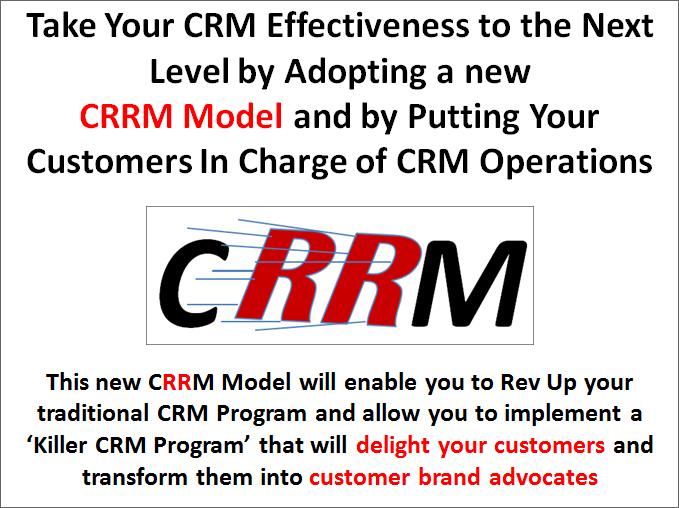
Blow Away Your Competition by Replacing Your Old CRM Program with the New Customer Relevant Relationship Management (CRRM) Model

Customer Relationship Management (CRM) Best Practices, Trends, Tools and Techniques

Customer Relationship Management New CRRM model

Blow Away Your Competition by Replacing Your Old CRM Program with a more effective Customer Relevant Relationship Management (CRRM) Model

1)               Introduction

  1. Do you have a robust CRM program in-place, but you feel you are still missing the mark in terms of delivering what your customers really want & need?
  2. Is your organization at risk of making market decisions that can cause a backlash and mass defection by your customers like the Bank of America $5 fee decision or the Netflix business split decision?
  3. Do you have volumes of consumer data and analytics, but sales are declining or flat and customers are churning at an increasing rate?
  4. Do you feel you could improve the quantity and quality of your customer insights including ascertaining critical consumer needs, preferences, likes/dislikes, interests, preferred communication channel for you to contact them, preferred timing and frequency for you to communicate with them, etc?

If you can say “Yes” to any of these questions, the rest of this post is a MUST READ for you and it is time to consider this more effective CRRM Model to replace your outdated CRM Model.

2)               CRM vs. CRRM Model Overview

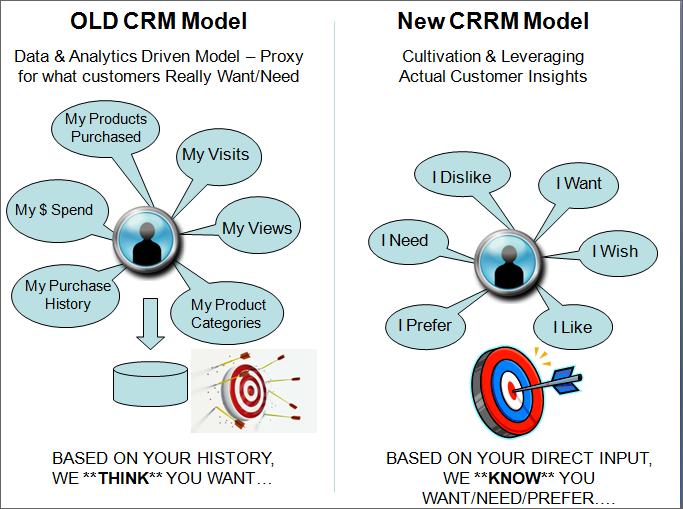
The following diagram depicts the major differences between the old CRM Model and the new CRRM Model including the problems associated with the old CRM model and benefits of the newer CRRM model.

Customer Relationship Management CRRM old vs. new model
Old CRM Model vs. Customer Relevant Relationship Management (CRRM)

Old CRM Model (left above):

  1. Relies on historical data and analytics to determine what customers need, want, etc. by the analysis of sales history, types of products purchased, categories of products purchased, views on websites, stores visited, etc.
  2. Customer activity information is a proxy to what customers really want and need. Example, you will seldom learn that a customer hates an in-store or web experience through this proxy for what they are wanting, feeling, needing, disliking, etc.
  3. Companies are unlikely to gain insights into the impact that any future company decisions will have on customer loyalty, retention, acquisition.

New CRRM Model (right above):

  1. Takes a more direct approach with customers and utilizes a systemic querying method to ascertain exactly what customer want/need/prefer/etc.
  2. Embraces customer councils, customer forums, customer voting to drive future content, interactions, product/service offerings, etc.
  3. Activity solicits ratings from customers on many aspects (marketing materials, web experience, in-store experience, product usability, quality of customer service, etc.) regarding the health of the overall customer relationship and continually asks “How well are we managing our relationship”

3)               Example of CRM Model Gaps

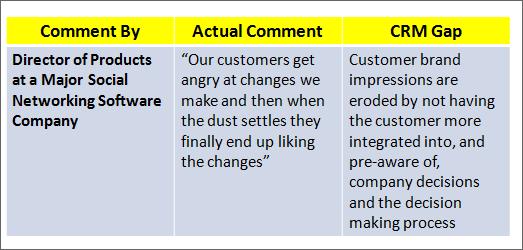
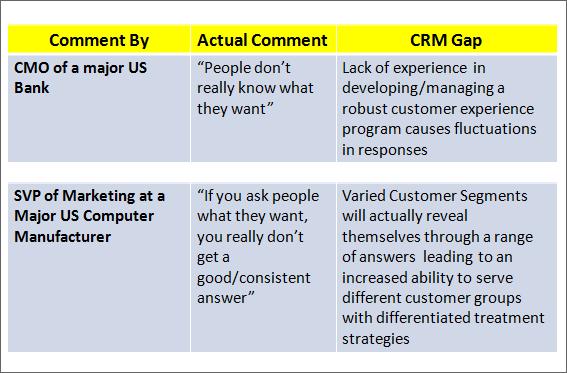
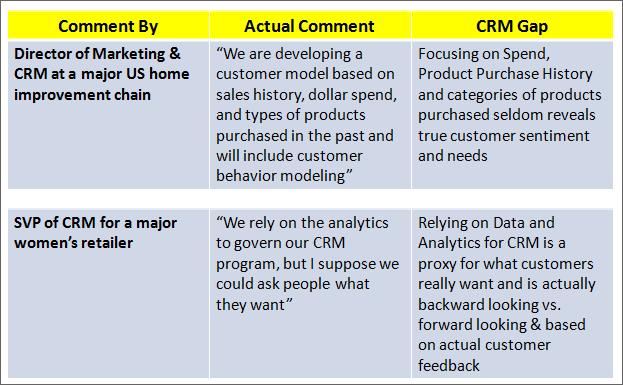
To illustrate how companies are struggling to really determine the real needs of their customers, I took selected comments from interactions with senior CRM executives from major US Corporations based on consulting engagements, job interviews, speaking to them in passing, etc. The following charts are their actual verbatim comments as well as my read on their CRM gap that prevents them from developing world-class relationships with their customers.

Customer Relationship Management Verbatims

Customer Relationship Management Verbatims

Customer Relationship Management Verbatims

Customer Relationship Management CRRM Model

Traditional CRM Programs:

  1. Organizational culture, operations, and go-to-market strategy does not put the customer and real customer insights into the center of CRM operations
  2. Relies on data, analytics, and customer history to drive on-going customer interactions.
  3. Puts the organization at extreme risk of missing the boat from a customer’s perspective – real needs, wants, concerns, preferences, experiences, etc.
  4. Companies that rely on this model are at-risk of customer defections, decreased customer spend/loyalty, etc.
Customer Relationship Management CRRM Model
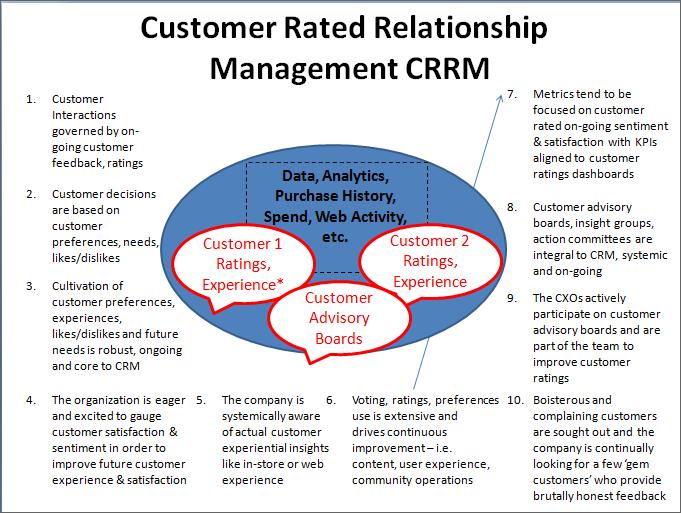
New CRRM Model – with Customers In The Center of Customer Operations

New CRRM Program:

  1. The organizational culture, operations, and go-to-market strategy puts the customer and real customer insights into the center of CRM operations rather than rely on the proxies of what customers want, i.e. data, analytics, and customer history.
  2. The customer becomes the actual judge, ‘rater’ of whether you are delivering quality, value and a good relationship to them.
  3. The customer is put in charge of CRM operations and enables a bi-directional and on-going dialog with the customer whereby they tell you their real needs, wants, concerns, preferences, experiences, etc.
  4. Companies that rely on this model are more likely to develop products, services, offers, communications that delight the customer and whereby they are more loyal, greater brand advocates, and likely to refer your company to their friends as a company who listens, cares and empowers their customers.
Customer Relationship Management Best Practice Companies

6)             Companies That Get the Customer Relationship Management CRRM MODEL

The following are samples of companies that, in my opinion, get the CRRM model and details how/why each of them get this new go-to-market customer model.

Companies That ‘Get’ CRRM – 1 of 2

Companies That Get CRRM – 2 of 2

Phrases That Describe Companies who ‘Get’ the New CRRM Model

  1. We don’t hide behind data and analytics to drive our customer & CRM operations, but rather we ask our customers what they want.
  2. We are eager to ask our most disgruntled customers how we can improve our relationship with them and to determine who to improve our go-to-market strategy
  3. Before we make any major market-facing decisions, we ask a cross-segment of our customers what they think about each of our proposed decisions and then ask them how to improve upon how these changes are implemented so we ensure a continued delighted customer base.

The bottom line of this post is that, if your company relies less on historical data and analytics to determine what customer want and actually builds methods, processes, and systems to put the customer in charge of rating CRM operations in order to provide you with ongoing and valuable real insights (needs, wants, likes dislikes, preferences, concerns, etc.), the customers will feel more valued and connected with your brands. The benefit of adopting this new CRRM model will be more loyal, empowered and delighted customers who will be brand advocates and brand referrers that will increase shareholder and company value.

As I have now built this new CRRM model for several major US brands, my next blog post will be on ‘how to’ develop this capability at the enterprise level.

Additional Customer Relationship Management Resources

For additional information on this topic, please reference the following credible resources:

  1. What Is CRM? The Ultimate Guide to Customer Relationship Management – Excellent foundational resource covering CRM strategy, customer data management, sales, service, and relationship-building. Salesforce CRM Guide
  2. What Is Customer Relationship Management (CRM)? This is a strong foundational source because the article positions CRRM as an evolution of traditional CRM. Salesforce CRM Guide