Introducing: The Customer Bill of Rights

Covered in this blog article:
A) The brand promise
B) Customer bill of rights definition
C) Why the customer bill of rights is needed and important
D) Company mantra, tagline, and brand promise examples
E) The hierarchy of company mantra, tagline, brand promise and customer bill of rights
F) Customer bill of rights company examples
G) Internal service organization customer bill of rights treatment standards
H) How to get started creating your own customer bill of rights

  1. The Familiar Brand Promise:
    We have all heard of a brand promise and have an idea of what this is all about. Simply put, a brand promise is the definition of the high-level quality of experience a company’s customers can expect to receive during every interaction with the company and its customer facing employees. The brand promise speaks to the brand’s purpose and speaks to the value that the brand will deliver.
  1. Customer Bill of Rights Why Needed & A Simple Definition:
    The downside of a brand promise is that it is short of specifics on what the customer can expect during their interactions with the company. To bridge the gap between the higher-level brand promise and to explain what the customers can specifically experience when interacting with the company, we introduce the relatively new customer bill of rights. Here is a simple definition of what a customer bill of rights is:

A customer bill of rights is a public statement designed to communicate to customers what specific service level standards and guarantees the company is going to provide to them.

  1. Hierarchy: Company Mantra, Tagline, Brand Promise and Customer Bill of Rights:
    To first explain how a brand promise ties into the customer bill of rights I thought it important to review the hierarchy of company-customer experience value statements starting with the Company Mantra at the highest level. Simply put, a company mantra states what the company stands for and why they exist. Here are some examples of company mantras that demonstrates “their why”. (a great related read on this “Finding your Why” by Simon Sinek):

A) Company Mantra Examples:
Disney: “Fun, Family Entertainment.”
Nike: “Authentic Athletic Performance.”
McDonald’s: “Fun, Family, Food.”
Next down in the hierarchy of company-customer experience statements comes the company tagline that supports the company mantra. A tagline is a very short and memorable phrase used to convey the value of a brand experience or its products. Here are some examples of the same set of companies and their taglines that demonstrates their why:

B) Company Tagline Examples:
Disney: “The most magical place on Earth.”
Nike: “Just do It.”
McDonald’s: “I’m lovin’ it.”
Next down in the hierarchy of company-customer experience statements is the brand promise, that at a high level, clearly and concisely states the quality of experience a company’s customers can expect to receive during every interaction with the company and its customer facing employees.

C) Company Brand Promise Examples:
Disney: “to create happiness through magical experiences.”
Nike: “To bring inspiration and innovation to every athlete in the world.”
McDonald’s: “make delicious feel-good moments easy for everyone.”

While the company mantra, the tagline and the brand promise all support alignment to the company/brand and its values, it does little to speak to the customer on what specifically they can expect while interacting with the company and its customer facing employees. Hence, last, in the hierarchy of company-customer experience statements we introduce a relatively new tool called the customer bill of rights that explicitly states the specifics the customer can expect when interacting with the company and its customer facing functions and employees.

Hierarchy of Customer Experience Statements: Company Mantra – Tagline – Brand Promise – Customer Bill of Rights

Since it is relatively new to the customer experience world, we are going to break from the 3 previous companies we illustrated (Disney, Nike, McDonalds) and instead highlight some innovative companies who have been bold enough to create and display their customer bill of rights.

  1. Customer Bill of Right Examples:
    Here are some great small business examples that illustrate exactly what a customer bill of rights is all about:
    A) Herb’s Auto:

Herb’s Auto Customer Bill of Rights

Source: https://herbsauto.biz/specials/details/herbs-auto-customer-bill-of-rights

Herb’s is a great example in that it combines their goals from a customer experience standpoint Delivering “fast, Courteous Service” along with specifics on what a customer is to expect “Lifetime Oil, Filter, Lube $12.99*”.


B) Here is another great example from Eden Prairie Painting Company:

Eden Prairie Painting Company Customer Bill of Rights

Source: https://edenprairiepaintingcompany.com/about/customer-bill-rights/

I absolutely love this example as it combines a mantra/tagline along with attractive and high quality visuals of what customer can expect as well as some service level agreements and standards (e.g., “we will begin painting within 3 weeks”, “no less than 4 years experience before working in the field for our customers”) as well as a contact number clearly visible for customers to contact them (i.e. clear call to action). .

C) Here is a 3rd example from C&R Tire:

C&R Tire Customer Bill of Rights

Source: https://www.candrtire.com/About/Customer-Bill-of-Rights

The C&R tire resonates with me personally due to the last item above. How many times have you gone into a tire or auto service establishment’s dirty/dingy waiting room waiting for service and feel like you are in the actual service bay with all the grease, oil, and grime. Some auto establishment’s waiting rooms are truly cringe worthy. That last item on their customer bill of rights is the masterful capitalization on other competitor’s weakness and making it differentiator for your own business by putting directly into in a customer bill of rights!

D) Next up, we have this small business example from a service organization, Chautauqua Opportunities:

Chautauqua Opportunities Customer Bill of Rights

Source: https://www.chautauquaopportunities.com/customer-bill-of-rights/

“Chautauqua Opportunities is an organization established under the Economic Opportunity Act of 1964 to fight America’s war on poverty.” This community service organization tailors their bill of rights around service standards that are appropriate for the constituencies they serve. I particularly like their statements on the delivery of their service in a way that is “non-discriminatory” and “without bias” and safeguards their constituency’s privacy, etc. which is highly applicable to their constituents.

E) Next up, we have this small business example from Capital Homes, Inc.:

Capital Homes, Inc. Customer Bill of Rights

Source: https://capitolhomeideas.com/customer-bill-rights/

F) Leading the charge for larger businesses, we have the excellent and innovative customer bill of rights from Jet Blue:

Jet Blue Customer Bill of Rights

Source: https://www.jetblue.com/magnoliapublic/dam/ui-assets/p/Bill_Of_Rights.pdf

Having consulted and worked for numerous Fortune 500 companies, this bill of rights from Jet Blue is absolutely my favorite. This combines the commitment on informing customers and under what circumstances, details different customer impacting events and what customers can expect for the occurrence of each event type, but most importantly details the exact specifics the customer can expect for each customer disrupting event. Behind the scenes, I can safely predict that their revenue/finance department pre-calculated the cost of the specific customer considerations (vouchers) by multiplying the cost of each consideration by the historical incident rates and customer volumes for each type of event (departure delays, cancellations, etc.). In essence, it is solidifying a predictable revenue model while communicating this to their customer base to gain competitive advantage which is brilliant.

G) My Customer Bill of Rights Examples:

Here are some sanitized (removed client identifiable information) examples from companies I have recently worked for:

Client Customer Bills of Rights – Company Commitment

H) Customer Service Organization (internal) Customer Bills of Rights Example:

At a customer service representative level, I have created the following in terms of what type of specific customer treatment we will uphold and what the customer can expect from each and every one of our customer facing people and functions:

Our Customer Service & Experience Experts Make the Following Promises to Our Customers

Customer Service Customer Treatment Bill of Rights

5. How to Get Started, Create Your Own Organization’s Customer Bill of Rights

Does your company (large or small) have a Customer Bill of Rights? This is not in a company mantra, tagline, or brand promise, but rather a simple set of rules, standards and guidelines that details the specifics of your customer service and customer experience delivery and helps set specific customer <–> customer-service expectations.

Start by discussing this possibility with your upper management and with your customer support organization. Challenge your organization to create 5-10 customer service expectations that your customers can specifically expect from your company and team. Then make sure that every employee knows and understands it is their obligation to deliver on those expectations. Key to this is aligning your internal standards, process, employee incentives and technology infrastructure to support the pledge, training your frontline employees, and recognizing customer service employee stars who are exceptional in upholding your customer service standards and pledges to your customer.

6. Summary

We have all heard of and mostly understand customer experience terms like the company mantra, tagline, and brand promise. These terms while effective in communicating the values of the company and the brand(s), these fail to communicate what the customer is to specifically expect when interacting with the company and their frontline employees for various customer needs. To address this gap in helping customers understand what specifics the company will deliver from a customer service perspective the increasing use of the customer bill of rights has been introduced by a growing number of companies. The many examples of a customer bill of rights presented in this article will give you food for thought in terms of what your own might look like. It is easy to get started to create your own and can start as simple as with a conversation with your customer facing team and upper management. If you do create a customer bill of rights, you must ensure all capabilities are in place to deliver on these customer promises, otherwise it will be judged as just a company marketing gimmick that nobody believes and you risk losing a great deal of marketplace credibility and customer faith.

7) Need help in creating your own customer bill of rights?

If your organization is seeking a proven resource in measuring and improving your customer service and experience via a customer bill of rights, then give me a call or e-mail me at 518-339-5857 or stevenjeffes@gmail.com.

Lastly, this is just one article nearly 60 articles I have written on customer strategy, customer experience, CRM, marketing, product management, competitive intelligence, corporate innovation, change management – all of which I have significant experience in delivering for Fortune 500 companies. In fact, my blog is now followed by nearly 106,000 world-wide and was just named one of the top 100 CRM blogs on the planet by Feedspot, alongside Salesforce.com, Infor, Microsoft, SAS, etc. – Reference this informative site here: https://blog.feedspot.com/crm_blogs/.

Developing an Enterprise Level Customer Relationship Management (CRM) Strategy & Road-map

Enterprise CRM Strategy Development Framework

Enterprise Customer & CRM Strategy Development Framework

The chart above is a framework I have used to guide the development and future operational model of a customer relationship management (CRM) strategy and roadmap for a large multi-national company. This framework is comprised of the following major components that must be taken into account in developing a customer strategy & roadmap (from bottom to top) :

  1. Major customer segments that exist comprise the foundation of the framework. These need to be taken into consideration as the major customer stakeholders that either are in place, or need to be defined as part of the future-state strategy.

  2. The customer channel content that exists and will be needed moving forward once the major customer segments have been determined.

  3. The partner matrix and partner relationship model that exists and will be needed – types of partners, partner distribution model, partner communications methods, partner acquisition model, etc.

  4. The current and future customer touch-points specifications – usage, volume, delivery method, cost structure, etc.

  5. Major customer, partner and market insights that exist and that are needed in the future.

  6. The current and needed future state model for customer facing operations and capabilities that exist within each functional area.

  7. The existing and future engagement model that will operate through the customer channels, utilizing the information/insights and channel and customer specific content, etc. – cost structure, automation, key strategies in each (sell in service, one and done customer service, etc.)

  8. Finally the top of the pyramid, the customer and CRM strategy that drives all other structure capabilities and operating models as defined through a series of workshops shown later in this article.

graphic2

High Level Enterprise CRM Transformation Approach

The chart above is a depiction of the transformation approach I have used to guide the development of the actual CRM strategy shown on the top of the pyramid from the last chart. In this chart we have the following:

  1. Left side, “Synthesize Insights” – Depicts sample insights that need to be gathered and synthesized on the left in order to determine a realistic future state customer strategy and roadmap.

  2. Top, under “CRM Transformation Approach” – The delivery, governance and oversight structures that must oversee and manage the delivery of a final customer strategy and 5+ year roadmap.

  3. Middle, under “CRM Transformation Approach” – The major program phases in the delivery of the future state customer strategy and roadmap as well as the major goals and deliverables from each phase.

  4. Right side, under “Net Positive Impact” – The major positive impacts from the development of a customer strategy and 5+ year roadmap stated in both quantitative measures (via a business case) and qualitative dimensions.


CRM Opportunity Assessment Process

CRM Opportunity Assessment Process

The chart above is the high level process (level 0) I have used to assess the CRM (future-state) opportunities at a large multi-national company. While I start with this CRM process flow to accelerate the delivery of a customer strategy and roadmap, each is tailored to each client situation and set of requirements. This also includes a detailed approach and plan for conducting a series of “CRM Opportunity Assessment Workshops” attended by key executives and stakeholders whereby many of the components listed in the above flowchart are actually defined.

 “To Be”, Future-State CRM Strategy Definition

“To Be”, Future-State CRM Strategy Definition

The chart above details a small sample of the steps details that exist within the “CRM Opportunity Assessment” processes step. In this particular example, we must define the major customer strategies we want moving forward as well as the supporting details to successfully deliver the strategy:

  1. Performance metrics that will be put in place to monitor the success of the overall program once the customer/CRM strategy is implemented

  2. Budget & governance structure that will manage both the implementation of the strategy as well its ongoing operation of the program

  3. Program success criteria for the strategy to be considered a success

  4. Specific programs and projects to deliver the strategy

  5. The stated strategic goals for each defined customer strategy

CRM Strategy & Roadmap Development Process

CRM Strategy & Roadmap Development Process

The chart above is the high level process (level 0) I have used to develop a future operational model of a customer relationship management (CRM) strategy and roadmap for a large multi-national company. I full project plan that includes task dependencies, project critical path, logical sequencing of project tasks, resourcing plan, etc. accompanies the above chart during an actual client project. This also includes a detailed approach and plan for conducting a series of “CRM Definition Workshops” attended by key executives and stakeholders that provide direct input into the future-state CRM strategy & road-map.

Strategic CRM Goals Definition Process

Strategic CRM Goals Definition Process

The chart above highlights the details associated with developing the specific and measurable objectives for a future state CRM & customer strategy. These details are highly variable and need to be tailored based on the specifics associated with the client’s market & requirements, budget, competition, market/customer gaps, etc.

This is just one article of 40+ total I have written on Customer strategy, CRM, marketing, product management, competitive intelligence, corporate innovation, change management – all of which I have significant experience in delivering for Fortune 500 companies.

In fact, my blog is now followed by nearly 160,000 world-wide and was just named one of the top 100 CRM blogs on the planet by Feedspot, alongside Salesforce.com, Infor, Microsoft, SAS, etc. – Reference this informative site here: https://blog.feedspot.com/crm_blogs/


The Basic S4 (S**4) Building Blocks to Creating and Implementing an Effective Customer Strategy

4S - Customer Strategy Building Blocks

4S – Customer Strategy Building Blocks


The following blog article will succinctly and effectively answer the following questions as related to developing and deploying an effective customer strategy:

  • What are the basic building blocks of an effective customer strategy ecosystem?

  • What is the function of each process in this customer delivery ecosystem?

  • What are the critical questions that must be answered by each function in this ecosystem?

  • How can you develop an effective customer strategy that delivers maximized customer satisfaction simultaneous to maximized profitability?

  • What is the checklist to ensuring your customer strategy and delivery is effective?

The Building Blocks of the Customer Strategy Life Cycle

The Building Blocks of the Customer Strategy Life Cycle


Above are the basic building blocks to delivering an effective customer experience.  Each process is designed to work in an ongoing continuous ecosystem (loop) in order to deliver a personalized customer experience that matches the customer’s current and future needs, preferences, etc.

Let’s examine each process and how it supports the overall infrastructure model.

  • Segment – the analogy for the segment process is that the more and differentiated customer knowledge you have, the better you will be able separate customers into unique needs groups in order to deliver a unique experience that they truly value.

  • Separate – Once you have effectively segmented your customers and prospects into unique needs groups, you can then start to separate them in order to deliver differentiated and 1-on-1 treatments that are uniquely valuable to each of those customer segment groups.

  • Satisfy – The next step in the process is to deliver content and programs that deliver value, not only to the needs of the overall segment group, but also delivers value to every customer sub-segment within the overall segment group via program sub-segment delivery structures. This is accomplished by delivering customized 1-to-1 customer programs that effectively leverage the unique customer insights gathered (history, needs, preferences, likes, dislikes, previous pain points, etc.).

  • Stratify – The last step in this foundational process is to develop program that migrate customers from low value segments to ever increasing higher value segments. The goal of this process to increase customer’s overall spend, overall share of wallet with the company and overall loyalty and brand ‘stickiness’ such that migrating to a competitor and defecting becomes increasingly difficult. In addition, the migration of customer to higher value segments should also increase the customer’s brand advocacy ranking such that there is a correlation between higher value customer segments and their likelihood to be more likely brand super-advocates {see blog on this topic titled “Achieving Market Leadership by Effectively Managing Customer Loyalty and Advocacy ” : Achieving Market Leadership by Effectively Managing Customer Loyalty and Advocacy  }

The 4S Customer Capabilities

The 4S Customer Capabilities


Critical Questions Answered by Each Process in the Above Customer Delivery Ecosystem:

  • Segment – What specific data elements and insights can we leverage or collect to increase our ability to develop unique customer treatment groups.

  • Separate – Which customer groups does it make sense to develop and deliver differentiated treatment strategies based on profitability models?

  • Satisfy – What are the optimal customer treatment strategies that can simultaneously optimize customer profitability, loyalty, brand advocacy and customer growth objectives?

  • Stratify – How do we deliver a progressive and tiered customer program to differentiate ourselves vs. our competitors and grow our market share?

Summary: You might read many complex articles on what a good customer strategy should be based on, but the above basic foundational building blocks are a simple way to start thinking about your customer ecosystem and what corporate capabilities need to be put in place to deliver effective customer and market success.

Win a Customer for Life by Employing the 5 R’s of Customer Loyalty


slide1

The 5 “R’s” of Customer Loyalty

slide2

Ensure Your Company is 5 “R” Customer Compliant

Following the 5 R’s of Customer Loyalty Will Enable Your Company to Attract and Keep Customers for Life


slide3

Ensure Your Company is Customer R-Reliable


slide4n

Top Steps to Ensuring Your Company is R-Reliable

The First “R” of Customer Loyalty Is Setting High Quality Customer Standards (External) and Goals (Internal) and then Delivering on that Customer Promise for Each and Every Customer Interaction as well as the overall & long-term customer relationship


slide5

Example of How a Company Demonstrates Customer R-Reliability


slide6

Example of How a Company Demonstrates Customer R-Reliability (continued)


slide7

Ensure Your Company is Customer R-Responsive


slide8

Top Steps for Your Company to Become Customer R-Responsive


The 2nd “R” of Customer Loyalty Is Ensuring That Customer’s Expectations Are Met: Needs, Concerns, Quality, Cycle Time Expectations, etc.


Example of How a Company Demonstrates Customer R-Responsiveness

Example of How a Company Demonstrates Customer R-Responsiveness


slide10

Example of How a Company Demonstrates Customer R-Responsiveness (continued)


slide11

Ensure Your Company is Customer R-Recognizable


slide12

Top Steps for Your Company to Become Customer R-Recognizable

The 3rd “R” of Customer Loyalty Is Ensuring That Your Brand and Company has Distinctive and Positive Characteristics such that it drives positive emotions (driving repeat business, customer referrals, word-of-mouth adverting, etc. 


slide13

Example of How a Company Becomes Customer R-Recognizable


slide14

Example of How a Company Becomes Customer R-Recognizable (continued)


slide15

Ensure Your Company is R-Relationship Oriented


slide16n

Top Steps for Your Company to Become Customer R-Relationship Oriented

The 4th “R” of Customer Loyalty Is Ensuring That Your Brand and Company develops a high quality and mutually beneficial relationship with your customers based on mutual respect, customer insights, an ongoing and open dialogue and a model that encourages a partnership between your brand & company and your customers 


slide17

Example of How a Company Demonstrates That It Is Customer R-Relationship Oriented


slide18

Example of How a Company Demonstrates That It Is Customer R-Relationship Oriented (continued)


slide19

Ensure Your Company is Customer R-Rewarding


slide20

Top Steps for Your Company to Become Customer R-Rewarding

The 5th “R” of Customer Loyalty Is Ensuring That Your Brand and Company rewards mutually beneficial customer behavior (greater share of wallet, spend, brand partnership activities, etc.) such that it drives further and longer-term customer loyalty.


slide21

Example of How a Company Demonstrates Customer R-Rewarding


slide22

Example of How a Company Demonstrates Customer R-Rewarding (continued)


slide23

Is Your Company Ready to Take the 5 “R” Pledge?

SUMMARY: If you take the pledge above to adhere to the 5 R’s of customer loyalty, you will enhance your ability to attract and retain customers for life. Key to this is developing the capabilities to be best in class for each “R” and ensuring that you are (cost effectively) maintaining a major qualitative advantage in each customer R vs. your competitors.

Blow Away Your Competition by Replacing Your Old CRM Program with the New Customer Relevant Relationship Management (CRRM) Model – Part 2: The Necessary Components.

1) Introduction:

In my previous blog, I covered what the new Customer Relevant Relationship Model (CRRM) is and the benefits of adopting this new model. In this blog, I will cover the components of the new CRRM model and what you need to put in place to make this new model a reality.

Ever wonder why companies like ESPN, Apple, Google, Zynga, Amazon, and Marriott dominate their respective markets? The reason is that they are ‘Customer First’ organizations and are passionate about listening to, understanding and then delighting their customers based on leveraging true customer insights. They treat their customers as business partners vs. commodities and include them in many critical decision making processes. They get this new CRRM model. Why/how ? – Read the rest of this blog to find out…

The differences between the old CRM model and how these companies are embracing the newer CRRM model are depicted in the following chart:

The Old CRM Model vs. New CRRM Model – Customers as Business Partners

2) Customers are fed up with old Dictatorial Management Style & Want to be Empowered as Business Partners

Customers and stakeholders today are longing for a company to partner with them and include them in the corporate decision making process.  These same constituencies are sick and tired of political, corporate, and other organizations making unilateral decisions for them that are really not in-line with their needs,  wants, etc. The backlash from this unwanted dictatorial management style of some companies can be seen in the Bank of America fee customer rebellion, the customer backlash from Netflix deciding to  split their company without first consulting with their customers and HPs initial decision to exit the computer market.

3) Components of the New CRRM Model:

In order to progress your organization from the old CRM model to the new CRRM  model, a few key essentials must be put in place and are as follows:

A. New CRRM Model that includes the 360° Cultivation of Customer & Market Insights.  This model enables a 360° view of all customer and market insights including customer feedback, preferences, likes, dislikes, social sentiment, competitor activity, etc. This new model takes your insights to an entirely new level whereby you are now enabled to delight customers, stakeholders and stockholders by having insights that are light-years ahead of insights provided by a traditional CRM model.

B. Customer First Culture driven by management that is passionate about their customers including a set of customer first principles and guidelines developed by company leaders

C. Customer Ratings & Feedback Structure that will identify areas where you will collect customer 360° feedback from customer and stakeholder interactions

D. Customer Feedback & Preferences Cultivation Process and corresponding infrastructure in order to allow your customers to continually rate how well you are serving them

E. Customer Health Scorecard that provides real-time insights on how well the customers, stakeholders and stockholders perceives you as serving them as well as insights into a Continuous Customer Improvement Process (CCIP) that enables you to continually improve your customer perceptions, satisfaction, brand loyalty, etc.

These components can apply to large enterprises as well as Small to Medium Businesses (SMBs).

The following graphics are all sample components from the list above (A-D) that need to be put in place to enable this new CRRM Model.

New CRRM Model – 360° Cultivation of Customer & Market Insights

 3A) The above chart “New CRRM Model – 360 Cultivation of Customer & Market Insights” demonstrates the new insights model that must be put in place to deliver world-class stakeholder and customer programs.

These enhanced insights will enable you to deliver products and services that delight your customers, stakeholders and stockholders as well as enable you to leapfrog the competition in terms of market share if they continue to rely on their antiquated CRM data and analytics insights only model. 

For Small to Medium sized Businesses (SMBs), some of the insights do not apply, but the following charts (3B-3E) most certainly apply and can be tracked via simple Microsoft Excel spreadsheets.

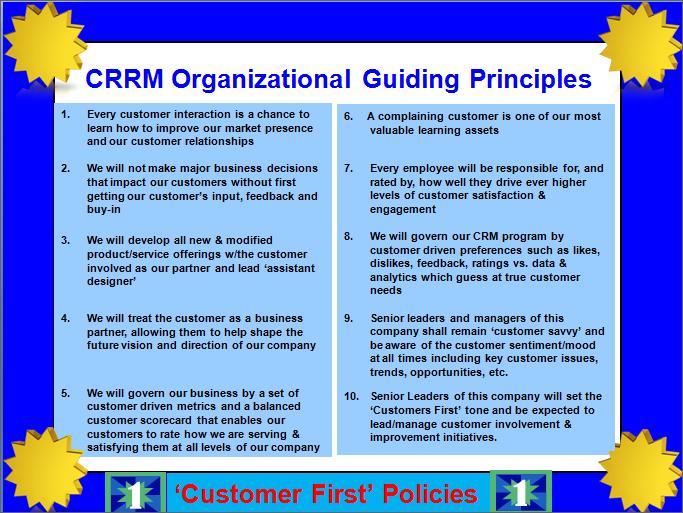
CRRM Customer First Policies & Organizational Principles

3B) The above chart “CRRM Organizational Guiding Principles” demonstrates the principles that must be in-place to be customer first culture. This culture is driven by management that is passionate about their customers and governs the company around a set of customer first policies.

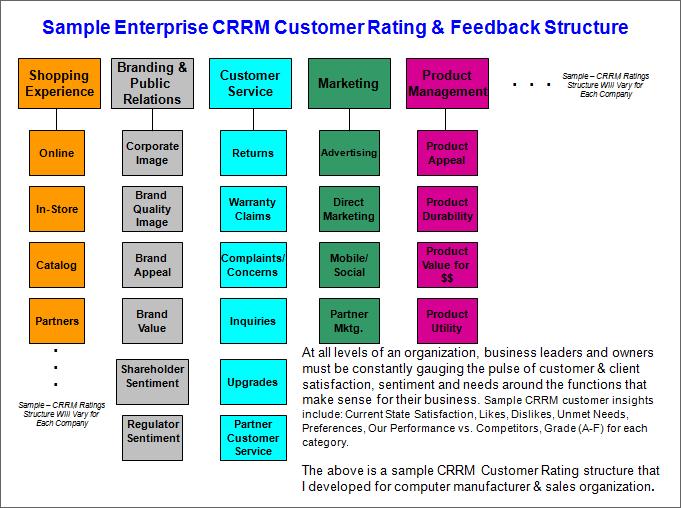
Sample Enterprise CRRM Customer Rating & Feedback Structure

3C) The above chart “Enterprise CRRM Customer Rating & Feedback Structure” illustrates a sample structure (will vary for each type of business) whereby customer feedback and preferences will be cultivated in order to develop 360° insights into customer needs, wants, likes, etc.

Enterprise CRRM Customer Feedback & Preferences Cultivation Process

3D) The above chart “CRRM Customer Ratings & Feedback Cultivation Process” illustrates a how customer feedback and preferences will be cultivated in order to develop 360° insights into customer needs, wants, likes, etc.

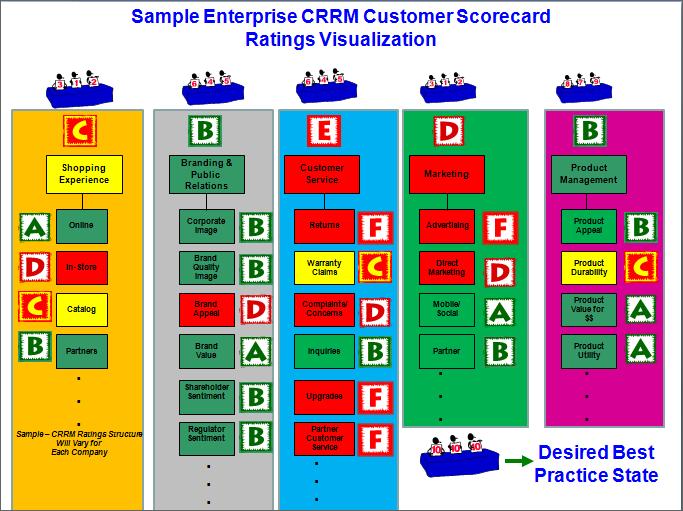
Sample Enterprise CRRM Customer Scorecard Ratings Visualization

3E) The above chart “Enterprise CRRM Customer Scorecard Ratings Visualization” illustrates a how customer feedback and preferences ratings will be visually represented in a scorecard. 

Sample Enterprise CRRM Customer Scorecard Metrics

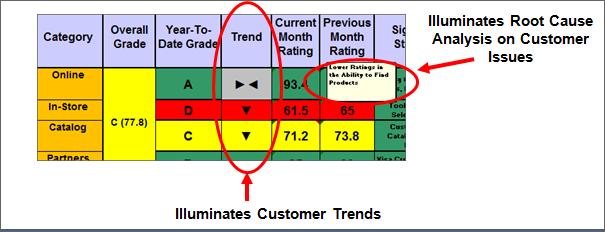
3E-2) The above chart “Enterprise CRRM Customer Scorecard” illustrates a how customer feedback and preferences ratings will be rolled up into an analytical scorecard that provides insights into customer trends,  customer feedback, customer issues, core customer strengths and weaknesses, etc. 

This scorecard can also be used to manage a Continuous Customer Improvement Process (CCIP) that continually drives improvements to customer perceptions, ratings, satisfaction, etc. 

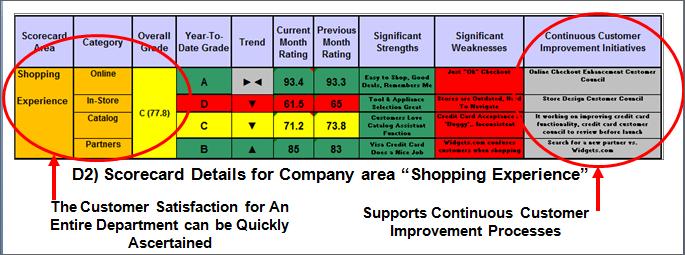
Sample Scorecard for “Shopping Experience”

The above depicts how analytics and metrics would be maintained for a business who had a retail or wholesale shopping function.

Sample Shopping Experience Scorecard – #2

Robust Scorecard Analytics and Metrics should support Customer Trend Identification and Root Cause Analysis for Customer Issues.

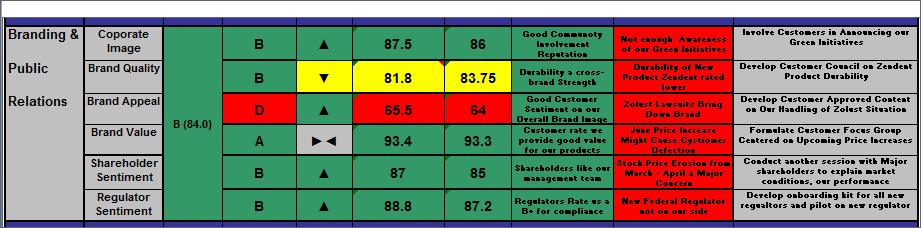
Sample Branding & Public Relations Scorecard

Sample Public Relations Scorecard Above gives you insights into how well your company and brands are perceived by customers, stakeholders, stockholders, etc.

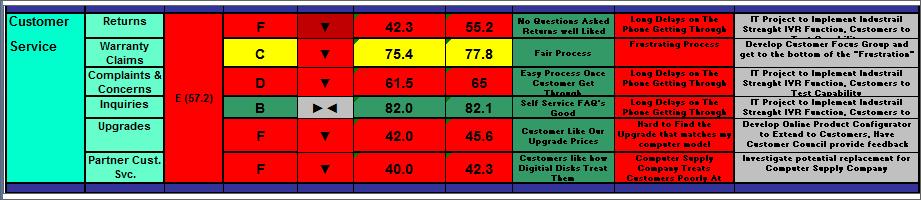
Sample Customer Service Scorecard

Sample Customer Scorecard Above from Customer Service tells how well you are serving your customers.

Sample Marketing Scorecard

Sample Marketing Scorecard Above Gives you insights into how well your Marketing Efforts are resonating with your customers.

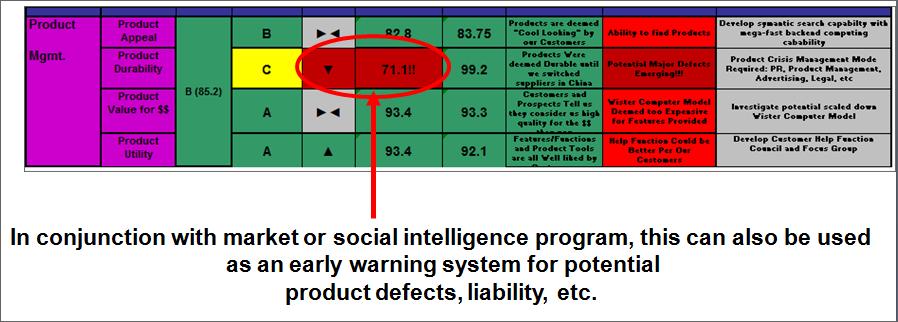
Sample Product Management Scorecard

The Sample Product Management Scorecard above gives you insights into how well perceived your products and services are with customers and prospects.

4) Company & Customer Benefits of Adopting the CRRM Model:

By treating customers as business partners (vs. commodities) and including them in the corporate decision making process, as well as allowing them to rate how well you are serving them from an array of customer facing areas, companies can reap huge rewards including the following:

1. Better insights into the types of products and services customers want & need

2. Fiercely loyal customers who feel part of the corporate team

3. Customers who are most likely to spend more, be retained longer and purchase at premium prices with higher profit margins

4. Customers who are very likely to be brand advocates and refer others to your company, brands, and services.

5. Customers who feel connected to the company and empowered to improve company operations

The following are actual customer comments from those who have participated in a customer feedback program to help shape products & services:

“I feel like xyz company cares about me since they ask my opinion”

“Finally a company that listens to us”

“It is so refreshing to have a company ask you your opinions on products and services vs. ramming something down our throats that we don’t like”

“Wow – this is fun. I enjoy providing my opinion”

“As silly as this might sound, xyz company is the only company that ever asked me what I wanted”

“In my opinion, xyz company is much more progressive than their competitors by seeking consumer opinions, what matters to them, etc.

 5) Conclusion:

More dynamic companies like Goodle, Zynga, Amazon, etc. are inviting customers to become part of the corporate decision making process and empowering them to provide feedback, insights and rate company operations in order to drive continous customer improvements. Companies who adopt this new CRRM model whereby company management is democratized by including stakeholders and customers into the decision making process will reap the rewards of ever higher customer acquisition, retention and spend – leading to ever higher profits and share price.