The Delivered Optimal Customer Satisfaction through Customer Relationship Management Best Practices
Major Stages of The Customer Relationship Life-cycle
The first step in developing the optimal customer relationship is to define the various major phases in your customer’s journey as they interact with your company (i.e. customer acquisition through customer retirement/closure).
The subsequent steps in the process are to define the phase objectives of each major customer relationship life-cycle stage and to determine the range of customer treatments, by customer segment, that exist within each phase. In addition, in order to arrive at accurate segmentation definitions, a segmentation approach and method must be defined in order to properly develop distinct and meaningful customer segments groups.
Balancing Customer Service Costs with Customer Needs & Satisfaction
Once customer value segments are properly determined, customer needs and appropriate service levels for those segments can be determined. This is important to delivering cost effective service levels that doesn’t over-deliver to customers and ensures a maximized customer satisfaction level for that particular customer segment group. Equilibrium is achieved when customer service costs are balanced with delivered customer satisfaction and customer value (i.e. a company would not want to expend a great deal to over-deliver to a traditionally frugal customer segment with a negative contribution (value) margin).
The Dynamics of a Changing Customer Relationship for Maximized Customer Satisfactions
Matching Customer Service Delivery Levels to Customer Value
As customers deliver greater value to the company, service and reward levels are adjusted to deliver increasing levels of customer value to maintain market equilibrium and prevent high value customer defection to competitors.
Architect The Cost Effective Customized Customer Experience Across All Touch Points
Each customer touch-point needs to be examined to determine the optimal customer treatment approach for each customer segment that interacts with that particular touch-point. Only then can an econometric model can be developed via a multi-dimensional matrix of customer touch-point, customer value segment and customer relationship life-cycle stage.
Developing The Optimal Customer Relationship across all touch-points, segments, customer life-cycle stages
The final multi-dimensional matrix developed should consist of 4 dimensions (comparable to a Rubik’s Cube) of 1) Customer touch-point; 2) Customer Needs/Preferences; 3) Customer value segment and 4) Customer relationship Life-cycle Stages (CRLS).
Developing the Optimal Customer Relationship Life-cycle
I have found that the best approach to determining the final multi-dimensional matrix developed to be through a series of cross-functional workshops with internal knowledge experts consisting of customer analytics, customer service, marketing, sales, warranty claims (if separate from service) and touch-point subject matter experts like website managers, multi-channel contact center managers, etc.
The above is the structure for determining the optimal customer relationship for each segment group per touch-point as they transit through the customer relationship life-cycle stages. The final outcome is your delivered customer treatment strategy across all touch-points, segments and stages in the customer relationship life-cycle.
The benefit of this requirements definition exercise is minimized customer service cost at a level that just meets (or slightly exceeds) customer expectations such that high levels of customer satisfaction is delivered at the ‘maximum bang for the buck’.
For Additional Information on this topic, please reference the following credible sources:
Do you know which of your customers is destroying your company and brand value via negative word-of-mouth comments?
Do you know which of your customers is on the verge on defecting from your company and brands to one of your competitors?
Do you know which of your customers is promoting your company and brands and generating positive company and brand value on your behalf?
Do you know which of your customers is as passionate about your company and brand as your CxOs and should be rewarded as such?
Customer Loyalty Best Practice Components
To find out the answer to these questions, read the rest of this informative blog article below.
Customer Loyalty & Advocacy
{Click on image above for a larger/clearer view}
Customer Loyalty Framework
Your customer base is almost always represented by the above spectrum of customers. What varies from business to business is the percentage in each segment group. The more well managed your business, the more skewed to the right your customers tend to be. Therefore a business must develop strategies to migrate customers continually from the left to the right from segment group to segment group in increasing numbers. The rest of this blog is dedicated to sharing best practices on how to migrate more of your customers to the right of the spectrum.
Customer Loyalty and Advocacy Framework
{Click on image above for a larger/clearer view}
For any company to achieve world-class status, one must carefully map out a customer loyalty and advocacy framework including the following component steps from the chart above:
Clearly articulated customersegment definitions based on customer satisfaction levels, in addition to customer buy/sell segment definitions (top independent seller, high volume digital seller, etc.)
A clear customersegment strategy and detailed tactics on the customer treatment that should be employed for each customer satisfaction segment
Customer cross-segment best practices and processes to drive segment migrations from the far most left segment to the far most right segment (i.e. from dissenters to super advocates)
Customer Loyalty & Advocacy Framework Segments
{Click on image above for a larger/clearer view}
The above customer loyalty & advocacy framework includes the following segments:
Customer Brand Dissentersor Malcontents – Very negative and detrimental to the company’s brand(s)
Customer Company Defectors– Very likely to defect to a competitor
Customer Neutralor Indifferent – Neither brand supporters or detractors of the company’s brand(s)
Customer Brand Supporters– Slightly positive about the company’s brand(s)
Customer Brand Advocates– Very positive and generating positive value to the company brand image
Customer Brand Super Advocatesor Delighted Customers – Active promoters of the company’s brands, adding continuous & tremendous value to the company brand image
A formal social and company/brand listening and tracking program is a best practice on how to identify which of your customers exist in each of the above segments (see my previous blog entry on the topic of Social listening programs).
Customer Dissenters & Defectors
{Click on image above for a larger/clearer view}
From this graphic above, we can see clearly that the strategy should be as follows:
Dissenters:Diffuse and redirect customer angst and anger and come to some sort of closure agreement on for the source of their angst/anger.
Defectors: Get the defectors to see the entire spectrum of value the company has to offer and get them back to the level of positive company engagement vs. disenfranchisement. Provide insights to how a more positive company relationship would reward them – loyalty programs and other rewards.
Unless the individuals in these segments are high value or high profitability customers, then you would want to minimize the financial rewards to these customer satisfaction segments.
In addition and based on my research and experience, you are wasting your marketing and sales $$ spend to these two segments as they are much more unlikely to respond to any marketing offers due to being so currently dissatisfied with the company and brands (think about it – why would they trust you and buy more of the same when their initial experiences were so terrible?).
Customer Neutrals & Supporters
{Click on image above for a larger/clearer view}
From this graphic above, we can see clearly that the strategy should be as follows:
Neutrals:Develop strategies to more of these customers to a net positive relationship by communicating more frequently and effectively with this segment group. The path toward becoming a company/brand supporter should be clearly and frequently communicated to these customers so that they are encouraged to become ever more value to the company and its brands. This group is likely to be lukewarm to your sales and marketing efforts so expenditures here should be highly selective.
Supporters: Develop these supporters into more loyal and more committed customers by developing brand ‘stickiness’ through company loyalty rewards, referral programs, by making it easy (discounts) to buy additional company brands or products, etc. The path toward becoming a company/brand advocate should be clearly and frequently communicated so that these customers become ever more value to the company and its brands. You should have formal programs in place that amplifies their support of your company and brands via social media, forums, etc.
Customers in these segments should be offered tiered financial rewards to incentivize them to want to contribute at even higher levels to brand value and to remain even more loyal to the company and its brands.
Customer Advocates & Super Advocates
{Click on image above for a larger/clearer view}
From this graphic above, we can see clearly that the strategy should be as follows:
Advocates:This group should be provided with an array of rewards and accolades for helping effectively spread the word about the company or value of the company’s brands, especially if the individual customer is of high value, profitability or influence. The path toward becoming a company/brand super-advocate should be clearly and frequently communicated to these customers so that they are encouraged to become ever more value to the company and its brands. You should have formal programs in place that amplifies their advocacy of your company and brands via social media, forums, etc.
Super Advocates: This group should be provided with top tier rewards and accolades for helping effectively spread the word about the company or value of the company’s brands, especially if the individual customer is of high value, profitability or influence. You should have formal programs in place that, not only amplifies their super-advocacy of your company and brands via social media, forums, etc., but also provides significant rewards for helping increase your brand value (i.e. via a “brand ambassador” rewards program).
Customer Loyalty & Advocacy Cross-Segment Best Practices
{Click on image above for a larger/clearer view}
The graphic above highlights just a few of the cross-segment customer loyalty & advocacy best practices I recommend that companies continually practice to migrate customers from the negative segments that hurt the company’s brand value (dissenters, defectors) to positive segments (advocates and super advocates) that adds incredible value to a company’s brand.
Customer Loyalty Dissenters
Here are the brands for which I am a Dissenter, Defector, Neutralist, Advocate and Super-Advocate for based on my own personal experience and opinions:
Companies and Brands for which I am an official dissenter:
Companies For Which I am a Dissenter
{Click on image above for a larger/clearer view}
Sears
Sears – I received abject customer service back in the late 1980’s and don’t want anything to do with the retailer ever again. I have tried to give them a second chance and continue to have an unsatisfactory experience. I pledge to never set foot in a Sears store again.
Target
Target – I interviewed for a senior management position at Target a several years ago was treated so poorly that even the HR manager at the time said the treatment of me was ‘questionable’. She then shared with me that she asked upper management “are we really trying to hire the best candidate here?” before she left the company. I vowed to never shop in Target again and have held true to my word.
Empire Carpet Today
Empire Carpet – We had several issues with our carpet installation and follow up customer service. They are very disorganized, non-customer friendly and do not seem to keep with the volume of sales that they generate. I will never use this company ever again. We steer people away from this company if asked.
2) Companies and Brands I am likely to Defect from or have defected from and tell everybody about why I am about to leave (or have left) these company & brands:
Companies for which I am a (potential) Defector
Bank of America
Bank of America – Closed many of the local branches where I live and the abundance of local branches was the reason I opened an account with BOA in the first place. The remaining branches are now crowded and not staffed adequately. This tells me they care more about the bottom line than customer satisfaction.
Marriott
Marriott – In my opinion Marriott has lost its way. I used to be a Platinum member at Marriott for many years. Their properties since that time have become worn as compared to their competitors and they seem to not listen well to their customers. An example of this myopia is when they converted the Courtyards to the Bistro concept. Every customer I speak to was disappointed by this change but they went ahead and did it anyway (presumably to save $$ on operations costs).
Frigidaire/Electrolux
Frigidaire/Electrolux – Our dehumidifier stopped working after only 1 year. We have been trying to get a credit from them for six months with no end in sight. The return process is the most customer unfriendly I have ever encountered with no possibility of human interaction. We have been without a dehumidifier for an entire year due to their poor customer service process.
3) Companies and Brands I am Neutral about and don’t really have much to say about them:
Companies For Which I Have Have Neutral Sentiment
Samsung, Sony, Direct TV, Time Warner Cable, Panasonic, Cuisinart, Hunter Fans, Home Depot, Lowes, Macy’s, Sunoco, US Air, Delta, Tractor Supply, Wal-Mart, McDonalds, Burger King, Chili’s, Pizzeria Uno, American Airlines, Holiday Inn and many more. This category contains the most number of brands due to the distribution across segment group being shaped like a bell curve
4) Companies and Brands I am an Advocate of and share positive stories with anybody who is willing to listen:
Companies For Which I am An Advocate
American Express
American Express – I have worked with American Express as a consultant on several different strategic projects. They are an extremely well run organization with some very smart people running the company. I have also been a Platinum card member for many years. They provide excellent customer service and their fee structure is the only thing keeping me from being a super-advocate. I tell everyone I meet I consider American Express a world-class company.
Southwest Airlines
Southwest Airlines – Southwest is just a great airline and makes the flying experience pleasurable. They are almost always on-time, the employees are friendly (some even humorous) and they try to be reasonable to their customers at every turn. I used to hate Southwest and am now a Southwest lover/advocate.
Hilton Hotels
Hilton Hotels – Did you guess what hotel I become more loyal to after minimizing my Marriott loyalty? Guess no further. Hilton has been on a roll creating new and invigorating hotels and I am now an advocate/loyalist and stay at Hilton Hotels whenever possible.
Dooney & Bourke
Dooney & Burke – Dooney & Bourke creates high quality, classic and trendy handbags and accessories that last over long periods of time even with heavy usage. Styles and collections are priced to reflect the consistent durability and attractiveness of this brand. If something goes wrong with their products, they stand behind them through high quality customer service.
5) Companies and Brands I am a Super – Advocate of and go out of my way to tell everyone how wonderful my experience has been with dealing with these companies:
Companies For Which I am a Super-Advocate
Cox Automotive
Cox Automotive Customer Loyalty Program
Cox Automotive – Cox Automotive has a great company culture consisting of many top automotive brands that includes Kelly Blue Book, Autotrader, Manheim, NextGear, DealSheild to name a few. The company is one of the best places I have ever worked and includes an employee first culture that they actually adhere to and practice. The company is run by a world-class CEO named Sandy Schwartz that has a great vision for the company’s future and is very visible in his support for the employee oriented culture.
Toyota
Toyota – My family has owned Toyota vehicles for many years. Toyotas are extremely reliable automobiles. I have a Tundra with 132,000 miles on it and have had zero major issues with it. I have such an affinity with my Tundra I have a hard time thinking about trading it in for another vehicle even though it would most definitely be another Toyota.
Ritz Carlton
Ritz-Carlton – I love staying at Ritz-Carlton since the experience each and every time is truly memorable. I also worked as a consultant for Ritz-Carlton to help design the perfect customer experience for guests. Ritz Carlton’s goal is to create an experience to remember and smile about and they live up to this promise every time.
The amazing (or sad) part about my sentiment rankings of the above companies is that, despite spending millions ($$$) on analytic systems and databases, I am willing to bet that very few, if any, actually were knowledgeable about my sentiment toward their brands prior to my writing this article.
This relates directly to a previous blog entry I developed on why CRM (Customer Relationship Management based on historical analytic insights) is dead and a new CRRM model is now a best practice. In this article I point out how world-class companies now query their customers how they feel about the company and brands on a periodic basis. Like me, many customers would be more than willing to share their sentiment and how they are feeling towards the company and their associated brands. Bottom Line: Analytic models provide minimal understand of true customer sentiment when it is primarily focused on historical purchases, spend, etc.
For Additional Information on The Topic of Customer Loyalty Programs
Customer loyalty and customer advocacy are among the most powerful drivers of sustainable growth and market leadership. While many organizations focus heavily on customer acquisition, market leaders recognize that retaining existing customers and transforming them into active advocates often produces greater long-term value. Loyal customers tend to purchase more frequently, remain customers longer, and are more likely to recommend a company to friends, colleagues, and business associates.
Organizations that successfully manage customer loyalty and advocacy typically invest in delivering consistent customer experiences, building trust, and creating meaningful customer relationships. By measuring customer satisfaction, loyalty, advocacy, and referral behavior, companies can identify opportunities to strengthen customer relationships and improve long-term business performance.
For additional information on customer loyalty and advocacy, review these resources:
Organizations that consistently create loyal customers and passionate advocates are often better positioned to increase retention, strengthen their competitive advantage, and achieve long-term market leadership.
A High Performing Company with All Value Chain Links Strong (No Brand Value Links Broken or Sub-optimized):
Company Brand Value Chain
How a Broken Value Chain Impacts Your Company
In order for your company to have a chance at being a market leader, it is important for it to have all links in the brand value chain attaining top effectiveness. Just one broken link in this brand value chain (BVC) can bring your whole company down and subject your company to the following risks:
1) Loss of Market Share as compared to your competitors
2) Inability to close sales
3) Lack of marketing leads and inquiries
4) Declining customer base over time including customer defection to the competition
What is the Brand Value Chain (BVC) you might ask?
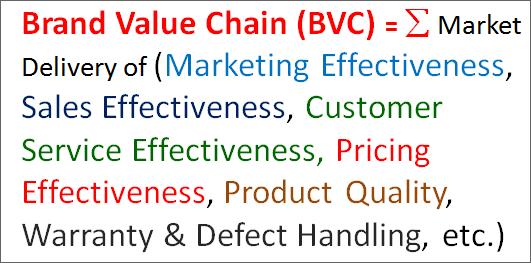
The BVC is defined as the effectiveness of the sum of all company functions delivered to your customers and the marketplace: Marketing, Sales, Product/Service Quality, Customer Service, Pricing, Warranties/Returns, Customer Relationship & Experience Quality, etc.
Brand Value Chain Defined
Therefore, when one link of the brand value chain is weak or about to break, the following rule regarding brand image almost always holds true:
Brand Image & Brand Value Chain Rule
Symptoms of a Broken Value Chain:
Your sales team just can’t seem to close the deals.Potential broken value chain links: Poor customer service, product utility/quality, pricing.
You have great products, pricing and customer service but nobody has heard of you.Likely broken value chain links: Poor marketing and/or sales operations.
Your customer base keeps declining year-over-year:Likely broken value chain links: Poor customer service or eroding product quality or pricing.
Your marketing generates a plethora of leads that are not closed or turned into sales deals: Likely broken value chain links: Sales operations and marketing-sales lead management procedures are non-existent or sub-optimized.
Examples Companies with Potential Broken Value Chains:
Every day we see examples of companies that seem to have everything going for them except one weak link in the brand value chain that brings the entire perceived brand value down. Some examples are as follows:
Comcast – great programming, great marketing/sales, great products, great technology & infrastructure but perceived bad customer service and pricing creates a negative impression of the company by many customers and prospects – their company’s Achilles heel.
Sears – great products, good pricing, good in-store sales, etc. but is severely lacking in marketing and promotions including in-store and on-line customer experience design which tends to brings down the other great intra-company performers and has led to a decline in the customer base.
General Motors – good pricing, promotions, dealer sales, etc. but perceived increased negative product quality due to the number of recent recalls has brought many questions regarding the GM brand. These questions about product quality could impact customer retention and acquisition in the longer-term.
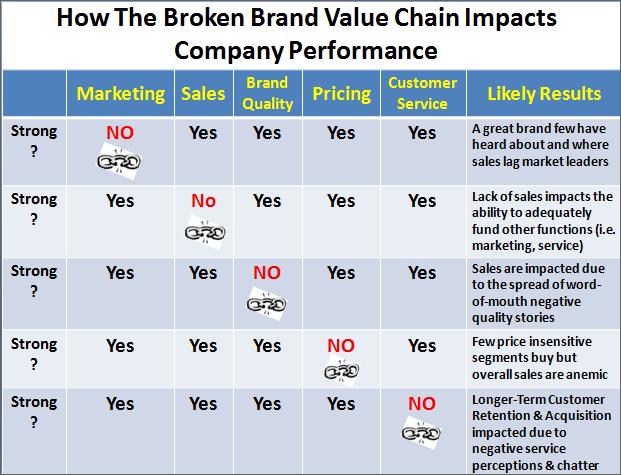
How the BVC Impacts Company Performance:
What all of these examples show is that a company must deliver great performances in every category to become a market leader. One broken link in the brand value chain is enough to reduce the company to a market laggard and risks them going out of business over time if not rectified.
The following chart illustrates how one broken BVC has the ability to bring down the entire company and risk its overall viability:
Company Impacts of the Broken Brand Value Chain
How to Identify & Rectify a Broken Value Chain:
What steps can you take to identify and then rectify a broken brand value chain (BBVC) you might ask? Here are some easy steps to take to first, identify and then rectify a broken value chain:
Proven Methods to Identify a Broken Value Chain (BVC):
Inter-departmental peer reviews – How well do our peer departments think we are performing?
External departmental & function benchmark reviews – how well are doing vs. market leading company’s similar function (e.g. sales to sales or marketing to marketing performance comparison)?
Customer external scorecard reviews – How well do our customers and prospects think we are performing?
Methods to Rectify a broken value chain:
Perform Six-Sigma process and effectiveness improvement reviews
Invite customers to participate in focus groups and advisory councils to help identify ways to improve the department’s effectiveness (sales, marketing, customer service, etc.)
Form Improvement “Tiger Teams” consisting of inter-departmental high performers to assist with increasing functional performance.
Invite outside and leading consulting firms to help infuse a holistic set of industry best practices across and within company functions – marketing, sales, customer service, pricing, etc.
Tie performance and variable rewards to customer rated scorecards where company employees only get paid bonuses when our customers rate us as high performing.
For additional resources on this topic, please reference the following:
CEOpedia: Brand Value Chain: Good overview of Keller and Lehmann’s Brand Value Chain model, including the value stages and multipliers: Brand Value Chain (CEOpedia)
Marketing91: The Brand Value Chain. Detailed explanation of the four value stages, multipliers, and how brand investments translate into shareholder value: Link: The Brand Value Chain (Marketing91)
Best & Leading Practices in Measuring Marketing ROI
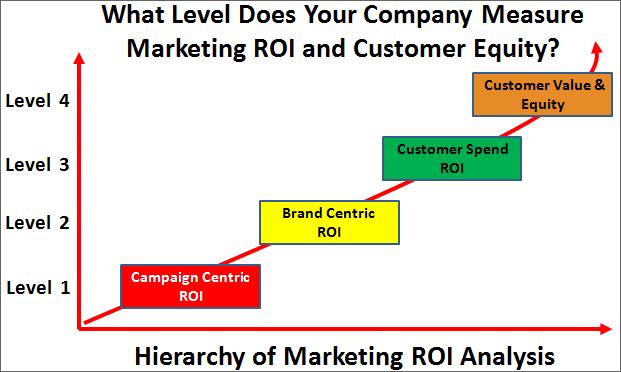
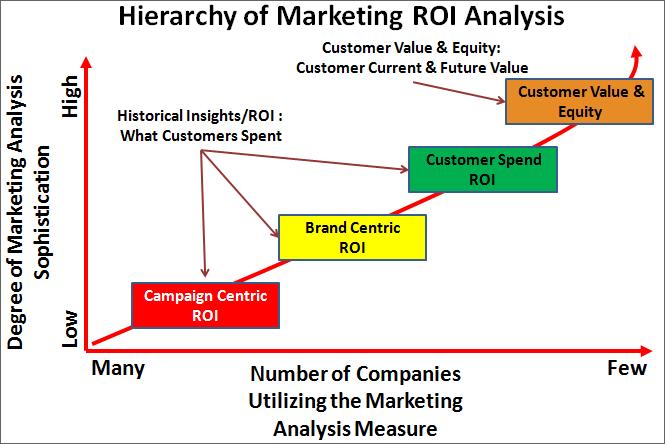
Hierarchy of Marketing ROI Analysis (Levels 1-4)
In this blog we cover the following topics:
The four (4) levels of sophistication in measuring marketing and customer ROI
The three traditional levels of marketing ROI that focus on spend vs. return
The calculations for measuring campaign ROI, Brand ROI and Customer Spend ROI
Why measuring customer value and equity is a far better measure than traditional marketing ROI
How Customer Value and Equity Covers the Measurement of ALL customer facing activity – marketing, PR, sales, customer service, community relations, etc.
What your company needs to do to increase its sophistication of measuring market and customer insights
The Levels of Marketing ROI Measurement
The following chart depicts the capability levels for measuring market ROI and customer value.
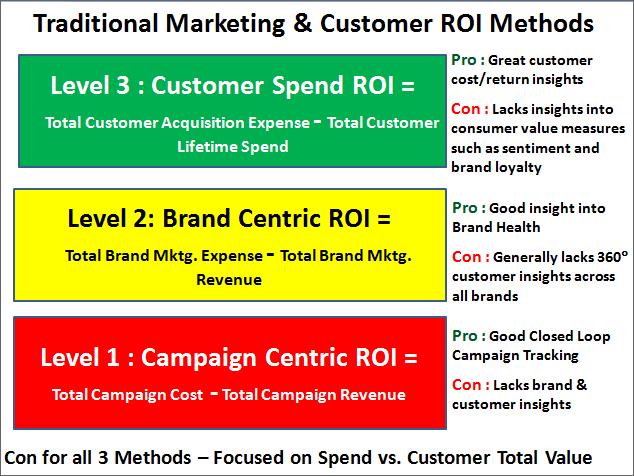
Level 1: Campaign centric ROI is the measurement, at a campaign level, of campaign costs vs. campaign return (customer spend vs. campaign return)
Level 2: Brand Centric ROI is the measurement, at a brand level, of brand return for all conducted campaigns (roll up of campaign ROI to a brand level)
Level 3: Customer Spend ROI is the sum of all brand and all brand campaign ROI at a customer level.
Levels of Marketing ROI Measurement (Levels 1-4)
The following chart defines the first three levels of marketing ROI and points out the pros and cons for utilizing each method. The downfall for all three methods, as indicated at the bottom of the chart, is that they rely on historical spend vs. forward looking measures as are found in Level 4 – Customer Value and Equity Measures.
Traditional Marketing & Customer ROI Methods (Levels 1-3)
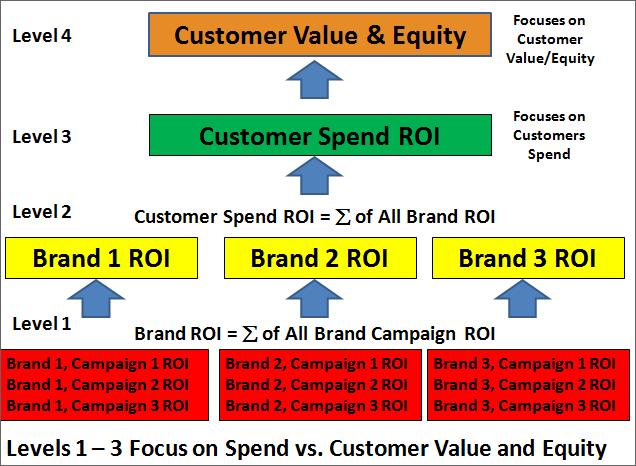
The following chart depicts the calculations for determining campaign level and brand level ROI that, if done correctly, should roll up to a customer level (Level 3 – Customer Spend ROI). The detailed definition of the highest level (Level 4 – Customer Value & Equity) is covered just below in this blog.
Levels 1 – 3 Focus on Spend vs. Customer Value and Equity
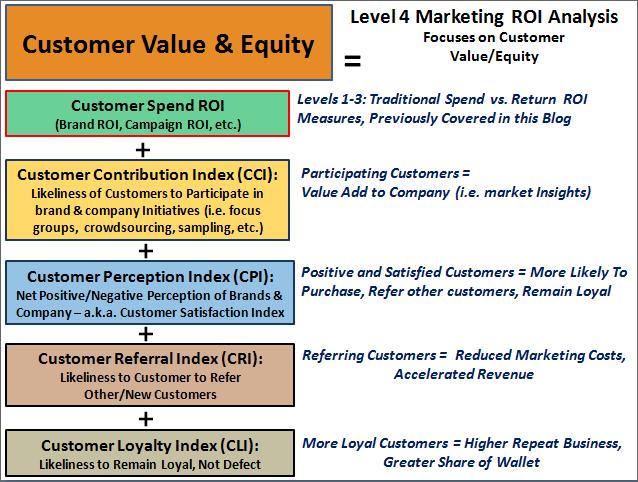
The following chart defines the components of Level 4 ROI analysis – “Customer Value and Equity”. This level includes the roll-up for Customer Spend ROI, but also includes insights that predict customer future behavior as well as defining how valuable the customer is to the company beyond what they spend.
For example, a customer who is referring 2-3 customers to the company per week, participating in customer focus groups is a far more valuable customer than another customer with equal spend with your company.
Similar to company stock value, the measurement of customer value and equity is a far more robust way to measure the value of the customer base, how likely they are to remain a loyal customer, etc.
Customer Value & Equity Calculations, as shown below includes several different indices such as Customer Contribution Index (CCI), Customer Perception Index (CPI), Customer Referral Index (CRI) and Customer Loyalty Index (CLI). These indices help determine the overall health of the customer base vs. merely customer spend as is associated with levels 1-3 (spend focused).
Customer Value and equity calculations take into account the level 1-3 spend ROI measures, but utilizes a balanced scorecard approach in that the indices above are weighted against the spend vs. ROI measures. For example, if Brand A has a high ROI but also has a bunch of irate customers unwilling to partner and participate in brand activities, then this is indicative of a brand that, while doing well now, will experience a great deal of future customer churn, negative social comments, brand tarnishing, etc.
Level 4 Marketing ROI Analysis – Customer Value & Equity
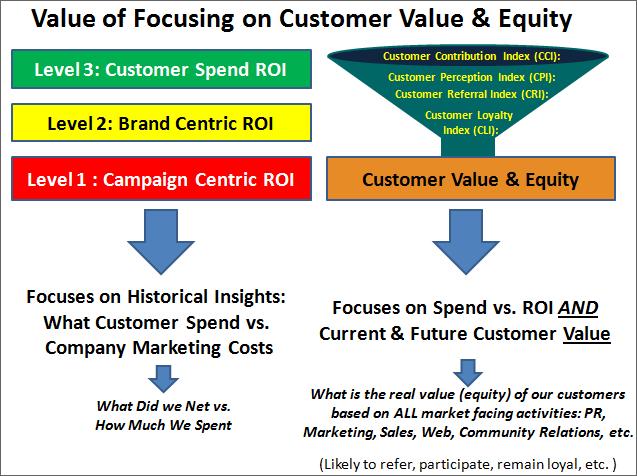
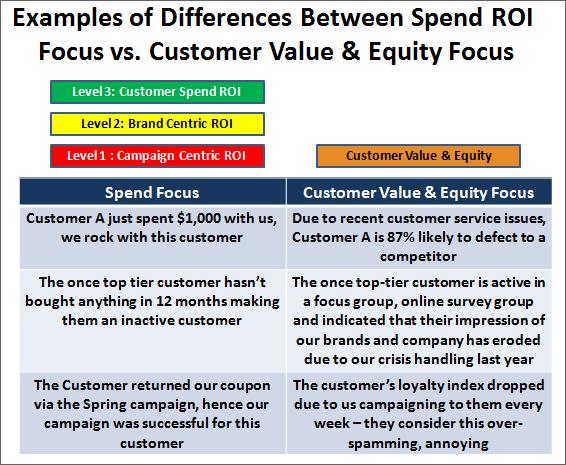
The following chart further defines the difference between focusing on spend ROI analysis vs. focusing on customer value and equity.
Value of Focusing on Customer Value & Equity
The last chart provides some real examples of the difference between focusing on spend ROI analysis vs. focusing on customer value and equity.
Examples of Differences Between Spend ROI Focus vs. Customer Value & Equity Focus
The bottom line here is that if you are focusing on Level 1-3 ROI calculations, you have a short-term and myopic view of the health and value of your customer base and are missing the strategic and longer-term insights that enable you to determine customer, company and brand future value and earnings.
Any company thinking about acquiring another should perform this robust customer diagnostic to determine if they are inheriting a group of angry/upset customers that will defect after a merger or a set of extremely valuable customers with positive customer equity who will take the stock value of the merged company to the stratosphere.
Contact me to find out how to move past traditional marketing ROI measurement and how to evolve into developing more robust customer value and equity insights for your company.
For more information on the topic of measuring marketing ROI, please consult these references:
Google Analytics Help: Drive Better ROI with Google Analytics – Explains how to measure marketing performance across channels using attribution, conversion tracking, and ROI-focused analytics. Read the Google Analytics resource[support.google.com]
HubSpot: A Simple Guide to Marketing ROI (Formula & Examples). Covers ROI formulas, required inputs, channel-specific tracking, and practical measurement frameworks. Read the guide[blog.hubspot.com]
The 80/20 Customer Profitability Rule: Best Practices with Examples
Develop intelligent customer service & customer management programs based on customer value insights and the 80/20 customer profitability rule…
Has your business ever performed an analysis of your customer base to determine any of the following:
1)Which customers are frequent visitors and have the greatest repeat business?
2)Which ones rarely do business with your company?
3)Which ones are the most valuable and profitable to your company?
If you haven’t then you really don’t have the insights necessary to really develop an effective customer service, customer management and/or loyalty program. In performing analytics and customer analysis for nearly 10% of the Fortune 500 companies in the United States, I have found a very revealing and astonishing pattern (rule) in this customer analysis that holds true company after company. The pattern is as follows:
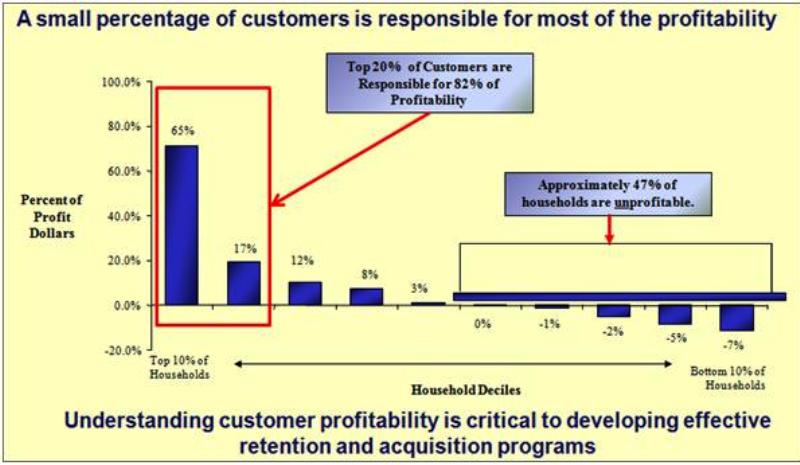
80% of all company profits are derived from ~20% of your customers
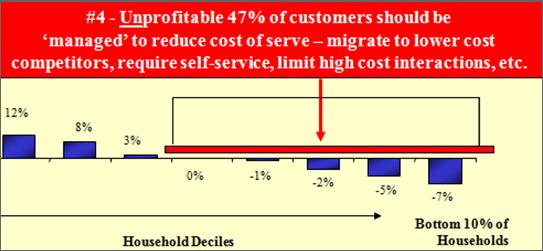
Take the chart below (Chart 1) from one of the top US banks that shows 20% of their customers are responsible for 82% of their profitability and that a full 47% of customers are actually unprofitable and not worth having as customer as each transaction costs the bank more than it is worth (each customer interaction/transaction actually drives the bank further away from profitability) {Click on Chart for a larger/clearer image}:
80% of all company profits are derived from ~20% of your customers
When I presented this customer profitability analysis to the bank, the bank executives were amazed at the results and of the customer profitability distribution. (Note – The deciles were developed using a SAS generated RFM analytics model whereby Recency (How recent customer have visited/purchased), Frequency (How frequently customers have visited/purchased and when they visited/purchased) and Monetary spend (How much they spend and on what types of products/services they spent their $$ on). The RFM model was then used as input into a profitability model, using actual profit data for each product/service/customer using a unique customer id to match the profit data to the RFM score.)Why are these insights and analytics so important and what might the bank or any other business do to manage customer relationships more effectively? These insights are key in developing a customer relationship management (CRM) and loyalty program that is tailored and specific to each customer group.
Note: The 80/20 customer profitability rule rule applies to companies that have higher transaction volumes, a diverse set of product & services and a heterogeneous customer base.
Ask yourself the following questions:
Should your company treat your best and most profitable customers differently than other, less profitable customers?
Should your company develop special customer programs so that the 20% most profitable customers are not lured away by competitors?
Do you think your company’s most profitable and valuable customers want to be shown appreciation for their repeat and profitable business in a way that makes them feel welcome and special?
Is it in your company’s best interest to want to develop strategies and programs that turn unprofitable customers into profitable or at least revenue neutral customers?
The answer to all four questions should be a resounding YES!
Armed with the above insights and analysis a company can start to architect customer intimacy and loyalty programs such as the following:
Offer most profitable customer special discounts or accelerated loyalty rewards earning rates
Conduct special top customer, by invite only, appreciation events
Deliver occasional special top customer gifts or recognition when they interact with you in-person or on-line
Invite your top 1-5% of customers to participate in an invite only customer advisory board or insights group event every year at an exciting destination where most or all expenses are paid for by your company
Develop unprofitable customer management programs such that these customers become more profitable, cost less per company transaction and/or they are effectively ‘encouraged’ to migrate to competitors.
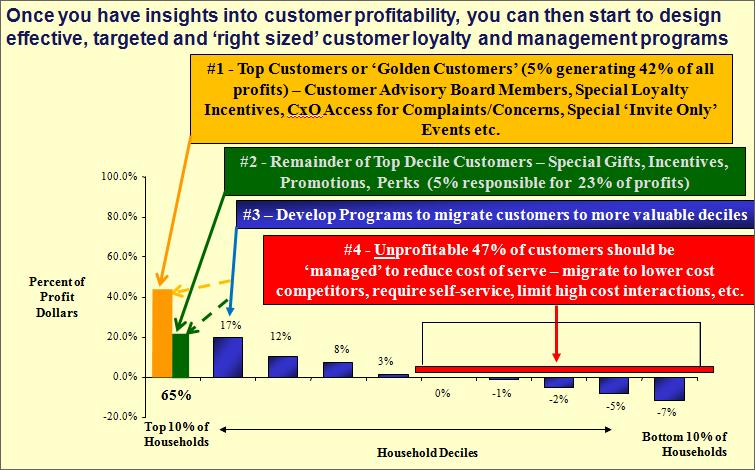
Take the same chart above and now overlay customer treatment programs to each customer decile and sub-segment (Chart 2) {Click on Chart for a larger/clearer image}:
Effective Customer Management Programs Based on Profitability Insights
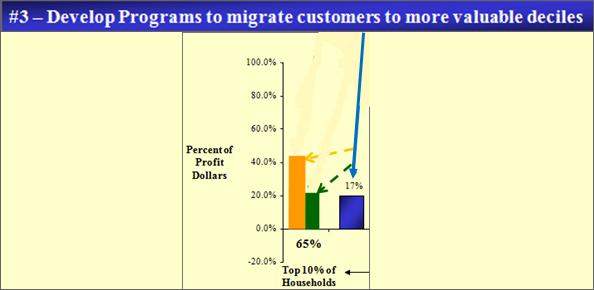
Even though decile #1 (10% of all customers) has been identified as the most valuable customer segment generating 65% of all company profits, the decile can then be further sub-segmented based on further profitability analysis/decomposition. In this particular case:
The top 5% of the top profitability decile customers generated 42% of all profits
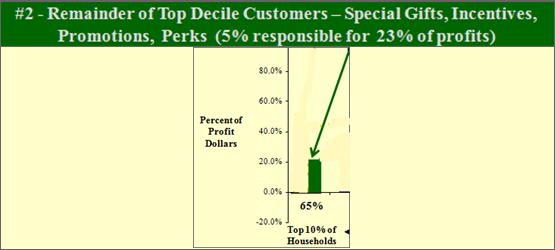
The remaining 5% of the top profitability decile customers generated 23% of profits
As shown in the ‘golden’ box (#1) above and below, these top tier customers should be given special access and special attention and made to feel totally appreciated and a partner of the company. The golden box also demonstrates the types of special programs you might want to provide to this top profitability group. It is of your utmost importance to do everything in your company’s power not to lose these most valuable/profitable customers. These suggested treatments are just a sample, but ones I have developed for many clients in the past, including top tier banks, retailers, life sciences companies, telecommunications providers, etc. {Click on Chart for a larger/clearer image}:
Top 5% of Customers Receive Platinum Plus Customer Programs
The next (Green) group of profitable customers highlighted in box #2 (below) can receive special treatment as well, but not quite the golden treatment as the most profitable 5%. These next valuable set of customers would still receive top customer treatment, but not quite the platinum access that the most valuable 5% would receive. You wouldn’t want to lose these valuable customers either, so their treatment would still be special, memorable and differentiated vs. your competitors. {Click on Chart for a larger/clearer image}:
Next Top Set of Customers Receive Top Treatment, but not Special Access, Handling Like the top 5% (Platinum) Group
The blue box (#3) in the chart below speaks to customer migration programs that incentivize customers to spend more, visit your company (physical or online) more, purchase higher value items, buy in bundles, etc. {Click on Chart for a larger/clearer image}:
Effective Customer Management Programs Effectively Transition Customers into More Valuable Customers Over Time
One very effective way to do this is to develop what I call modeled incentives. In that, if a loyalty program is to be effective there should be an incentive for the customer to model the behavior to achieve the next loyalty reward level and the following must be present:
1)Every customer group must know what they need to do to achieve the next loyalty rewards level
2)Customers need to feel the next loyalty rewards level is significantly more valuable than their existing level
3)There should be prestige and/or notoriety associated with achievement of the next loyalty rewards level so that customers feel privileged, special and differentiated from regular customers.
Lastly, the red box (#4) below speaks to customer management programs that need to either turn these unprofitable customers into profitable customers or find ways to reduce the cost to serve these unprofitable segments. Some strategies including limiting these customers to self-service, providing incentives to transact during off hours, incentivizing them to seek lower cost providers, etc. {Click on Chart for a larger/clearer image}:
Effective Customer Management Program Also Address Unprofitable Customers
The bottom line is that, through customer insights and analytics, you will find that not all customers are the same in terms of profitability (the 80/20 rule), therefore it makes no sense whatsoever to treat all customers the same. Through a robust customer insights program you will then be able to leverage these insights and develop a sophisticated and custom loyalty and retention program in order to accomplish the following:
Develop break-away tier 1 (Platinum) loyalty programs that stand alone in the industry such that your top 1-5% most valuable customers would not even consider defecting to another provider
Develop programs to retain your most profitable customers and make them want to remain a loyal customer
Develop a loyalty migration path for customers to want to achieve the next loyalty rewards level (Silver, Gold, and Platinum) so that they simultaneously feel more recognized/special/connected to the company while providing your company great value/profits/monetary return.
Develop programs to mitigate expenses when dealing with your least profitable customers (more self-service, helping them ‘discover’ lower cost competitors, offering more limited services, etc.) (the other 80%)
For additional Resources on this topic, reference the following:
Investopedia: The 80-20 Rule (Pareto Principle). Excellent authority source explaining why a small percentage of customers often drives the majority of revenue. Link: The 80-20 Rule (Pareto Principle)
Corporate Finance Institute: Customer Profitability Analysis. Strong reference for the financial side of identifying which customers create the most value and profit. Link: Customer Profitability Analysis





Achieving Market Leadership by Effectively Managing Customer Loyalty and Advocacy
September 11, 2015 1 Comment
Customer Loyalty Program Best Practices
Customer Loyalty Best Practice Components
To find out the answer to these questions, read the rest of this informative blog article below.
Customer Loyalty & Advocacy
{Click on image above for a larger/clearer view}
Customer Loyalty Framework
Your customer base is almost always represented by the above spectrum of customers. What varies from business to business is the percentage in each segment group. The more well managed your business, the more skewed to the right your customers tend to be. Therefore a business must develop strategies to migrate customers continually from the left to the right from segment group to segment group in increasing numbers. The rest of this blog is dedicated to sharing best practices on how to migrate more of your customers to the right of the spectrum.
Customer Loyalty and Advocacy Framework
{Click on image above for a larger/clearer view}
For any company to achieve world-class status, one must carefully map out a customer loyalty and advocacy framework including the following component steps from the chart above:
Customer Loyalty & Advocacy Framework Segments
{Click on image above for a larger/clearer view}
The above customer loyalty & advocacy framework includes the following segments:
A formal social and company/brand listening and tracking program is a best practice on how to identify which of your customers exist in each of the above segments (see my previous blog entry on the topic of Social listening programs).
Customer Dissenters & Defectors
{Click on image above for a larger/clearer view}
From this graphic above, we can see clearly that the strategy should be as follows:
Unless the individuals in these segments are high value or high profitability customers, then you would want to minimize the financial rewards to these customer satisfaction segments.
In addition and based on my research and experience, you are wasting your marketing and sales $$ spend to these two segments as they are much more unlikely to respond to any marketing offers due to being so currently dissatisfied with the company and brands (think about it – why would they trust you and buy more of the same when their initial experiences were so terrible?).
Customer Neutrals & Supporters
{Click on image above for a larger/clearer view}
From this graphic above, we can see clearly that the strategy should be as follows:
Customers in these segments should be offered tiered financial rewards to incentivize them to want to contribute at even higher levels to brand value and to remain even more loyal to the company and its brands.
Customer Advocates & Super Advocates
{Click on image above for a larger/clearer view}
From this graphic above, we can see clearly that the strategy should be as follows:
Customer Loyalty & Advocacy Cross-Segment Best Practices
{Click on image above for a larger/clearer view}
The graphic above highlights just a few of the cross-segment customer loyalty & advocacy best practices I recommend that companies continually practice to migrate customers from the negative segments that hurt the company’s brand value (dissenters, defectors) to positive segments (advocates and super advocates) that adds incredible value to a company’s brand.
Customer Loyalty Dissenters
Here are the brands for which I am a Dissenter, Defector, Neutralist, Advocate and Super-Advocate for based on my own personal experience and opinions:
Companies For Which I am a Dissenter
{Click on image above for a larger/clearer view}
Sears
Sears – I received abject customer service back in the late 1980’s and don’t want anything to do with the retailer ever again. I have tried to give them a second chance and continue to have an unsatisfactory experience. I pledge to never set foot in a Sears store again.
Target
Target – I interviewed for a senior management position at Target a several years ago was treated so poorly that even the HR manager at the time said the treatment of me was ‘questionable’. She then shared with me that she asked upper management “are we really trying to hire the best candidate here?” before she left the company. I vowed to never shop in Target again and have held true to my word.
Empire Carpet Today
Empire Carpet – We had several issues with our carpet installation and follow up customer service. They are very disorganized, non-customer friendly and do not seem to keep with the volume of sales that they generate. I will never use this company ever again. We steer people away from this company if asked.
2) Companies and Brands I am likely to Defect from or have defected from and tell everybody about why I am about to leave (or have left) these company & brands:
Companies for which I am a (potential) Defector
Bank of America
Bank of America – Closed many of the local branches where I live and the abundance of local branches was the reason I opened an account with BOA in the first place. The remaining branches are now crowded and not staffed adequately. This tells me they care more about the bottom line than customer satisfaction.
Marriott
Marriott – In my opinion Marriott has lost its way. I used to be a Platinum member at Marriott for many years. Their properties since that time have become worn as compared to their competitors and they seem to not listen well to their customers. An example of this myopia is when they converted the Courtyards to the Bistro concept. Every customer I speak to was disappointed by this change but they went ahead and did it anyway (presumably to save $$ on operations costs).
Frigidaire/Electrolux
Frigidaire/Electrolux – Our dehumidifier stopped working after only 1 year. We have been trying to get a credit from them for six months with no end in sight. The return process is the most customer unfriendly I have ever encountered with no possibility of human interaction. We have been without a dehumidifier for an entire year due to their poor customer service process.
3) Companies and Brands I am Neutral about and don’t really have much to say about them:
Samsung, Sony, Direct TV, Time Warner Cable, Panasonic, Cuisinart, Hunter Fans, Home Depot, Lowes, Macy’s, Sunoco, US Air, Delta, Tractor Supply, Wal-Mart, McDonalds, Burger King, Chili’s, Pizzeria Uno, American Airlines, Holiday Inn and many more. This category contains the most number of brands due to the distribution across segment group being shaped like a bell curve
4) Companies and Brands I am an Advocate of and share positive stories with anybody who is willing to listen:
American Express
American Express – I have worked with American Express as a consultant on several different strategic projects. They are an extremely well run organization with some very smart people running the company. I have also been a Platinum card member for many years. They provide excellent customer service and their fee structure is the only thing keeping me from being a super-advocate. I tell everyone I meet I consider American Express a world-class company.
Southwest Airlines
Southwest Airlines – Southwest is just a great airline and makes the flying experience pleasurable. They are almost always on-time, the employees are friendly (some even humorous) and they try to be reasonable to their customers at every turn. I used to hate Southwest and am now a Southwest lover/advocate.
Hilton Hotels
Hilton Hotels – Did you guess what hotel I become more loyal to after minimizing my Marriott loyalty? Guess no further. Hilton has been on a roll creating new and invigorating hotels and I am now an advocate/loyalist and stay at Hilton Hotels whenever possible.
Dooney & Bourke
Dooney & Burke – Dooney & Bourke creates high quality, classic and trendy handbags and accessories that last over long periods of time even with heavy usage. Styles and collections are priced to reflect the consistent durability and attractiveness of this brand. If something goes wrong with their products, they stand behind them through high quality customer service.
5) Companies and Brands I am a Super – Advocate of and go out of my way to tell everyone how wonderful my experience has been with dealing with these companies:
Companies For Which I am a Super-Advocate
Cox Automotive
Cox Automotive Customer Loyalty Program
Cox Automotive – Cox Automotive has a great company culture consisting of many top automotive brands that includes Kelly Blue Book, Autotrader, Manheim, NextGear, DealSheild to name a few. The company is one of the best places I have ever worked and includes an employee first culture that they actually adhere to and practice. The company is run by a world-class CEO named Sandy Schwartz that has a great vision for the company’s future and is very visible in his support for the employee oriented culture.
Toyota
Toyota – My family has owned Toyota vehicles for many years. Toyotas are extremely reliable automobiles. I have a Tundra with 132,000 miles on it and have had zero major issues with it. I have such an affinity with my Tundra I have a hard time thinking about trading it in for another vehicle even though it would most definitely be another Toyota.
Ritz Carlton
Ritz-Carlton – I love staying at Ritz-Carlton since the experience each and every time is truly memorable. I also worked as a consultant for Ritz-Carlton to help design the perfect customer experience for guests. Ritz Carlton’s goal is to create an experience to remember and smile about and they live up to this promise every time.
The amazing (or sad) part about my sentiment rankings of the above companies is that, despite spending millions ($$$) on analytic systems and databases, I am willing to bet that very few, if any, actually were knowledgeable about my sentiment toward their brands prior to my writing this article.
This relates directly to a previous blog entry I developed on why CRM (Customer Relationship Management based on historical analytic insights) is dead and a new CRRM model is now a best practice. In this article I point out how world-class companies now query their customers how they feel about the company and brands on a periodic basis. Like me, many customers would be more than willing to share their sentiment and how they are feeling towards the company and their associated brands. Bottom Line: Analytic models provide minimal understand of true customer sentiment when it is primarily focused on historical purchases, spend, etc.
For Additional Information on The Topic of Customer Loyalty Programs
Customer loyalty and customer advocacy are among the most powerful drivers of sustainable growth and market leadership. While many organizations focus heavily on customer acquisition, market leaders recognize that retaining existing customers and transforming them into active advocates often produces greater long-term value. Loyal customers tend to purchase more frequently, remain customers longer, and are more likely to recommend a company to friends, colleagues, and business associates.
Organizations that successfully manage customer loyalty and advocacy typically invest in delivering consistent customer experiences, building trust, and creating meaningful customer relationships. By measuring customer satisfaction, loyalty, advocacy, and referral behavior, companies can identify opportunities to strengthen customer relationships and improve long-term business performance.
For additional information on customer loyalty and advocacy, review these resources:
https://hbr.org/2014/08/the-value-of-customer-experience-quantified
Qualtrics Customer Loyalty Guide
Organizations that consistently create loyal customers and passionate advocates are often better positioned to increase retention, strengthen their competitive advantage, and achieve long-term market leadership.
Share this:
Like this:
Filed under CRM, Customer Profitability, Marketing Tagged with abject customer service, American Express, Bank of America, best customer satisfaction management programs, best customer sentiment management programs, bottom tier customers, brand affinity, brand champions, brand detractors, brand identity, brand image, brand images, brand passionate, brand supporters, brand word cloud, brand zealots, companies with crappy customer service, companies with great customer service, companies with poor customer service, company champions, company passionate, company public image, company reputation, company word clouds, company zealots, Cox Automotive, cross-sell products, cross-sell services, customer advisory boards, customer advocacy, customer advocacy best practices, customer advocacy councils, customer advocacy management programs, customer advocate, customer advocate programs, customer advocates, customer awards ceremonies, customer brand identity, customer communications programs, customer councils, Customer cross-segment best practices and processes, Customer Defection Prevention, customer defectors, customer destroyers, customer dissenters, customer engagement levels, customer engagement scores, customer financial rewards, Customer focus groups, customer lifetime value, customer lifetime value and customer satisfaction, customer loyalist, Customer Loyalty, Customer Loyalty Best Practices, customer loyalty programs, customer management cost containment, customer management costs, Customer Management Programs, customer management strategies, customer negative buzz, customer neutral, customer participation rates, customer positive buss, customer recognition, customer recognition programs, customer referral network, customer referrals, customer rewards, customer rewards programs, customer roundtables, customer satisfaction brand management, customer satisfaction improvement, customer satisfaction improvement programs, customer satisfaction levels, customer satisfaction ratings, customer satisfaction segments, customer satisfaction word cloud, customer segment definitions, customer segment management, customer segment migration, customer segment strategies, customer segment strategy, customer sentiment brand management, customer sentiment segments, customer sentiment trends, customer sentiment word cloud, customer service continuum, customer service cost reduction, customer service from hell, customer service levels ratings, customer service nightmare stories, customer service spectrum, customer spend and satisfaction, customer supporters, customer top advocates, Customer Value, customer win-back, customers from hell, dealing with angry customers, dealing with irate customers, dealing with unhappy customers, destroy brand image, destroy company image, destroying brand image, Dooney & Bourke, efficient customer service, electrolux, Empire Carpet, Empire Today, firing customers, Frigidaire, great customer service, happy customers, high profitability customers, high value customers, Hilton Hotels, impact from great customer service, impact of poor customer service, impacting brand image, increase customer value, irate customers, irrational customers, isolating angry customers, low value customers, lowest profitability customers, marketing and customer satisfaction, Marriott, mid-tier customers, most loyal customers, negative brand comments, negative brand sentiment, negative company comments, negative customer sentiment, net promoter score, net promoters, neutral brand sentiment, neutral customer sentiment, nightmare customer, nightmare customer service, poor customer service, positive brand comments, positive brand sentiment, positive company comments, positive customer sentiment, Ritz Carlton, Sears, Southwest Airlines, Steven Jeffes, target, top customer advocate, top tier customers, Toyota, tracking customer satisfaction, unhappy customers, up-sell products, up-sell services, valuable customer segments, word of mouth negative comments, word of mouth positive comments, world-class customer satisfaction management programs, world-class customer sentiment management programs