Customer Advisory Boards That Actually Generate New Revenue
April 15, 2026 Leave a comment
A practical guide to structuring, recruiting, and facilitating Customer Advisory Boards (CABs) that consistently produce actionable insights and new strategic revenue opportunities
I. Introduction: Why Most CABs Underperform
Most Customer Advisory Boards fail. Not because companies don’t invest in them, but because they fundamentally misunderstand what they are.
In practice, most CABs devolve into relationship theater:
- Executive dinners disguised as strategy sessions
- Polished presentations followed by polite feedback
- “Great conversation” with no measurable business outcome
The result is predictable: high effort, low impact.
The failure modes are consistent across industries:
- Discussions lack structure and strategic intent
- Participants are misaligned (too senior to be candid, too tactical to be strategic, or too agreeable to challenge)
- Outputs are disconnected from revenue, product strategy, or growth initiatives
- Insights are captured but never operationalized
This is not a CAB problem. It is a design problem.
The reframe is critical:
A Customer Advisory Board is not an event. It is strategic growth infrastructure.
When designed correctly, CABs become:
- Early warning systems for churn and competitive risk
- Engines for uncovering unmet customer needs
- Platforms for co-creating new revenue streams
The difference between underperforming CABs and high-impact ones is not effort, it is intentional architecture.

The difference becomes clear when you look at how CABs actually evolve. Most organizations believe they are operating strategically—but in reality, they remain stuck in early maturity stages. This is shown clearly above in Chart 1 – The Customer Advisory Board (CAB) Maturity Model.
II. Defining the Purpose: From Feedback to Revenue Discovery
The most important decision you make about a CAB happens before the first invitation is sent:
What is this board designed to produce?
Most organizations default to “gathering feedback.”
That is necessary—but insufficient.
World-class CABs are anchored to three explicit business outcomes:
1. Retention Protection
Identify early signals of dissatisfaction, friction, or competitive vulnerability before they appear in lagging indicators like churn.
2. Expansion Discovery
Surface new use cases, unmet needs, and adjacent opportunities that customers are already willing to pay for—but that the organization has not yet productized.
3. Strategic Foresight
Understand how customer priorities, markets, and expectations are evolving—often ahead of internal awareness.
This is where most organizations miss the real opportunity.
Customers don’t hand you fully formed strategy—they provide signals: friction, workarounds, and emerging needs.
“Customers don’t hand you strategy—they hand you signals.”
The role of a well-designed CAB is to convert those signals into:
· Pipeline influence
· Product roadmap prioritization
· New monetizable offerings

This dynamic becomes clear in Chart 2 – The Customer Advisory Board (CAB) Value Pyramid.
The difference is not in how much feedback you collect—it’s how far you take it.
High-performing CABs systematically move from raw input to monetizable opportunity.
III. Member Selection: Precision Over Prestige
The instinct in building a CAB is to prioritize brand names and seniority.
This is a mistake.

The effectiveness of a CAB is driven not by who looks impressive on the invitation list—but by who contributes meaningful perspective. Chart 3 illustrates the best cross-sectional composition of a Customer Advisory Board (CAB).
Ideal Composition
High-performing CABs deliberately balance four archetypes:
- Daily Operators
Experience the product or service in real workflows and understand friction points - Strategic Buyers
Understand long-term direction, investment priorities, and executive constraints - Executive Innovators / Challengers
Push boundaries, question assumptions, and introduce non-obvious perspectives - Key Market Influencers and Key Opinion Leaders
Shape or create sentiment, shape perceptions, create positive and negative market perceptions
Segmentation Matters
CABs should be intentionally structured across:
- Revenue tiers (Platinum, Gold, Growth)
- Industry verticals
- Lifecycle stages (new, mature, at-risk)
What to Avoid
- Over-indexing on “friendly” customers
- Overrepresentation from a single segment
- Homogeneous thinking environments
Design Principle: Constructive Tension
The most valuable CABs are not harmonious—they are productive tension environments.
When customers respectfully challenge:
- Your assumptions
- Each other’s perspectives
- Industry norms
…you unlock deeper insight.
Without that tension, you get validation.
With it, you get discovery.
IV. Structuring the CAB: Architecture That Drives Outcomes
World-class CABs operate on a repeatable system, not ad hoc meetings.
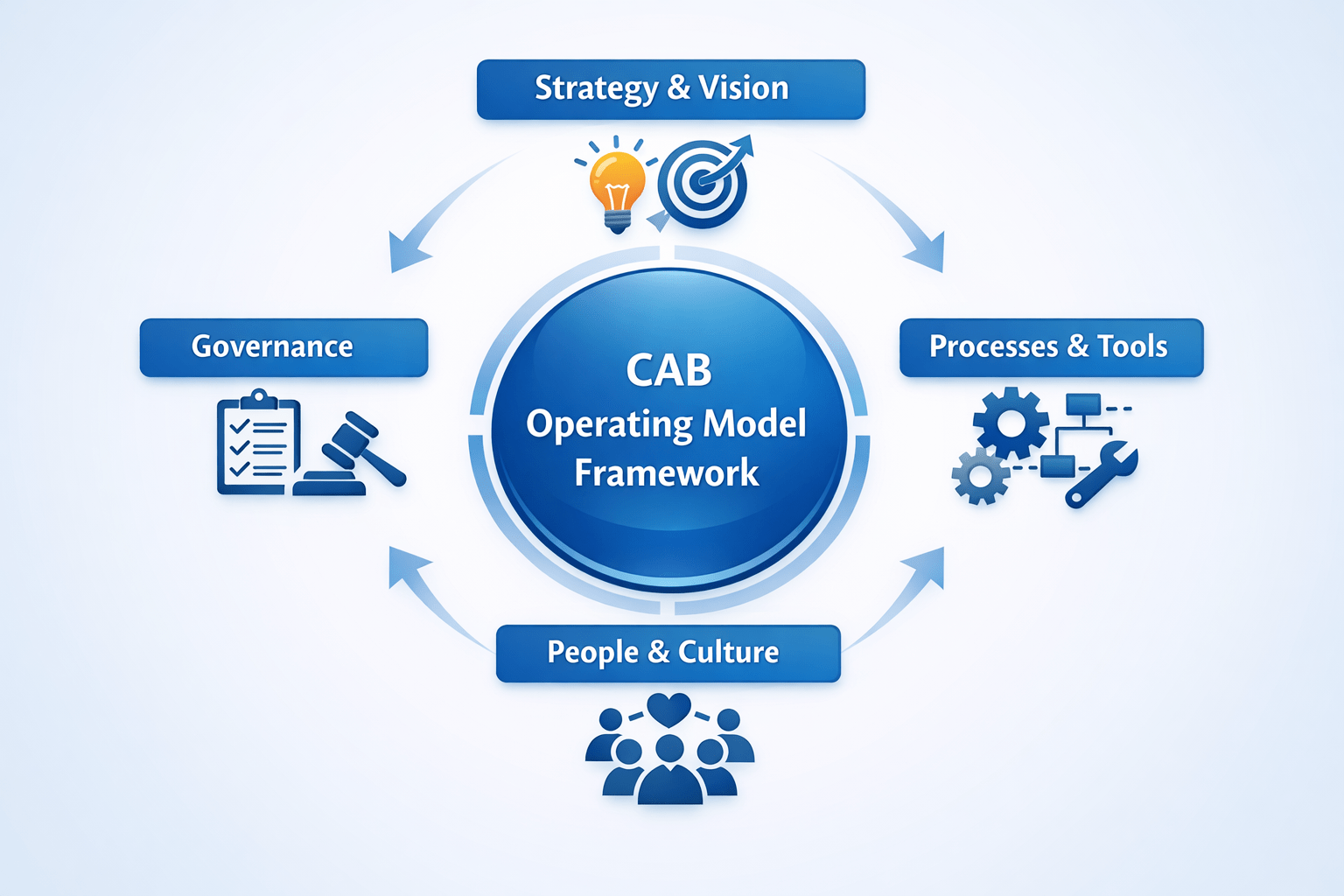
Most organizations approach CABs as discrete events.
High-performing CABs are not events—they are systems.
The difference is a structured operating loop that continuously converts conversations into action.
As shown in Chart 4, The Customer Advisory Board (CAB) Operating Model Framework, the optimal operating model definition.
Cadence
- 2 executive-level sessions annually
- Quarterly virtual working sessions focused on specific themes
Pre-Work (Critical, Often Missing)
The quality of the session is determined before it begins.
Effective pre-work includes:
- Insight briefs summarizing known trends and hypotheses
- Data snapshots (usage patterns, churn signals, adoption gaps)
- Clearly articulated questions requiring customer input
Without pre-work, CABs default to reactive conversation.
With it, they become strategic working sessions.
Defined Roles
- Executive Sponsor – signals importance and alignment
- Facilitator – neutral, structured, not sales-driven
- Insight Capture Lead – ensures outputs are usable, not anecdotal
Agenda Design
- 30% validation of known insights
- 70% exploration and co-creation
Most CABs invert this ratio—and lose value as a result.
The Operating Loop
A high-performing CAB follows a continuous lifecycle:
- Define hypotheses
- Select members
- Distribute pre-work
- Facilitate session
- Extract insights
- Operationalize
- Close the loop with customers
The final step—closing the loop—is where trust compounds and participation quality improves over time.
V. Facilitation Techniques That Unlock Real Insight
The difference between a good CAB and a transformational one lies in facilitation quality.
Traditional approaches—open Q&A, roundtable updates—produce surface-level feedback.
Elite facilitation drives depth.
Techniques That Work
- Scenario-Based Exploration
“What would have to be true for this to become a top priority?” - Forced Prioritization
Customers rank trade-offs, revealing true value drivers - Structured Breakouts with Opposing Views
Designed to surface conflict and contrast
What to Avoid
- Vendor-led presentations dominating time
- Passive “round-robin” sharing
- Over-polished narratives that suppress honesty
The Core Skill: Extracting Latent Needs
Customers articulate:
- Symptoms
- Workarounds
- Frustrations
They rarely articulate:
- Root causes
- Systemic gaps
- Monetizable opportunities
Your role is to move the conversation down the insight depth curve:
- Opinions → Feedback → Pain Points → Root Causes → Unmet Needs
The final level is where revenue is discovered—and where most organizations never reach.

Most CABs never get past opinions and surface feedback. The real value emerges only when you push into root causes and unmet needs—where revenue opportunities actually exist. Chart 5 brings this to life – The Customer Advisory Board (CAB) Insight Depth Ladder.
VI. Converting Insights into Revenue Opportunities
This is where CABs shift from advisory to value creation engines.
Most organizations stop at “insight.”
World-class organizations convert insight into commercial outcomes.

This is where CABs either create value—or stall. The organizations that win treat insight as the starting point of a structured revenue conversion system. This is shown clearly above in Chart 6 – The Revenue Conversion Funnel.
The Conversion Framework
Insight → Theme → Opportunity → Business Case
Categorizing Opportunities
- New product features
- New services or offerings
- Pricing and packaging innovations
Quantifying Value
Each opportunity should be assessed based on:
- Willingness to pay
- Frequency and consistency of need
- Validation across multiple customers
This eliminates anecdotal bias and creates investment-grade opportunities.
When done correctly, CAB outputs directly influence:
- Product investment decisions
- Go-to-market strategies
- Revenue forecasting
VII. Operationalizing CAB Outputs (Where Most Fail)
This is the most common breakdown point.
Insights are generated—but not embedded.

- This is the single biggest failure point for most CABs. Without a clear system to translate insight into execution, even the best ideas never reach revenue. This dynamic becomes clear in Chart 7 – CAB-to-Execution System Map.
To avoid this, CAB outputs must integrate into core systems:
Integration Points
- Product roadmap governance
- Sales plays and enablement
- Customer success planning
Required Infrastructure
- CAB Insight Tracker (owners, timelines, status)
- Executive reporting cadence
- Cross-functional accountability
Metrics Alignment
Tie CAB outputs to:
- Net Revenue Retention (NRR)
- Expansion revenue
- Time-to-market improvements
Without operationalization, CABs are episodic.
With it, they become systemic growth drivers.
VIII. Measuring CAB Effectiveness
If CABs are strategic assets, they must be measured accordingly.

What gets measured gets funded—and scaled. When CABs are tied to tangible inputs and outputs, they consistently demonstrate disproportionate ROI. Chart 8 illustrates The Customer Advisory Board (CAB) ROI Dashboard that measures the value of the overall value of conducting the CAB (cost, revenue).
Leading Indicators
- Insight quality (depth, novelty, actionability)
- Participation engagement and candor
Lagging Indicators
- Revenue influenced or created
- Retention improvements
- Expansion rates
The CAB ROI Model
Inputs:
- Time
- Cost
- Executive involvement
Outputs:
- Revenue generated
- Churn avoided
- Pipeline influenced
When measured properly, CABs consistently demonstrate outsized ROI relative to cost.
IX. Case Example: CAB → Insight → Revenue Outcome
Context:
A global enterprise organization was experiencing strong customer satisfaction but plateauing growth.
CAB Insight:
Customers revealed a consistent but previously unarticulated need:
They were solving adjacent problems outside the platform using fragmented tools.
Action:
Through structured CAB sessions, the organization:
- Identified common patterns across customers
- Defined a new bundled offering addressing the adjacent use case
- Validated willingness to pay across multiple participants
Result:
- New revenue stream launched within 6 months
- Significant increase in expansion revenue
- Improved retention due to increased platform dependency
The insight was not hidden—it was simply never structured, surfaced, or validated.
X. Common Pitfalls and How to Avoid Them
Even well-intentioned CABs fail for predictable reasons:

These failure patterns are not random—they are systemic and repeatable. The organizations that outperform are the ones that deliberately design against them. Shown in Chart 9, The Customer Advisory Board (CAB) Failure Modes vs. Best Practices, demonstrated the operating principles for managing a CAB.
Pitfalls
- Treating CABs as one-time events
- Lack of executive alignment and ownership
- Failure to close the loop with participants
- Over-reliance on anecdotal input
Best Practices
- Establish CABs as ongoing strategic programs
- Ensure executive sponsorship and cross-functional integration
- Communicate outcomes and actions back to participants
- Validate insights across multiple data points
Avoiding these pitfalls is less about effort—and more about discipline and design.
XI. The Future of CABs: From Advisory to Co-Creation Ecosystems
CABs are evolving.

CABs are no longer periodic advisory forums—they are becoming continuous growth engines.
Organizations that recognize this shift early will outpace those still operating in legacy models. Chart 10 brings this to life – The Evolution of Customer Advisory Boards (CABs).
The traditional model—periodic advisory sessions—is giving way to continuous, integrated ecosystems.
Emerging Trends
- Always-on digital CAB environments
- AI-assisted insight synthesis across conversations
- Customer co-innovation labs
The Evolution Path
Advisory → Insight Engine → Co-Creation Platform → Revenue Ecosystem
In this future state, CABs are no longer a supporting function.
They become a core component of customer-led growth strategy.
Closing Perspective
Most organizations search for growth externally:
- New markets
- New products
- Acquisitions
Yet some of the most valuable opportunities already exist within the current customer base.

The difference between companies that unlock this value—and those that don’t—is not incremental. It is structural.
It comes down to whether the CAB is designed to generate revenue—or simply to listen. This is shown clearly above in Chart 11 – Companies With, and Without Revenue Generation CABs
The challenge is not access to customers.
It is the ability to systematically extract, interpret, and act on what they are already telling you.
When designed and managed correctly, Customer Advisory Boards become:
- A strategic intelligence system
- A revenue discovery engine
- A durable competitive advantage
And in a market where differentiation is increasingly difficult, that advantage compounds.
About the Author
Steven Jeffes is a Customer Experience and Customer Strategy executive focused on one outcome: turning customer insight into new revenue.
Over a 40+ year career, he has worked with or consulted for organizations including Accenture, IBM Global Services, PricewaterhouseCoopers, Cox Automotive, and INEOS Automotive, and led CX, CRM, and customer strategy initiatives for global brands such as American Express, Microsoft, Verizon, Pfizer, Capital One, Toyota, Ritz-Carlton, Amazon, and Delta Airlines.
While most companies treat Customer Advisory Boards as feedback forums, Steven designs them as revenue engines—structured systems that uncover unmet needs, validate demand, and convert customer conversations into new products, services, and expansion opportunities.
His work has helped organizations identify and activate hundreds of millions of dollars in new revenue by transforming how they listen to—and act on—their customers.
He partners with executive teams to build customer-led growth engines, aligning Customer Success, Product, Sales, and Marketing around one principle:
Customers will tell you where your next revenue opportunity is—if you know how to listen.
Connect: www.stevenjeffes.com | stevenjeffes@gmail.com, 📞 – 518-339-5857


Achieving Market Leadership by Effectively Managing Customer Loyalty and Advocacy
September 11, 2015 1 Comment
To find out the answer to these questions, read the rest of this informative blog article below.
Customer Loyalty & Advocacy
{Click on image above for a larger/clearer view}
Your customer base is almost always represented by the above spectrum of customers. What varies from business to business is the percentage in each segment group. The more well managed your business, the more skewed to the right your customers tend to be. Therefore a business must develop strategies to migrate customers continually from the left to the right from segment group to segment group in increasing numbers. The rest of this blog is dedicated to sharing best practices on how to migrate more of your customers to the right of the spectrum.
Customer Loyalty and Advocacy Framework
{Click on image above for a larger/clearer view}
For any company to achieve world-class status, one must carefully map out a customer loyalty and advocacy framework including the following component steps from the chart above:
Customer Loyalty & Advocacy Framework Segments
{Click on image above for a larger/clearer view}
The above customer loyalty & advocacy framework includes the following segments:
A formal social and company/brand listening and tracking program is a best practice on how to identify which of your customers exist in each of the above segments (see my previous blog entry on the topic of Social listening programs).
Customer Dissenters & Defectors
{Click on image above for a larger/clearer view}
From this graphic above, we can see clearly that the strategy should be as follows:
Unless the individuals in these segments are high value or high profitability customers, then you would want to minimize the financial rewards to these customer satisfaction segments.
In addition and based on my research and experience, you are wasting your marketing and sales $$ spend to these two segments as they are much more unlikely to respond to any marketing offers due to being so currently dissatisfied with the company and brands (think about it – why would they trust you and buy more of the same when their initial experiences were so terrible?).
Customer Neutrals & Supporters
{Click on image above for a larger/clearer view}
From this graphic above, we can see clearly that the strategy should be as follows:
Customers in these segments should be offered tiered financial rewards to incentivize them to want to contribute at even higher levels to brand value and to remain even more loyal to the company and its brands.
Customer Advocates & Super Advocates
{Click on image above for a larger/clearer view}
From this graphic above, we can see clearly that the strategy should be as follows:
Customer Loyalty & Advocacy Cross-Segment Best Practices
{Click on image above for a larger/clearer view}
The graphic above highlights just a few of the cross-segment customer loyalty & advocacy best practices I recommend that companies continually practice to migrate customers from the negative segments that hurt the company’s brand value (dissenters, defectors) to positive segments (advocates and super advocates) that adds incredible value to a company’s brand.
Here are the brands for which I am a Dissenter, Defector, Neutralist, Advocate and Super-Advocate for based on my own personal experience and opinions:
Companies For Which I am a Dissenter
{Click on image above for a larger/clearer view}
Sears
Sears – I received abject customer service back in the late 1980’s and don’t want anything to do with the retailer ever again. I have tried to give them a second chance and continue to have an unsatisfactory experience. I pledge to never set foot in a Sears store again.
Target
Target – I interviewed for a senior management position at Target a several years ago was treated so poorly that even the HR manager at the time said the treatment of me was ‘questionable’. She then shared with me that she asked upper management “are we really trying to hire the best candidate here?” before she left the company. I vowed to never shop in Target again and have held true to my word.
Empire Carpet Today
Empire Carpet – We had several issues with our carpet installation and follow up customer service. They are very disorganized, non-customer friendly and do not seem to keep with the volume of sales that they generate. I will never use this company ever again. We steer people away from this company if asked.
2) Companies and Brands I am likely to Defect from or have defected from and tell everybody about why I am about to leave (or have left) these company & brands:
Companies for which I am a (potential) Defector
Bank of America
Bank of America – Closed many of the local branches where I live and the abundance of local branches was the reason I opened an account with BOA in the first place. The remaining branches are now crowded and not staffed adequately. This tells me they care more about the bottom line than customer satisfaction.
Marriott
Marriott – In my opinion Marriott has lost its way. I used to be a Platinum member at Marriott for many years. Their properties since that time have become worn as compared to their competitors and they seem to not listen well to their customers. An example of this myopia is when they converted the Courtyards to the Bistro concept. Every customer I speak to was disappointed by this change but they went ahead and did it anyway (presumably to save $$ on operations costs).
Frigidaire/Electrolux
Frigidaire/Electrolux – Our dehumidifier stopped working after only 1 year. We have been trying to get a credit from them for six months with no end in sight. The return process is the most customer unfriendly I have ever encountered with no possibility of human interaction. We have been without a dehumidifier for an entire year due to their poor customer service process.
3) Companies and Brands I am Neutral about and don’t really have much to say about them:
Samsung, Sony, Direct TV, Time Warner Cable, Panasonic, Cuisinart, Hunter Fans, Home Depot, Lowes, Macy’s, Sunoco, US Air, Delta, Tractor Supply, Wal-Mart, McDonalds, Burger King, Chili’s, Pizzeria Uno, American Airlines, Holiday Inn and many more. This category contains the most number of brands due to the distribution across segment group being shaped like a bell curve
4) Companies and Brands I am an Advocate of and share positive stories with anybody who is willing to listen:
American Express
American Express – I have worked with American Express as a consultant on several different strategic projects. They are an extremely well run organization with some very smart people running the company. I have also been a Platinum card member for many years. They provide excellent customer service and their fee structure is the only thing keeping me from being a super-advocate. I tell everyone I meet I consider American Express a world-class company.
Southwest Airlines
Southwest Airlines – Southwest is just a great airline and makes the flying experience pleasurable. They are almost always on-time, the employees are friendly (some even humorous) and they try to be reasonable to their customers at every turn. I used to hate Southwest and am now a Southwest lover/advocate.
Hilton Hotels
Hilton Hotels – Did you guess what hotel I become more loyal to after minimizing my Marriott loyalty? Guess no further. Hilton has been on a roll creating new and invigorating hotels and I am now an advocate/loyalist and stay at Hilton Hotels whenever possible.
Dooney & Bourke
Dooney & Burke – Dooney & Bourke creates high quality, classic and trendy handbags and accessories that last over long periods of time even with heavy usage. Styles and collections are priced to reflect the consistent durability and attractiveness of this brand. If something goes wrong with their products, they stand behind them through high quality customer service.
5) Companies and Brands I am a Super – Advocate of and go out of my way to tell everyone how wonderful my experience has been with dealing with these companies:
Companies For Which I am a Super-Advocate
Cox Automotive
Cox Automotive – Cox Automotive has a great company culture consisting of many top automotive brands that includes Kelly Blue Book, Autotrader, Manheim, NextGear, DealSheild to name a few. The company is one of the best places I have ever worked and includes an employee first culture that they actually adhere to and practice. The company is run by a world-class CEO named Sandy Schwartz that has a great vision for the company’s future and is very visible in his support for the employee oriented culture.
Toyota
Toyota – My family has owned Toyota vehicles for many years. Toyotas are extremely reliable automobiles. I have a Tundra with 132,000 miles on it and have had zero major issues with it. I have such an affinity with my Tundra I have a hard time thinking about trading it in for another vehicle even though it would most definitely be another Toyota.
Ritz Carlton
Ritz-Carlton – I love staying at Ritz-Carlton since the experience each and every time is truly memorable. I also worked as a consultant for Ritz-Carlton to help design the perfect customer experience for guests. Ritz Carlton’s goal is to create an experience to remember and smile about and they live up to this promise every time.
The amazing (or sad) part about my sentiment rankings of the above companies is that, despite spending millions ($$$) on analytic systems and databases, I am willing to bet that very few, if any, actually were knowledgeable about my sentiment toward their brands prior to my writing this article.
This relates directly to a previous blog entry I developed on why CRM (Customer Relationship Management based on historical analytic insights) is dead and a new CRRM model is now a best practice. In this article I point out how world-class companies now query their customers how they feel about the company and brands on a periodic basis. Like me, many customers would be more than willing to share their sentiment and how they are feeling towards the company and their associated brands. Bottom Line: Analytic models provide minimal understand of true customer sentiment when it is primarily focused on historical purchases, spend, etc.
Share this:
Like this:
Filed under CRM, Customer Profitability, Marketing Tagged with abject customer service, American Express, Bank of America, best customer satisfaction management programs, best customer sentiment management programs, bottom tier customers, brand affinity, brand champions, brand detractors, brand identity, brand image, brand images, brand passionate, brand supporters, brand word cloud, brand zealots, companies with crappy customer service, companies with great customer service, companies with poor customer service, company champions, company passionate, company public image, company reputation, company word clouds, company zealots, Cox Automotive, cross-sell products, cross-sell services, customer advisory boards, customer advocacy, customer advocacy best practices, customer advocacy councils, customer advocacy management programs, customer advocate, customer advocate programs, customer advocates, customer awards ceremonies, customer brand identity, customer communications programs, customer councils, Customer cross-segment best practices and processes, Customer Defection Prevention, customer defectors, customer destroyers, customer dissenters, customer engagement levels, customer engagement scores, customer financial rewards, Customer focus groups, customer lifetime value, customer lifetime value and customer satisfaction, customer loyalist, Customer Loyalty, Customer Loyalty Best Practices, customer loyalty programs, customer management cost containment, customer management costs, Customer Management Programs, customer management strategies, customer negative buzz, customer neutral, customer participation rates, customer positive buss, customer recognition, customer recognition programs, customer referral network, customer referrals, customer rewards, customer rewards programs, customer roundtables, customer satisfaction brand management, customer satisfaction improvement, customer satisfaction improvement programs, customer satisfaction levels, customer satisfaction ratings, customer satisfaction segments, customer satisfaction word cloud, customer segment definitions, customer segment management, customer segment migration, customer segment strategies, customer segment strategy, customer sentiment brand management, customer sentiment segments, customer sentiment trends, customer sentiment word cloud, customer service continuum, customer service cost reduction, customer service from hell, customer service levels ratings, customer service nightmare stories, customer service spectrum, customer spend and satisfaction, customer supporters, customer top advocates, Customer Value, customer win-back, customers from hell, dealing with angry customers, dealing with irate customers, dealing with unhappy customers, destroy brand image, destroy company image, destroying brand image, Dooney & Bourke, efficient customer service, electrolux, Empire Carpet, Empire Today, firing customers, Frigidaire, great customer service, happy customers, high profitability customers, high value customers, Hilton Hotels, impact from great customer service, impact of poor customer service, impacting brand image, increase customer value, irate customers, irrational customers, isolating angry customers, low value customers, lowest profitability customers, marketing and customer satisfaction, Marriott, mid-tier customers, most loyal customers, negative brand comments, negative brand sentiment, negative company comments, negative customer sentiment, net promoter score, net promoters, neutral brand sentiment, neutral customer sentiment, nightmare customer, nightmare customer service, poor customer service, positive brand comments, positive brand sentiment, positive company comments, positive customer sentiment, Ritz Carlton, Sears, Southwest Airlines, Steven Jeffes, target, top customer advocate, top tier customers, Toyota, tracking customer satisfaction, unhappy customers, up-sell products, up-sell services, valuable customer segments, word of mouth negative comments, word of mouth positive comments, world-class customer satisfaction management programs, world-class customer sentiment management programs