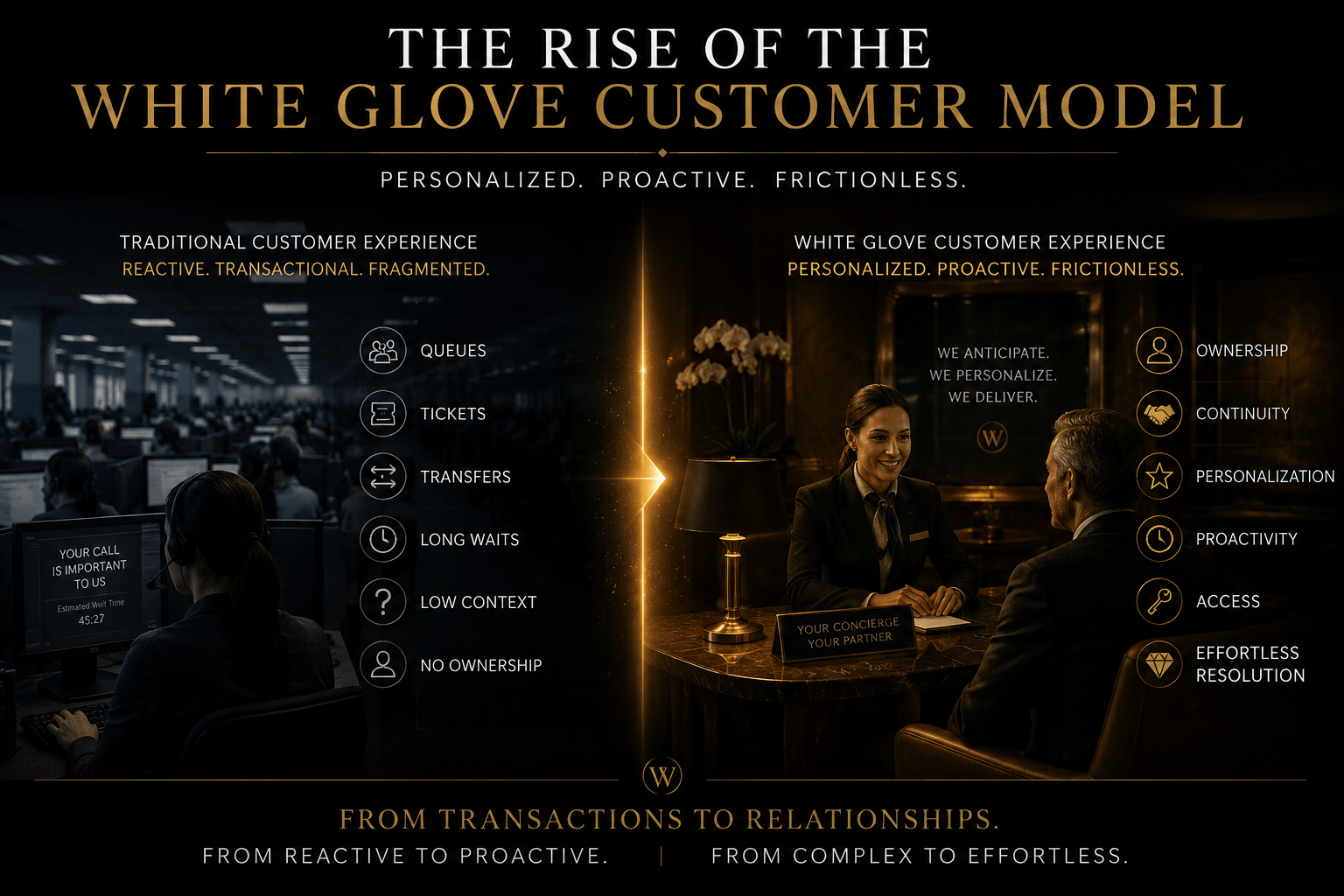
INTRODUCING: THE DEATH OF “STANDARD” CUSTOMER SERVICE AND THE RISE OF WHITE GLOVE CUSTOMER SERVICE.
Why Elite Customers Now Expect White Glove Customer Service, Concierge-Level Experiences
For decades, most companies treated customer service as a standardized operational function:
Same queue
Same process
Same escalation model
Same support experience
That model is rapidly collapsing.
Because not all customers create equal value.
Some customers:
Influence billions in purchasing decisions
Shape market perception
Control enterprise relationships
Influence Wall Street narratives
Drive ecosystem adoption
Accelerate or damage brand reputation
And increasingly, the companies winning at the highest levels understand something critically important:
High-value customers should never experience commodity service. They expect white glove customer service!
THE RISE OF THE WHITE GLOVE CUSTOMER SERVICE
The modern white glove service model is built around a simple premise:
The higher the customer value, influence, or strategic importance…
the more elevated, personalized, proactive, and frictionless the experience should become.
This is not favoritism.
It is intelligent customer strategy.
Many of the world’s most successful luxury, hospitality, financial services, and technology brands have quietly operated this way for decades.
Examples of World-Class White Glove Customer Service
EXAMPLE #1 — THE AMERICAN EXPRESS CENTURION MODEL
One of the most famous examples is the American Express Centurion Card, commonly referred to as the “Black Card.
“One of the most famous examples is the American Express Centurion Card, commonly referred to as the ‘Black Card,’ which helped redefine premium concierge-level customer experience through personalized service and elite relationship management.”
…with “premium concierge-level customer experience” linked to:
The Centurion experience was never simply about a payment card.
It was about creating:
Exclusivity
Status
Emotional connection
Personalized service
Operational prioritization
Elite access
The program became famous for:
Invitation-only membership
Dedicated concierge access
Personalized travel assistance
Event access
Emergency support
Premium reservations
White glove issue resolution
Highly personalized treatment experiences
The larger strategic insight was this:
The customer was no longer interacting with a call center.
They were interacting with a relationship ecosystem.
Over the course of my consulting and customer strategy work, I had the opportunity to help envision and architect several elite white glove customer experience concepts influenced by this exact model:
High-value customer segmentation
Concierge escalation paths
Elite service tiers
Proactive account orchestration
Executive relationship servicing
Differentiated support models for influential customers
The underlying principle was always the same:
Remove friction for the customers who matter most strategically.
EXAMPLE #2 — THE RITZ-CARLTON SERVICE MODEL
Another legendary example is The Ritz-Carlton.
Ritz-Carlton became globally recognized not merely for luxury accommodations, but for:
Anticipatory service
Empowered employees
Personalized guest memory systems
Concierge-level personalization
Emotional recovery experiences
Service ownership culture
Its Club Level experience includes:
Dedicated concierge staff
Personalized planning assistance
Curated guest experiences
Elevated access models
The company became famous for stories where employees solved highly personalized customer problems far beyond standard policy expectations.
The lesson:
White glove service is not reactive support.
It is proactive emotional relationship management.
EXAMPLE #3 — NORDSTROM’S HIGH-VALUE CLIENTELING MODEL
Nordstrom pioneered high-touch retail clienteling long before most companies understood personalized commerce.
Its highest-value customers often receive:
Dedicated stylists
Personalized recommendations
Direct outreach
Curated experiences
Appointment-based service
Frictionless returns
Elevated relationship treatment
Luxury retailers increasingly use VIP clienteling models because a very small percentage of elite customers often generate disproportionate revenue.
This is a critical modern business reality:
A tiny percentage of customers often drive a massive percentage of profitability.
THE NEW REALITY: NOT ALL CUSTOMERS SHOULD EXPERIENCE THE SAME SERVICE MODEL
This is where many organizations still fail.
They continue operating:
One-size-fits-all support
Generic escalation structures
Reactive service models
Commodity treatment architectures
Meanwhile elite customers increasingly expect:
Immediate access
Contextual awareness
Proactive service
Continuity
Ownership
Relationship familiarity
Strategic treatment
A CEO, EVP, SVP, major investor, strategic influencer, or enterprise decision-maker should never feel like:
Ticket #48372
Another queue entry
Another escalation
Another transfer
THE 10 COMMANDMENTS OF WHITE GLOVE CUSTOMER SERVICE
1. KNOW WHO MATTERS MOST
Not all customers create equal value.
Elite service begins with intelligent segmentation:
Revenue
Influence
Ecosystem importance
Expansion potential
Strategic visibility
2. REMOVE FRICTION AGGRESSIVELY
White glove customers should never:
Repeat themselves
Navigate complex IVRs
Restart conversations
Manage internal coordination
The organization should absorb the complexity — not the customer.
3. PROVIDE A SINGLE POINT OF OWNERSHIP
The most important phrase in white glove service is:
“I’ll personally handle this.”
Ownership creates emotional trust.
4. CREATE CONTEXTUAL MEMORY
Elite customers expect:
Rremembered preferences
Relationship continuity
Contextual intelligence
Historical awareness
They should feel recognized instantly.
5. PRIORITIZE SPEED WITHOUT SACRIFICING QUALITY
White glove service is not merely “fast.”
It is:
Precise
Informed
Orchestrated
High confidence
6. ANTICIPATE NEEDS BEFORE THEY BECOME PROBLEMS
True concierge organizations become predictive.
They proactively identify:
Risks
Delays
Disruptions
Lifecycle events
Unmet needs
before the customer asks.
7. EMPOWER FRONTLINE CONCIERGE TEAMS
Elite experiences collapse when concierge agents lack authority.
World-class white glove teams require:
Decision authority
Flexibility
Escalation access
Operational autonomy
8. DESIGN FOR EMOTIONAL EXPERIENCE
White glove customers remember:
Confidence
Reassurance
Calmness
Trust
Competence
Not just transaction completion.
9. MEASURE RELATIONSHIP STRENGTH — NOT JUST EFFICIENCY
Traditional metrics:
AHT
SLA
ticket closure
are insufficient.
White glove metrics must include:
Executive trust
Relationship durability
Strategic account health
Advocacy
Concierge satisfaction
Influence retention
10. MAKE THE CUSTOMER FEEL IMPORTANT
Because they are.
Elite service ultimately communicates:
“You matter differently here.”
That emotional signal is enormously powerful.
THE 10 PRE-REQUISITES FOR BUILDING A WHITE GLOVE CUSTOMER SERVICE
Many companies attempt white glove service without building the operational foundation required to sustain it.
That always fails.
1. CUSTOMER VALUE SEGMENTATION
Define:
Strategic customers
Executive customers
Influence tiers
VIP treatment criteria
2. DEDICATED CONCIERGE TEAMS
Do not mix:
Standard queues
Transactional service
Elite relationship management
These require different talent profiles.
3. ADVANCED AGENT CERTIFICATION
Concierge agents should undergo certification in:
Executive communication
Conflict recovery
Emotional intelligence
Operational orchestration
Relationship management
Industry expertise
4. CONTEXTUAL CUSTOMER INTELLIGENCE SYSTEMS
Agents need:
Unified customer profiles
Historical context
Lifecycle visibility
Relationship intelligence
Preference management
5. PROACTIVE MONITORING CAPABILITIES
Elite service organizations proactively monitor:
Account health
Usage anomalies
Risk indicators
Escalation patterns
Sentiment shifts
6. WHITE GLOVE HANDLING STANDARDS
Define:
Response times
Escalation ownership
Communication cadence
Executive outreach protocols
Recovery standards
7. CROSS-FUNCTIONAL ESCALATION ACCESS
Concierge teams require rapid access into:
Engineering
Product
Operations
Logistics
Marketing
Pricing
Executive leadership
8. SPECIALIZED PERFORMANCE METRICS
Measure:
Relationship durability
Expansion rates
Executive satisfaction
Trust indicators
Advocacy
Retention quality
9. CULTURAL ALIGNMENT
White glove service cannot operate inside:
Cost-first cultures
Rigid bureaucracy
Empowerment-resistant organizations
The culture must support elevated treatment models.
10. EXECUTIVE COMMITMENT
White glove service requires leadership commitment.
The organizations that win the next decade will understand:
High-value customers should never experience commodity operations.
They should experience:
Confidence
Continuity
Ownership
Access
Orchestration
Emotional assurance
Strategic partnership
FINAL THOUGHT
The companies creating the strongest loyalty in the modern economy are no longer delivering “customer service.”
They are delivering:
relationship privilege.
That is the future of elite customer experience.
And the organizations that operationalize it correctly will create:
Higher retention
Stronger advocacy
Deeper loyalty
Greater expansion
More resilient executive relationships
Dramatically stronger long-term profitability
Because when elite customers feel truly understood, protected, prioritized, and valued…
they rarely leave.
Interested in architecting a world-class level white glove customer experience program? Contact Customer Experience strategist Steve Jeffes at stevenjeffes@gmail.com or 518-339-5857. Below is a small sample of the companies I have helped elevate their customer experience to best world-class.
How Customer Advisory Boards Reveal New Revenue Streams Hidden in Your Existing Customer Base
Executive Summary
Many companies search for growth through new markets, acquisitions, or product expansion. Yet some of the most valuable revenue opportunities already exist inside their current customer base.
When organizations create structured environments where customers openly discuss challenges, future needs, and industry changes, entirely new revenue opportunities often emerge quickly.
Across multiple Customer Advisory Board (CAB) programs I have designed and facilitated, these conversations have uncovered more than $500 million in previously unidentified revenue opportunities. Additional significant revenue discovery is almost guaranteed in future customer advisory boards given the approach I am about to lay in this and future CAB topic series blog articles.
1. The Untapped Revenue Inside Your Customer Base
Most organizations pursue growth through new products, new markets, or acquisitions. While these strategies can generate results, they often overlook one of the largest opportunities already available: unmet customer needs.
Over the course of facilitating Customer Advisory Boards and executive focus groups across more than fifteen organizations, structured customer discussions have repeatedly surfaced revenue opportunities that were invisible in company data.
The discovery process is illustrated in Graphic 1: The $500M+ Customer Insight Funnel.
Graphic 1 illustrates how structured customer conversations reveal operational pain points and unmet needs. These insights move through a progression—from identifying unmet demand to validating opportunity areas and ultimately developing new revenue streams. Over time, organizations that systematically capture these insights convert customer conversations into a powerful engine for innovation and growth.
2. The Revenue Discovery Gap
If the opportunity exists within the customer base, why do many organizations fail to discover it? The answer lies in what can be described as the Revenue Discovery Gap.
Most organizations rely on three sources of insight: • Analytics data – reveals past behavior but rarely unmet needs • Sales conversations – focused on tactical issues • Internal innovation sessions – based on internal assumptions
These blind spots create what can be described as the Revenue Discovery Gap, illustrated in Graphic 2.
Graphic 2 highlights the difference between traditional insight sources and direct customer engagement. Analytics and internal brainstorming provide useful information but rarely uncover the deeper operational challenges customers face. Customer Advisory Boards close this gap by bringing customers directly into strategic conversations about future needs.
3. Customer Advisory Board Revenue Discovery
Customer Advisory Boards create a structured forum where organizations engage directly with thoughtful customers about industry trends, operational challenges, and future needs.
For additional research on Customer Advisory Board best practices, the Customer Experience Professionals Association (CXPA) provides useful customer engagement and customer strategy resources: https://www.cxpa.org
The strategic value created through these conversations is illustrated in Graphic 3: The CAB Value Pyramid.
Graphic 3 illustrates how CAB programs create value across three layers. The foundation is customer insight, where structured dialogue reveals unmet needs. Those insights drive innovation and revenue creation, which ultimately leads to deeper strategic partnerships where customers become collaborators in shaping future solutions.
Real Examples: Revenue Generators That Emerged From CAB Conversations
Example 1 – Automotive Concierge Ownership Service
During a Customer Advisory Board discovery session with a group of vehicle owners and fleet customers, I asked a simple question that often reveals entirely new opportunities:
“What services would you pay for — or pay more for — that we don’t currently offer?”
The room quickly began discussing the complexity of managing every aspect of vehicle ownership.
Customers described the number of tasks required throughout a vehicle’s lifecycle:
• Scheduling routine maintenance • Coordinating service appointments • Arranging transportation while the vehicle is being serviced • Managing repairs and insurance claims • Organizing detailing and upkeep • Transporting vehicles between locations • Dealing with unexpected breakdowns or logistical issues
One customer summarized the frustration succinctly:
“Owning the vehicle is the easy part. Managing everything around it is the real headache.”
Several CAB members then converged on the same idea: they would gladly pay a reasonable premium for a fully managed automotive concierge service that would handle every operational aspect of vehicle ownership.
The proposed service would function as a single point of coordination for the entire vehicle lifecycle, managing:
• Maintenance scheduling and service logistics • Detailing and vehicle care • Transportation to remote or alternate locations • Insurance and repair coordination • Lifecycle tracking and vehicle replacement planning
In essence, customers were asking for a “vehicle ownership management service” where they never had to think about the operational details of maintaining their vehicle.
Multiple CAB participants emphasized that the service would not only save time but also reduce stress and uncertainty associated with vehicle ownership.
Several customers indicated they would be willing to pay $1,000–$2,500 per year per vehicle for such a service if it were executed reliably.
Across a large installed customer base, a premium concierge program like this could realistically yield $50–$120 million in new service revenue while simultaneously increasing customer loyalty and retention.
The insight did not emerge from product analytics, surveys, or internal brainstorming.
It emerged from a structured conversation among customers describing the real-world friction they experience every day.
Example 2 – Veteran Affinity Credit Card
In another Customer Advisory Board discovery session involving credit card customers, participants were discussing the emotional connection consumers increasingly want to feel with the brands they support.
Several CAB members raised the idea of financial products tied to causes that customers deeply care about.
One participant suggested an idea that quickly gained traction among the group:
A credit card specifically designed to support U.S. veterans.
Customers explained that many Americans actively look for ways to support veterans and veteran-focused organizations but often lack simple, everyday mechanisms to do so.
The CAB participants proposed a credit card that would direct a portion of card proceeds — such as transaction fees or annual membership fees — to vetted veteran support organizations.
The idea resonated strongly across the group for several reasons.
First, it allowed cardholders to support veterans through everyday spending rather than requiring separate charitable contributions.
Second, it provided a simple way for consumers to align their financial behavior with causes they care about.
Several CAB members indicated they would gladly pay a premium annual fee for such a card, viewing the additional cost as a meaningful way to contribute to veteran causes.
Participants also pointed out that no major financial institution had yet created a credit card explicitly structured around supporting veterans in this way.
Strategic Product Design
The financial institution ultimately designed a new credit card that maximized the benefits available under the Servicemembers Civil Relief Act (SCRA) and the Military Lending Act (MLA).
The product incorporated benefits such as waived annual fees, enhanced rewards programs, charitable contributions to veteran organizations, and other military-focused features that made the card uniquely attractive to veterans, active-duty service members, and the millions of Americans who support them.
By aligning the product design with existing military consumer protection frameworks, the institution was able to create a differentiated financial product while maintaining full regulatory compliance.
This meant the concept could serve not only as a new product offering but also as a powerful market differentiator capable of attracting an entirely new audience of customers motivated by purpose-driven financial products.
CAB participants suggested that the product could appeal not only to veterans and military families but also to the millions of Americans who actively support veteran-focused initiatives.
With the right positioning and partnerships with credible veteran organizations, such a product could realistically yield $30–$75 million in new annual revenue through a combination of annual fees, transaction volume, and expanded card adoption.
More importantly, it would position the issuing financial institution as a brand aligned with a cause that resonates deeply with many consumers.
Once again, the idea did not originate inside the company.
The idea and new revenue stream came directly from customers when they were invited to participate in shaping the future of the products they use.
Example 3 – Predictive Maintenance & Failure Prevention Services
During a Customer Advisory Board discussion involving enterprise equipment operators and fleet managers, participants began describing a common operational frustration: unexpected equipment failures that created costly downtime and disrupted operations.
Several CAB members explained that while existing products performed well, they lacked advanced tools that could predict failures before they occurred.
Customers suggested that if the company could combine equipment telemetry, operational data, and predictive analytics into a monitoring service, they would gladly pay a subscription fee for predictive maintenance insights that would help them prevent downtime.
The proposed solution included:
• Continuous monitoring of equipment performance data • Predictive alerts for potential failures • Maintenance scheduling recommendations • Performance optimization insights across fleets or facilities
Customers emphasized that avoiding even a single major failure could save tens or hundreds of thousands of dollars in operational disruption.
Because of that, they viewed the service not as a cost, but as an operational insurance policy.
Several CAB members indicated they would be willing to pay $500–$2,000 per asset annually for such a service.
When applied across large installed equipment bases, this type of predictive maintenance platform could yield $40–$80 million in annual recurring revenue while simultaneously improving customer uptime and satisfaction.
In many industries, the shift from reactive support to predictive service has become one of the fastest-growing sources of new service revenue.
Example 4 – Industry Benchmarking & Performance Intelligence Platform
In another Customer Advisory Board session involving senior leaders from multiple organizations within the same industry, participants began discussing a challenge many of them shared.
While each company collected extensive internal performance data, they had very little visibility into how their operations compared to industry peers.
CAB participants expressed strong interest in an industry benchmarking and performance intelligence platform that could provide anonymized insights across participating organizations.
Customers explained that access to credible benchmarking data would help them make better strategic decisions, justify internal investments, and identify performance gaps earlier.
Several participants suggested they would gladly pay for such insight if it were provided by a trusted industry partner.
CAB members proposed a subscription-based benchmarking service available to participating organizations.
Early estimates from CAB participants suggested companies would pay between $50,000 and $150,000 annually for access to credible industry benchmarking intelligence.
If adopted across even a modest number of customers within the ecosystem, such a platform could yield $25–$60 million in recurring annual revenue, while positioning the provider as a trusted strategic intelligence partner within the industry.
In addition to the direct revenue opportunity, these types of platforms often strengthen customer relationships because they provide ongoing strategic insight rather than simply operational support.
Organizations that consistently uncover meaningful revenue opportunities through CAB programs typically follow a structured process.
Step 1– Identify the Right Customers Step 2– Curate the Advisory Board Step 3– Design the Discussion Step 4– Facilitate Discovery
Step 4 – Facilitate Discovery (deeper dive, sample content of next blog topic on CABs)
Even with the right participants and discussion topics, the role of facilitation remains critical. The quality of insights generated during a Customer Advisory Board (CAB) session depends heavily on whether participants feel comfortable sharing candid perspectives—even when that feedback may challenge existing products, services, or strategies.
To create an environment where honest dialogue can occur, I begin every CAB session by establishing a simple set of ground rules designed to encourage openness, respect, and constructive debate.
CAB Ground Rules for Productive Discovery
Ground Rule #1 – Radical Honesty Is Expected All ideas and comments are welcome, no matter how negative they may be. If we are going to improve, we need complete honesty. I often remind participants of an old saying: only your best and most trusted friend would tell you that you have a dirty face or bad breath. The same principle applies here—honest feedback is a sign of trust.
Ground Rule #2 – Candor Will Never Be Penalized No feedback, regardless of its severity, will ever cause leadership to view participants negatively. On the contrary, those who share completely honest perspectives will be valued as trusted advisors to the brand.
Ground Rule #3 – Challenge Assumptions Participants are encouraged to speak openly and challenge assumptions. Many of the most valuable insights emerge when customers question ideas that organizations have long taken for granted.
Ground Rule #4 – Respect Every Voice Only one person speaks at a time, and all participants must respect each other’s viewpoints and perspectives. Productive CAB sessions depend on thoughtful listening as much as thoughtful speaking.
Ground Rule #5 – Think Like Owners As with brainstorming, no suggestion or criticism is off-limits. Every idea will be treated with respect and serious consideration. During the session, participants are not simply customers, they are co-CEOs helping shape the future of the company.
Segueing from this final ground rule, I then introduce an exercise designed to shift the mindset of the room even further.
Graphic 3A – Participant Certification of Company Ownership.
To shift the conversation from customer feedback to strategic thinking, each participant receives a Certificate of Ownership above that symbolically appoints them as the temporary owner and CEO of the company for the duration of the CAB session.
After distributing the certificates, I explain:
For new customer led problem identification and rectification focused sessions, the question becomes“For the next few hours, you are the owners of this company. You can change anything you want—products, services, pricing, policies, strategy, or how we operate.”
For customer led new revenue focused sessions, the question becomes “For the next few hours, you are the owners of this company. You need to focus on new revenue generation ideas that would sell easily – new products, services, premium services, events, partnerships, etc.”
Participants are then asked a simple but powerful question:
“If you owned this company, what changes would you make on day one, week one, and month one?”
This exercise immediately moves participants from the mindset of customers providing feedback to owners responsible for improving the business. The result is more candid conversations, more strategic thinking, and insights that rarely surface in traditional customer meetings.
A deeper look at the full methodology behind designing and facilitating high-impact CAB sessions, including facilitation techniques, session structures, and insight extraction frameworks will be covered in the next article in this series:
This process is illustrated in Graphic 4: The Revenue Discovery Framework.
Graphic 4 above shows how organizations move from customer insight to measurable revenue creation. Each stage builds upon the previous one, transforming structured customer conversations into a repeatable pipeline for innovation and growth.
5. Strategic Benefits of a Customer Advisory Board Beyond Revenue
While CAB programs are powerful engines for uncovering new revenue, their impact extends far beyond innovation alone. They strengthen customer relationships and can serve as an early warning system for emerging risks.
This dynamic is illustrated in Graphic 5: The Loyalty Multiplier Effect.
Graphic 5 shows how including customers in strategic conversations creates a reinforcing cycle of engagement, advocacy, and loyalty. When customers help shape solutions, they often become advocates for the brand and long‑term partners in its success.
6. Types of Revenue Opportunities a Customer Advisory Board Reveal
Revenue opportunities uncovered through CAB discussions typically fall into four categories:
• New services • Premium offerings • Product enhancements • Entirely new offerings These categories are illustrated in Graphic 6: The Revenue Opportunity Spectrum.
Graphic 6 demonstrates how CAB insights often begin with incremental opportunities such as services or premium offerings and can expand into entirely new products or businesses.
Internal brainstorming generates ideas, but it often lacks market validation. Customer Advisory Boards introduce perspectives internal teams cannot replicate.
The difference between internal ideas and customer‑validated insight is shown in Graphic 7.
Graphic 7 highlights how internal brainstorming often produces ideas based on assumptions, while customer‑driven innovation begins with real operational problems and validated demand.
8. The Strategic Imperative
Many successful growth strategies begin in the same place: a room full of customers sharing honest perspectives about their challenges and future needs.
The overall strategic impact of customer‑driven discovery is summarized in Graphic 8, Strategic Impact of Customer‑Driven Discovery.
Graphic 8 reinforces the central idea of this article: when organizations systematically involve customers in shaping their future, they unlock new revenue streams, stronger loyalty, and long‑term strategic partnerships.
“Every company has untapped revenue hiding inside its customer base. The companies that discover it first are the ones willing to ask their customers the right questions.”
9. The Experience Behind This Perspective
The ideas presented here are grounded in more than four decades of work in customer strategy, customer experience, consulting, and technology leadership.
I have worked with or consulted for organizations including Lockheed‑Martin, Carrier, General Electric, IBM Global Services, PricewaterhouseCoopers, Unisys, Accenture, Cox Automotive, Wave Systems, INEOS Automotive, American Express, Microsoft, Samsung, AT&T, Verizon, Pfizer, Capital One, Toyota, Amazon, Google, Oracle, Adobe, Southwest Airlines, Delta Airlines, Siemens, Wells Fargo and many others.
10. An Invitation to C‑Suite Leaders
If you are a CEO, Chief Customer Officer, Chief Revenue Officer, or senior executive seeking to uncover new growth opportunities while strengthening customer relationships, I would welcome the opportunity to speak with you.
Customer Advisory Boards are one of the most powerful, and most underutilized, strategic tools available to executive leadership teams.
When designed and facilitated correctly, CAB programs do far more than generate feedback. They uncover entirely new revenue streams, reveal emerging market risks before they become crises, and transform customers into strategic partners in shaping a company’s future.
Over the past four decades working with global enterprises across industries—including financial services, automotive, technology, healthcare, and manufacturing—I have helped organizations design and lead Customer Advisory Boards that have revealed hundreds of millions of dollars in new revenue opportunities while simultaneously strengthening long-term customer loyalty and advocacy.
In the next three articles in this series, I will go deeper into the mechanics behind these outcomes, including:
How to Design and Run World-Class Customer Advisory Boards that consistently produce strategic insight and breakthrough ideas.
How Leading Companies Convert Customer Insight Into Revenue, transforming CAB conversations into new services, premium offerings, and entirely new business models.
The Hidden Strategic Value of Customer Advisory Boards, including how trusted CAB members can serve as early-warning systems for emerging operational, regulatory, and market risks.
Because when companies move customers from the sidelines into the strategy room, they don’t just learn more about their markets.
They start discovering opportunities their competitors haven’t even seen yet.