Customer Advisory Boards That Actually Generate New Revenue
April 15, 2026 Leave a comment
A practical guide to structuring, recruiting, and facilitating Customer Advisory Boards (CABs) that consistently produce actionable insights and new strategic revenue opportunities
I. Introduction: Why Most CABs Underperform
Most Customer Advisory Boards fail. Not because companies don’t invest in them, but because they fundamentally misunderstand what they are.
In practice, most CABs devolve into relationship theater:
- Executive dinners disguised as strategy sessions
- Polished presentations followed by polite feedback
- “Great conversation” with no measurable business outcome
The result is predictable: high effort, low impact.
The failure modes are consistent across industries:
- Discussions lack structure and strategic intent
- Participants are misaligned (too senior to be candid, too tactical to be strategic, or too agreeable to challenge)
- Outputs are disconnected from revenue, product strategy, or growth initiatives
- Insights are captured but never operationalized
This is not a CAB problem. It is a design problem.
The reframe is critical:
A Customer Advisory Board is not an event. It is strategic growth infrastructure.
When designed correctly, CABs become:
- Early warning systems for churn and competitive risk
- Engines for uncovering unmet customer needs
- Platforms for co-creating new revenue streams
The difference between underperforming CABs and high-impact ones is not effort, it is intentional architecture.

The difference becomes clear when you look at how CABs actually evolve. Most organizations believe they are operating strategically—but in reality, they remain stuck in early maturity stages. This is shown clearly above in Chart 1 – The Customer Advisory Board (CAB) Maturity Model.
II. Defining the Purpose: From Feedback to Revenue Discovery
The most important decision you make about a CAB happens before the first invitation is sent:
What is this board designed to produce?
Most organizations default to “gathering feedback.”
That is necessary—but insufficient.
World-class CABs are anchored to three explicit business outcomes:
1. Retention Protection
Identify early signals of dissatisfaction, friction, or competitive vulnerability before they appear in lagging indicators like churn.
2. Expansion Discovery
Surface new use cases, unmet needs, and adjacent opportunities that customers are already willing to pay for—but that the organization has not yet productized.
3. Strategic Foresight
Understand how customer priorities, markets, and expectations are evolving—often ahead of internal awareness.
This is where most organizations miss the real opportunity.
Customers don’t hand you fully formed strategy—they provide signals: friction, workarounds, and emerging needs.
“Customers don’t hand you strategy—they hand you signals.”
The role of a well-designed CAB is to convert those signals into:
· Pipeline influence
· Product roadmap prioritization
· New monetizable offerings

This dynamic becomes clear in Chart 2 – The Customer Advisory Board (CAB) Value Pyramid.
The difference is not in how much feedback you collect—it’s how far you take it.
High-performing CABs systematically move from raw input to monetizable opportunity.
III. Member Selection: Precision Over Prestige
The instinct in building a CAB is to prioritize brand names and seniority.
This is a mistake.

The effectiveness of a CAB is driven not by who looks impressive on the invitation list—but by who contributes meaningful perspective. Chart 3 illustrates the best cross-sectional composition of a Customer Advisory Board (CAB).
Ideal Composition
High-performing CABs deliberately balance four archetypes:
- Daily Operators
Experience the product or service in real workflows and understand friction points - Strategic Buyers
Understand long-term direction, investment priorities, and executive constraints - Executive Innovators / Challengers
Push boundaries, question assumptions, and introduce non-obvious perspectives - Key Market Influencers and Key Opinion Leaders
Shape or create sentiment, shape perceptions, create positive and negative market perceptions
Segmentation Matters
CABs should be intentionally structured across:
- Revenue tiers (Platinum, Gold, Growth)
- Industry verticals
- Lifecycle stages (new, mature, at-risk)
What to Avoid
- Over-indexing on “friendly” customers
- Overrepresentation from a single segment
- Homogeneous thinking environments
Design Principle: Constructive Tension
The most valuable CABs are not harmonious—they are productive tension environments.
When customers respectfully challenge:
- Your assumptions
- Each other’s perspectives
- Industry norms
…you unlock deeper insight.
Without that tension, you get validation.
With it, you get discovery.
IV. Structuring the CAB: Architecture That Drives Outcomes
World-class CABs operate on a repeatable system, not ad hoc meetings.
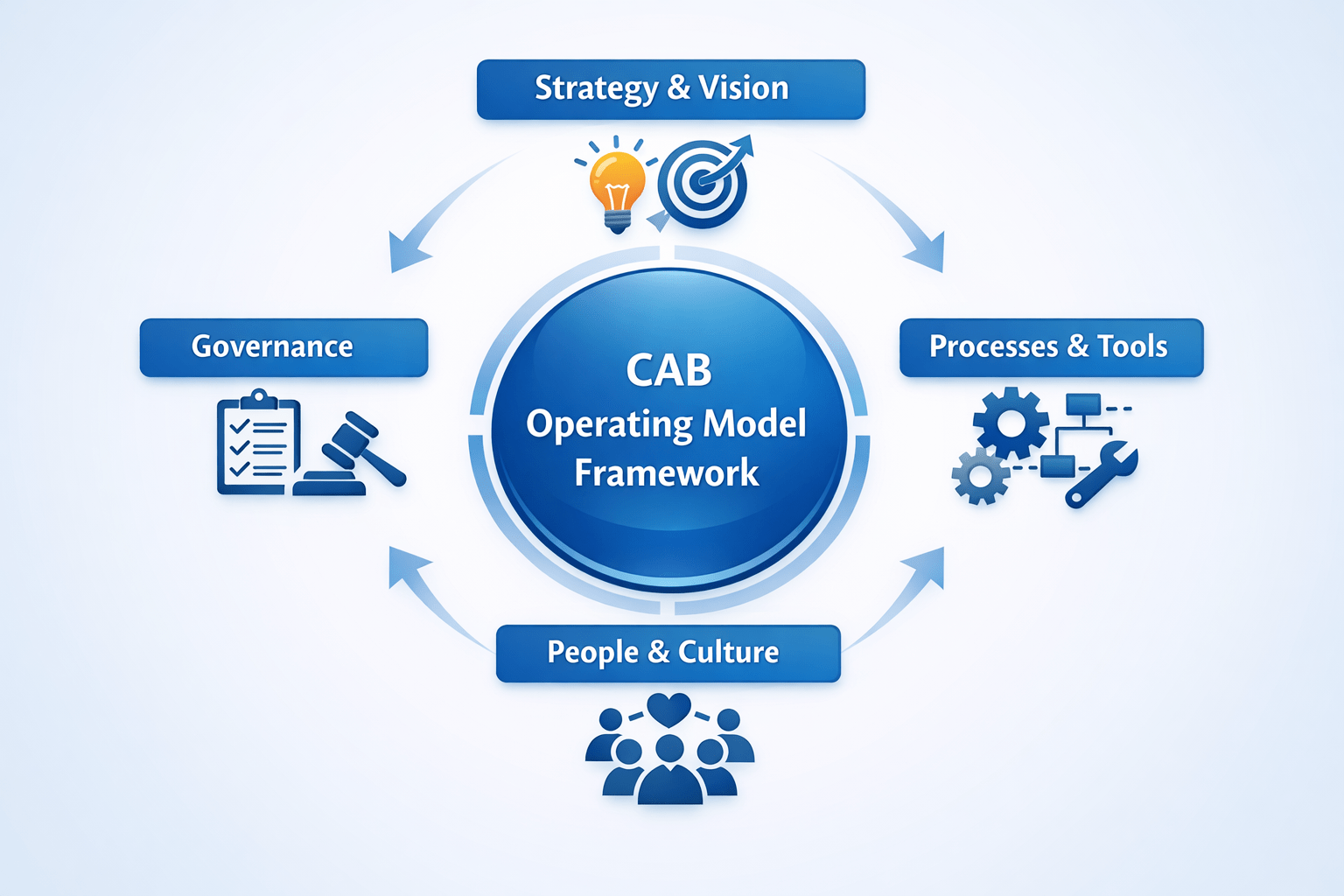
Most organizations approach CABs as discrete events.
High-performing CABs are not events—they are systems.
The difference is a structured operating loop that continuously converts conversations into action.
As shown in Chart 4, The Customer Advisory Board (CAB) Operating Model Framework, the optimal operating model definition.
Cadence
- 2 executive-level sessions annually
- Quarterly virtual working sessions focused on specific themes
Pre-Work (Critical, Often Missing)
The quality of the session is determined before it begins.
Effective pre-work includes:
- Insight briefs summarizing known trends and hypotheses
- Data snapshots (usage patterns, churn signals, adoption gaps)
- Clearly articulated questions requiring customer input
Without pre-work, CABs default to reactive conversation.
With it, they become strategic working sessions.
Defined Roles
- Executive Sponsor – signals importance and alignment
- Facilitator – neutral, structured, not sales-driven
- Insight Capture Lead – ensures outputs are usable, not anecdotal
Agenda Design
- 30% validation of known insights
- 70% exploration and co-creation
Most CABs invert this ratio—and lose value as a result.
The Operating Loop
A high-performing CAB follows a continuous lifecycle:
- Define hypotheses
- Select members
- Distribute pre-work
- Facilitate session
- Extract insights
- Operationalize
- Close the loop with customers
The final step—closing the loop—is where trust compounds and participation quality improves over time.
V. Facilitation Techniques That Unlock Real Insight
The difference between a good CAB and a transformational one lies in facilitation quality.
Traditional approaches—open Q&A, roundtable updates—produce surface-level feedback.
Elite facilitation drives depth.
Techniques That Work
- Scenario-Based Exploration
“What would have to be true for this to become a top priority?” - Forced Prioritization
Customers rank trade-offs, revealing true value drivers - Structured Breakouts with Opposing Views
Designed to surface conflict and contrast
What to Avoid
- Vendor-led presentations dominating time
- Passive “round-robin” sharing
- Over-polished narratives that suppress honesty
The Core Skill: Extracting Latent Needs
Customers articulate:
- Symptoms
- Workarounds
- Frustrations
They rarely articulate:
- Root causes
- Systemic gaps
- Monetizable opportunities
Your role is to move the conversation down the insight depth curve:
- Opinions → Feedback → Pain Points → Root Causes → Unmet Needs
The final level is where revenue is discovered—and where most organizations never reach.

Most CABs never get past opinions and surface feedback. The real value emerges only when you push into root causes and unmet needs—where revenue opportunities actually exist. Chart 5 brings this to life – The Customer Advisory Board (CAB) Insight Depth Ladder.
VI. Converting Insights into Revenue Opportunities
This is where CABs shift from advisory to value creation engines.
Most organizations stop at “insight.”
World-class organizations convert insight into commercial outcomes.

This is where CABs either create value—or stall. The organizations that win treat insight as the starting point of a structured revenue conversion system. This is shown clearly above in Chart 6 – The Revenue Conversion Funnel.
The Conversion Framework
Insight → Theme → Opportunity → Business Case
Categorizing Opportunities
- New product features
- New services or offerings
- Pricing and packaging innovations
Quantifying Value
Each opportunity should be assessed based on:
- Willingness to pay
- Frequency and consistency of need
- Validation across multiple customers
This eliminates anecdotal bias and creates investment-grade opportunities.
When done correctly, CAB outputs directly influence:
- Product investment decisions
- Go-to-market strategies
- Revenue forecasting
VII. Operationalizing CAB Outputs (Where Most Fail)
This is the most common breakdown point.
Insights are generated—but not embedded.

- This is the single biggest failure point for most CABs. Without a clear system to translate insight into execution, even the best ideas never reach revenue. This dynamic becomes clear in Chart 7 – CAB-to-Execution System Map.
To avoid this, CAB outputs must integrate into core systems:
Integration Points
- Product roadmap governance
- Sales plays and enablement
- Customer success planning
Required Infrastructure
- CAB Insight Tracker (owners, timelines, status)
- Executive reporting cadence
- Cross-functional accountability
Metrics Alignment
Tie CAB outputs to:
- Net Revenue Retention (NRR)
- Expansion revenue
- Time-to-market improvements
Without operationalization, CABs are episodic.
With it, they become systemic growth drivers.
VIII. Measuring CAB Effectiveness
If CABs are strategic assets, they must be measured accordingly.

What gets measured gets funded—and scaled. When CABs are tied to tangible inputs and outputs, they consistently demonstrate disproportionate ROI. Chart 8 illustrates The Customer Advisory Board (CAB) ROI Dashboard that measures the value of the overall value of conducting the CAB (cost, revenue).
Leading Indicators
- Insight quality (depth, novelty, actionability)
- Participation engagement and candor
Lagging Indicators
- Revenue influenced or created
- Retention improvements
- Expansion rates
The CAB ROI Model
Inputs:
- Time
- Cost
- Executive involvement
Outputs:
- Revenue generated
- Churn avoided
- Pipeline influenced
When measured properly, CABs consistently demonstrate outsized ROI relative to cost.
IX. Case Example: CAB → Insight → Revenue Outcome
Context:
A global enterprise organization was experiencing strong customer satisfaction but plateauing growth.
CAB Insight:
Customers revealed a consistent but previously unarticulated need:
They were solving adjacent problems outside the platform using fragmented tools.
Action:
Through structured CAB sessions, the organization:
- Identified common patterns across customers
- Defined a new bundled offering addressing the adjacent use case
- Validated willingness to pay across multiple participants
Result:
- New revenue stream launched within 6 months
- Significant increase in expansion revenue
- Improved retention due to increased platform dependency
The insight was not hidden—it was simply never structured, surfaced, or validated.
X. Common Pitfalls and How to Avoid Them
Even well-intentioned CABs fail for predictable reasons:

These failure patterns are not random—they are systemic and repeatable. The organizations that outperform are the ones that deliberately design against them. Shown in Chart 9, The Customer Advisory Board (CAB) Failure Modes vs. Best Practices, demonstrated the operating principles for managing a CAB.
Pitfalls
- Treating CABs as one-time events
- Lack of executive alignment and ownership
- Failure to close the loop with participants
- Over-reliance on anecdotal input
Best Practices
- Establish CABs as ongoing strategic programs
- Ensure executive sponsorship and cross-functional integration
- Communicate outcomes and actions back to participants
- Validate insights across multiple data points
Avoiding these pitfalls is less about effort—and more about discipline and design.
XI. The Future of CABs: From Advisory to Co-Creation Ecosystems
CABs are evolving.

CABs are no longer periodic advisory forums—they are becoming continuous growth engines.
Organizations that recognize this shift early will outpace those still operating in legacy models. Chart 10 brings this to life – The Evolution of Customer Advisory Boards (CABs).
The traditional model—periodic advisory sessions—is giving way to continuous, integrated ecosystems.
Emerging Trends
- Always-on digital CAB environments
- AI-assisted insight synthesis across conversations
- Customer co-innovation labs
The Evolution Path
Advisory → Insight Engine → Co-Creation Platform → Revenue Ecosystem
In this future state, CABs are no longer a supporting function.
They become a core component of customer-led growth strategy.
Closing Perspective
Most organizations search for growth externally:
- New markets
- New products
- Acquisitions
Yet some of the most valuable opportunities already exist within the current customer base.

The difference between companies that unlock this value—and those that don’t—is not incremental. It is structural.
It comes down to whether the CAB is designed to generate revenue—or simply to listen. This is shown clearly above in Chart 11 – Companies With, and Without Revenue Generation CABs
The challenge is not access to customers.
It is the ability to systematically extract, interpret, and act on what they are already telling you.
When designed and managed correctly, Customer Advisory Boards become:
- A strategic intelligence system
- A revenue discovery engine
- A durable competitive advantage
And in a market where differentiation is increasingly difficult, that advantage compounds.
About the Author
Steven Jeffes is a Customer Experience and Customer Strategy executive focused on one outcome: turning customer insight into new revenue.
Over a 40+ year career, he has worked with or consulted for organizations including Accenture, IBM Global Services, PricewaterhouseCoopers, Cox Automotive, and INEOS Automotive, and led CX, CRM, and customer strategy initiatives for global brands such as American Express, Microsoft, Verizon, Pfizer, Capital One, Toyota, Ritz-Carlton, Amazon, and Delta Airlines.
While most companies treat Customer Advisory Boards as feedback forums, Steven designs them as revenue engines—structured systems that uncover unmet needs, validate demand, and convert customer conversations into new products, services, and expansion opportunities.
His work has helped organizations identify and activate hundreds of millions of dollars in new revenue by transforming how they listen to—and act on—their customers.
He partners with executive teams to build customer-led growth engines, aligning Customer Success, Product, Sales, and Marketing around one principle:
Customers will tell you where your next revenue opportunity is—if you know how to listen.
Connect: www.stevenjeffes.com | stevenjeffes@gmail.com, 📞 – 518-339-5857
