The how to guide to Win a Customer for Life by Employing the 5 R’s of Customer Loyalty
The 5 “R’s” of Customer Loyalty
Ensure Your Company is 5 “R” Customer Compliant
Following the 5 R’s of Customer Loyalty Will Enable Your Company to Attract and Keep Customers for Life
Ensure Your Company is Customer R-Reliable
Top Steps to Ensuring Your Company is R-Reliable
The First “R” of Customer Loyalty Is Setting High Quality Customer Standards (External) and Goals (Internal) and then Delivering on that Customer Promise for Each and Every Customer Interaction as well as the overall & long-term customer relationship
Example of How a Company Demonstrates Customer R-Reliability
Example of How a Company Demonstrates Customer R-Reliability (continued)
Ensure Your Company is Customer R-Responsive
Top Steps for Your Company to Become Customer R-Responsive
The 2nd “R” of Customer Loyalty Is Ensuring That Customer’s Expectations Are Met: Needs, Concerns, Quality, Cycle Time Expectations, etc.
Example of How a Company Demonstrates Customer R-Responsiveness
Example of How a Company Demonstrates Customer R-Responsiveness (continued)
Ensure Your Company is Customer R-Recognizable
Top Steps for Your Company to Become Customer R-Recognizable
The 3rd “R” of Customer Loyalty Is Ensuring That Your Brand and Company has Distinctive and Positive Characteristics such that it drives positive emotions (driving repeat business, customer referrals, word-of-mouth adverting, etc.
Example of How a Company Becomes Customer R-Recognizable
Example of How a Company Becomes Customer R-Recognizable (continued)
Ensure Your Company is R-Relationship Oriented
Top Steps for Your Company to Become Customer R-Relationship Oriented
The 4th “R” of Customer Loyalty Is Ensuring That Your Brand and Company develops a high quality and mutually beneficial relationship with your customers based on mutual respect, customer insights, an ongoing and open dialogue and a model that encourages a partnership between your brand & company and your customers
Example of How a Company Demonstrates That It Is Customer R-Relationship Oriented
Example of How a Company Demonstrates That It Is Customer R-Relationship Oriented (continued)
Ensure Your Company is Customer R-Rewarding
Top Steps for Your Company to Become Customer R-Rewarding
The 5th “R” of Loyalty Is Ensuring That Your Brand and Company rewards mutually beneficial customer behavior (greater share of wallet, spend, brand partnership activities, etc.) such that it drives further and longer-term customer loyalty.
Example of How a Company Demonstrates Customer R-Rewarding
Example of How a Company Demonstrates Customer R-Rewarding (continued)
Is Your Company Ready to Take the 5 “R” Pledge?
SUMMARY: If you take the pledge above to adhere to the 5 R’s of customer loyalty, you will enhance your ability to attract and retain customers for life. Key to this is developing the capabilities to be best in class for each “R” and ensuring that you are (cost effectively) maintaining a major qualitative advantage in each customer R vs. your competitors.
For addition information on this topic, consult the following resources:
The 80/20 Customer Profitability Rule: Best Practices with Examples
Develop intelligent customer service & customer management programs based on customer value insights and the 80/20 customer profitability rule…
Has your business ever performed an analysis of your customer base to determine any of the following:
1)Which customers are frequent visitors and have the greatest repeat business?
2)Which ones rarely do business with your company?
3)Which ones are the most valuable and profitable to your company?
If you haven’t then you really don’t have the insights necessary to really develop an effective customer service, customer management and/or loyalty program. In performing analytics and customer analysis for nearly 10% of the Fortune 500 companies in the United States, I have found a very revealing and astonishing pattern (rule) in this customer analysis that holds true company after company. The pattern is as follows:
80% of all company profits are derived from ~20% of your customers
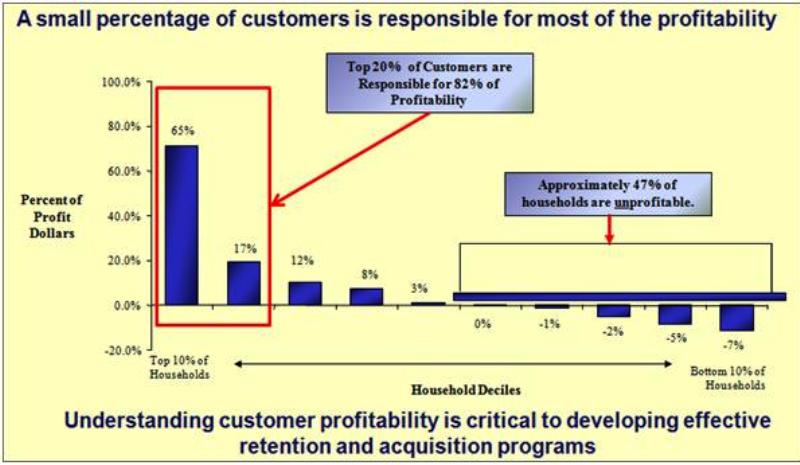
Take the chart below (Chart 1) from one of the top US banks that shows 20% of their customers are responsible for 82% of their profitability and that a full 47% of customers are actually unprofitable and not worth having as customer as each transaction costs the bank more than it is worth (each customer interaction/transaction actually drives the bank further away from profitability) {Click on Chart for a larger/clearer image}:
80% of all company profits are derived from ~20% of your customers
When I presented this customer profitability analysis to the bank, the bank executives were amazed at the results and of the customer profitability distribution. (Note – The deciles were developed using a SAS generated RFM analytics model whereby Recency (How recent customer have visited/purchased), Frequency (How frequently customers have visited/purchased and when they visited/purchased) and Monetary spend (How much they spend and on what types of products/services they spent their $$ on). The RFM model was then used as input into a profitability model, using actual profit data for each product/service/customer using a unique customer id to match the profit data to the RFM score.)Why are these insights and analytics so important and what might the bank or any other business do to manage customer relationships more effectively? These insights are key in developing a customer relationship management (CRM) and loyalty program that is tailored and specific to each customer group.
Note: The 80/20 customer profitability rule rule applies to companies that have higher transaction volumes, a diverse set of product & services and a heterogeneous customer base.
Ask yourself the following questions:
Should your company treat your best and most profitable customers differently than other, less profitable customers?
Should your company develop special customer programs so that the 20% most profitable customers are not lured away by competitors?
Do you think your company’s most profitable and valuable customers want to be shown appreciation for their repeat and profitable business in a way that makes them feel welcome and special?
Is it in your company’s best interest to want to develop strategies and programs that turn unprofitable customers into profitable or at least revenue neutral customers?
The answer to all four questions should be a resounding YES!
Armed with the above insights and analysis a company can start to architect customer intimacy and loyalty programs such as the following:
Offer most profitable customer special discounts or accelerated loyalty rewards earning rates
Conduct special top customer, by invite only, appreciation events
Deliver occasional special top customer gifts or recognition when they interact with you in-person or on-line
Invite your top 1-5% of customers to participate in an invite only customer advisory board or insights group event every year at an exciting destination where most or all expenses are paid for by your company
Develop unprofitable customer management programs such that these customers become more profitable, cost less per company transaction and/or they are effectively ‘encouraged’ to migrate to competitors.
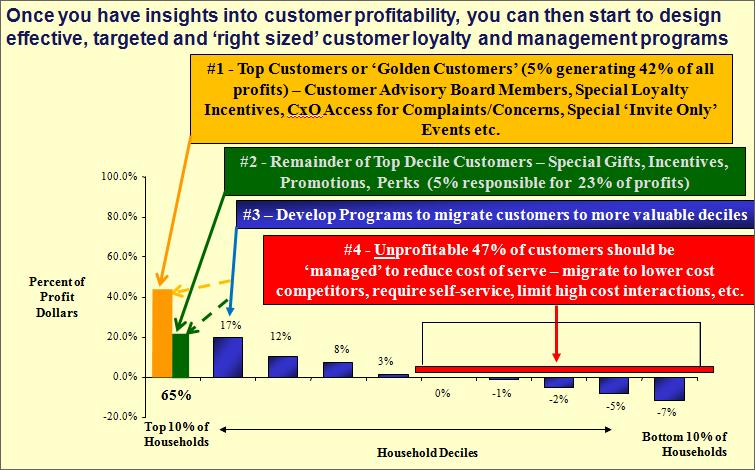
Take the same chart above and now overlay customer treatment programs to each customer decile and sub-segment (Chart 2) {Click on Chart for a larger/clearer image}:
Effective Customer Management Programs Based on Profitability Insights
Even though decile #1 (10% of all customers) has been identified as the most valuable customer segment generating 65% of all company profits, the decile can then be further sub-segmented based on further profitability analysis/decomposition. In this particular case:
The top 5% of the top profitability decile customers generated 42% of all profits
The remaining 5% of the top profitability decile customers generated 23% of profits
As shown in the ‘golden’ box (#1) above and below, these top tier customers should be given special access and special attention and made to feel totally appreciated and a partner of the company. The golden box also demonstrates the types of special programs you might want to provide to this top profitability group. It is of your utmost importance to do everything in your company’s power not to lose these most valuable/profitable customers. These suggested treatments are just a sample, but ones I have developed for many clients in the past, including top tier banks, retailers, life sciences companies, telecommunications providers, etc. {Click on Chart for a larger/clearer image}:
Top 5% of Customers Receive Platinum Plus Customer Programs
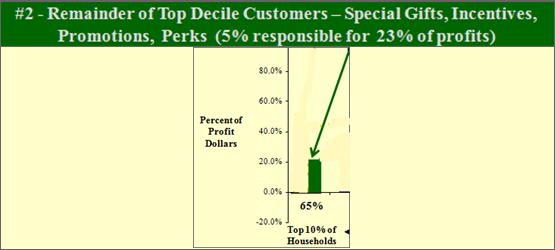
The next (Green) group of profitable customers highlighted in box #2 (below) can receive special treatment as well, but not quite the golden treatment as the most profitable 5%. These next valuable set of customers would still receive top customer treatment, but not quite the platinum access that the most valuable 5% would receive. You wouldn’t want to lose these valuable customers either, so their treatment would still be special, memorable and differentiated vs. your competitors. {Click on Chart for a larger/clearer image}:
Next Top Set of Customers Receive Top Treatment, but not Special Access, Handling Like the top 5% (Platinum) Group
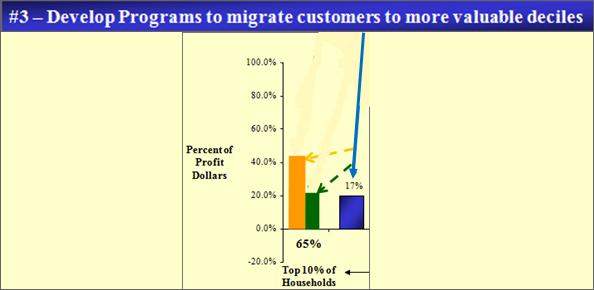
The blue box (#3) in the chart below speaks to customer migration programs that incentivize customers to spend more, visit your company (physical or online) more, purchase higher value items, buy in bundles, etc. {Click on Chart for a larger/clearer image}:
Effective Customer Management Programs Effectively Transition Customers into More Valuable Customers Over Time
One very effective way to do this is to develop what I call modeled incentives. In that, if a loyalty program is to be effective there should be an incentive for the customer to model the behavior to achieve the next loyalty reward level and the following must be present:
1)Every customer group must know what they need to do to achieve the next loyalty rewards level
2)Customers need to feel the next loyalty rewards level is significantly more valuable than their existing level
3)There should be prestige and/or notoriety associated with achievement of the next loyalty rewards level so that customers feel privileged, special and differentiated from regular customers.
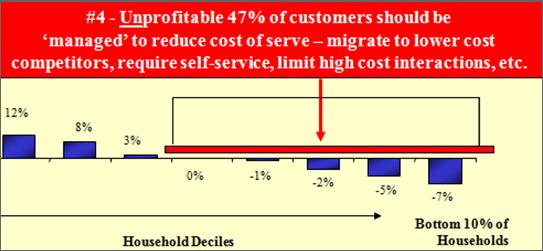
Lastly, the red box (#4) below speaks to customer management programs that need to either turn these unprofitable customers into profitable customers or find ways to reduce the cost to serve these unprofitable segments. Some strategies including limiting these customers to self-service, providing incentives to transact during off hours, incentivizing them to seek lower cost providers, etc. {Click on Chart for a larger/clearer image}:
Effective Customer Management Program Also Address Unprofitable Customers
The bottom line is that, through customer insights and analytics, you will find that not all customers are the same in terms of profitability (the 80/20 rule), therefore it makes no sense whatsoever to treat all customers the same. Through a robust customer insights program you will then be able to leverage these insights and develop a sophisticated and custom loyalty and retention program in order to accomplish the following:
Develop break-away tier 1 (Platinum) loyalty programs that stand alone in the industry such that your top 1-5% most valuable customers would not even consider defecting to another provider
Develop programs to retain your most profitable customers and make them want to remain a loyal customer
Develop a loyalty migration path for customers to want to achieve the next loyalty rewards level (Silver, Gold, and Platinum) so that they simultaneously feel more recognized/special/connected to the company while providing your company great value/profits/monetary return.
Develop programs to mitigate expenses when dealing with your least profitable customers (more self-service, helping them ‘discover’ lower cost competitors, offering more limited services, etc.) (the other 80%)
For additional Resources on this topic, reference the following:
Investopedia: The 80-20 Rule (Pareto Principle). Excellent authority source explaining why a small percentage of customers often drives the majority of revenue. Link: The 80-20 Rule (Pareto Principle)
Corporate Finance Institute: Customer Profitability Analysis. Strong reference for the financial side of identifying which customers create the most value and profit. Link: Customer Profitability Analysis