The how to guide to Win a Customer for Life by Employing the 5 R’s of Customer Loyalty
The 5 “R’s” of Customer Loyalty
Ensure Your Company is 5 “R” Customer Compliant
Following the 5 R’s of Customer Loyalty Will Enable Your Company to Attract and Keep Customers for Life
Ensure Your Company is Customer R-Reliable
Top Steps to Ensuring Your Company is R-Reliable
The First “R” of Customer Loyalty Is Setting High Quality Customer Standards (External) and Goals (Internal) and then Delivering on that Customer Promise for Each and Every Customer Interaction as well as the overall & long-term customer relationship
Example of How a Company Demonstrates Customer R-Reliability
Example of How a Company Demonstrates Customer R-Reliability (continued)
Ensure Your Company is Customer R-Responsive
Top Steps for Your Company to Become Customer R-Responsive
The 2nd “R” of Customer Loyalty Is Ensuring That Customer’s Expectations Are Met: Needs, Concerns, Quality, Cycle Time Expectations, etc.
Example of How a Company Demonstrates Customer R-Responsiveness
Example of How a Company Demonstrates Customer R-Responsiveness (continued)
Ensure Your Company is Customer R-Recognizable
Top Steps for Your Company to Become Customer R-Recognizable
The 3rd “R” of Customer Loyalty Is Ensuring That Your Brand and Company has Distinctive and Positive Characteristics such that it drives positive emotions (driving repeat business, customer referrals, word-of-mouth adverting, etc.
Example of How a Company Becomes Customer R-Recognizable
Example of How a Company Becomes Customer R-Recognizable (continued)
Ensure Your Company is R-Relationship Oriented
Top Steps for Your Company to Become Customer R-Relationship Oriented
The 4th “R” of Customer Loyalty Is Ensuring That Your Brand and Company develops a high quality and mutually beneficial relationship with your customers based on mutual respect, customer insights, an ongoing and open dialogue and a model that encourages a partnership between your brand & company and your customers
Example of How a Company Demonstrates That It Is Customer R-Relationship Oriented
Example of How a Company Demonstrates That It Is Customer R-Relationship Oriented (continued)
Ensure Your Company is Customer R-Rewarding
Top Steps for Your Company to Become Customer R-Rewarding
The 5th “R” of Loyalty Is Ensuring That Your Brand and Company rewards mutually beneficial customer behavior (greater share of wallet, spend, brand partnership activities, etc.) such that it drives further and longer-term customer loyalty.
Example of How a Company Demonstrates Customer R-Rewarding
Example of How a Company Demonstrates Customer R-Rewarding (continued)
Is Your Company Ready to Take the 5 “R” Pledge?
SUMMARY: If you take the pledge above to adhere to the 5 R’s of customer loyalty, you will enhance your ability to attract and retain customers for life. Key to this is developing the capabilities to be best in class for each “R” and ensuring that you are (cost effectively) maintaining a major qualitative advantage in each customer R vs. your competitors.
For addition information on this topic, consult the following resources:
A High Performing Company with All Value Chain Links Strong (No Brand Value Links Broken or Sub-optimized):
Company Brand Value Chain
How a Broken Value Chain Impacts Your Company
In order for your company to have a chance at being a market leader, it is important for it to have all links in the brand value chain attaining top effectiveness. Just one broken link in this brand value chain (BVC) can bring your whole company down and subject your company to the following risks:
1) Loss of Market Share as compared to your competitors
2) Inability to close sales
3) Lack of marketing leads and inquiries
4) Declining customer base over time including customer defection to the competition
What is the Brand Value Chain (BVC) you might ask?
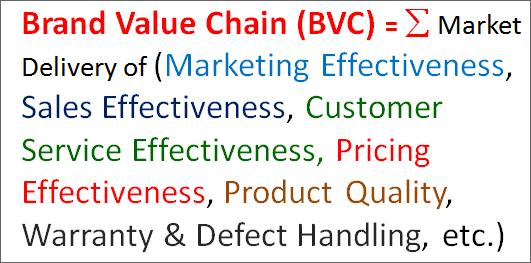
The BVC is defined as the effectiveness of the sum of all company functions delivered to your customers and the marketplace: Marketing, Sales, Product/Service Quality, Customer Service, Pricing, Warranties/Returns, Customer Relationship & Experience Quality, etc.
Brand Value Chain Defined
Therefore, when one link of the brand value chain is weak or about to break, the following rule regarding brand image almost always holds true:
Brand Image & Brand Value Chain Rule
Symptoms of a Broken Value Chain:
Your sales team just can’t seem to close the deals.Potential broken value chain links: Poor customer service, product utility/quality, pricing.
You have great products, pricing and customer service but nobody has heard of you.Likely broken value chain links: Poor marketing and/or sales operations.
Your customer base keeps declining year-over-year:Likely broken value chain links: Poor customer service or eroding product quality or pricing.
Your marketing generates a plethora of leads that are not closed or turned into sales deals: Likely broken value chain links: Sales operations and marketing-sales lead management procedures are non-existent or sub-optimized.
Examples Companies with Potential Broken Value Chains:
Every day we see examples of companies that seem to have everything going for them except one weak link in the brand value chain that brings the entire perceived brand value down. Some examples are as follows:
Comcast – great programming, great marketing/sales, great products, great technology & infrastructure but perceived bad customer service and pricing creates a negative impression of the company by many customers and prospects – their company’s Achilles heel.
Sears – great products, good pricing, good in-store sales, etc. but is severely lacking in marketing and promotions including in-store and on-line customer experience design which tends to brings down the other great intra-company performers and has led to a decline in the customer base.
General Motors – good pricing, promotions, dealer sales, etc. but perceived increased negative product quality due to the number of recent recalls has brought many questions regarding the GM brand. These questions about product quality could impact customer retention and acquisition in the longer-term.
How the BVC Impacts Company Performance:
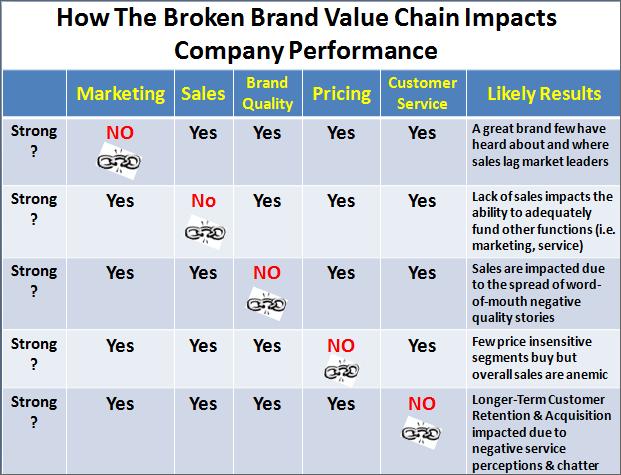
What all of these examples show is that a company must deliver great performances in every category to become a market leader. One broken link in the brand value chain is enough to reduce the company to a market laggard and risks them going out of business over time if not rectified.
The following chart illustrates how one broken BVC has the ability to bring down the entire company and risk its overall viability:
Company Impacts of the Broken Brand Value Chain
How to Identify & Rectify a Broken Value Chain:
What steps can you take to identify and then rectify a broken brand value chain (BBVC) you might ask? Here are some easy steps to take to first, identify and then rectify a broken value chain:
Proven Methods to Identify a Broken Value Chain (BVC):
Inter-departmental peer reviews – How well do our peer departments think we are performing?
External departmental & function benchmark reviews – how well are doing vs. market leading company’s similar function (e.g. sales to sales or marketing to marketing performance comparison)?
Customer external scorecard reviews – How well do our customers and prospects think we are performing?
Methods to Rectify a broken value chain:
Perform Six-Sigma process and effectiveness improvement reviews
Invite customers to participate in focus groups and advisory councils to help identify ways to improve the department’s effectiveness (sales, marketing, customer service, etc.)
Form Improvement “Tiger Teams” consisting of inter-departmental high performers to assist with increasing functional performance.
Invite outside and leading consulting firms to help infuse a holistic set of industry best practices across and within company functions – marketing, sales, customer service, pricing, etc.
Tie performance and variable rewards to customer rated scorecards where company employees only get paid bonuses when our customers rate us as high performing.
For additional resources on this topic, please reference the following:
CEOpedia: Brand Value Chain: Good overview of Keller and Lehmann’s Brand Value Chain model, including the value stages and multipliers: Brand Value Chain (CEOpedia)
Marketing91: The Brand Value Chain. Detailed explanation of the four value stages, multipliers, and how brand investments translate into shareholder value: Link: The Brand Value Chain (Marketing91)