The Loyalty Program Toolkit: Lessons Learned & Best Practices Enabling Break-Away Competitive Advantage
May 29, 2015 1 Comment
The content of this blog is a customer loyalty toolkit containing a host of loyalty program development ‘how to knowledge’ including best practices, project plan, business case, pros/cons, customer loyalty definition, customer loyalty benefits, loyalty program communications plan, loyalty program change drivers and loyalty program development lessons learned.

Sample Blog Content
{Click on image above for a larger/clearer view}
The market is currently saturated with customer loyalty programs that are either marginally effective or that actually represent an inconvenience to the very customers they are trying to retain. If you are even thinking of launching a loyalty program, consider the Ten Commandments of Loyalty Programs listed below.
Ten Commandments of Loyalty Programs:
- The rewards of the loyalty program must be so compelling that customers are actually driven to defect from your competitors and organically refer other customers to your program
- The rewards from the loyalty program must be so super-simple to redeem, the customer can do it without any unnatural and inconvenient steps: finding their card, remembering their rewards number, etc.
- The rewards from the loyalty program maximize customer choice for redemption: Cash back, points with cash payments, merchandise, travel, buy points, donate points, transfer points, etc.
- Company employees are empowered to distribute points to customers based on need such as distributing points to make up for a customer service issue or for a customer’s good will toward the company
- Top Tier Customer loyalty achievers for each year are recognized in special ways: Meet with company CxOs to get their feedback; special in-person awards ceremonies, extra unannounced super-perks the following year, etc.
- The pre-launch company rewards program is designed such that rewards programs rating agencies (Freddie Awards, Flyertalk), pre-determine the program to be top in class prior to launch based on the design concepts, rewards program content, etc. Ongoing reviews ensure top program billing following the program launch
- Rewards program acquisition strategy must include conversion of a customer’s competitor points to join your company’s rewards program at the same level as your competitor(s). (a.k.a. a lateral join)
- Any loyalty program should not even be considered without first leveraging Advanced Predictive Modeling Techniques (APMTs) to determine an overall program cost estimate. These APMTs tend to be much more responsive and accurate, quickly reflecting the impacts of all available information on the program liability. Without this APMT component, the program must be cost prohibitive and drive your product/services costs up to unsustainable levels.
- The loyalty program must enable communications with its members via the member’s communication channel of choice without burdening members will annoying and redundant member information requests.
- The loyalty program should encourage family company loyalty to the extent of top market leaders (USAA insurance for military service members) such that rewards can be transferred to family members, left to family members after death, allow entry at preferred reward program loyalty levels for select family members of top earners, etc.

Loyalty Program Strategic Drivers & Levers
Any world-class loyalty programs that I have helped establish and/or evolve at Macy’s, Bank of America, Wells Fargo, Starwood, Marriott, and American Airlines ALL contain (at least, as a common denominator) the above seven (7) strategic levers as part of their loyalty program.
{Click on image above for a larger/clearer view}
Loyalty Program Levers

Reasons People Leave Companies
The Relationship Between Customers Treatment & Retention
{Click on image above for a larger/clearer view}
Benefits of Customer Loyalty

Benefits Of Customer Loyalty
Company Benefits of Customer Loyalty
{Click on image above for a larger/clearer view}
Loyalty Definition

What Is Customer Loyalty
A Good Definition for Customer Loyalty
{Click on image above for a larger/clearer view}
Change Drivers for Loyalty Programs

Change Drivers For Customer Loyalty Programs
Drivers (Reasons) for Creating a Customer Loyalty Program
{Click on image above for a larger/clearer view}

Objectives & Desired Behavior Of A Loyalty Program
Loyalty Program Corporate Objectives
{Click on image above for a larger/clearer view}

Loyalty Program Approach
Customer Loyalty Program Approach
{Click on image above for a larger/clearer view}

Positioning The Loyalty Program
Customer Loyalty Program Requirements Development
{Click on image above for a larger/clearer view}
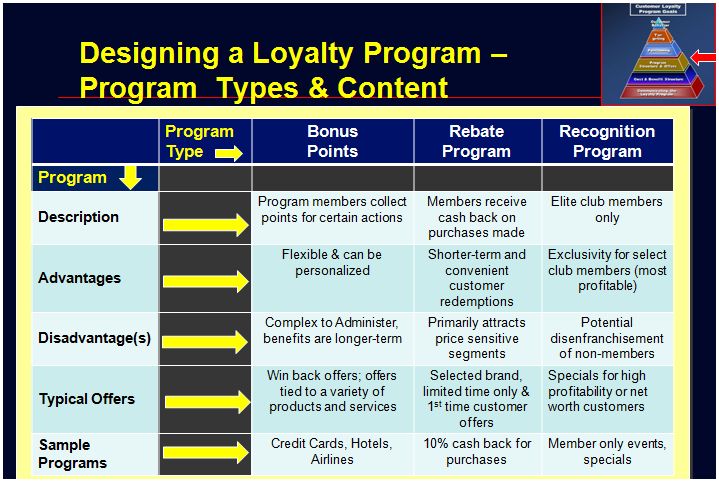
Loyalty Program Type & Content Examples
{Click on image above for a larger/clearer view}

Loyalty Program – Balancing Benefits With Company Costs
Loyalty Program Customer Benefits & Company Costs
{Click on image above for a larger/clearer view}

Loyalty Program Business Case
Loyalty Program Business Case and Reward Financial Model
{Click on image above for a larger/clearer view}

Loyalty Program Communications Plan
Customer Loyalty Program Communication Plan Structure
{Click on image above for a larger/clearer view}

Loyalty Program Point Collection Simulator
Customer Loyalty Program Reward Point Redemption Simulator
{Click on image above for a larger/clearer view}

Loyalty Program Point Redemption Calculator
Loyalty Program Reward Category Point Redemption Volume Estimates
{Click on image above for a larger/clearer view}

Loyalty Program Business Case & Project Plan
Loyalty Program Business Case & Project Plan
{Click on image above for a larger/clearer view}

Loyalty Program Pros and Cons
Customer Loyalty Program Pros & Cons
{Click on image above for a larger/clearer view}

Loyalty Program Lessons Learned – 1 of 3
Customer Loyalty Program Lessons Learned & Best Practices (1 of 3)
{Click on image above for a larger/clearer view}

Loyalty Program Lessons Learned – 2 of 3
Customer Loyalty Program Lessons Learned & Best Practices (2 of 3)
{Click on image above for a larger/clearer view}

Loyalty Program Lessons Learned – 3 of 3
Customer Loyalty Program Lessons Learned & Best Practices (3 of 3)
{Click on image above for a larger/clearer view}
Bottom Line: If you are ever considering implementing a customer loyalty program, please take the above lessons learned and best practices into account as these were all developed after having successfully implemented several of these loyalty programs at Fortune 500 companies across the globe.
