The Loyalty Program Toolkit: Lessons Learned & Best Practices Enabling Break-Away Competitive Advantage

The content of this blog is a customer loyalty toolkit containing a host of loyalty program development ‘how to knowledge’ including best practices, project plan, business case, pros/cons, customer loyalty definition, customer loyalty benefits, loyalty program communications plan, loyalty program change drivers and loyalty program development lessons learned.

Sample Blog Content

                                                               Sample Blog Content

{Click on image above for a larger/clearer view}

The market is currently saturated with customer loyalty programs that are either marginally effective or that actually represent an inconvenience to the very customers they are trying to retain. If you are even thinking of launching a loyalty program, consider the Ten Commandments of Loyalty Programs listed below.

Ten Commandments of Loyalty Programs:

  1. The rewards of the loyalty program must be so compelling that customers are actually driven to defect from your competitors and organically refer other customers to your program
  2. The rewards from the loyalty program must be so super-simple to redeem, the customer can do it without any unnatural and inconvenient steps: finding their card, remembering their rewards number, etc.
  3. The rewards from the loyalty program maximize customer choice for redemption: Cash back, points with cash payments, merchandise, travel, buy points, donate points, transfer points, etc.
  4. Company employees are empowered to distribute points to customers based on need such as distributing points to make up for a customer service issue or for a customer’s good will toward the company
  5. Top Tier Customer loyalty achievers for each year are recognized in special ways: Meet with company CxOs to get their feedback; special in-person awards ceremonies, extra unannounced super-perks the following year, etc.
  6. The pre-launch company rewards program is designed such that rewards programs rating agencies (Freddie Awards, Flyertalk), pre-determine the program to be top in class prior to launch based on the design concepts, rewards program content, etc. Ongoing reviews ensure top program billing following the program launch
  7. Rewards program acquisition strategy must include conversion of a customer’s competitor points to join your company’s rewards program at the same level as your competitor(s). (a.k.a. a lateral join)
  8. Any loyalty program should not even be considered without first leveraging Advanced Predictive Modeling Techniques (APMTs) to determine an overall program cost estimate. These APMTs tend to be much more responsive and accurate, quickly reflecting the impacts of all available information on the program liability. Without this APMT component, the program must be cost prohibitive and drive your product/services costs up to unsustainable levels.
  9. The loyalty program must enable communications with its members via the member’s communication channel of choice without burdening members will annoying and redundant member information requests. 
  10. The loyalty program should encourage family company loyalty to the extent of top market leaders (USAA insurance for military service members) such that rewards can be transferred to family members, left to family members after death, allow entry at preferred reward program loyalty levels for select family members of top earners, etc.
Loyalty Program Strategic Drivers & Levers

Loyalty Program Strategic Drivers & Levers

Any world-class loyalty programs that I have helped establish and/or evolve at Macy’s, Bank of America, Wells Fargo, Starwood, Marriott, and American Airlines ALL contain (at least, as a common denominator) the above seven (7) strategic levers as part of their loyalty program. 

{Click on image above for a larger/clearer view}

Loyalty Program Levers

Reasons People Leave Companies

Reasons People Leave Companies

 The Relationship Between Customers Treatment & Retention

{Click on image above for a larger/clearer view}

 Benefits of Customer Loyalty

Benefits Of Customer Loyalty

Benefits Of Customer Loyalty

Company Benefits of Customer Loyalty

{Click on image above for a larger/clearer view}

Loyalty Definition

What Is Customer Loyalty

What Is Customer Loyalty

A Good Definition for Customer Loyalty

{Click on image above for a larger/clearer view}

 Change Drivers for Loyalty Programs

Change Drivers For Customer Loyalty Programs

Change Drivers For Customer Loyalty Programs

Drivers (Reasons) for Creating a Customer Loyalty Program

{Click on image above for a larger/clearer view}

Objectives & Desired Behavior Of A Loyalty Program

Objectives & Desired Behavior Of A Loyalty Program

Loyalty Program Corporate Objectives

{Click on image above for a larger/clearer view}

Loyalty Program Approach

                                Loyalty Program Approach

Customer Loyalty Program Approach

{Click on image above for a larger/clearer view}

Positioning The Loyalty Program

Positioning The Loyalty Program

Customer Loyalty Program Requirements Development

{Click on image above for a larger/clearer view}
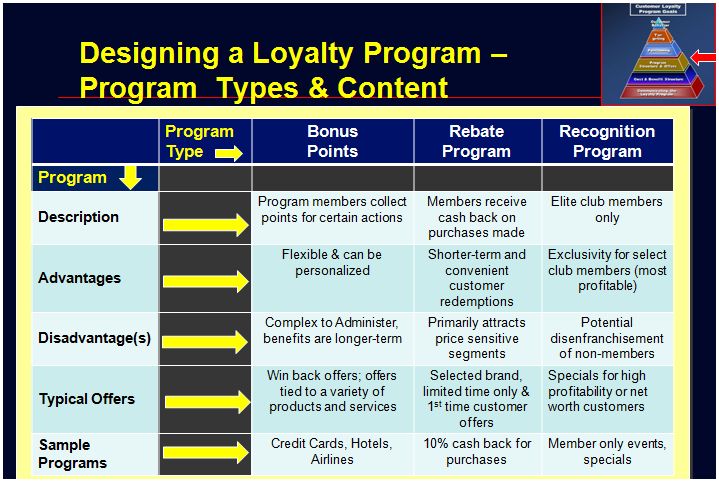
Loyalty Program Type & Content Examples

Loyalty Program Type & Content Examples

{Click on image above for a larger/clearer view}

Loyalty Program - Balancing Benefits With Company Costs

Loyalty Program – Balancing Benefits With Company Costs

Loyalty Program Customer Benefits & Company Costs

{Click on image above for a larger/clearer view}

Loyalty Program Business Case

                            Loyalty Program Business Case

Loyalty Program Business Case and Reward Financial Model

{Click on image above for a larger/clearer view}

Loyalty Program Communications Plan

Loyalty Program Communications Plan

Customer Loyalty Program Communication Plan Structure

{Click on image above for a larger/clearer view}

Loyalty Program Point Collection Simulator

Loyalty Program Point Collection Simulator

Customer Loyalty Program Reward Point Redemption Simulator

{Click on image above for a larger/clearer view}

Loyalty Program Point Redemption Calculator

Loyalty Program Point Redemption Calculator

Loyalty Program Reward Category Point Redemption Volume Estimates

{Click on image above for a larger/clearer view}

Loyalty Program Business Case & Project Plan

Loyalty Program Business Case & Project Plan

Loyalty Program Business Case & Project Plan

{Click on image above for a larger/clearer view}

Loyalty Program Pros and Cons

Loyalty Program Pros and Cons

Customer Loyalty Program Pros & Cons

{Click on image above for a larger/clearer view}

Loyalty Program Lessons Learned - 1 of 3

Loyalty Program Lessons Learned – 1 of 3

Customer Loyalty Program Lessons Learned & Best Practices (1 of 3)

{Click on image above for a larger/clearer view}

Loyalty Program Lessons Learned - 2 of 3

Loyalty Program Lessons Learned – 2 of 3

Customer Loyalty Program Lessons Learned & Best Practices (2 of 3)

{Click on image above for a larger/clearer view}

Loyalty Program Lessons Learned - 3 of 3

Loyalty Program Lessons Learned – 3 of 3

Customer Loyalty Program Lessons Learned & Best Practices (3 of 3)

{Click on image above for a larger/clearer view}


Bottom Line: If you are ever considering implementing a customer loyalty program, please take the above lessons learned and best practices into account as these were all developed after having successfully implemented several of these loyalty programs at Fortune 500 companies across the globe.

Managing Customer Life Stages and Events Can Super-Charge Your Marketing Effectiveness

Why Knowing Your Customer’s ‘Life Stage’ & Associated Events are Crucial to Delivering Effective Marketing

{Click on Chart for a Larger Image}

overview
Life Stage Overview

Customer Life Stage Marketing Can Help You Deliver the Right Promotions with the Right Offers, at the Right Time and Via the Right Channel

Here are some important questions to bring into perspective how important it is to track and recognize your customer’s life-stages and events:

  • Would you forget to celebrate a school graduation for an important relative?
  • Would you forget to celebrate the birthday of a spouse or significant other?
  • Would you forget to recognize the birth of the first child of a couple that is close to you?
  • Would you miss noticing the retirement of a person that is very special to you?

If not, then why would you miss these important milestones for your valuable and long-time customers as these all represent significant and extremely meaningful life-stage events for them?!

A Statement on Life-Stage Marketing to Remember: “Marketing without Considering Your Customer’s Life Stages is Comparable to Marketing to Them With A Blindfold On”

For this reason, your segmentation strategy must take into account an array of customer profile variables including customer life stages. The following chart depicts how customers follow normal life stages and are grouped into life stage segments. As customers evolve to the next life stage segment, their consumer spending evolves and generally increases until they reach the most mature life stages. {Click on Chart for a Larger Image}:

Customer Life Stage Segments

Customer Life Stage Segments

As your customers age and evolve through their normal life-cycles, their customer profile changes along with this evolution including:

1) Needs & Preferences

2) Propensity to spend at higher levels 

3) Desire for higher quality products and services

4) Growing insensitivity to higher product pricing in exchange for premium service

The next chart highlights the significant life stage events that are associated when a customer migrates from one life stage segment to another. These are the life-events you should track and recognize in order to build stronger and more meaningful relationship with your customers. Customers have reported that they feel “appreciated” or “valued” 31% more from companies that take the time to acknowledge a significant life stage event vs. those who do not recognize these events.  {Click on Chart for a Larger Image}:

Customer Life Stage Events

Customer Life Stage Events

How do you obtain insights into the above major customer life events? The simple answer is that you ask them. Customers are very willing to share their preferences and life events since volunteering this information builds the potential for a better relationship with your company. This also demonstrates that, as a company, you care and listen to your customers. 

By using preference and life event subscription portals, world-class companies allow their customers take control of their relationship with your company by self-reporting their contact preferences (preferred topics they want to hear about, maximum frequency of communication, preferred communications channels, exception events that allow you to contact them even when there is a previous “do not contact” preference set,  etc.). These same relationship preference portals also allow customers to report either known or as they occur life stage events (birthdays, anniversaries, expected graduation dates, job promotions, etc.) in exchange for being recognized and appreciated (discounts, upgrades) for supplying this relationship enhancing and sensitive information.

The next chart illustrates how customer’s needs for products and services evolves as they migrate through their natural customer life stages. By offering products and services that are right for the customer’s associated life-stage, companies can experience a much higher offer acceptance rates (8-47%).  {Click on Chart for a Larger Image}:

Types of Products Offered Should VMatch Customers Life Stages

Types of Products Offered Should Match Customers Life Stages

The following chart illustrates how your marketing promotions and offers must be in total alignment with their life-stage segment needs.  {Click on Chart for a Larger Image}:

Marketing & Promotional Offers Should Match Your Customer's Life-Stages

Marketing & Promotional Offers Should Match Your Customer’s Life-Stages

The above two charts depict how both products and offers must be in total alignment with your customer’s life-stage in order to be effective. This ensures products/services and marketing offers are at the right time, with the right content and are at the right time and via the right channel (by collecting and managing life-stage channel preferences). {Click on Chart for a Larger Image}:
Customer Life Stages Segments with Matched Products, Offers, Spend

Customer Life Stages Segments with Matched Products, Offers, Spend

Bottom-line: If you are not taking your customer’s life stages and associated events into your segmentation and marketing strategy, then you are marketing with a blindfold on and not recognizing what is most important or relevant to your customers. A large US bank where I implemented this life stage segmentation schema and associated customer life-stage marketing management program witnessed a 25% increase in customer offer acceptance as well as a 18% increase in overall customer loyalty as measured by the reduction of customer defection rates.

The Importance of the Brand Value Chain (BVC) to Attaining Market Leadership

A High Performing Company with All Value Chain Links Strong (No Brand Value Links Broken or Sub-optimized):

Company Brand Value Chain

How a Broken Value Chain Impacts Your Company

In order for your company to have a chance at being a market leader, it is important for it to have all links in the brand value chain attaining top effectiveness. Just one broken link in this brand value chain (BVC) can bring your whole company down and subject your company to the following risks:

1)      Loss of Market Share as compared to your competitors

2)      Inability to close sales

3)      Lack of marketing leads and inquiries

4)      Declining customer base over time including customer defection to the competition

What is the Brand Value Chain (BVC) you might ask?

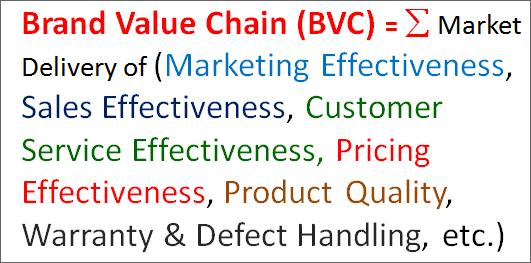
The Brand Value Chain is defined as the effectiveness of the sum of all company functions delivered to your customers and the marketplace: Marketing, Sales, Product/Service Quality, Customer Service, Pricing, Warranties/Returns, Customer Relationship & Experience Quality, etc.

Brand Value Chain Defined

Therefore, when one link of the brand value chain is weak or about to break, the following rule regarding brand image almost always holds true:

Brand Image & Brand Value Chain Rule

Symptoms of a Broken Value Chain:

  1. Your sales team just can’t seem to close the deals. Potential broken value chain links: Poor customer service, product utility/quality, pricing.
  2. You have great products, pricing and customer service but nobody has heard of you. Likely broken value chain links: Poor marketing and/or sales operations.
  3. Your customer base keeps declining year-over-year: Likely broken value chain links: Poor customer service or eroding product quality or pricing.
  4. Your marketing generates a plethora of leads that are not closed or turned into sales deals: Likely broken value chain links: Sales operations and marketing-sales lead management procedures are non-existent or sub-optimized.

Examples Companies with Potential Broken Value Chains:

Every day we see examples of companies that seem to have everything going for them except one weak link in the brand value chain that brings the entire perceived brand value down. Some examples are as follows:

  • Comcast – great programming, great marketing/sales, great products, great technology & infrastructure but perceived bad customer service and pricing creates a negative impression of the company by many customers and prospects – their company’s Achilles heel.
  • Searsgreat products, good pricing, good in-store sales, etc. but is severely lacking in marketing and promotions including in-store and on-line customer experience design which tends to brings down the other great intra-company performers and has led to a decline in the customer base.
  • General Motorsgood pricing, promotions, dealer sales, etc. but perceived increased negative product quality due to the number of recent recalls has brought many questions regarding the GM brand. These questions about product quality could impact customer retention and acquisition in the longer-term.

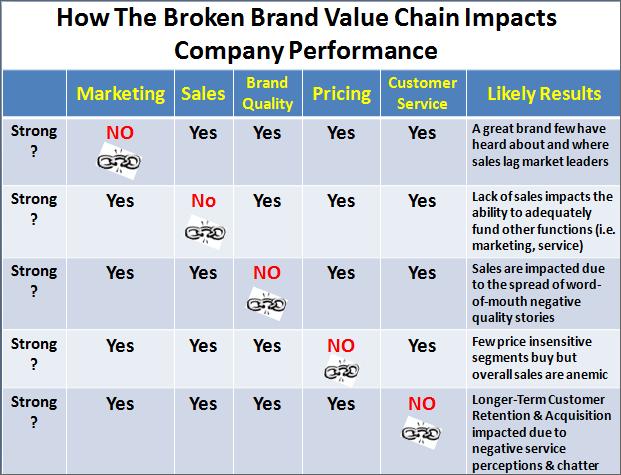
How the Broken Value Chain Impacts Company Performance:

What all of these examples show is that a company must deliver great performances in every category to become a market leader. One broken link in the brand value chain is enough to reduce the company to a market laggard and risks them going out of business over time if not rectified.

The following chart illustrates how one broken brand value chain has the ability to bring down the entire company and risk its overall viability:

Company Impacts of the Broken Brand Value Chain


How to Identify & Rectify a Broken Value Chain:

What steps can you take to identify and then rectify a broken brand value chain (BBVC) you might ask? Here are some easy steps to take to first, identify and then rectify a broken value chain:

Proven Methods to Identify a Broken Value Chain (BVC):


  • Inter-departmental peer reviews – How well do our peer departments think we are performing?
  • External departmental & function benchmark reviews – how well are doing vs. market leading company’s similar function (e.g. sales to sales or marketing to marketing performance comparison)?
  • Customer external scorecard reviews – How well do our customers and prospects think we are performing?


 Methods to Rectify a broken value chain:

  1. Perform Six-Sigma process and effectiveness improvement reviews
  2. Invite customers to participate in focus groups and advisory councils to help identify ways to improve the department’s effectiveness (sales, marketing, customer service, etc.)
  3. Form Improvement “Tiger Teams” consisting of inter-departmental high performers to assist with increasing functional performance.
  4. Invite outside and leading consulting firms to help infuse a holistic set of industry best practices across and within company functions – marketing, sales, customer service, pricing, etc.
  5. Tie performance and variable rewards to customer rated scorecards where company employees only get paid bonuses when our customers rate us as high performing.

Measuring Marketing ROI vs. Measuring Customer Value & Equity

Hierarchy of Marketing ROI Analysis (Levels 1-4)

Hierarchy of Marketing ROI Analysis (Levels 1-4)

In this blog we cover the following topics:

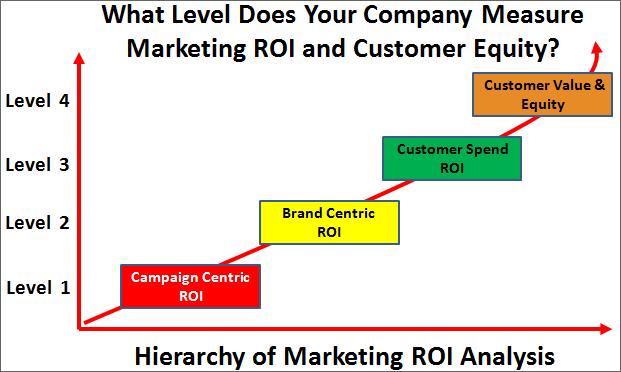
  1. The four (4) levels of sophistication in measuring marketing and customer ROI
  2. The three traditional levels of marketing ROI that focus on spend vs. return
  3. The calculations for measuring campaign ROI, Brand ROI and Customer Spend ROI
  4. Why measuring customer value and equity is a far better measure than traditional marketing ROI
  5. How Customer Value and Equity Covers the Measurement of ALL customer facing activity – marketing, PR, sales, customer service, community relations, etc.
  6. What your company needs to do to increase its sophistication of measuring market and customer insights

The following chart depicts the capability levels for measuring market ROI and customer value.

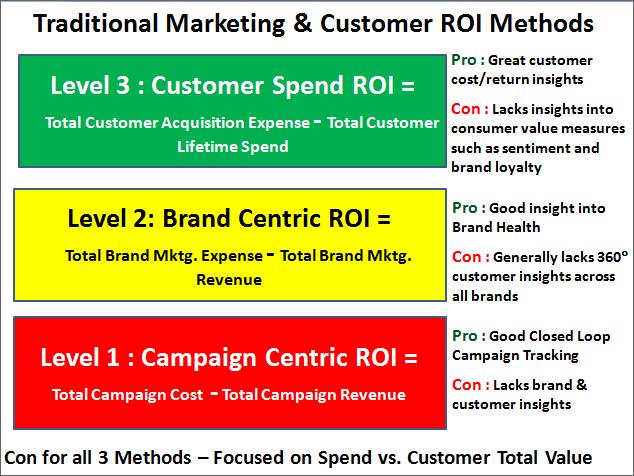
Level 1: Campaign centric ROI is the measurement, at a campaign level, of campaign costs vs. campaign return (customer spend vs. campaign return)

Level 2: Brand Centric ROI is the measurement, at a brand level, of brand return for all conducted campaigns (roll up of campaign ROI to a brand level)

Level 3: Customer Spend ROI is the sum of all brand and all brand campaign ROI at a customer level.

Levels of Marketing ROI Measurement (Levels 1-4)

Levels of Marketing ROI Measurement (Levels 1-4)

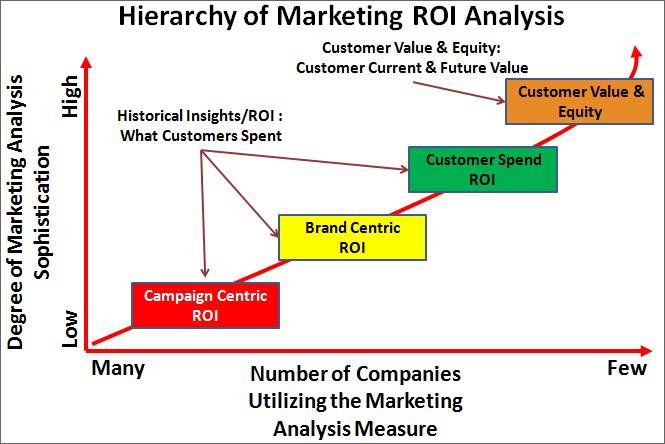
The following chart defines the first three levels of marketing ROI and points out the pros and cons for utilizing each method. The downfall for all three methods, as indicated at the bottom of the chart, is that they rely on historical spend vs. forward looking measures as are found in Level 4 – Customer Value and Equity Measures.

Traditional Marketing & Customer ROI Methods (Levels 1-3)

Traditional Marketing & Customer ROI Methods (Levels 1-3)

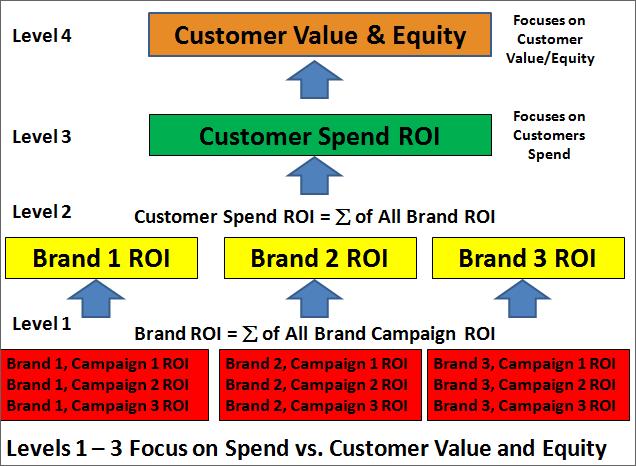
The following chart depicts the calculations for determining campaign level and brand level ROI that, if done correctly, should roll up to a customer level (Level 3 – Customer Spend ROI). The detailed definition of the highest level (Level 4 – Customer Value & Equity) is covered just below in this blog.

Levels 1 – 3 Focus on Spend vs. Customer Value and Equity

Levels 1 – 3 Focus on Spend vs. Customer Value and Equity

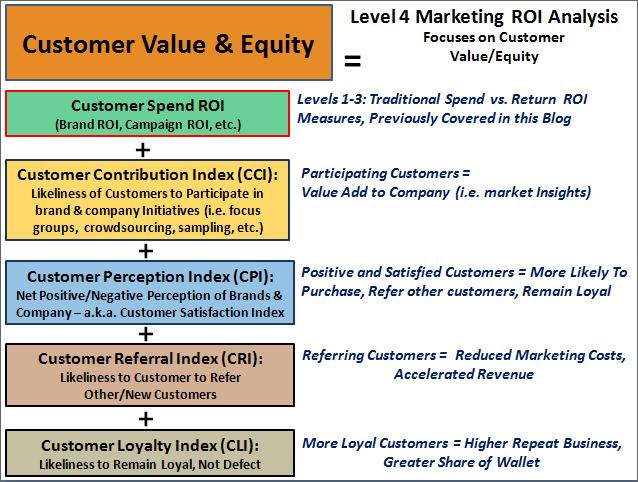
The following chart defines the components of Level 4 ROI analysis – “Customer Value and Equity”.  This level includes the roll-up for Customer Spend ROI, but also includes insights that predict customer future behavior as well as defining how valuable the customer is to the company beyond what they spend.

For example, a customer who is referring 2-3 customers to the company per week, participating in customer focus groups is a far more valuable customer than another customer with equal spend with your company.  

Similar to company stock value, the measurement of customer value and equity is a far more robust way to measure the value of the customer base, how likely they are to remain a loyal customer, etc. 

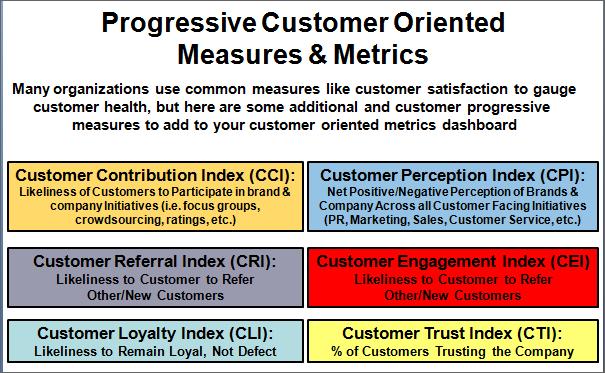
Customer Value & Equity Calculations, as shown below includes several different indices such as Customer Contribution Index (CCI), Customer Perception Index (CPI), Customer Referral Index (CRI) and Customer Loyalty Index (CLI). These indices help determine the overall health of the customer base vs. merely customer spend as is associated with levels 1-3 (spend focused).

Customer Value and equity calculations take into account the level 1-3 spend ROI measures, but utilizes a balanced scorecard approach in that the indices above are weighted against the spend vs. ROI measures. For example, if Brand A has a high ROI but also has a bunch of irate customers unwilling to partner and participate in brand activities, then this is indicative of a brand that, while doing well now, will experience a great deal of future customer churn, negative social comments, brand tarnishing, etc.

Level 4 Marketing ROI Analysis - Customer Value & Equity

Level 4 Marketing ROI Analysis – Customer Value & Equity

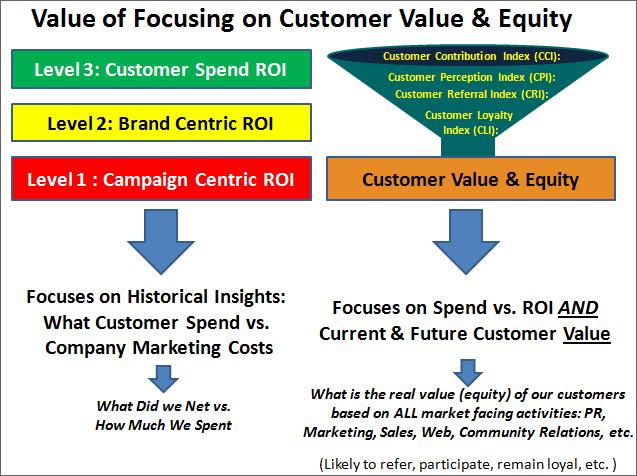
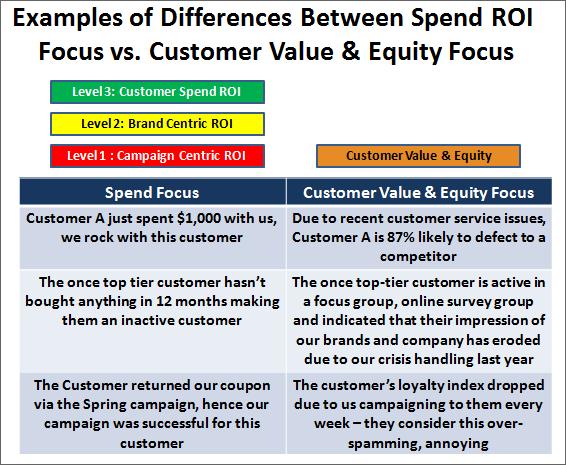
The following chart further defines the difference between focusing on spend ROI analysis vs. focusing on customer value and equity.

Value of Focusing on Customer Value & Equity

Value of Focusing on Customer Value & Equity

The last chart provides some real examples of the difference between focusing on spend ROI analysis vs. focusing on customer value and equity.

Examples of Differences Between Spend ROI  Focus vs. Customer Value & Equity Focus

Examples of Differences Between Spend ROI
Focus vs. Customer Value & Equity Focus

The bottom line here is that if you are focusing on Level 1-3 ROI calculations, you have a short-term and myopic view of the health and value of your customer base and are missing the strategic and longer-term insights that enable you to determine customer, company and brand future value and earnings.

Any company thinking about acquiring another should perform this robust customer diagnostic to determine if they are inheriting a group of angry/upset customers that will defect after a merger or a set of extremely valuable customers with positive customer equity who will take the stock value of the merged company to the stratosphere.

Contact me to find out how to move past traditional marketing ROI measurement and how to evolve into developing more robust customer value and equity insights for your company.  

The 80/20 Customer Profitability Rule

Develop intelligent customer service & customer management programs based on customer value insights…

Has your business ever performed an analysis of your customer base to determine any of the following:

1)      Which customers are frequent visitors and have the greatest repeat business?

2)      Which ones rarely do business with your company?

3)      Which ones are the most valuable and profitable to your company?

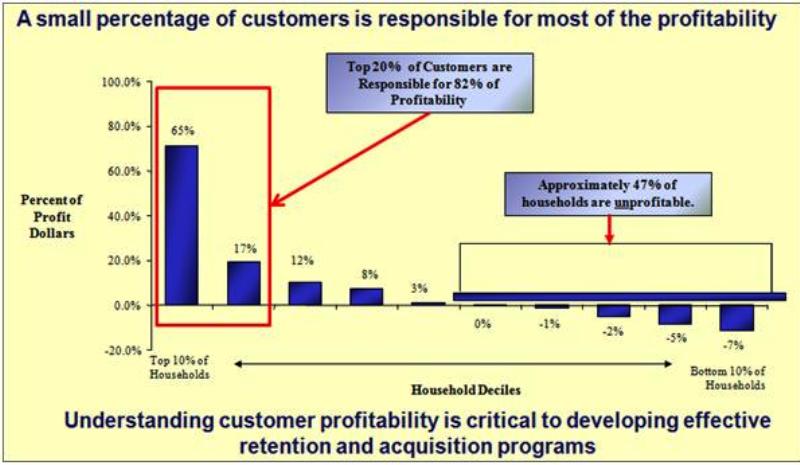
If you haven’t then you really don’t have the insights necessary to really develop an effective customer service, customer management and/or loyalty program.  In performing analytics and customer analysis for nearly 10% of the Fortune 500 companies in the United States, I have found a very revealing and astonishing pattern (rule) in this customer analysis that holds true company after company.  The pattern is as follows:

80% of all company profits are derived from ~20% of your customers

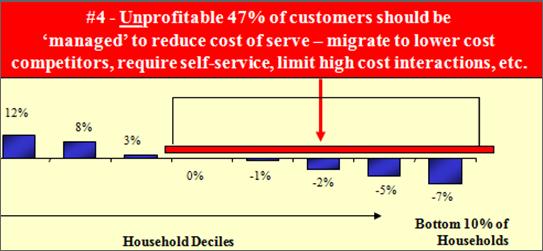
Take the chart below (Chart 1) from one of the top US banks that shows 20% of their customers are responsible for 82% of their profitability and that a full 47% of customers are actually unprofitable and not worth having as customer as each transaction costs the bank more than it is worth (each customer interaction/transaction actually drives the bank further away from profitability) {Click on Chart for a larger/clearer image}:

80% of all company profits are derived from ~20% of your customers

80% of all company profits are derived from ~20% of your customers

When I presented this customer profitability analysis to the bank, the bank executives were amazed at the results and of the customer profitability distribution. (Note – The deciles were developed using a SAS generated RFM analytics model whereby Recency (How recent customer have visited/purchased), Frequency (How frequently customers have visited/purchased and when they visited/purchased) and Monetary spend (How much they spend and on what types of products/services they spent their $$ on). The RFM model was then used as input into a profitability model, using actual profit data for each product/service/customer using a unique customer id to match the profit data to the RFM score.)Why are these insights and analytics so important and what might the bank or any other business do to manage customer relationships more effectively?  These insights are key in developing a customer relationship management (CRM) and loyalty program that is tailored and specific to each customer group. 

Note: The 80/20 rule applies to companies that have higher transaction volumes, a diverse set of product & services and a heterogeneous customer base.

Ask yourself the following questions:

  1. Should your company treat your best and most profitable customers differently than other, less profitable customers?
  2. Should your company develop special customer programs so that the 20% most profitable customers are not lured away by competitors?
  3. Do you think your company’s most profitable and valuable customers want to be shown appreciation for their repeat and profitable business in a way that makes them feel welcome and special?
  4. Is it in your company’s best interest to want to develop strategies and programs that turn unprofitable customers into profitable or at least revenue neutral customers?

The answer to all four questions should be a resounding YES!

Armed with the above insights and analysis a company can start to architect customer intimacy and loyalty programs such as the following:

  1. Offer most profitable customer special discounts or accelerated loyalty rewards earning rates
  2. Conduct special top customer, by invite only, appreciation events
  3. Deliver occasional special top customer gifts or recognition when they interact with you in-person or on-line
  4. Invite your top 1-5% of customers to participate in an invite only customer advisory board or insights group event every year at an exciting destination where most or all expenses are paid for by your company
  5. Develop unprofitable customer management programs such that these customers become more profitable, cost less per company transaction and/or they are effectively ‘encouraged’ to migrate to competitors.

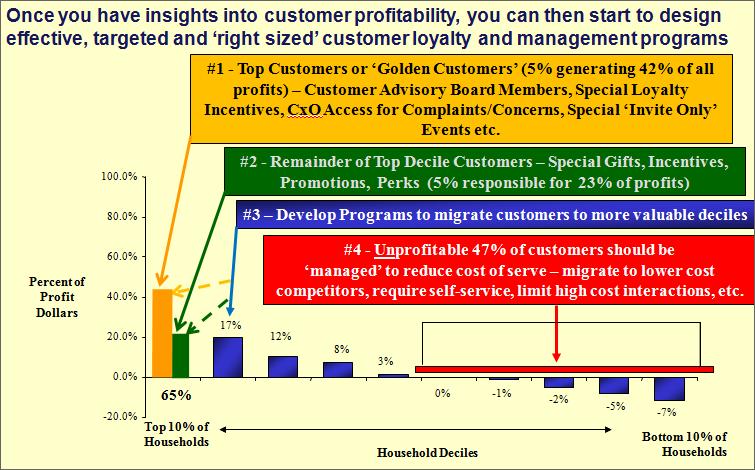
Take the same chart above and now overlay customer treatment programs to each customer decile and sub-segment (Chart 2) {Click on Chart for a larger/clearer image}

Effective Customer Management Programs Based on Profitability Insights

Effective Customer Management Programs Based on Profitability Insights

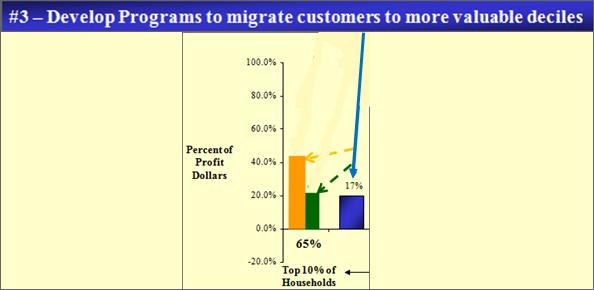
Even though decile #1 (10% of all customers) has been identified as the most valuable customer segment generating 65% of all company profits, the decile can then be further sub-segmented based on further profitability analysis/decomposition.  In this particular case:

  1. The top 5% of the top profitability decile customers generated 42% of all profits
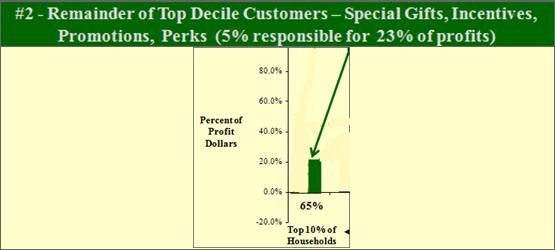
  2. The remaining 5% of the top profitability decile customers generated 23% of profits

As shown in the ‘golden’ box (#1) above and below, these top tier customers should be given special access and special attention and made to feel totally appreciated and a partner of the company. The golden box also demonstrates the types of special programs you might want to provide to this top profitability group. It is of your utmost importance to do everything in your company’s power not to lose these most valuable/profitable customers. These suggested treatments are just a sample, but ones I have developed for many clients in the past, including top tier banks, retailers, life sciences companies, telecommunications providers, etc. {Click on Chart for a larger/clearer image}:

Top 5% of Customers Receive Platinum Plus Customer Programs

Top 5% of Customers Receive Platinum Plus Customer Programs

The next (Green) group of profitable customers highlighted in box #2 (below) can receive special treatment as well, but not quite the golden treatment as the most profitable 5%. These next valuable set of customers would still receive top customer treatment, but not quite the platinum access that the most valuable 5% would receive. You wouldn’t want to lose these valuable customers either, so their treatment would still be special, memorable and differentiated vs. your competitors. {Click on Chart for a larger/clearer image}:

Next Top Set of Customers Receive Top Treatment, but not Special Access, Handling Like the top 5% (Platinum) Group

Next Top Set of Customers Receive Top Treatment, but not Special Access, Handling Like the top 5% (Platinum) Group

The blue box (#3) in the chart below speaks to customer migration programs that incentivize customers to spend more, visit your company (physical or online) more, purchase higher value items, buy in bundles, etc. {Click on Chart for a larger/clearer image}:

Effective Customer Management Programs Effectively Transition Customers into More Valuable Customers Over Time

Effective Customer Management Programs Effectively Transition Customers into More Valuable Customers Over Time

One very effective way to do this is to develop what I call modeled incentives. In that, if a loyalty program is to be effective there should be an incentive for the customer to model the behavior to achieve the next loyalty reward level and the following must be present:

1)      Every customer group must know what they need to do to achieve the next loyalty rewards level

2)      Customers need to feel the next loyalty rewards level is significantly more valuable than their existing level

3)      There should be prestige and/or notoriety associated with achievement of the next loyalty rewards level so that customers feel privileged, special and differentiated from regular customers.

Lastly, the red box (#4) below speaks to customer management programs that need to either turn these unprofitable customers into profitable customers or find ways to reduce the cost to serve these unprofitable segments. Some strategies including limiting these customers to self-service, providing incentives to transact during off hours, incentivizing them to seek lower cost providers, etc. {Click on Chart for a larger/clearer image}:

Effective Customer Management Program Also Address Unprofitable Customers

Effective Customer Management Program Also Address Unprofitable Customers

The bottom line is that, through customer insights and analytics, you will find that not all customers are the same in terms of profitability (the 80/20 rule), therefore it makes no sense whatsoever to treat all customers the same. Through a robust customer insights program you will then be able to leverage these insights and develop a sophisticated and custom loyalty and retention program in order to accomplish the following:

  1. Develop break-away tier 1 (Platinum) loyalty programs that stand alone in the industry such that your top 1-5% most valuable customers would not even consider defecting to another provider
  2. Develop programs to retain your most profitable customers and make them want to remain a loyal customer
  3. Develop a loyalty migration path for customers to want to achieve the next loyalty rewards level (Silver, Gold, and Platinum) so that they simultaneously feel more recognized/special/connected to the company while providing your company great value/profits/monetary return.
  4. Develop programs to mitigate expenses when dealing with your least profitable customers (more self-service, helping them ‘discover’ lower cost competitors, offering more limited services, etc.) (the other 80%)

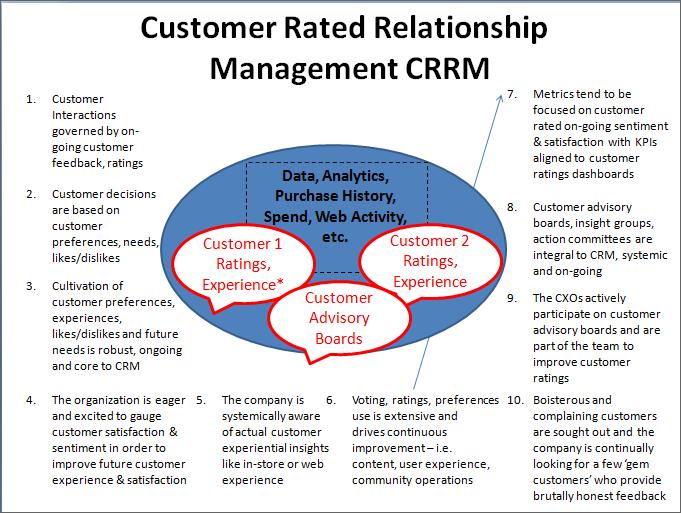
Blow Away Your Competition by Replacing Your Old CRM Program with the New Customer Relevant Relationship Management (CRRM) Model – Part 2: The Necessary Components.

1) Introduction:

In my previous blog, I covered what the new Customer Relevant Relationship Model (CRRM) is and the benefits of adopting this new model. In this blog, I will cover the components of the new CRRM model and what you need to put in place to make this new model a reality.

Ever wonder why companies like ESPN, Apple, Google, Zynga, Amazon, and Marriott dominate their respective markets? The reason is that they are ‘Customer First’ organizations and are passionate about listening to, understanding and then delighting their customers based on leveraging true customer insights. They treat their customers as business partners vs. commodities and include them in many critical decision making processes. They get this new CRRM model. Why/how ? – Read the rest of this blog to find out…

The differences between the old CRM model and how these companies are embracing the newer CRRM model are depicted in the following chart:

The Old CRM Model vs. New CRRM Model – Customers as Business Partners

2) Customers are fed up with old Dictatorial Management Style & Want to be Empowered as Business Partners

Customers and stakeholders today are longing for a company to partner with them and include them in the corporate decision making process.  These same constituencies are sick and tired of political, corporate, and other organizations making unilateral decisions for them that are really not in-line with their needs,  wants, etc. The backlash from this unwanted dictatorial management style of some companies can be seen in the Bank of America fee customer rebellion, the customer backlash from Netflix deciding to  split their company without first consulting with their customers and HPs initial decision to exit the computer market.

3) Components of the New CRRM Model:

In order to progress your organization from the old CRM model to the new CRRM  model, a few key essentials must be put in place and are as follows:

A. New CRRM Model that includes the 360° Cultivation of Customer & Market Insights.  This model enables a 360° view of all customer and market insights including customer feedback, preferences, likes, dislikes, social sentiment, competitor activity, etc. This new model takes your insights to an entirely new level whereby you are now enabled to delight customers, stakeholders and stockholders by having insights that are light-years ahead of insights provided by a traditional CRM model.

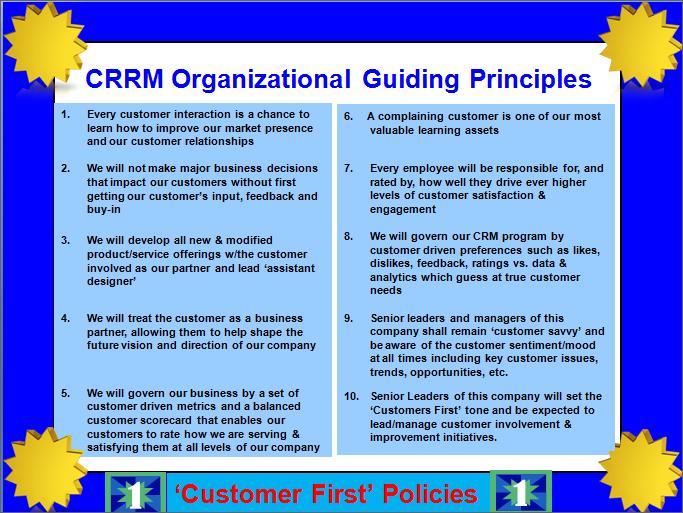
B. Customer First Culture driven by management that is passionate about their customers including a set of customer first principles and guidelines developed by company leaders

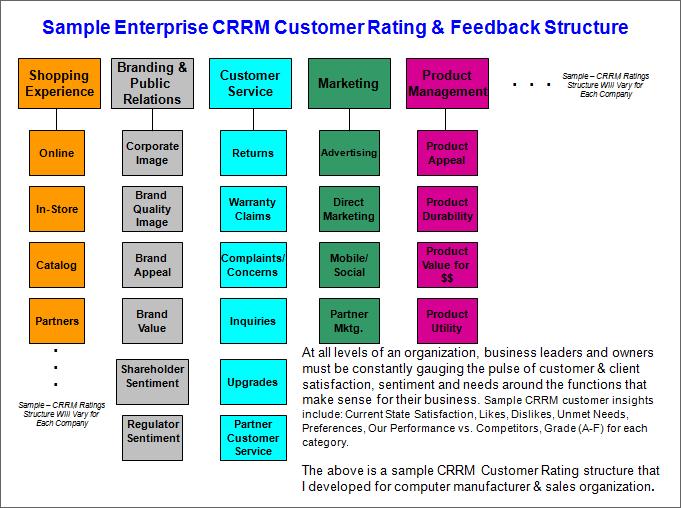
C. Customer Ratings & Feedback Structure that will identify areas where you will collect customer 360° feedback from customer and stakeholder interactions

D. Customer Feedback & Preferences Cultivation Process and corresponding infrastructure in order to allow your customers to continually rate how well you are serving them

E. Customer Health Scorecard that provides real-time insights on how well the customers, stakeholders and stockholders perceives you as serving them as well as insights into a Continuous Customer Improvement Process (CCIP) that enables you to continually improve your customer perceptions, satisfaction, brand loyalty, etc.

These components can apply to large enterprises as well as Small to Medium Businesses (SMBs).

The following graphics are all sample components from the list above (A-D) that need to be put in place to enable this new CRRM Model.

New CRRM Model – 360° Cultivation of Customer & Market Insights

 3A) The above chart “New CRRM Model – 360 Cultivation of Customer & Market Insights” demonstrates the new insights model that must be put in place to deliver world-class stakeholder and customer programs.

These enhanced insights will enable you to deliver products and services that delight your customers, stakeholders and stockholders as well as enable you to leapfrog the competition in terms of market share if they continue to rely on their antiquated CRM data and analytics insights only model. 

For Small to Medium sized Businesses (SMBs), some of the insights do not apply, but the following charts (3B-3E) most certainly apply and can be tracked via simple Microsoft Excel spreadsheets.

CRRM Customer First Policies & Organizational Principles

3B) The above chart “CRRM Organizational Guiding Principles” demonstrates the principles that must be in-place to be customer first culture. This culture is driven by management that is passionate about their customers and governs the company around a set of customer first policies.

Sample Enterprise CRRM Customer Rating & Feedback Structure

3C) The above chart “Enterprise CRRM Customer Rating & Feedback Structure” illustrates a sample structure (will vary for each type of business) whereby customer feedback and preferences will be cultivated in order to develop 360° insights into customer needs, wants, likes, etc.

Enterprise CRRM Customer Feedback & Preferences Cultivation Process

3D) The above chart “CRRM Customer Ratings & Feedback Cultivation Process” illustrates a how customer feedback and preferences will be cultivated in order to develop 360° insights into customer needs, wants, likes, etc.

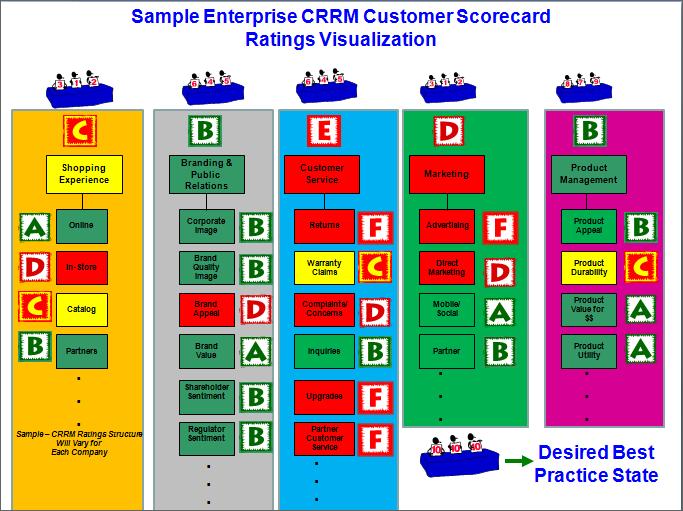
Sample Enterprise CRRM Customer Scorecard Ratings Visualization

3E) The above chart “Enterprise CRRM Customer Scorecard Ratings Visualization” illustrates a how customer feedback and preferences ratings will be visually represented in a scorecard. 

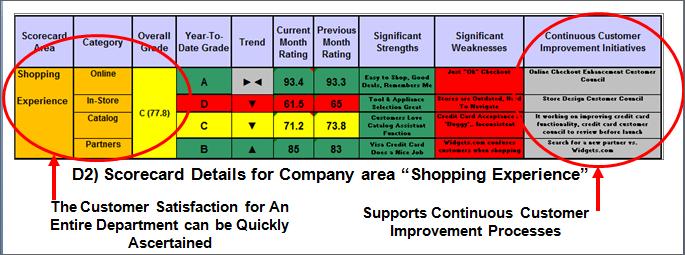
Sample Enterprise CRRM Customer Scorecard Metrics

3E-2) The above chart “Enterprise CRRM Customer Scorecard” illustrates a how customer feedback and preferences ratings will be rolled up into an analytical scorecard that provides insights into customer trends,  customer feedback, customer issues, core customer strengths and weaknesses, etc. 

This scorecard can also be used to manage a Continuous Customer Improvement Process (CCIP) that continually drives improvements to customer perceptions, ratings, satisfaction, etc. 

Sample Scorecard for “Shopping Experience”

The above depicts how analytics and metrics would be maintained for a business who had a retail or wholesale shopping function.

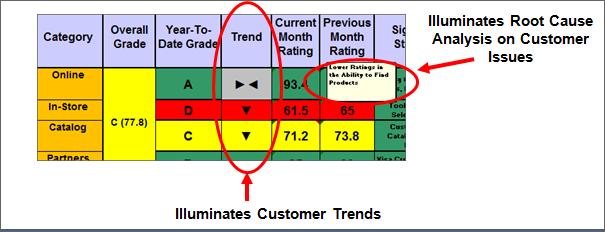
Sample Shopping Experience Scorecard – #2

Robust Scorecard Analytics and Metrics should support Customer Trend Identification and Root Cause Analysis for Customer Issues.

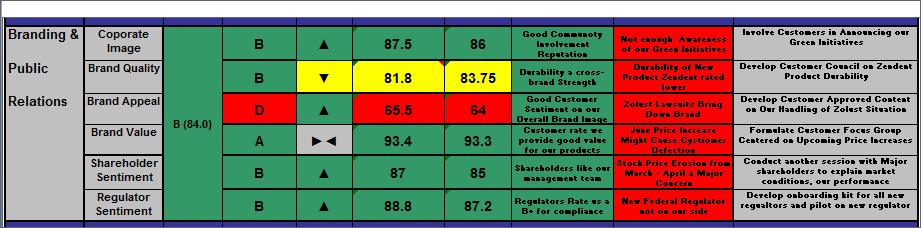
Sample Branding & Public Relations Scorecard

Sample Public Relations Scorecard Above gives you insights into how well your company and brands are perceived by customers, stakeholders, stockholders, etc.

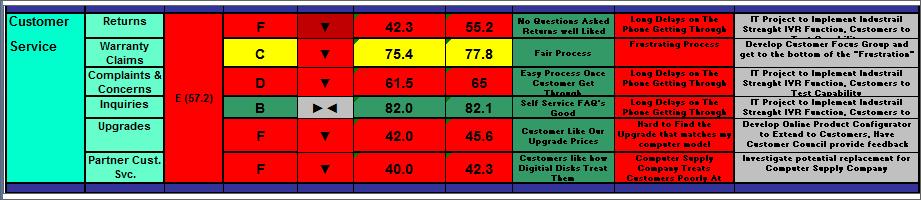
Sample Customer Service Scorecard

Sample Customer Scorecard Above from Customer Service tells how well you are serving your customers.

Sample Marketing Scorecard

Sample Marketing Scorecard Above Gives you insights into how well your Marketing Efforts are resonating with your customers.

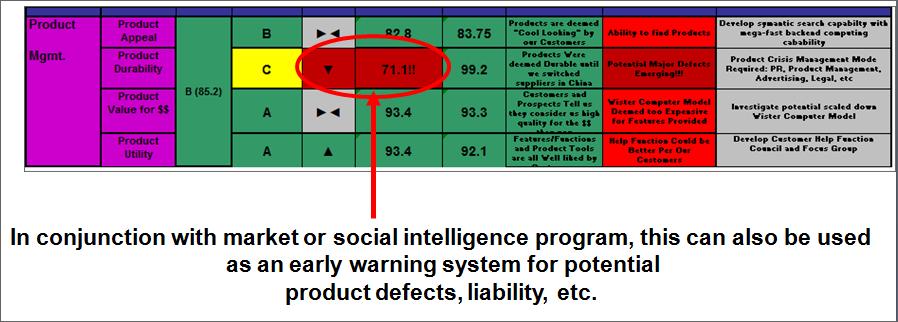
Sample Product Management Scorecard

The Sample Product Management Scorecard above gives you insights into how well perceived your products and services are with customers and prospects.

4) Company & Customer Benefits of Adopting the CRRM Model:

By treating customers as business partners (vs. commodities) and including them in the corporate decision making process, as well as allowing them to rate how well you are serving them from an array of customer facing areas, companies can reap huge rewards including the following:

1. Better insights into the types of products and services customers want & need

2. Fiercely loyal customers who feel part of the corporate team

3. Customers who are most likely to spend more, be retained longer and purchase at premium prices with higher profit margins

4. Customers who are very likely to be brand advocates and refer others to your company, brands, and services.

5. Customers who feel connected to the company and empowered to improve company operations

The following are actual customer comments from those who have participated in a customer feedback program to help shape products & services:

“I feel like xyz company cares about me since they ask my opinion”

“Finally a company that listens to us”

“It is so refreshing to have a company ask you your opinions on products and services vs. ramming something down our throats that we don’t like”

“Wow – this is fun. I enjoy providing my opinion”

“As silly as this might sound, xyz company is the only company that ever asked me what I wanted”

“In my opinion, xyz company is much more progressive than their competitors by seeking consumer opinions, what matters to them, etc.

 5) Conclusion:

More dynamic companies like Goodle, Zynga, Amazon, etc. are inviting customers to become part of the corporate decision making process and empowering them to provide feedback, insights and rate company operations in order to drive continous customer improvements. Companies who adopt this new CRRM model whereby company management is democratized by including stakeholders and customers into the decision making process will reap the rewards of ever higher customer acquisition, retention and spend – leading to ever higher profits and share price.

Blow Away Your Competition by Replacing Your Old CRM Program with the New Customer Relevant Relationship Management (CRRM) Model

Blow Away Your Competition by Replacing Your Old CRM Program with a more effective Customer Relevant Relationship Management (CRRM) Model

1)               Introduction

  1. Do you have a robust CRM program in-place, but you feel you are still missing the mark in terms of delivering what your customers really want & need?
  2. Is your organization at risk of making market decisions that can cause a backlash and mass defection by your customers like the Bank of America $5 fee decision or the Netflix business split decision?
  3. Do you have volumes of consumer data and analytics, but sales are declining or flat and customers are churning at an increasing rate?
  4. Do you feel you could improve the quantity and quality of your customer insights including ascertaining critical consumer needs, preferences, likes/dislikes, interests, preferred communication channel for you to contact them, preferred timing and frequency for you to communicate with them, etc?

If you can say “Yes” to any of these questions, the rest of this post is a MUST READ for you and it is time to consider this more effective CRRM Model to replace your outdated CRM Model.

2)               CRM vs. CRRM Model Overview

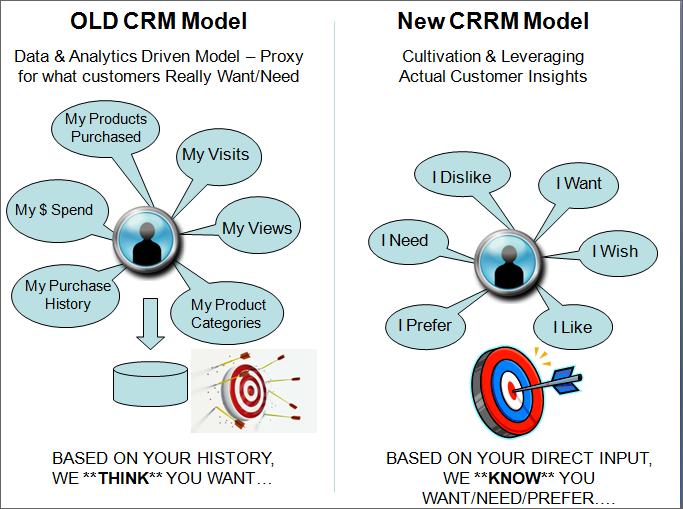
The following diagram depicts the major differences between the old CRM Model and the new CRRM Model including the problems associated with the old CRM model and benefits of the newer CRRM model.

Old CRM Model vs. Customer Relevant Relationship Management (CRRM)

Old CRM Model (left above):

  1. Relies on historical data and analytics to determine what customers need, want, etc. by the analysis of sales history, types of products purchased, categories of products purchased, views on websites, stores visited, etc.
  2. Customer activity information is a proxy to what customers really want and need. Example, you will seldom learn that a customer hates an in-store or web experience through this proxy for what they are wanting, feeling, needing, disliking, etc.
  3. Companies are unlikely to gain insights into the impact that any future company decisions will have on customer loyalty, retention, acquisition.

New CRRM Model (right above):

  1. Takes a more direct approach with customers and utilizes a systemic querying method to ascertain exactly what customer want/need/prefer/etc.
  2. Embraces customer councils, customer forums, customer voting to drive future content, interactions, product/service offerings, etc.
  3. Activity solicits ratings from customers on many aspects (marketing materials, web experience, in-store experience, product usability, quality of customer service, etc.) regarding the health of the overall customer relationship and continually asks “How well are we managing our relationship”

3)               Example of CRM Model Gaps

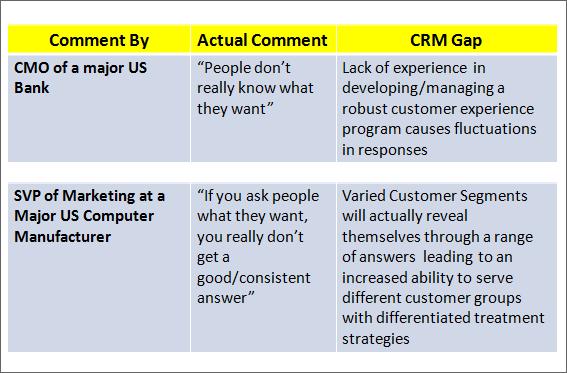
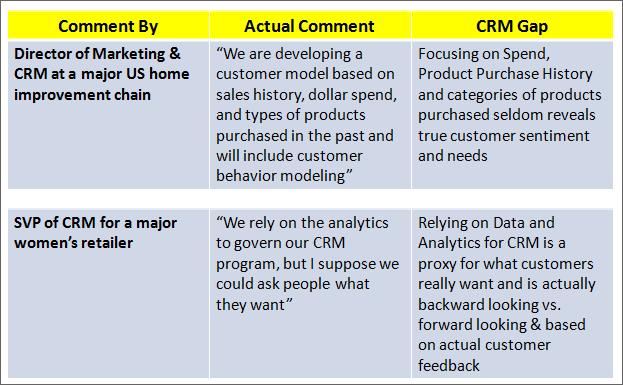
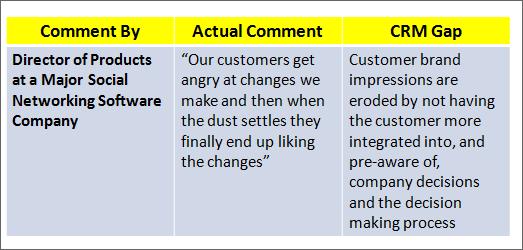
To illustrate how companies are struggling to really determine the real needs of their customers, I took selected comments from interactions with senior CRM executives from major US Corporations based on consulting engagements, job interviews, speaking to them in passing, etc. The following charts are their actual verbatim comments as well as my read on their CRM gap that prevents them from developing world-class relationships with their customers.

Traditional CRM Programs:

  1. Organizational culture, operations, and go-to-market strategy does not put the customer and real customer insights into the center of CRM operations
  2. Relies on data, analytics, and customer history to drive on-going customer interactions.
  3. Puts the organization at extreme risk of missing the boat from a customer’s perspective – real needs, wants, concerns, preferences, experiences, etc.
  4. Companies that rely on this model are at-risk of customer defections, decreased customer spend/loyalty, etc.

New CRRM Model – with Customers In The Center of Customer Operations

New CRRM Program:

  1. The organizational culture, operations, and go-to-market strategy puts the customer and real customer insights into the center of CRM operations rather than rely on the proxies of what customers want, i.e. data, analytics, and customer history.
  2. The customer becomes the actual judge, ‘rater’ of whether you are delivering quality, value and a good relationship to them.
  3. The customer is put in charge of CRM operations and enables a bi-directional and on-going dialog with the customer whereby they tell you their real needs, wants, concerns, preferences, experiences, etc.
  4. Companies that rely on this model are more likely to develop products, services, offers, communications that delight the customer and whereby they are more loyal, greater brand advocates, and likely to refer your company to their friends as a company who listens, cares and empowers their customers.

6)             Companies That ‘Get ‘CRRM

The following are samples of companies that, in my opinion, get the CRRM model and details how/why each of them get this new go-to-market customer model.

Companies That ‘Get’ CRRM – 1 of 2

Companies That Get CRRM – 2 of 2

Phrases That Describe Companies who ‘Get’ the New CRRM Model

  1. We don’t hide behind data and analytics to drive our customer & CRM operations, but rather we ask our customers what they want.
  2. We are eager to ask our most disgruntled customers how we can improve our relationship with them and to determine who to improve our go-to-market strategy
  3. Before we make any major market-facing decisions, we ask a cross-segment of our customers what they think about each of our proposed decisions and then ask them how to improve upon how these changes are implemented so we ensure a continued delighted customer base.

The bottom line of this post is that, if your company relies less on historical data and analytics to determine what customer want and actually builds methods, processes, and systems to put the customer in charge of rating CRM operations in order to provide you with ongoing and valuable real insights (needs, wants, likes dislikes, preferences, concerns, etc.), the customers will feel more valued and connected with your brands. The benefit of adopting this new CRRM model will be more loyal, empowered and delighted customers who will be brand advocates and brand referrers that will increase shareholder and company value.

As I have now built this new CRRM model for several major US brands, my next blog post will be on ‘how to’ develop this capability at the enterprise level.